



| Contents |
|---|
Introduction
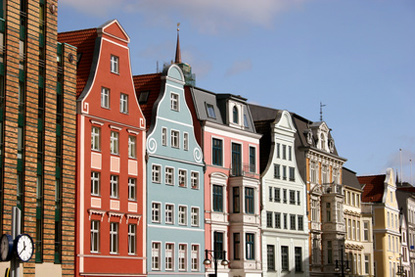
Rostock is the largest city in Mecklenburg-Western Pomerania, despite having a population of only 210,000 inhabitants. Once an active trading port of the Hanseatic League, it became a major shipbuilding and shipping centre in the industrial era, and as such was a prime target for Allied bombings in WWII.
The University of Rostock, founded in 1419, is the third oldest in Germany and the oldest in continental northern Europe.
At the estuary of the river Warnow, the district of Warnemünde is one of East Germany's most popular seaside resorts.
Interesting Facts about Rostock
- Rostock was chartered in 1218 and united its Old Town, New Town, and hops market in 1265, later becoming a powerful member of the Hanseatic League in the 14th century.
- The city celebrated its 800th anniversary in 2018 and retains rich North German Brick Gothic architecture in its churches and gabled merchant houses.
- St Mary’s Church (Marienkirche) houses a renowned astronomical clock built in 1472 by Hans Düringer.
- Warnemünde’s 31-metre lighthouse (built 1897/98) is a defining landmark, now electrically operated since 1927 and open for panoramic views.
- Next to the lighthouse stands the Teepott, a listed modernist beach pavilion with a distinctive curved concrete shell roof completed in 1968 by Ulrich Müther and collaborators.
- Rostock and Warnemünde host Hanse Sail each August, one of the world’s largest yachting and tall-ship gatherings, drawing around a million visitors and some 200 traditional vessels.
- Rostock University is one of the oldest in the Baltic region and anchors the city’s profile as both a Hanseatic port and university town.
- Historically East Germany’s principal ocean port, Rostock remains a major maritime and shipbuilding centre alongside modern industries and cruise operations.

History
Medieval Origins and Hanseatic Glory
Rostock's history stretches back over 800 years to its origins as a Slavic settlement in the 11th century, when Polabian Slavs founded a town at the Warnow river called "Roztoc," meaning "fork of a river". The Danish king Valdemar I set the town ablaze in 1161, after which German traders settled the area. By 1218, Prince Heinrich Borwin I granted Rostock its town charter under Lübeck law, marking the beginning of its development as a major Baltic metropolis. Initially consisting of three separate settlements - the Old Town around St. Peter's Church, the Middle Town around St. Mary's Church, and the New Town around the Hop Market - these were unified in 1265 to form a single powerful city. Rostock joined the prestigious Hanseatic League in the mid-13th century and became one of its most influential members by the 14th century, boasting 12,000 inhabitants and up to 370 ships sailing under its municipal flag. The city's wealth was built on herring trading privileges, a monopoly on Norwegian trade, and the export of Rostock beer and fish products.
Ducal Rule and University Foundation
The late medieval period saw significant changes in Rostock's governance and cultural development. In 1314, the city passed to Mecklenburg and subsequently to the dukes of Mecklenburg-Schwerin in 1352, though it maintained considerable independence. The establishment of the University of Rostock in 1419 marked a cultural milestone, making it the oldest university in continental northern Europe and the Baltic Sea region. However, by the end of the 15th century, the dukes of Mecklenburg successfully enforced their rule over the previously semi-independent city, taking advantage of civil unrest known as the "Domfehde". This shift in power led to the loss of many of the city's economic and political privileges, with the nobility introducing unfavourable taxes such as a beer excise that benefited the dukes. The 1573 Rostock Inheritance Agreement formally recognised the state princes' hereditary rule over the city, binding Rostock to ducal authority for centuries to come.
From Industrial Revival to Modern Era
After centuries of decline, Rostock experienced a remarkable renaissance in the 19th century, initially through the wheat trade and later through industrial development, particularly shipbuilding. The city's shipyards, which had built wooden vessels since medieval times, achieved a historic milestone in 1851 by constructing Germany's first propeller-driven steamer. The strategic location of Rostock made it a target for foreign occupation throughout history - Danish and Swedish forces occupied the city twice during conflicts in the 17th and early 18th centuries, whilst Napoleon's French forces controlled the town for approximately a decade until 1813. Following World War II, Rostock was extensively developed as East Germany's principal ocean port and served as the capital of Rostock district from 1952 to 1990. Since German reunification, whilst the harbour's relative importance has declined compared to other ports like Hamburg, Rostock has maintained its position as the largest city in Mecklenburg-Vorpommern and continues to be an important shipbuilding centre and economic hub for the region.
Main Attractions
Main Landmarks
Alter Markt
Alter Markt, or Old Market Square, is one of Rostock’s historic public spaces and served as a key commercial and social hub during the Middle Ages. Framed by significant buildings including St. Peter’s Church, the square once hosted open-air markets and civic gatherings. Today, it retains its medieval street alignment and features a mix of architectural styles, with historic facades and more recent developments. The site preserves the atmosphere of Rostock’s earlier urban life and often serves as a venue for seasonal events and local markets.
Neuer Markt
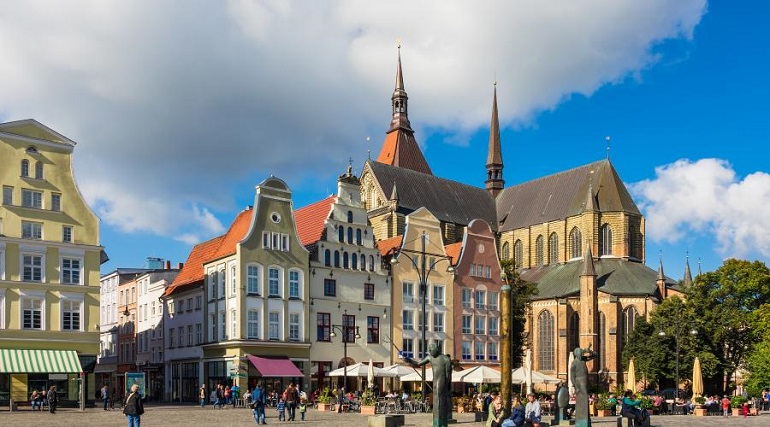
Neuer Markt, translating to New Market, functions as Rostock’s principal central square and has been a focal point of civic life since the Middle Ages. Bordered by merchant houses and significant civic buildings, it hosts regular markets, cultural events, and city celebrations. The square is distinguished by its spacious layout, colourful historic gabled facades, and proximity to the Rathaus. Neuer Markt serves as a vibrant meeting place connecting the old town’s main thoroughfares and forms an essential orientation point for visitors.
Town Hall (Rathaus)
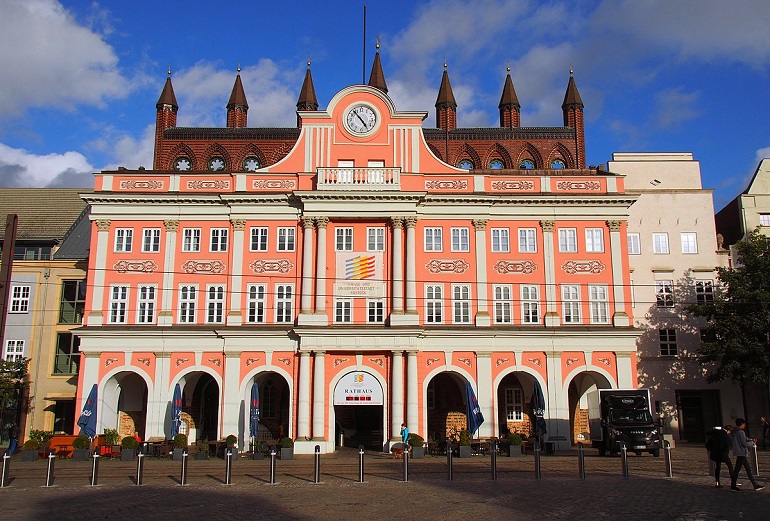
The Town Hall is a major architectural landmark situated on the Neuer Markt. Its origins date back to the 13th century, and it combines Brick Gothic elements with later Baroque modifications. The building features a distinctive pink façade with seven spires and a grand arcade at street level. Still serving as the seat of the city administration, the Rathaus is accessible to the public in part, including the historic assembly hall, and is frequently used for official ceremonies and events. Its prominent position reflects Rostock’s historical civic autonomy and traditions of self-government.
Ständehaus Rostock
The Ständehaus is a late 19th-century representative building on Wallstraße that historically served as the assembly house for regional estates. Its façade combines brick and stone detailing typical of historicist architecture, with symmetrical elevations and emphasised portals. The building’s location by the former fortifications places it within walking distance of other administrative and ecclesiastical landmarks. While interior access varies according to current use, the exterior can be examined closely from the pavement to appreciate stylistic details, cornice lines, and window surrounds. The Ständehaus’s urban presence reflects the period’s administrative consolidation and remains a standard point of reference on architectural walking routes.
Warnemünde Lighthouse
Warnemünde Lighthouse dates to the late 19th century and stands by the harbour entrance adjacent to the promenade and beach forecourt. Constructed in masonry with a classic cylindrical profile, it remains in operation as a navigational aid and is seasonally open for climbs. The viewing gallery offers a clear vantage over the Baltic, the Alter Strom channel, and the wider resort. On selected dates the area hosts maritime events and seasonal activities around the lighthouse square. The site is integrated with the resort’s pedestrian routes, and admission policies typically include concessions for children.
City Walls & Gates
Rostock City Wall
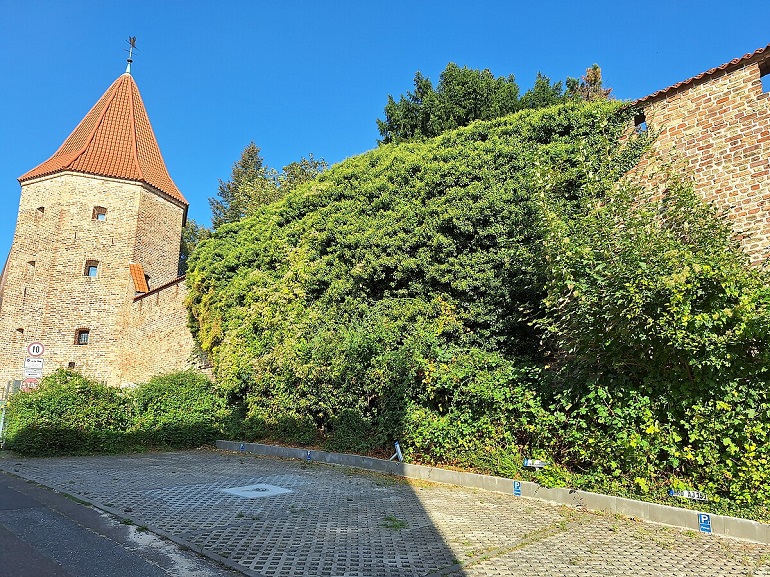
Rostock’s medieval city wall survives in substantial segments around the historic centre, illustrating the Hanseatic city’s former defensive perimeter. Built primarily of Baltic brick, it incorporates ramparts, towers, and several preserved gates that once regulated trade and movement. Walkable stretches such as Hinter der Mauer allow a clear view of the wall’s layered construction and later modifications. The system originally linked to the Warnow riverfront and functioned alongside fortified monasteries and merchant quarters, reflecting Rostock’s importance in the Hanseatic League. Today it frames parts of the old town’s street grid and marks transitions between historic and later urban fabric, with open public access at all hours.
Steintor
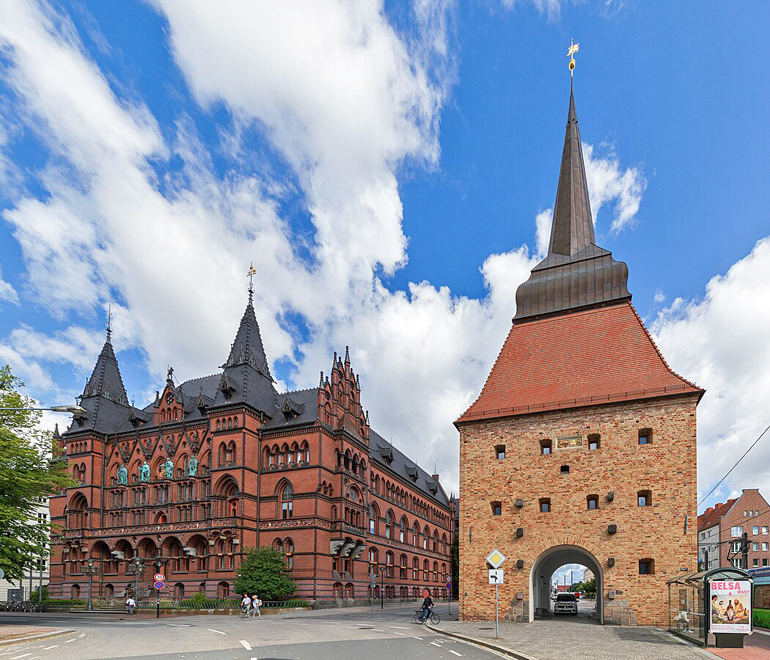
Steintor, or Stone Gate, marks the southern entrance to the old city and stands as a key remnant of Rostock’s historic fortifications. Built in the Renaissance style in 1574, it is recognisable by its ornate sandstone façade, decorated with the city’s coat of arms and allegorical figures. The Steintor symbolised the border between Rostock and surrounding territories, playing a role in customs and city defence. Its preservation provides insights into the city’s development and the changing styles of urban architecture from fortification to ceremonial gateway.
Kröpeliner Tor
Kröpeliner Tor is a 13th-century Gothic brick gate tower that once guarded the western approach along Kröpeliner Straße, a principal axis of Rostock’s old town. The tower’s massing and decorative brick forms typify North German medieval construction, and interior access leads via stairs and an elevator to upper levels. Exhibits relate to city history and fortifications, while upper platforms provide elevated views across the pedestrianised shopping street and historic rooflines. The structure anchors a key urban gateway between the former extramural zones and the medieval core. Opening hours usually align with daytime visitation throughout the week.
Mönchentor
Mönchentor is a surviving medieval gate along Strandstraße, representing a component of Rostock’s historic fortification network near the river approach. Its brickwork and archways illustrate defensive and administrative functions associated with gate taxation and control of goods. The structure can be viewed externally at any time, with interpretive value for understanding city wall alignments and historic access routes. Adjacent streets retain traces of medieval plot patterns, allowing the gate to be contextualised within the older urban morphology. The site forms a convenient stop on a circuit linking city wall fragments and religious buildings.
Churches
St. Mary’s Church (Marienkirche)
St. Mary’s Church is a 13th-century Brick Gothic parish church that exemplifies North German ecclesiastical architecture, notable for its tall nave, ribbed vaulting, and substantial brickwork. The interior features a painted wooden high altar and an imposing pipe organ that reflect centuries of liturgical and artistic patronage. As a working Evangelical church, it maintains regular visiting hours alongside services, with provision for wheelchair access at designated entrances. The building’s massing and tower form a focal point within the medieval street pattern near the market area, and conservation projects over time have stabilised key structural and decorative elements. Interpretation on site highlights the church’s role in Rostock’s religious and civic life.
St Peter’s Church (Sankt-Petri-Kirche)
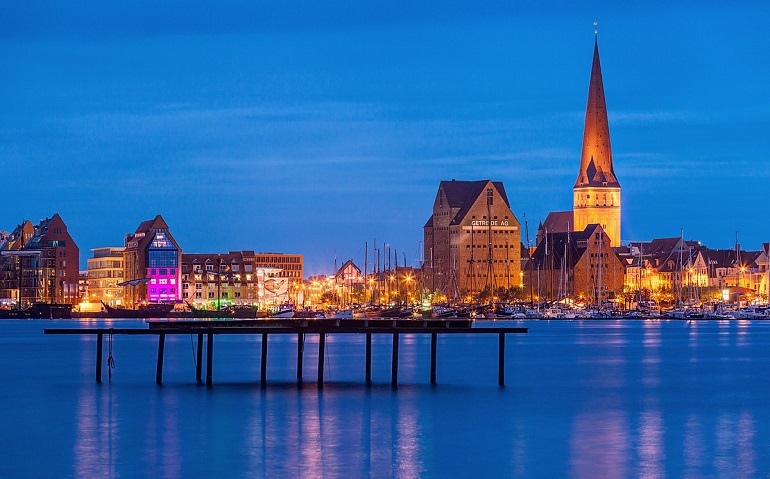
Sankt-Petri-Kirche, on Alter Markt, is among Rostock’s oldest parish churches, constructed in the 13th century in Brick Gothic style with a landmark spire. The church retains historic furnishings and artworks that chart changing devotional practices, and it features an observation platform in the tower providing views over the old town and the Warnow. Accessibility provisions include lift access noted for parts of the site, alongside paid parking nearby, and opening hours typically span daytime throughout the week. The tower’s vertical emphasis serves as a navigation point in the cityscape, and the church’s proximity to market-era parcels underlines its long-standing civic role.
St. Nikolaikirche
St. Nikolaikirche (St Nicholas’ Church) is the oldest remaining church building in Rostock, with its origins in the mid-13th century. Originally constructed as a Gothic basilica, it was associated with the sea trade and dedicated to the patron saint of sailors and merchants. The church suffered significant damage during World War II and was later restored; its nave now houses a combination of residential flats and a community church, making it a unique example of adaptive reuse. The exterior still displays key medieval features, while the interior illustrates the city’s capacity for architectural transformation.
Top Museums
Maritime Heritage Museums
Shipbuilding and Maritime Museum Rostock
Germany's largest floating museum presents an extraordinary journey through maritime history. This impressive museum boasts more than 12,000 exhibition pieces chronicling the development of shipbuilding and seafaring from the Hanseatic period to the present day. The highlight is the permanent exhibition "REEDER.RUDER.SEEMANNSGARN," which combines cutting-edge media technology with interactive stations suitable for all ages. Visitors can explore the evolution of maritime radio communications, seaplane development, and harbour economics whilst discovering the fascinating history of the ship itself.
Societät Rostock maritim e.V.
Housed in a listed building, this maritime museum specialises in shipping history, featuring exhibitions on lifeboats and steamers. The museum provides intimate insights into the technical and social aspects of seafaring, complementing the larger maritime museum with more focused displays on specific nautical themes.
Heimatmuseum Warnemünde
Located in Rostock's beloved seaside district, this heritage museum chronicles Warnemünde's transformation from a humble fishing village to a bustling seaside resort. Established in 1914 by fisherman Heinrich Holtfreter, who was concerned about the disappearance of traditional maritime artefacts, the museum preserves the area's rich cultural heritage. The collection encompasses the history of fishing and seafaring, pilotage and sea rescue operations, and the evolution of local maritime traditions. Visitors can explore exhibits showcasing traditional fishing techniques, local shipbuilding practices, and the development of maritime transport along the Baltic coast.
Art Museums and Galleries
Rostock Art Gallery (Kunsthalle Rostock)
Originally conceived as an exhibition pavilion for the biennial Baltic Sea Countries exhibition, the Kunsthalle has evolved into one of northern Germany's most significant contemporary art venues. The gallery's collection focuses particularly on East German modern art, regional artists, and works from Scandinavian and Baltic regions. Since 2009, under private management, the gallery has hosted internationally renowned artists including Georg Baselitz, Gerhard Richter, Richard Serra, and Norbert Bisky. The listed building from 1969 houses an impressive collection of graphic works, paintings, and sculptures, with special emphasis on pieces reflecting the region's artistic heritage.
Edvard-Munch-Haus
This unique museum occupies the 17th-century fisherman's house where Norwegian painter Edvard Munch lived from May 1907 to October 1908. During his 18-month residency in Warnemünde, Munch recovered from a profound life crisis whilst producing some of his most productive artistic work. The house, now under monument protection, serves as both a museum and an active artist residency, where contemporary German and Norwegian artists live, work, and present their creations to the public. The building functions simultaneously as studio, forum, and performance space, continuing Munch's legacy of artistic creativity.
Cultural and Historical Museums
Culture Museum Rostock
Housed within the historic Abbey of the Holy Cross, a Cistercian monastery founded in 1270, this museum stands as one of the most important repositories of Mecklenburg-Western Pomerania's cultural history. The museum's extensive collections span multiple periods and themes, including medieval religious art displayed in the stunning Gothic refectory from 1480. The Dutch art collection is particularly outstanding, featuring works from the 16th to 19th centuries by masters such as Jan Breughel, Rachel Ruysch, and Willem Kallf, alongside pieces by Rembrandt and van Dyck.
The museum's diverse permanent exhibitions include Rostock cityscapes showing the city's evolution from the early 19th to 20th centuries, and a poignant display titled "Ostracised Modernity," featuring the complete preserved collection from the Nazi "degenerate art" campaign of 1937. Additional collections encompass toys spanning two centuries, an extensive numismatic collection documenting Rostock's monetary history, archaeological finds, and approximately 35,000 objects representing regional arts and crafts from the 15th to early 20th centuries.
Dokumentations- und Gedenkstätte ehemalige Stasi-Untersuchungshaftanstalt Rostock
This memorial and documentation centre occupies a former Stasi prison, offering visitors a profound encounter with East Germany's repressive surveillance state. The site preserves one of the best-maintained Stasi detention facilities, allowing visitors to explore former prison cells, interrogation rooms, and administrative offices. The basement contains isolation cells known as "Dunkelzellen," whilst the courtyard features the notorious "tiger cages" used for prisoner exercise.
The permanent exhibition spans multiple floors, documenting the building's history, Stasi operations in northern East Germany, and daily life in detention. Personal accounts of political prisoners provide moving testimony to the human cost of authoritarian control. The third floor houses the exhibition "Über die Ostsee in die Freiheit" (Across the Baltic Sea to Freedom), which details escape attempts from East Germany via the Baltic Sea and the stringent coastal border regime.
Specialised Museums
Zoologische Sammlung Rostock
The University of Rostock's zoological collection offers educational insights into natural history and biodiversity. This academic museum provides an excellent complement to the city's cultural offerings, particularly appealing to families with children interested in natural sciences.
3D TrickArt
A thoroughly modern addition to Rostock's museum landscape, this interactive venue features 25 fascinating three-dimensional artworks created using perspective painting techniques. Visitors become part of the artwork by positioning themselves strategically to create spectacular photographic illusions using mobile phone cameras. The museum's life-sized 3D images create a fantastical world where visitors can ride hippos, be shrunk by mini-machines, or fly on magic carpets. Created by artist Hattori, these unique works are designed not merely for observation but for active participation, making it particularly popular with families, teenagers, and social media enthusiasts.
Local Cuisine
Rostock’s cuisine reflects its maritime heritage and northern German traditions, offering visitors a hearty taste of Mecklenburg-Vorpommern. Along the Baltic coast, freshly caught fish takes centre stage, with dishes such as Rostocker Bismarckhering (pickled herring), Matjesfilets (young herring fillets) and Fischbrötchen (fish sandwiches) popular favourites. Local classics also include Kale with smoked pork and sausages, especially enjoyed in the colder months, and sweet treats like Sanddorn specialities, made from the region’s bright orange sea buckthorn berries. Rostock’s markets and harbour-side restaurants provide excellent opportunities to sample these traditional flavours, often paired with a refreshing glass of local beer or Mecklenburg schnapps for a truly authentic experience.
Shopping
Shopping in Rostock centres on the pedestrianised Kröpeliner Straße and its side streets in the historic city centre, where national brands sit alongside specialist shops and local businesses; the Kröpeliner Tor Center provides an indoor mall option nearby for mixed retail and dining under one roof. Since 1968 Kröpeliner Straße has been a dedicated pedestrian zone and remains the main retail spine, complemented by passages such as the Rostocker Hof arcade near University Square. For a quieter browse, the east of the old town has small cafés, ateliers and craft-focused boutiques, while the seaside district of Warnemünde offers independent shops along Alter Strom and adjacent streets like Friedrich-Franz-Straße and Mühlenstraße with a maritime focus. Weekly markets operate across the city, including Neuer Markt from Tuesday to Friday and on Saturday, and a Saturday market in Warnemünde at Kirchenplatz, with additional neighbourhood markets on set weekdays.
Nature in and around Rostock
Chinese Garden in the IGA Park
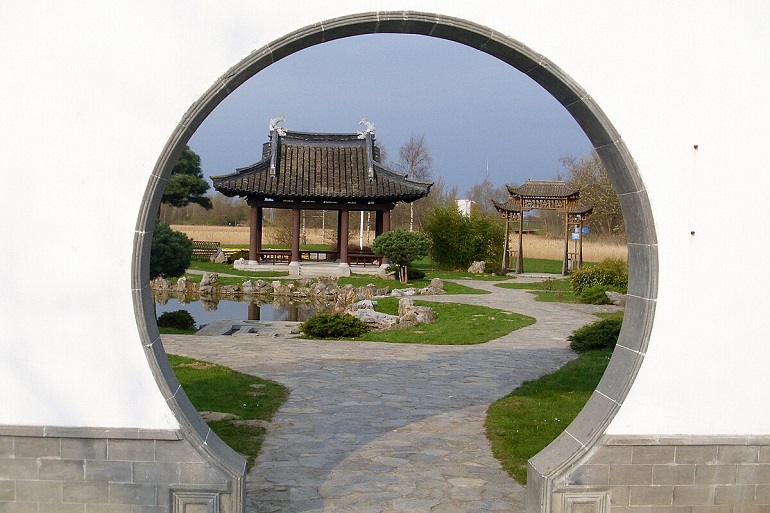
The Chinese Garden in IGA Park is a tranquil landscape created as part of Rostock’s international horticultural exhibitions. Built with the assistance of craftsmen from Rostock’s Chinese twin city, Qingdao, the garden includes classic architectural components such as pavilions, curved bridges, and a central pond with aquatic plants. Carefully arranged stones, traditional flora, and decorative gateways mirror the principles of Chinese landscape design, offering visitors a space for contemplation and cultural exchange amid the larger riverside park environment.
IGA Park
IGA Park in Schmarl was developed from horticultural exhibition grounds into a permanent public park with landscaped gardens, lawns, and leisure infrastructure. The site includes play areas, picnic tables, barbecue facilities, and courts for informal sport, plus signed walking routes around ponds and plantings. Opening hours cover morning to late evening, and access points, toilets, and parking incorporate provision for wheelchair users. The park hosts cultural and community events on a periodic basis in dedicated open-air spaces. Its riverside position along the Warnow provides visual connections to maritime traffic and adjacent attractions.
Rostock Zoo
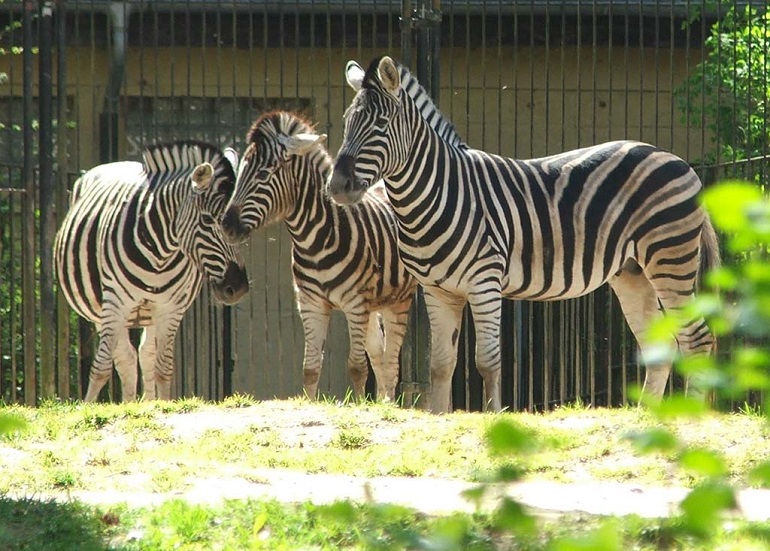
Rostock Zoo occupies a large, wooded site on Barnstorfer Ring with modernised enclosures intended to provide naturalistic habitats for a broad species collection. The grounds include an educational centre focused on evolutionary biology and interpretation linked to Charles Darwin, as well as several children’s play areas. Facilities comprise dining points, rest areas, and accessible pathways, with ticketing that supports card and contactless payments. The site operates daily with seasonal hour adjustments, and parking is available nearby. The combination of zoological exhibits and educational installations supports full-day visits.
Strand Warnemünde
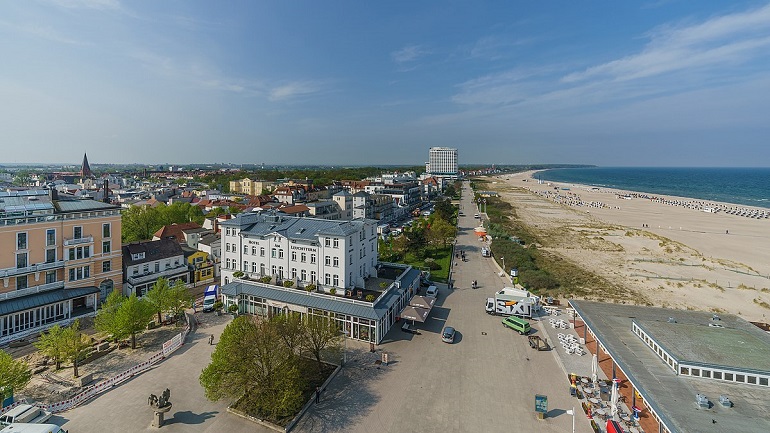
Warnemünde’s main beach stretches for kilometres along the Baltic coast with a wide sandy fore-dune and regularly maintained bathing zones. Public facilities include seasonal lifeguard coverage, toilets, showers, and beach sports areas such as volleyball courts, alongside children’s playgrounds. The promenade and nearby Kurhaus area connect the strand to the resort quarter with rail access to Rostock, and beach sections are designated for different uses, including family zones and water sports. Wheelchair-accessible entrances and parking are provided at marked points, and the coastal profile supports both summer bathing and off-season walking. The beach integrates with the harbour entrance and lighthouse area, linking seaside recreation to maritime observation points.
Rostocker Heide
Rostocker Heide is an extensive coastal forest and heath landscape east of the urban area, forming a protected natural region with mixed woodlands, wetlands, and dune systems. Waymarked trails support hiking and cycling, offering habitat transitions from inland forest to Baltic coastal environments. The area includes access points compatible with wheelchair users near certain car parks, and designated paths reduce erosion and protect sensitive flora. Wildlife observation is possible across seasons, with typical northern German bird and small mammal species present. As a large green buffer, the Heide provides an ecologically significant counterpart to the port and urban districts.
Stoltera Nature Reserve
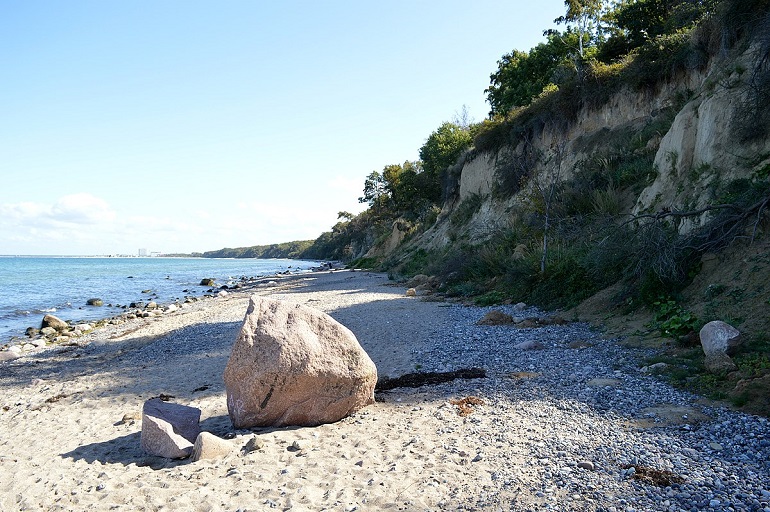
The Stoltera nature reserve extends along the cliffed coastline west of Warnemünde, protecting a stretch of Baltic bluff, beach, and coastal woodland. Trails run parallel to the edge and through the forest, giving access to viewpoints over the sea and sections of active coastal erosion. Waymarking encourages visitors to remain on paths to protect fragile cliff-top vegetation and to avoid risk areas. The reserve is freely accessible year-round and is commonly used for short hikes and nature observation. The mosaic of habitats supports coastal birdlife and characteristic Baltic shore flora.
Getting There
Rostock, the vibrant Hanseatic city on Germany's Baltic coast, is easily accessible through various transport options. By train, Rostock Hauptbahnhof serves as the main railway hub with regular Deutsche Bahn services connecting from major German cities including Berlin (approximately 3 hours), Hamburg (2.5 hours), and Munich (7-8 hours via connections). The station also provides direct links to other regional destinations throughout Mecklenburg-Vorpommern.
By coach, several long-distance bus operators including FlixBus run regular services to Rostock's central bus station from cities across Germany and neighbouring European countries, offering a budget-friendly alternative to rail travel with journey times typically longer than trains but often more economical.
By car, Rostock is well-connected via the German motorway network, primarily accessed through the A19 from Berlin (approximately 2.5 hours) and the A20 from Hamburg (2 hours), with the city centre easily reached via the A19's Rostock exits, though visitors should be aware that the historic city centre has limited parking and pedestrian zones.
Best Time to Visit
The best time to visit Rostock is late spring to early autumn, when milder temperatures, longer days and lively events make the Baltic city most appealing, with May to September generally offering the most pleasant weather for exploring the Hanseatic Old Town and the seaside resort of Warnemünde. July and August are the warmest months, bringing average daytime highs around 20–23°C and up to eight hours of sunshine, though brief showers are common and sea temperatures peak for beachgoers and boat trips. For sunseekers and outdoor activities, mid-July to mid-August is the prime window; those preferring fewer crowds might opt for May–June or September, which remain comfortably mild and well suited to coastal walks and harbour cruises. August also hosts Hanse Sail, one of Europe’s largest maritime festivals, typically held on the second weekend of the month, drawing historic tall ships and over a million visitors to the waterfront spectacle.


