



| Contents |
|---|
Introduction
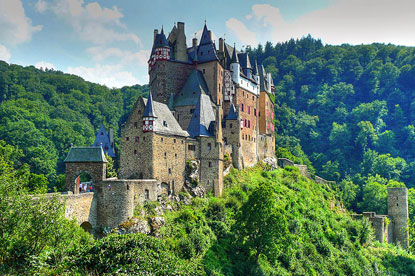
Eltz Castle (Burg Eltz) is a medieval fortress perched on a 70-metre-high rock spur above the Elzbach tributary of the Moselle, between Koblenz and Trier. Constructed from the 12th century onwards by the Eltz family, it is a rare example of a Ganerbenburg, or “castle of joint heirs”, with several wings added over centuries by different branches of the family. Remarkably, the castle has never been destroyed in conflict and remains in the possession of the original Eltz lineage, who still occupy part of the complex. Its well-preserved Romanesque and Gothic architecture, eight soaring towers and unspoilt wooded setting make Eltz Castle one of the finest surviving medieval castles in the Eifel region.
Interesting Facts about Eltz Castle
History
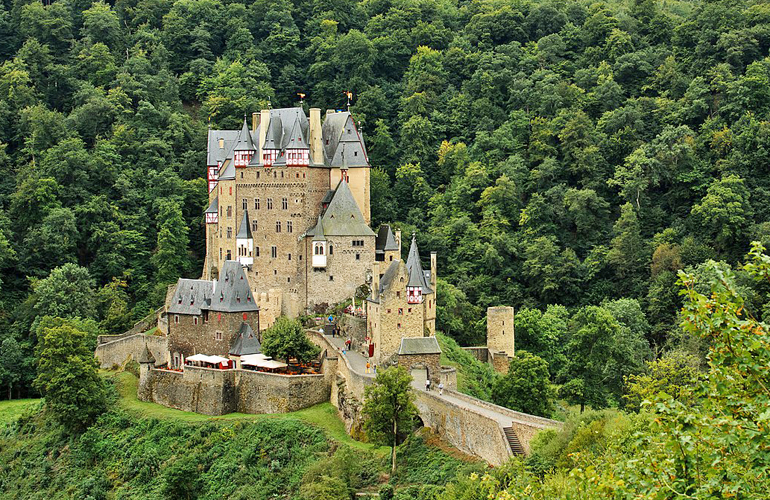
Eltz Castle's remarkable history stretches back over 850 years, with its origins rooted in strategic medieval trade routes. The first documented reference to the castle appears in 1157, when Rudolf von Eltz signed a deed of donation issued by Emperor Frederick Barbarossa as one of the witnesses. However, the site itself has an even older heritage, built upon a 9th-century manor house with a simple earthwork palisade. The castle was strategically positioned on a 70-metre-high rock outcrop beside the Eltzbach, a tributary of the Moselle River, to protect the vital trade route linking the Moselle Valley with the Eifel region and the fertile Maifeld. The oldest surviving structure is the Romanesque keep called Platteltz, which was constructed on the site of the original manor hall and remains the castle's most ancient section. Due to the limited space on the rocky foundation, the castle's unique architecture developed vertically rather than horizontally, with subsequent generations building upwards over the centuries.
Between 1331 and 1336, Eltz Castle endured its only significant military conflict during what became known as the Eltz Feud. This confrontation arose when local lords, including Johann of Eltz, formed an alliance with neighbouring free imperial knights to oppose the territorial expansion policies of Balduin of Luxembourg, the powerful Elector and Prince-Archbishop of Trier. When diplomatic resistance failed, Balduin laid siege to the castle, constructing a siege fortress called Trutzeltz on a rocky outcrop overlooking Eltz Castle, the ruins of which can still be seen today. The siege featured some of the earliest documented use of primitive cannons north of the Alps, known as Pot-de-fer, alongside traditional catapults that bombarded the castle with heavy stone balls for several years. After two years of relentless siege and severed supply lines, the knights of Eltz finally surrendered in 1333, signing a peace treaty with Balduin in 1336. Following this defeat, the free knights became vassals of the Elector of Trier, though they retained their castle as feudal tenure.
What makes Eltz Castle truly extraordinary is its continuous ownership by the same family for over eight centuries, a rarity amongst European castles. In 1268, the Eltz family divided the castle and estate into three equal parts amongst three brothers, creating the branches of Eltz-Kempenich (Golden Lion), Eltz-Rübenach (Silver Lion), and Eltz-Rodendorf (Buffalo Horns). These three lines continued as joint heirs, known as "Ganerben," sharing common areas such as the courtyard, well, and chapel whilst maintaining separate living quarters and continuing construction for the next 500 years. The castle remained a Ganerbenburg (joint inheritance castle) until 1815, when the Barons of Eltz-Rübenach sold their share to the Counts of Eltz-Kempenich, who have remained the sole owners ever since. Unlike virtually every other castle in the Rhine region, Eltz Castle has never been destroyed or significantly damaged by warfare, surviving conflicts including the Thirty Years' War and the Napoleonic Wars intact. For 34 generations, the noble family has maintained and preserved this medieval fortress, with the current owner being Dr. Karl Graf und Edler Herr von und zu Eltz-Kempenich. The castle's remarkable preservation led to it being featured on the 500 Deutsche Mark banknote from 1961 to 1995, cementing its status as a German national treasure.
Description
Nestled deep within the enchanting Eltz Forest, this extraordinary medieval castle represents the very essence of fairy-tale architecture. Perched dramatically on a 70-metre-high rock formation in a secluded valley, Eltz Castle offers visitors an authentic glimpse into medieval life, surrounded by pristine natural beauty that feels utterly removed from the modern world.
Architecture and Setting
The castle's distinctive silhouette is nothing short of breathtaking, with eight soaring towers reaching heights of up to 35 metres. The structure presents a captivating blend of architectural styles, seamlessly combining Romanesque, Renaissance, and Baroque elements that evolved over centuries of construction. Half-timbered facades, ornate oriels, Gothic spires, and decorative stonework create a complex yet harmonious composition that epitomises the romantic ideal of a knight's castle.
What makes Eltz Castle truly magical is its unrivalled location. Surrounded entirely by dense woodland and situated far from any modern development, the castle appears to emerge from the forest like something from a medieval dream. The approach through the ancient trees builds anticipation, revealing glimpses of towers and turrets before the full majesty of the structure comes into view.
Interior Splendour
The castle houses over 100 rooms, many containing original furnishings that have remained virtually unchanged for centuries. Visitors can explore an impressive array of medieval and early modern interiors, including:
- The Great Hall - a magnificent space showcasing period architecture
- The Knight's Hall - displaying authentic medieval atmosphere
- The Chapel - featuring religious artwork and sacred furnishings
- Living quarters and bedrooms - offering intimate glimpses of medieval domestic life
- The hunting room and kitchen - revealing the practical aspects of castle life
Each room tells its own story through carefully preserved artifacts, tapestries, furniture, and decorative arts that span eight centuries of continuous habitation.
The Treasury
Hidden within the castle's basement vaults lies one of Europe's most significant private treasure collections. This world-class treasury houses an acclaimed assemblage of:
- Exquisite gold and silversmith works
- Precious jewellery and ornamental pieces
- Fine porcelain and ceramics
- Historic weapons and suits of armour
- Courtly artifacts of exceptional craftsmanship
The collection represents centuries of accumulated wealth and artistic patronage, offering visitors a rare opportunity to view items of European, national, and regional significance in their original setting.
The Castle Experience
Guided tours provide expert commentary as visitors journey through nine centuries of German architecture and culture. These informative excursions, lasting approximately 40 minutes, reveal the castle's secrets whilst bringing medieval life vividly to reality. Tours commence regularly throughout the day, ensuring minimal waiting times.
The castle's authentic atmosphere is enhanced by its remarkable state of preservation. Unlike many European castles that have suffered destruction and reconstruction, Eltz Castle remains largely intact, allowing visitors to experience genuine medieval spaces rather than modern recreations.
Natural Paradise
The castle sits within a 300-hectare nature reserve, designated as a Flora-Fauna-Habitat and Natura 2000 site. The Eltz Forest has been declared an arboretum, featuring a particularly rich variety of rare indigenous and foreign tree species. This precious biotope provides habitat for typical woodland species as well as rare flora and fauna found in aquatic, brushwood, and forest environments.
Multiple walking trails wind through the forest, offering visitors the chance to explore this serene natural setting. The combination of medieval architecture and unspoilt woodland creates an atmosphere of tranquillity and timeless beauty that transports visitors far from contemporary concerns.
Visitor Amenities
Two self-service restaurants within the castle grounds provide refreshment opportunities, allowing visitors to relax and absorb the magical atmosphere. The facilities blend seamlessly with the historic setting whilst offering modern comfort and convenience.
The castle grounds themselves are freely accessible, providing ample opportunity to appreciate the exterior architecture and forest setting. The dramatic approach through woodland paths offers countless photographic opportunities and serves as a perfect introduction to this remarkable medieval treasure.
Getting There
By train Travelling to Eltz Castle by train is straightforward—take the train to Moselkern station, located at the foot of the hill leading to the castle. From Moselkern, visitors can either enjoy a scenic forest walk of roughly 5km to the castle or opt for a local taxi if preferred. During weekends and holidays (from May to October), you may also take the train to Hatzenport or Treis-Karden and connect to the Burgenbus (Castle Bus) which delivers you directly to the castle parking area.
By bus or coach The RegioBus 365 operates between Hatzenport train station and Eltz Castle’s parking lot from April to November, running several times a day and linking conveniently with the regional trains from Koblenz and Cochem. On weekends and public holidays from May to October, the special Burgenbus service runs from Treis-Karden, Mueden, Moselkern and Hatzenport, providing direct access for both individual travellers and groups.
By car Drivers can reach Eltz Castle by following signposts to “Burg Eltz, Wierschem.” Upon arrival, parking is available at the designated car parks. From there, it is a short and well-marked walk to the castle itself, with the option of a shuttle bus for those wishing to avoid the walk. The final approach takes visitors through picturesque forest scenery, adding to the charm of the visit.
Best Time to Visit
The ideal time to visit Eltz Castle is in the shoulder seasons of spring and autumn, when the weather is pleasantly mild and the crowds are thinner. Arriving in April, after the castle reopens, treats you to fresh greenery and blossoms without the summer throngs, while an autumn visit in October offers glorious changing leaves framing the turrets in fiery hues. For the most serene experience, plan your trip on a weekday morning—the gates open at 9.30 am—so you can wander the fairytale courtyards and enjoy the surrounding forest paths before the guided tours begin and coach parties descend.
| Travel destinations in Rhineland-Palatinate | ||||||||||||||
|---|---|---|---|---|---|---|---|---|---|---|---|---|---|---|
|
|
|
|
| ||||||||||
|
|
|
|
| ||||||||||
|
|
| ||||||||||||


