| Germany Guide |
|---|
|
| | Top National Parks |
|---|
|
| | German States |
|---|
|
| | Europe Guide |
|---|
|
|
|
|
North Rhine-Westphalia Travel Guide
 Cathedral of Cologne. Cathedral of Cologne.
Introduction

North Rhine-Westphalia (Nordrhein-Westfalen in German) is the most populous and most economically important state in Germany. The state was formed in 1946 by the merger of the Prussian provinces of northern Rhineland and Westphalia.
With a a population of 18,033,000 inhabitants, North Rhine-Westphalia would be the fifth most populous country in Western Europe, after France, the UK, Italy and Spain. The Rhine-Ruhr metropolitan region, which occupies most of the North Rhineland section of the state, is the main population centre with over 11 million inhabitants. It comprises among others the cities of Bonn, Cologne, Düsseldorf, Mönchengladbach, Duisburg, Essen and Dortmund. Its population density is a staggering 1,422 inhabitants per km² (3,684/sq mi), 3.5 times more than the (already packed) neighbouring Netherlands and Belgium, and over 4 times the German average.
North Rhine-Westphalia has a surface area of 34,084 km², just in between that of Belgium and the Netherlands, and scarcely bigger than the U.S. state of Maryland.
Before the dissolution of the Holy Roman Empire in 1806, what is now North Rhine-Westphalia was composed of the Free Imperial City of Aachen, the Duchy of Jülich, the Duchy of Kleve, the Archbishopric of Cologne, the Free Imperial City of Dortmund, the Duchy of Berg, the County of Mark, the Prince-Bishopric of Münster, the Duchy of Westphalia, and the Bishopric of Paderborn.
Many famous German beers are brewed in North Rhine-Westphalia, including Dortmunder Export, Kölsch, König, Krombacher, Veltins, and Warsteiner (Germany's largest privately owned brewery).
Famous people from North Rhine-Westphalia include (chronologically): the composer Ludwig van Beethoven, the poet Heinrich Heine, the industrialist Alfred Krupp, the social scientist and political theorist Friedrich Engels, the physicist Wilhelm Röntgen, Chancellor Konrad Adenauer, Chancellor Gerhard Schröder, the F1 driver Michael Schumacher, the model Claudia Schiffer, and the model and actress Heidi Klum.
History of North Rhine-Westphalia
The region that comprises modern North Rhine-Westphalia boasts a rich tapestry of human settlement stretching back to prehistoric times, most famously evidenced by the discovery of Neanderthal remains just outside Düsseldorf. In ancient times, the territories west of the Rhine were inhabited by Celtic tribes including the Eburones, whom Julius Caesar identified as "Germani cisrhenani" around 55 BCE, before his systematic conquest incorporated the region into the Roman Empire as part of Gallia Belgica. The Roman occupation lasted approximately 500 years until 459-461 CE, during which time the area was reorganised as the province of Lower Germania (Germania inferior) around 85 CE, with the magnificent Colonia Claudia Ara Agrippinensium—modern Cologne—serving as the provincial capital and seat of the Roman governor. Germanic tribes such as the Ubii, Sugambri, Usipeti, and Tencteri populated the eastern banks of the Rhine, frequently under pressure from the migrating Suebi, and these groups would eventually succeed Roman rule when the Franks captured Cologne in the 5th century. The province experienced considerable prosperity from the end of the 1st century, witnessed by Trajan's foundation of Colonia Ulpia Traiana near Xanten around 100 CE and the construction of the impressive Eifel aqueduct to supply Cologne with water.
During the medieval period, the region evolved into a complex patchwork of ecclesiastical and secular territories within the Holy Roman Empire, with Aachen achieving particular significance as the coronation site for 31 Holy Roman Emperors who were crowned Kings of the Germans. The Rhineland became integral to the Holy Roman Empire under Otto I, whilst Westphalia was elevated to ducal status by Emperor Frederick Barbarossa in 1180, with the newly created Duchy of Westphalia being granted to the Archbishop-Elector of Cologne and lasting until its secularisation in 1803. The region's political fragmentation intensified over time as central imperial authority weakened, creating numerous smaller territories that nevertheless remained centres of German culture and progress. The area gained immense historical importance during the devastating Thirty Years' War (1618-1648), when the Westphalian cities of Münster and Osnabrück hosted the prolonged peace negotiations that culminated in the Peace of Westphalia on 24 October 1648. This momentous treaty not only ended one of Europe's most destructive conflicts but also established fundamental principles of international law and state sovereignty that continue to underpin the modern international system. The Napoleonic era brought dramatic upheaval as French forces dissolved the Holy Roman Empire and reorganised the region under the Confederation of the Rhine from 1806, with much of traditional Westphalia being assigned to the Grand Duchy of Berg, whilst Napoleon created an artificial Kingdom of Westphalia for his brother Jérôme with its capital at Kassel.
The modern state of North Rhine-Westphalia emerged from the post-Second World War reconstruction of Germany, when the British military administration implemented "Operation Marriage" on 23 August 1946, amalgamating the former Prussian provinces of Westphalia and the northern Rhine Province into a single territorial unit. This artificial union brought together two culturally distinct regions that had come under Prussian control following the Congress of Vienna in 1814-15, when Prussia was awarded most of the Rhineland as compensation for territorial losses elsewhere and established the Rhine Province in 1824. The new state was further enlarged on 21 January 1947 with the incorporation of the former Free State of Lippe, and its constitution was subsequently ratified through a popular referendum. The region's significance grew dramatically during Germany's post-war division when Bonn, located in North Rhine-Westphalia, served as the federal capital of West Germany from 1949 until reunification in 1990, and continued as the seat of government until 1999 when the capital functions transferred to Berlin. The late 19th and early 20th centuries had already transformed the area into the world's most heavily industrialised region, particularly the densely populated Ruhr valley, which became the powerhouse of German industrial development and remains a vital economic centre today. This remarkable historical journey from ancient Roman frontier province through medieval fragmentation and Napoleonic reorganisation to modern federal state reflects the region's enduring importance as a crossroads of European civilisation and political development.
|
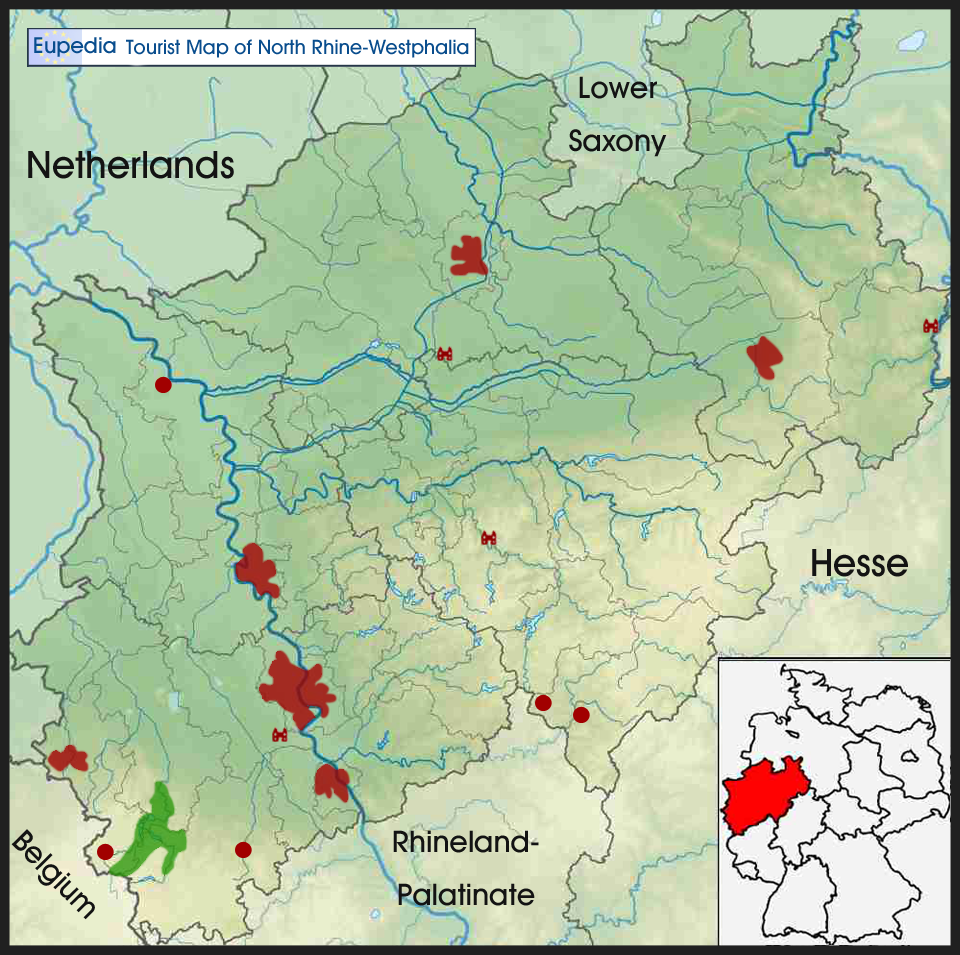
Clickable Tourist Map of North Rhine-Westphalia
Note that dots, castle icons and national parks are not clickable on the mobile version. Please use the desktop version for optimal navigation.
Blank map of North Rhine-Westphalia by Grundkarte TUBS, Relief by Alexrk2. Tourist locations by Maciamo. CC BY-SA 3.0.
Attractions
Attractions are listed geographically, from west to east (left to right) and north to south (top to bottom).
Eifel region
| Aachen (※) |
|---|

 Aachen, located at Germany’s western border where it meets Belgium and the Netherlands, was the capital of Charlemagne's empire. Aachen is still dominated by its medieval past. Its main sights, the Aachener Dom, was built in 786, making it one of the oldest buildings still in use in Northern Europe, and is now a UNESCO World Heritage Site. The city has historically been a centre for spa culture, owing to its natural hot springs that date back to Roman times. Today, Aachen is also a university hub, home to RWTH Aachen University and a large student population. |
| Monschau |
|---|

 Sitting right across the Belgian border, concealed in a forested valley, Monschau is one of the Rhineland's best kept secrets, a jewel of timber-framed architecture protected by medieval ramparts. The town is situated in a valley along the Rur River, offering scenic walking trails and outdoor activities. Monschau also has a number of museums, including the Red House, which provides insight into local cloth manufacturing. |
|
Eifel National Park |
|---|

 Eifel National Park, located in western Germany near the Belgian border, covers approximately 110 square kilometres of protected forest, heath, and meadows. It is known for its diverse wildlife, including wildcats, red deer, and various bird species, and features walking and cycling trails that allow visitors to explore its natural landscapes. The park also contains volcanic formations and a range of habitats shaped by centuries of human influence and natural processes. Facilities include visitor centres offering information, guided tours, and educational programmes aimed at promoting conservation and environmental awareness. |
| Bad Münstereifel |
|---|

 Bad Münstereifel is an appealing historical spa town tucked in the Eifel mountains, and is one of the rare towns in regions (along with Monschau) to have preserved its ramparts. The town is also notable for its thermal spas, offering wellness and relaxation. Bad Münstereifel is easily accessible by train and road, making it a convenient destination for day trips or short breaks. |
Rhine Valley
| Düsseldorf |
|---|

 Düsseldorf is the capital of North Rhine-Westphalia. Wiped off the map in WWII, it has little historical to offer, but boasts some of the best shopping, restaurants, nightlife and museums in Germany. The city features a charming old town (Altstadt) with numerous bars and restaurants, often referred to as the "longest bar in the world." Visitors can explore the Rhine Promenade, offering scenic river views, and visit museums such as the Kunstsammlung Nordrhein-Westfalen. Düsseldorf is also famed for its fashion industry, hosting major trade fairs and fashion events. The city's efficient public transport system makes it easy to explore various neighbourhoods and nearby attractions. |
| Xanten |
|---|

 Founded by the Romans to protect the border with Germania, Xanten is said to be the birthplace of the Germanic mythological hero Siegfried, the dragon slayer in the Nibelungenlied. Its main attraction is the LVR-Archäologischer Park, a large open-air museum located on the grounds of the former Roman city, Colonia Ulpia Traiana. The park features reconstructed buildings, including an amphitheatre, a harbour temple, and city walls, alongside the excavated remains of the original settlement. Adjacent to the archaeological site is the medieval town centre, which is notable for the prominent Gothic St. Viktor Cathedral. The town is also offers recreational activities at the nearby Xantener Nordsee and Südsee lakes. |
| Cologne (※) |
|---|

Founded over 2,000 years ago by the Romans, Cologne is the largest city in the Rhineland, famous for its Kölsch beer, its Eau de Cologne, and of course its breathtaking black cathedral, which took over 600 years to complete. The adjacent Old Town (Altstadt) features a rebuilt historic centre with cobbled streets, colourful townhouses. The city's Roman foundations are displayed in the Roman-Germanic Museum, while the Museum Ludwig holds a significant collection of modern art, including many works by Picasso. Other key points of interest include the Hohenzollern Bridge, which is covered in thousands of 'love lock' padlocks, and the Chocolate Museum located on the river's bank. |
| Augustusburg Palace ※ |
|---|

Located in the town of Brühl, between Cologne and Bonn, Augustusburg Palace is a key example of 18th-century Rococo architecture in Germany. Commissioned in 1725 by Clemens August, the Archbishop-Elector of Cologne, the palace served as his summer residence. The UNESCO World Heritage site also includes the nearby Falkenlust hunting lodge and formal gardens designed in the French style. A notable feature within the main palace is the grand staircase by architect Balthasar Neumann. The building is well-preserved, with many original fixtures intact. The interior can only be seen as part of a compulsory guided tour, which provides access to the ornate rooms and explains the building's history, including its use as a reception palace for the German Federal President until 1994. |
| Bonn |
|---|

Former capital of West Germany, Bonn remains a major centre of politics and administration. Its other claim to fame is for being the birthplace of Ludwig van Beethoven, whose house can be visited. Bonn features a mix of modern and traditional architecture, with notable landmarks such as the Bonn Minster and the Poppelsdorf Palace. The city is also home to several parks and gardens, providing green spaces for relaxation. With good public transport connections, Bonn serves as a convenient base for exploring the surrounding Rhineland region. |
Westphalia
| Münster |
|---|

Münster is an independent city with a vibrant student community. Its traditional architecture has strong Dutch/Flemish undertones. Münster dubs itself the 'bicycle capital of Germany'. Its city centre was substantially rebuilt following the Second World War, with the Prinzipalmarkt featuring its characteristic gabled houses. Key architectural sites include the St. Paulus-Dom, the Gothic Lambertikirche with its suspended Anabaptist cages, and the historic Rathaus where the 1648 Peace of Westphalia was signed. A green belt known as the Promenade, located where the city walls once stood, encircles the centre and serves as a primary route for cyclists and pedestrians, while the nearby Aasee lake provides a large recreational area. |
| Nordkirchen Palace |
|---|

Known as the "Versailles of Westphalia", the Palace of Nordkirchen was the residence of the Prince-Bishops of Munster. Built between 1703 and 1734 in the Baroque style by architects Gottfried Laurenz Pictorius and Johann Conrad Schlaun, the palace complex features highly symmetrical wings and is surrounded by extensive formal gardens. The park, open to the public year-round, covers a vast area and includes landscaped parterres, avenues, sculptures, and water features. Today, guided tours offer visitors a glimpse into the palace's architecture and interiors, while the grounds are popular for walking and cycling, making it a notable destination on the 100-Castle Route in the region. |
| Altena Castle |
|---|

Built by the Counts of Berg in the 12th century, Burg Altena was the seat of the influential House of La Marck. It became the world's first youth hostel established within the castle in 1912, which is is still used as such today. Some of the original rooms were preserved as a museum. A modern lift, reached via a 90-metre tunnel, transports visitors up to the castle courtyard. |
| Freudenberg |
|---|

Freudenberg is distinguished by its compact old town known as "Alter Flecken", where over 80 closely clustered black-and-white half-timbered houses create a unique and recognisable townscape. The area’s topography lends itself to outdoor activities including hiking on marked trails through the surrounding Siegerland forests and meadows. Notable attractions include the Technikmuseum with its historic steam engine, the Kurpark with a popular viewpoint over the old town, and the Südwestfälische Freilichtbühne open-air theatre, which hosts performances in the summer months. Freudenberg also offers several museums, speciality shops, and a selection of traditional German restaurants concentrated within its historic centre. |
| Siegen |
|---|
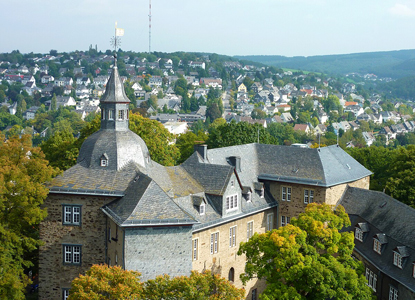
Siegen is a city known for its historical significance in the Siegerland region. It features several notable landmarks such as the Upper Castle, which houses the Siegerland Museum, and the Lower Castle, used for cultural events. The city offers a mix of urban amenities and green spaces, including parks and the nearby Rothaargebirge hills, ideal for walking and cycling. Siegen has a university that contributes to its vibrant student population and cultural scene. Its location provides easy access to other parts of Germany, making it a practical base for exploring the surrounding area. |
| Paderborn |
|---|

Situated in the northeast corner of Westphalia, Paderborn is a university town with a history closely associated with Charlemagne. The city features the Paderborn Cathedral, which dates back to the 8th century and showcases Romanesque and Gothic architecture. Visitors can explore various museums, including the Libori Museum and the Heinz Nixdorf MuseumsForum, one of the largest computer museums in the world. The city also offers pleasant green spaces like the Pader River springs, where the river originates. Paderborn’s combination of history, culture, and natural beauty makes it a notable destination for those interested in exploring a medium-sized German city. |
| Princely Abbey of Corvey ※ |
|---|

The Princely Abbey of Corvey is a former Benedictine monastery situated on the River Weser. Founded in 822, it was an important spiritual, cultural, and economic centre during the Carolingian era and later became a self-ruling princely abbey of the Holy Roman Empire. The complex is architecturally significant for its well-preserved Carolingian westwork, the oldest standing medieval structure in Westphalia, which influenced later Romanesque and Gothic design. Now a UNESCO World Heritage site, the property includes the westwork with its rare mythological wall paintings, a Baroque abbey church, an Imperial Hall, and a Princely Library containing approximately 75,000 volumes. The site operates as a museum and cultural venue, and the grounds include the grave of Hoffmann von Fallersleben, who wrote the lyrics for the German national anthem. |
|


 : Local interest
 : Moderately interesting
 : Outstanding place
 : Must-see in the country
 : Top cities in Europe