| Contents |
|---|
Introduction
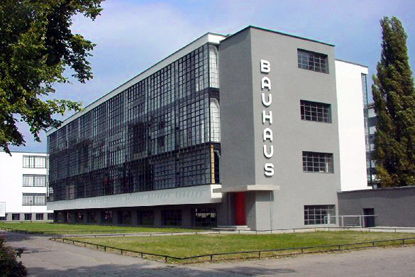
Between 1925 and 1933 Dessau (pop. 80,000) was the focal point of the modernist Bauhaus school of architecture and art. Many fine examples of Walter Gropius' buildings can be visisted, some decorated by Kandisky, Klee, and other masters. All are listed by the UNESCO. The city also borders the Dessau-Wörlitz Garden Realm, an 18th-century landscape ensemble recognised by UNESCO, complementing its Bauhaus World Heritage status.
Historically, Dessau served as the capital of the Principality of Anhalt, from 1396 to 1918, and the city possesses no less than four 18th-century palaces (Georgium, Großkühnau, Mosigkau, Luisium), each set within a park. Other notable historical buildings include the Anhalt Theatre and the Town History Museum in the Renaissance Johannbau.
Much of the city was rebuilt after wartime destruction, resulting in a mix of restored historic landmarks and post-war urban fabric, while surrounding floodplains and the Middle Elbe Biosphere Reserve offer accessible green spaces and riverside trails.
Interesting Facts about Dessau
- Dessau sits at the confluence of the Elbe and Mulde rivers, giving it a uniquely floodplain landscape.
- It became the capital of the mini-state of Anhalt-Dessau and later of the Duchy/Free State of Anhalt, shaping its princely heritage.
- The city is world-famous for the Bauhaus: Walter Gropius moved the school to Dessau in 1925, and its iconic buildings are UNESCO-listed.
- Dessau and nearby Wörlitz form the Garden Kingdom of Dessau-Wörlitz, one of Europe’s earliest English-style landscape parks and a UNESCO World Heritage Site.
- The composer Kurt Weill and the philosopher Moses Mendelssohn were both born in Dessau.
- Dessau was heavily bombed in March 1945, and much of its post-war fabric reflects GDR-era reconstruction.
- The city is part of Dessau-Roßlau, created in 2007 by merging Dessau with the town of Roßlau.
- Aviation pioneer Hugo Junkers established major works in Dessau, linking the city to early aircraft and engine innovation.
- Dessau is among Germany’s greenest towns, encircled by parks, palaces, and the Middle Elbe Biosphere Reserve.
- The Bauhaus Masters’ Houses and the Bauhaus Building in Dessau remain pilgrimage sites for modern architecture and design enthusiasts.

History
Medieval Origins and Political Development
Dessau's documented history begins in 1213, when it was first mentioned as a small settlement in the region of Saxony-Anhalt. The city's strategic location at the confluence of the Elbe and Mulde rivers contributed to its early development and eventual prominence. In 1471, Dessau became the capital of Anhalt and the residence of the Princes of Anhalt. The town's significance increased dramatically in 1570 when the Principality of Anhalt was founded, with Dessau serving as its capital within the Holy Roman Empire. However, political fragmentation followed in 1603 when the state was divided into four separate territories, making Dessau the capital of the mini-state of Anhalt-Dessau. During the Renaissance period, the city began to flourish architecturally with the construction of notable buildings such as St. Mary's church and the Stadtschloss. The city converted to Protestantism in 1540, aligning with the broader religious reforms sweeping through German territories.
Eighteenth Century Enlightenment and Cultural Golden Age
The 18th century marked a transformative period for Dessau under the enlightened rule of Leopold III Frederick Franz, Duke of Anhalt-Dessau, known as Prince Franz. This visionary ruler transformed the surrounding landscape into a centre for landscape gardening and architecture, creating the renowned Dessau-Wörlitz Garden Realm, which applied Enlightenment philosophical principles to landscape design and later became a UNESCO World Heritage site in 2000. During this era, the Anhalt line commissioned the construction of a castle in the Mosigkau district, which now houses a museum of the Rococo period and contains a notable collection of paintings. In 1863, two of the noble Anhalt lines died out, leading to the reunification of the Duchy of Anhalt. From 1918 to 1945, following the collapse of the German Empire, Dessau served as the capital of the Free State of Anhalt within the Weimar Republic. The city is also notable as the birthplace of the renowned philosopher Moses Mendelssohn in 1729 and the composer Kurt Weill, who later achieved international fame for works including The Threepenny Opera.
Modern Era: Bauhaus Legacy and Wartime Destruction
Dessau achieved international recognition in the 20th century when it became the second home of the revolutionary Bauhaus school of design in 1925, after the institution was forced to close in Weimar. Under the leadership of Walter Gropius, the Bauhaus attracted world-renowned artists and architects including Paul Klee and Wassily Kandinsky, who served as lecturers and helped establish Dessau as a centre of modernist design and architecture. The iconic Bauhaus Building and Masters' Houses, constructed during this period, remain architectural landmarks and were designated UNESCO World Heritage sites in 1996. However, Nazi control of the city council forced the closure of the Dessau Bauhaus in 1932, and the school permanently closed in 1933. The city suffered devastating destruction on 7 March 1945, when Allied air raids almost completely destroyed the historic town centre, just six weeks before American forces occupied the area. After the war, Dessau was rebuilt with typical East German concrete slab architecture (Plattenbau) and became a major industrial centre of the German Democratic Republic. Since German reunification in 1990, extensive efforts have been made to restore many historic buildings, and today the city serves as a vibrant cultural and educational centre that celebrates its Bauhaus heritage whilst maintaining its role as a gateway to the Middle Elbe Biosphere Reserve.
Main Attractions
Historical Centre
Johannbau (Dessau Palace)
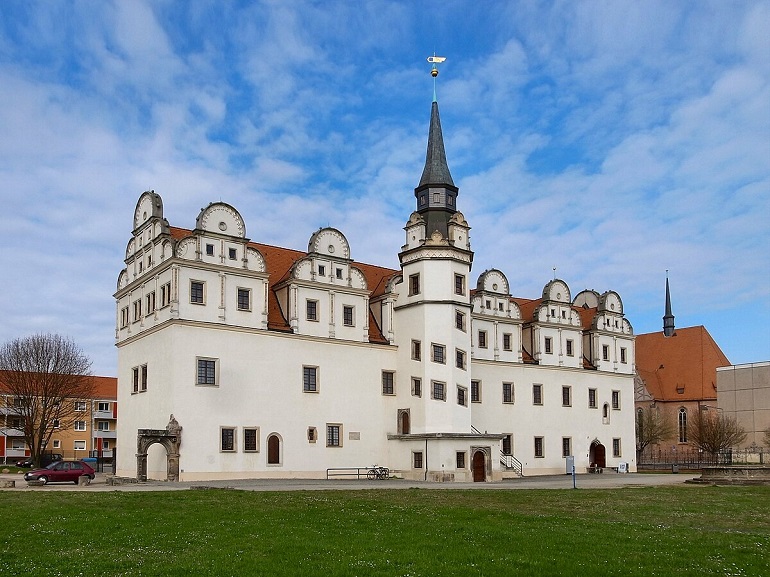
The Johannbau is the only surviving wing of the former Dessau City Palace and a notable example of Renaissance architecture. Built in the 16th century as the west wing of a four-winged complex later destroyed in the Second World War, it features ornate gables, a decorative façade, and a prominent stair tower. Extensively restored after the war, the building now houses the city history museum, presenting the development of Dessau from its origins to the present and offering a historical counterpart to the city’s modernist landmarks.
Market Square (Marktplatz)
The Market Square is the historical centre of Dessau and remains a key civic space. Framed by significant buildings including the Town Hall and St Mary’s Church, the square reflects both reconstruction and post-war urban design following heavy wartime damage. It continues its traditional role as a venue for regular markets, seasonal events, and public gatherings, serving as a central point of orientation and community life in the city centre.
Town Hall (Rathaus)
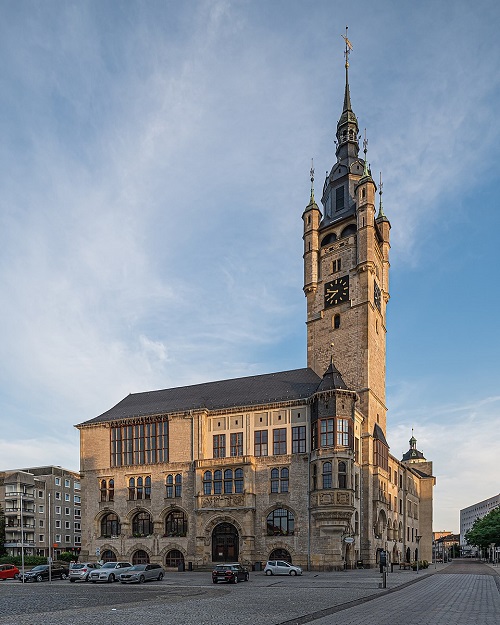
The Dessau Town Hall is a neo-Renaissance building marking the western edge of the Market Square. Completed in the early 20th century, it is distinguished by its tall tower, a prominent feature of the city skyline. Damaged in 1945 and subsequently rebuilt, the structure retains its representative façade and continues to function as the administrative centre of the city, symbolising Dessau’s civic identity and continuity.
Mausoleum in the Georgengarten
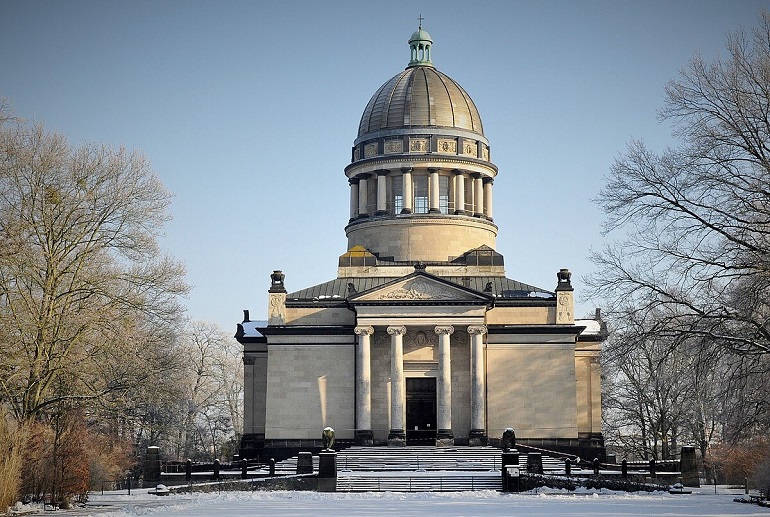
The Mausoleum of the Dukes of Anhalt, situated within the Georgengarten, is a neoclassical funerary structure built in the early 19th century as the burial place of the ducal family. Set within landscaped grounds, the building features a centralised plan, classical orders, and a sober interior appropriate to its commemorative function. The surrounding parkland integrates the monument into a sequence of paths and clearings typical of English landscape design, providing a contemplative setting. The site offers insight into the dynastic history of Anhalt-Dessau and complements the city’s narrative that spans from baroque and neoclassical patronage to modernist innovation.
Anhaltisches Theater Dessau
The Anhaltisches Theater Dessau is a prominent performing arts venue reconstructed after the Second World War, known for its large stage capacity and multi-genre programme including opera, theatre, and ballet. Architecturally, the building exhibits post-war modernist characteristics with a functional layout oriented around stages, rehearsal rooms, and public foyers. Its location near central transport links and public squares supports its role as a regional cultural hub. Even when not attending performances, visitors can appreciate the scale of the complex and its integration with nearby civic spaces that host events and seasonal activities.
St Mary’s Church (Marienkirche)
St Mary’s Church is a historic parish church in Dessau with medieval origins, later modified through periods of reconstruction that reflect changing liturgical and architectural practices. The building typically features a blend of Gothic elements and subsequent restorations, with a tower visible in the cityscape and an interior organised around a nave suited to Protestant worship. Surviving fabric and memorials document local religious and civic history, including phases of damage and repair connected to wartime events. The church remains active in community life and provides a focal point for understanding Dessau’s pre-modern urban development.
Dessau-Wörlitz Garden Realm ※
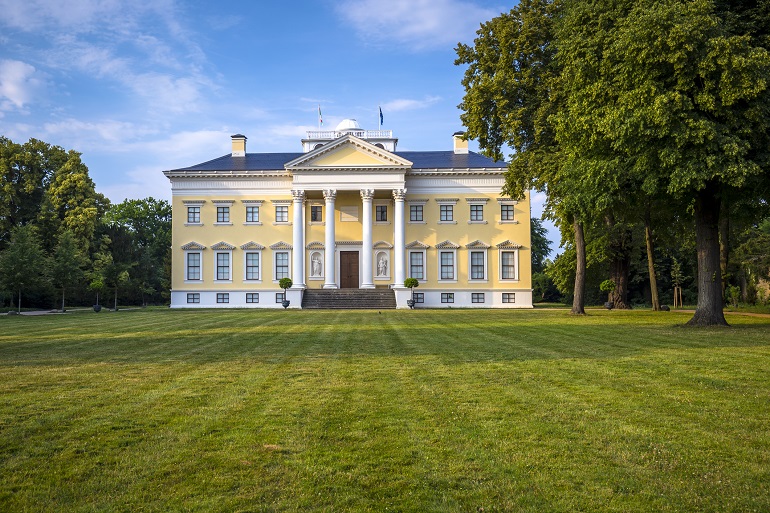
The Dessau-Wörlitz Garden Realm stands as a magnificent testament to 18th-century landscape design, philosophy, and cultural vision. Spanning approximately 142 square kilometres along the Elbe and Mulde rivers in central Germany, this extraordinary cultural landscape represents one of Europe's most significant achievements in landscape architecture. Recognized as a UNESCO World Heritage Site since 2000, the Garden Realm exemplifies the philosophical principles of the Age of Enlightenment through its harmonious integration of art, education, and economy. Created under the visionary leadership of Prince Leopold III Friedrich Franz von Anhalt-Dessau (1740-1817), this remarkable ensemble of parks, palaces, and gardens embedded within the natural floodplain landscape offers visitors an unparalleled journey through history, architecture, and horticultural innovation.
=> Full Guide to the Dessau-Wörlitz Garden Realm
Bauhaus Building ※
The Bauhaus Building, designed by Walter Gropius and completed in 1926, is a seminal work of modernist architecture that served as the headquarters of the Bauhaus school after its move from Weimar to Dessau. It is composed of interconnected wings with a distinctive curtain-wall glass façade on the workshop wing, functional student dormitories (Prellerhaus), and a bridge-like director’s office spanning the street frontage. The complex illustrates Bauhaus principles of functionality, standardisation, and integration of art, craft, and technology, and remains a key site for understanding 20th-century design education. Guided tours typically focus on the workshops, auditorium, canteen, and preserved student rooms, offering insight into the school’s daily operations and pedagogy.
Törtener Siedlung (Törten Estate)
The Törten Estate, developed between 1926 and 1928 under Walter Gropius, is a large-scale social housing project showcasing Bauhaus experiments in affordable, standardised construction. It comprises rows of modest terraced houses built with prefabrication methods, flat roofs, and minimal ornamentation, designed to maximise light and function at low cost. Features include rational street layouts, private garden plots intended for self-sufficiency, and the integration of the experimental Steel House by the Junkers company nearby. The estate demonstrates interwar efforts to address housing shortages through industrialised building techniques and remains a living neighbourhood with conserved exemplars and interpretive signage.
Kornhaus
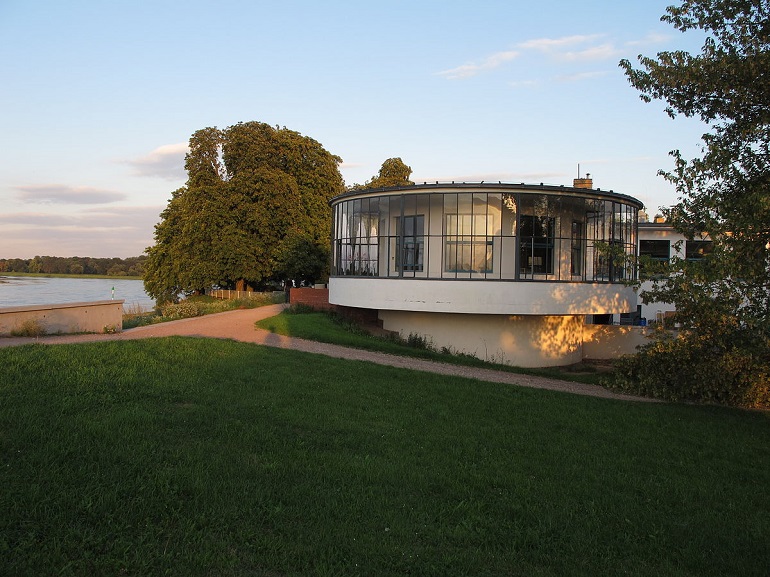
The Kornhaus is a riverside restaurant and event building on the Elbe designed by Carl Fieger and completed in 1930, notable for its streamlined, ship-like composition and semi-circular glazed pavilion facing the water. Built as a leisure amenity for Dessau’s residents, it integrates modernist form with practical hospitality functions, including a terrace oriented towards river traffic and flood-resilient construction considerations. The structure exemplifies Bauhaus-era design applied to public recreation architecture, with an emphasis on transparency, light, and horizontality. Its setting on the Elbe cycle route makes it a convenient stop for visitors exploring Dessau’s waterfront.
Meisterhäuser (Masters’ Houses)
The Masters’ Houses are a set of residences for Bauhaus masters, constructed in 1925–26 near the Bauhaus Building and designed by Walter Gropius as cubic, flat-roofed structures in a wooded setting. The ensemble includes the Director’s House and semi-detached pairs for masters such as Kandinsky and Klee, conceived as modular systems exploring spatial proportion, light, and standardised components. Several houses were damaged or destroyed during the Second World War and were later reconstructed, with some rebuilt as abstracted contemporary interpretations that distinguish between original fabric and new work. The site presents domestic-scale applications of Bauhaus principles and offers a contrast to the larger institutional complex.
Other Places of Interest
Junkers Technical Heritage Sites
Dessau’s industrial history is closely tied to Hugo Junkers, whose enterprises in the early 20th century advanced aircraft and appliance production and influenced the city’s urban development. Surviving elements in the urban fabric include former factory grounds, workers’ housing, and infrastructural remnants that reflect the scale of interwar industrial activity. While museum interiors are excluded, the broader setting underscores how Junkers’ emphasis on lightweight construction, metalworking, and serial production paralleled Bauhaus experiments in standardisation. Visitors can contextualise Dessau’s modernist architecture within this industrial legacy by observing the layout of former industrial districts and associated residential quarters.
Top Museums
Bauhaus Museum Dessau
The Bauhaus Museum Dessau stands as a monument to one of the most influential design movements in history. Located in the town centre and opened in September 2019, this striking contemporary building was designed by Spanish architects González Hinz Zabala. The museum houses the second-largest Bauhaus collection in the world, with over 50,000 exhibits.
The permanent exhibition, entitled “Versuchsstätte Bauhaus. Die Sammlung” (“The Bauhaus as a place of experimentation. The collection”), takes a unique approach by focusing not on the famous design icons and their masters, but on the school itself and its students. Rather than showcasing well-known pieces, the collection emphasises the educational process, featuring students' work, teaching records, and prototypes from the workshops. The exhibition explores the Bauhaus as a dynamic learning environment where artistic experimentation met industrial pressure, and where the tension between creative freedom and economic necessity shaped modern design.
At the heart of the museum is the Black Box, specifically designed to house the collection's treasures. The freely accessible foyer serves as an open stage for contemporary artistic ideas and events, maintaining the Bauhaus spirit of innovation and experimentation.
Anhalt Art Gallery Dessau
The Anhalt Art Gallery Dessau has been housed in the stunning Georgium Palace, a UNESCO World Heritage Site, for over 70 years. Founded in 1927, the gallery's collection originates from several older Anhalt collections, predominantly of princely provenance.
The painting collection focuses on two main areas: Dutch painting from the 15th to 18th centuries and German painting from the 15th to early 19th centuries. The gallery is particularly renowned for its major works by Lucas Cranach the Elder. Beyond paintings, the institution maintains a rich graphic collection that spans from the 14th century to the present day, encompassing both drawings and prints.
The gallery showcases everything from German Renaissance painters to Flemish masters, offering visitors a journey through centuries of European artistic achievement. The setting in Georgium Palace adds an extra dimension to the experience, with the historic architecture providing an elegant backdrop to the artistic treasures within.
Town History Museum
The Town History Museum occupies the historic Johannbau, the sole surviving wing of Dessau's former palace (Stadtschloss). This Renaissance building, which once served as the seat of the princes and dukes of Anhalt, was badly damaged during World War II but restored in the late 1990s. The remarkable stair tower of the Johannbau makes it an architectural attraction in its own right.
The museum's permanent exhibition, “Schauplatz vernünftiger Menschen – Kultur und Geschichte in Anhalt-Dessau” (“A theatre of reasonable people – culture and history in Anhalt-Dessau”), chronicles 800 years of regional history and culture. The exhibition highlights how Dessau and its surrounding region often served as the birthplace of innovations that would influence Germany and Europe.
The museum employs modern presentation techniques, including numerous exhibits, models, films, and interactive multimedia shows to bring history to life. Notable displays include a model of the Dessau synagogue that was destroyed in 1938, and unique teaching models from the Dessau Philanthropinum school, founded in 1774. The museum is fully accessible to visitors with disabilities, and all exhibition texts are available in abbreviated English translations.
Technology Museum "Hugo Junkers"
The Technology Museum "Hugo Junkers" celebrates the legacy of one of Dessau's most important industrial figures. Hugo Junkers, an engineer and technological visionary, played a decisive role in shaping Dessau's industrial development from 1888 until his expropriation by the National Socialists in 1933.
The museum's centrepiece is a meticulously restored Junkers Ju 52, familiarly known as "Aunt Ju," one of history's most famous aircraft. This silver-skinned plane with its distinctive corrugated aluminium sheeting and three radial engines exemplifies the innovative spirit that defined the Junkers company. Alongside this aviation icon stands a replica of the F 13, recognised as the world's first civil all-metal aircraft.
The exhibition extends beyond aviation to showcase Junkers' diverse innovations, including gas boilers and engines that revolutionised domestic and industrial applications. The museum also explores the early days of civil aviation and displays a unique surviving all-metal test chamber built by Professor Junkers himself. Metal furniture items on display testify to the fruitful collaboration between Junkers and the Bauhaus Dessau.
The museum's location is particularly significant, as it sits in immediate proximity to other historic Junkers buildings, including the administrative office block, a wind tunnel, and part of the runway from the former factory airfield.
Museum of Natural History and Prehistory
The Museum of Natural History and Prehistory combines geological, ecological, and archaeological exhibitions to present the natural and human history of the region. The museum building itself has historical significance, having been inaugurated in 1750 as the Leopold-Dank-Stift, a hospice for the elderly and needy. The distinctive 40-metre-high tower, added in 1847, was modelled after the St. Spirito Hospital near Rome.
The permanent exhibitions focus on several key areas: the Stone and Bronze Ages in the Middle Elbe region, the period from the Germanic era through the Middle Ages in Dessau and its surroundings, and the Middle Elbe floodplain landscapes. Visitors can explore valuable mineral collections and geological exhibits showcasing “treasures from underground”.
The museum tower serves as both an exhibition space for fossils and an observation point. From the uppermost floor, visitors enjoy an excellent panoramic view of Dessau and the surrounding region. The museum has operated in its current capacity since 1927, making it one of the city's longest-established cultural institutions.
Local Cuisine
Visitors to Dessau can sample Bauernfrühstück (a fried potato, egg, and bacon skillet), Bötel mit Lehm und Stroh (pork knuckle with sauerkraut and split peas, a Magdeburg–Anhalt classic), and Harzer Käse with caraway on rye, while seasonal menus feature Spargel in spring and wild mushroom dishes in autumn. Sweet cravings are well met by Baumkuchen from the broader region and dense Streuselkuchen, often enjoyed in Bauhaus-era cafés that pair culinary tradition with modernist ambience. Local butchers offer Bregenwurst and other smoked sausages perfect for a picnic in the Dessau-Wörlitz Garden Realm, and many kitchens round out meals with tangy pickled vegetables and hearty gravies that speak to the area’s down-to-earth culinary heritage.
Getting There
By train Dessau is well connected by regional trains, with Dessau Hauptbahnhof offering frequent links to Leipzig and Bitterfeld via the S-Bahn/Regional lines and regular services towards Magdeburg and Lutherstadt Wittenberg, making arrivals from major German hubs straightforward.
By coach or bus Regional buses supplement the rail network and link nearby towns such as Wittenberg and Roßlau to Dessau, with direct, frequent services that slot into the wider Central Germany public transport network for easy onward connections.
By car Dessau lies just off the A9 autobahn between Berlin and Munich, with convenient access via the Dessau-Ost and Dessau-Süd exits, and the route crossing the Elbe near Vockerode shortly east of the city, making driving in from northern or southern Germany particularly straightforward.
| Travel destinations in Saxony-Anhalt | ||||||||||||||
|---|---|---|---|---|---|---|---|---|---|---|---|---|---|---|
|
|
|
|
| ||||||||||
|
|
|
|
| ||||||||||
|
|
|
| |||||||||||