



| Contents |
|---|
Introduction
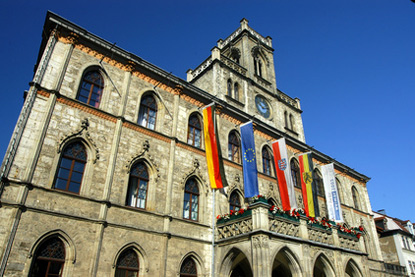
Cultural capital of the German Enlightenment, first democratic capital of Germany, and cradle of the Bauhaus movement, Weimar (pop. 65,000) has a lot to be proud of. Yet this modest town is not the country's most beautiful one, nor does it have any breathtaking sight. Weimar's attraction is more intellectual, a sort of pilgrimage site for the German nation in the footsteps of Goethe, Schiller and others. The city boasts well-preserved classical architecture, a range of museums, and UNESCO World Heritage Sites, including the Classical Weimar ensemble and the Bauhaus sites.
Interesting Facts about Weimar
- Weimar was once the capital of Thuringia and played a key role in German politics between the World Wars.
- The Weimar Republic, Germany's first democracy, was named after the city where its constitution was signed in 1919.
- The city is famous for its association with Goethe and Schiller, who helped make it a centre of German classical literature and culture.
- Weimar contains parts of two UNESCO World Heritage sites: one for its classical cultural legacy and one for its early Bauhaus architecture.
- The Bauhaus School of design was founded in Weimar in 1919, marking a revolution in modern art and architecture.
- The Buchenwald concentration camp, a significant site of Nazi atrocities, is located just outside the city.
- Weimar has historical roots stretching back to at least the year 899, making it one of the region’s oldest towns.
- The city boasts the Duchess Anna Amalia Library, housing precious collections central to German literary history.
- Classical Weimar's flourishing era in the late 18th century became renowned as the “Weimar Classicism” period, drawing artists and intellectuals from across Europe.
- In 1999, Weimar was selected as European Capital of Culture in recognition of its immense cultural legacy.
History
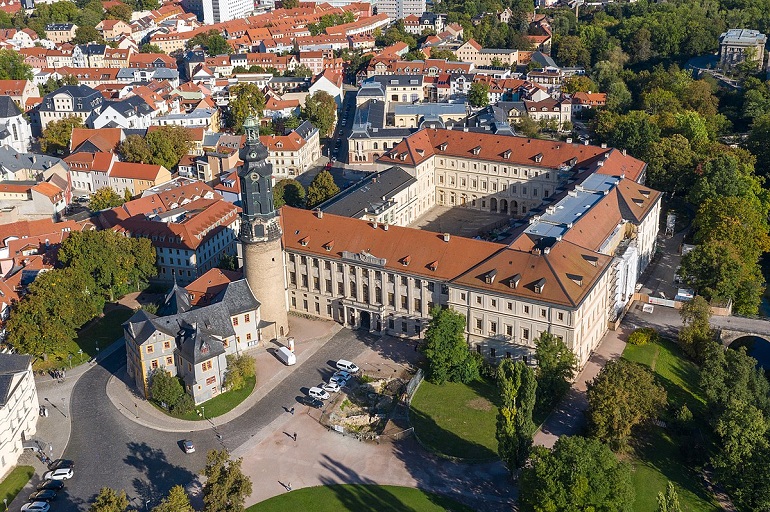
Weimar's documented history begins in 899, when the settlement was first recorded as Wimares, a name derived from Old High German meaning "holy standing water" or "swamp". The town emerged around a wooden castle and two churches dedicated to Saint Peter and Saint James, and by 1249 it had become an independent parish. Initially, Weimar served as the seat of the powerful County of Weimar, first mentioned in 949, which in 1062 was united with the County of Orlamünde. After the Thuringian Counts' War in 1346, the territory fell to the House of Wettin, marking the beginning of a new chapter in the city's development. The Wettins fostered urban growth by abolishing socage and granting privileges to citizens, leading to the construction of a town hall and the current main church during the 15th century.
The early modern period transformed Weimar into a significant cultural centre when it became the ducal residence in 1552, following the Ernestine branch of the Wettins' loss of Wittenberg after the Schmalkaldic War. The Protestant Reformation was introduced in 1525, with Martin Luther making several visits to the city. The 18th and early 19th centuries marked Weimar's golden age, known as Weimar Classicism, initiated by Duchess Anna Amalia who attracted renowned writers and philosophers to the court. This period saw luminaries such as Johann Sebastian Bach, who worked as the court organist from 1708 to 1717, and later, the great literary figures Johann Wolfgang von Goethe and Friedrich Schiller, who made Weimar a European centre of intellectual life. The ducal court's patronage led to significant architectural development, including the construction of the grand Schloss (palace) between 1789 and 1914.
The 20th century brought both triumph and tragedy to Weimar's history. In 1919, the city became the birthplace of Germany's first democratic constitution when the National Assembly met there to draft the founding document of what became known as the Weimar Republic (1919-1933), choosing the city over Berlin due to safety concerns following street riots. Weimar served as the capital of the newly formed federal state of Thuringia from 1920 to 1948. The city also became the cradle of the influential Bauhaus movement when Walter Gropius founded the school in 1919, merging the Weimar Saxon-Grand Ducal Art School with the Kunstgewerbeschule. However, Weimar's prominence made it a target for Nazi appropriation, with the party holding conventions there and later establishing some of Germany's first concentration camps in nearby Nohra and Bad Sulza in 1933. Despite this dark period, Weimar's cultural legacy endured, and in 1999 it was designated European Capital of Culture, with many of its classical and Bauhaus sites receiving UNESCO World Heritage status.
Main Attractions
Walking Tour
Generally hailed as Germany's greatest writer and poet, Johann Wolfgang von Goethe spent most of his working life in Weimar, from 1775 until his death in 1832. His principal benefactors and employer, Grand Duke Carl August of Saxe-Weimar-Eisenach, did all he could to keep this figurehead of the German Enlightenment in Weimar.
In 1776, Goethe first received as a gift a house in Park an der Ilm, a park spreading on both sides of the Ilm River on the eastern edge of town. Known today as Goethe's Garden House, it became his main residence from 1776 to 1782.
A few hundreds metres south-east of there is the Roman House, the summer residence of Grand Duke Carl August. The whole park is listed by the UNESCO and an exact replica of Goethe's house was built in 1999 for tourists to protect the original one.
In 1792 the duke presented another house to Goethe, where he was to spent the rest of his long life and write many of his greatest works. Now known simply as Goethe's House, it is Weimar's most popular attraction and houses the Goethe National Museum.
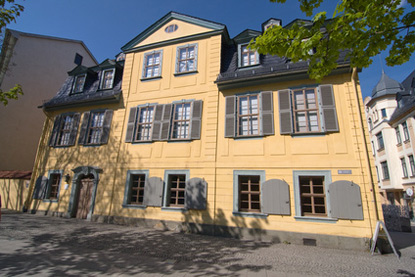
Schiller's House is located on Schillerstraße, close to the town hall. He spent the last six years of his life here, from 1799 to 1805, and his deathbed is still visible on the second floor.
Romantic composer and virtuoso pianist Franz Liszt also lived in the Park an der Ilm, in the so-called Liszt's House. He occupied it in 1848, then again from 1869 to 1886. It is here that he composed his Faust Symphony and Hungarian Rhapsody.
The enormous Stadtschloss (City Palace), extending to the north of the market square, was the seat of the Grand Dukes of Saxe-Weimar until 1918. It was converted into an art museum in 1923, which boasts paintings by Cranach, Dürer and Tischbein, and sculptures by Auguste Rodin.
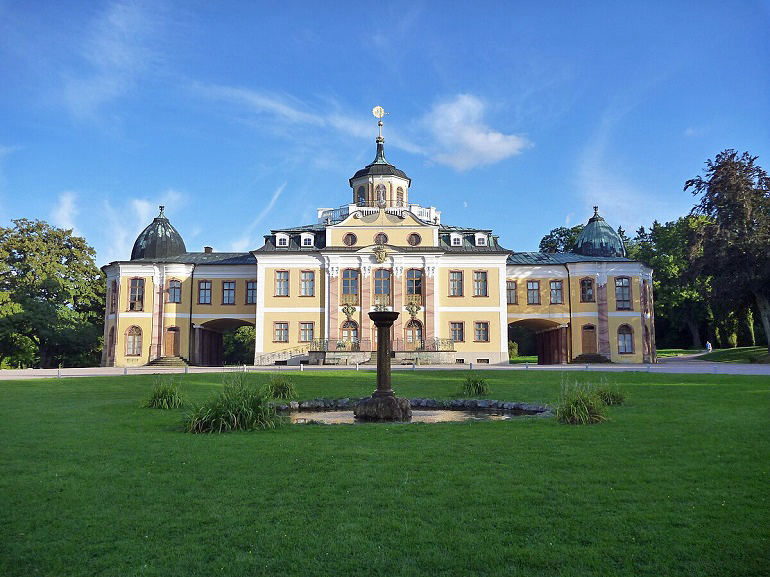
Weimar's most attractive building is surely the yellow-painted Belvedere Palace, Grand Duke Carl August's extensive Rococo-style hunting lodge. It is located 3 km south from the Roman House (or 4 km from the market square) straight along Belvedere Allee.
3 km north-east of the market square is another ducal residence inside Tiefurt Park. It is accessible on foot using the Karolinenpromenade across the forest from behind the Stadtschloss.
Belgian architect Henry van de Velde designed several Art Nouveau buildings in Weimar, such as the Haus unter den Hohen Pappeln ("house under the high poplar trees"), and the entrance of the Nietsche Archive.
Walter Gropius founded the Bauhaus School in Weimar in 1919, before moving to Dessau in 1925, then to Berlin in 1932. Anyone interested in this architectural and artistic style should visit the Bauhaus Museum.
Landmarks
Old Town
The historic Old Town of Weimar is a compact area defined by the Ilm River to the east and a series of streets that mark the former medieval fortifications. Its heart is the market square, which is framed by significant historical buildings. Here, you will find the neo-Gothic Town Hall, the Renaissance-era Cranach House, where painter Lucas Cranach the Elder once lived, and the Court Pharmacy. Many of the buildings in the Old Town date from the 17th and 18th centuries, as frequent fires destroyed earlier medieval structures.
A central feature of this area is the Stadtkirche (Town Church), also known as Herder Church, a late Gothic hall-church built in 1500 where the philosopher Johann Gottfried Herder preached. The cobblestone streets and squares create a vibrant atmosphere, particularly on market days, reflecting the city's rich and eventful history.
Town Hall
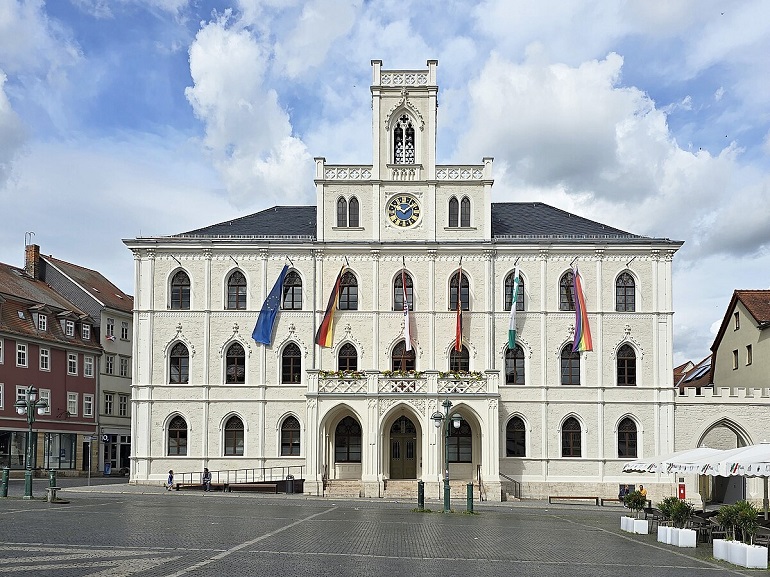
Weimar's Town Hall (Rathaus) is a prominent landmark located on the city's main market square. The current structure was built between 1837 and 1841 in the neo-Gothic style by architect Heinrich Heß, after its 15th-century predecessor was destroyed by fire. This three-storey building, with its distinctive balcony and central bell tower, is considered one of the city's key architectural symbols. The design was modelled after the town hall in Hof, Germany.
Stadtschloss
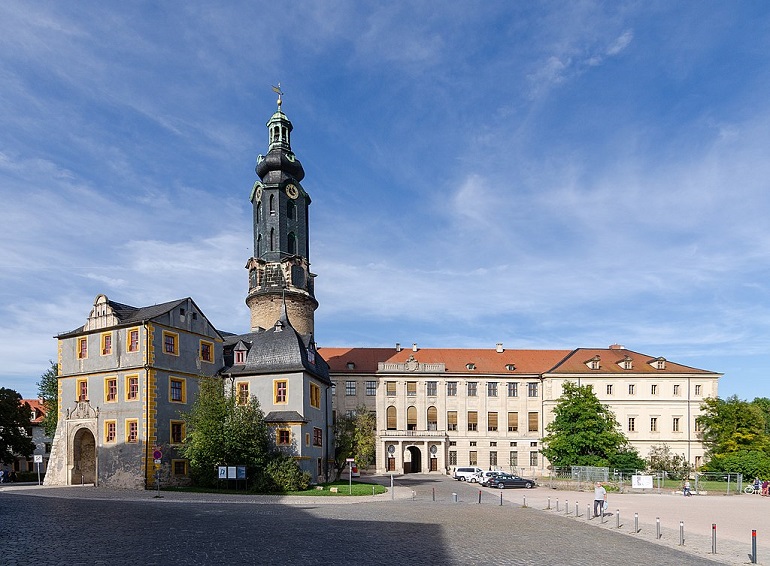
The Stadtschloss (City Castle), also known as Weimar Palace, is a grand three-story building with a neoclassical colonnade facing the Ilm River. Its history spans 500 years, beginning as a medieval moated castle in the 10th century. After numerous fires and reconstructions, the castle gained its present classical appearance following a devastating fire in 1774, with rebuilding efforts overseen by a commission headed by Johann Wolfgang von Goethe starting in 1789.
The interior features impressive rooms such as the grand staircase hall, the Great Hall, and memorial rooms dedicated to the poets Goethe, Schiller, Herder, and Wieland. Since 1923, the castle has served as a museum, housing significant art collections, including German art from the Middle Ages and Renaissance, as well as works by Dutch and Italian masters.
Roman House
Located in the Park an der Ilm, the Roman House was built between 1792 and 1797 as a garden retreat for Duke Carl August. Its design was inspired by Roman villas, based on ideas from Johann Wolfgang von Goethe following his trip to Italy. The neoclassical building, which served as the duke's favourite residence, features a temple-like structure supported by Doric columns and an Ionic portico at the entrance, offering expansive views over the Ilm valley.
Goethe himself supervised the construction, and the interior was designed with a cohesive concept featuring opulent stucco work, painted ornamentation, and reliefs. The house contains a representative entrance hall, a Blue Salon for social gatherings, and a Yellow Salon which was the Duke's study, and today it houses an exhibition on the history of the park.
Haus unter den Hohen Pappeln
The Haus unter den Hohen Pappeln (House under the High Poplars) was the private residence of the Belgian Art Nouveau architect and designer Henry van de Velde. Constructed in 1907-1908 from his own designs, the house served as a home for him and his family until they were forced to leave Germany during World War I. Van de Velde designed every aspect of the house, from the architecture and furnishings to the garden, creating a unified work of art based on the principle of functionality and modern industrial aesthetics.
The building is a prime example of his functionalist design language, with the exterior form dictated by the interior layout. Now a museum, it offers insight into the life and work of one of the key figures who paved the way for the Bauhaus movement.
Tempelherrenhaus
The Tempelherrenhaus is a neo-Gothic ruin located in Beethovenplatz, constructed in 1786. Despite fire damage in the 20th century, its atmospheric remnants and park setting make it a notable landmark and a favoured spot for events and quiet contemplation alike. Originally built as part of Duke Carl August's vision for creating romantic ruins within Weimar's park landscape, the structure was designed to evoke medieval chivalric traditions and provide a picturesque focal point for the surrounding gardens.
The building's distinctive pointed arches, weathered stone walls, and ivy-covered surfaces create an evocative atmosphere that has inspired countless artists and writers over the centuries. Following extensive fire damage during the Second World War, the structure was partially restored whilst maintaining its romantic ruined character. Today, the Tempelherrenhaus serves as a popular venue for small concerts, poetry readings, and wedding ceremonies, with its Gothic Revival architecture providing a dramatic backdrop for cultural events throughout the year.
Parks & Gardens
Tiefurt Mansion and Park
Tiefurt Park, laying east of Weimar, is a beautifully landscaped English-style park surrounding the historic mansion. It offers a peaceful setting by the Ilm River, with walking trails, sculptures, and open lawns, reflecting the taste and sensibility of Weimar's classical age. The park is suitable for picnics and is especially valued for its village-like character. Originally designed in the late 18th century as a summer residence for Duchess Anna Amalia, the 21-hectare park exemplifies the romantic landscape garden movement that swept across Europe during this period.
The grounds feature winding paths that lead visitors past classical temples, grottos, and carefully positioned specimen trees that frame views of the surrounding countryside. The Ilm River meanders through the eastern section of the park, creating natural swimming spots and fishing opportunities during appropriate seasons. Historical figures including Goethe, Schiller, and Herder frequently visited Tiefurt for literary salons and cultural gatherings, and today the park maintains its reputation as a centre for quiet contemplation and artistic inspiration.

Schlosspark Belvedere
Surrounding the Belvedere Palace south of the city, Schlosspark Belvedere is renowned for its formal baroque gardens, winding paths, and ornamental outbuildings. The park allows visitors to appreciate the 18th-century landscape architecture and features plenty of space for hiking, family outings, and relaxation. Created between 1724 and 1732 under Duke Ernst August, the park showcases classic baroque garden design with geometric patterns, carefully manicured hedgerows, and ornamental water features.
The grounds encompass approximately 43 hectares and include the historic Orangery building, various pavilions, and decorative garden structures that reflect the tastes of Weimar's ducal court. Seasonal flower displays transform the formal parterre gardens throughout the year, whilst the park's outer areas offer more naturalistic woodland walks. The elevated position provides panoramic views across the Thuringian countryside, and the park serves as a venue for classical concerts and garden festivals during the warmer months.
Park an der Ilm
A sprawling 18th-century riverside park, Park an der Ilm features scenic walking trails, picturesque views, and several historic monuments. This tranquil green space was influenced by Johann Wolfgang von Goethe and remains largely unchanged from its original design, making it ideal for leisurely strolls, picnics, and exploring landscaped gardens and wooded areas. The park extends for approximately 48 hectares along the Ilm River and incorporates both formal garden elements and naturalistic English landscape design principles.
Visitors can discover Goethe's Garden House, the Roman House, and the Borkenhaus within the park boundaries, each offering insights into Weimar's cultural golden age. The park's network of paths connects various historical points of interest whilst providing excellent opportunities for jogging, cycling, and birdwatching. During spring and summer months, the park hosts outdoor concerts and cultural events, and its ancient trees provide welcome shade during warmer weather.
Weimarhallen Park
Weimarhallen Park is an attractive central park popular for picnics, seasonal floral displays, and family-friendly walking trails. It offers easy access from the city centre and provides a restful green space ideal for relaxation, play, and informal gatherings. The park encompasses approximately 12 hectares and features well-maintained lawns, mature shade trees, and carefully designed flower beds that showcase different plant species throughout the growing season.
Facilities include children's playgrounds with modern equipment, public toilets, and numerous benches positioned to take advantage of pleasant views across the landscaped grounds. The park's central location makes it particularly convenient for families visiting Weimar's cultural attractions, providing a necessary break from museum visits and historical tours. During summer months, the park hosts outdoor film screenings, small concerts, and community festivals, whilst winter brings opportunities for sledging on the park's gentle slopes when snow conditions permit.
Poseckscher Garten
A quieter retreat, Poseckscher Garten is known for its peaceful environment, children's playgrounds, and shady walks. The park is dog-friendly and frequented by locals seeking respite from the city streets. Originally established in the 19th century as a private garden, this 8-hectare park was later opened to the public and has maintained its intimate, neighbourhood character rather than developing into a major tourist destination.
The garden features winding paths that meander between mature trees, small ponds with decorative bridges, and secluded seating areas perfect for reading or quiet conversation. Local families particularly appreciate the well-equipped children's play areas, which include both traditional playground equipment and natural play features constructed from wood and stone. The park's dog-friendly policies and off-lead areas make it popular with pet owners, whilst its network of shaded paths provides comfortable walking opportunities even during hot weather. Seasonal maintenance ensures year-round appeal, with spring bulb displays, summer perennial borders, and autumn leaf colours creating visual interest throughout the changing seasons.
Memorials
Goethe-Schiller Memorial
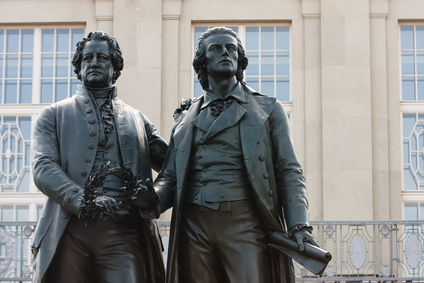
Standing prominently in Theatre Square, the Goethe-Schiller Monument honours two of Germany's most influential literary figures. Unveiled in 1857, the imposing bronze statues are a central gathering point in the city and serve as iconic symbols of Weimar's literary and cultural history. The monument was created by sculptor Ernst Rietschel and depicts both writers in classical robes, with Goethe's hand resting on Schiller's shoulder in a gesture of friendship and mutual respect.
Standing 4.5 metres tall on its granite pedestal, the monument has become one of Germany's most photographed literary memorials and regularly features in official city ceremonies and cultural celebrations. The square surrounding the monument hosts seasonal markets, outdoor performances, and public gatherings, making it a natural focal point for both tourists and residents. The bronze has developed a distinctive patina over the decades, and the monument underwent comprehensive restoration in the 1990s to preserve its historical significance for future generations.
Shakespeare Memorial
Located in Beethovenplatz, the Shakespeare Memorial acknowledges the Bard's lasting influence on German culture. It is a unique cultural landmark and is often paired with visits to nearby historic sites within the central park area. The memorial, installed in 1904, features a bronze medallion portrait of Shakespeare set within an ornate stone frame, surrounded by quotations from his most celebrated works translated into German.
This tribute reflects the profound impact of Shakespeare's plays and poetry on German literary development, particularly during the Romantic period when writers like Goethe and Schiller drew inspiration from his dramatic techniques and psychological insights. The memorial's location within Beethovenplatz creates an interesting juxtaposition of international cultural influences, with Shakespeare representing English literary traditions alongside other European artistic figures commemorated in the surrounding area. Visitors often combine viewing the memorial with walks through the adjacent park areas, where outdoor performances of Shakespeare's plays occasionally take place during summer festivals.
Herder Memorial
Situated on Herderplatz, the Herder Monument commemorates Johann Gottfried Herder, philosopher and theologian, and is integral to Weimar's Enlightenment history. The statue is a popular historical site and is surrounded by significant buildings associated with Herder's life and work. The bronze monument was erected in 1850 and depicts Herder in academic robes, reflecting his role as a leading figure in German intellectual life during the late 18th century.
The sculpture stands approximately 3 metres tall and captures Herder's thoughtful demeanour, symbolising his contributions to philosophy, theology, and literary criticism. The surrounding square features the Herder Church where he served as pastor, along with several historic buildings that housed his residence and study. Regular guided tours explain Herder's influence on German Romanticism and his collaborative relationships with other Weimar luminaries, whilst the monument itself serves as a starting point for walking tours exploring the city's philosophical heritage.
Alexander Puschkin Memorial
This modest monument pays tribute to Russian poet Alexander Pushkin, highlighting Weimar's international cultural connections. It is located in a quiet corner of the city and offers a point of interest for those exploring Weimar's more diverse historical legacy. Erected in 1949 to commemorate the 150th anniversary of Pushkin's birth, the bronze bust reflects the cultural exchange between German and Russian literary traditions that flourished during the 19th century.
The monument recognises Pushkin's appreciation for German literature and his particular admiration for Goethe's works, which influenced his own poetic development. Set within a small garden area with benches and interpretive plaques, the memorial provides information about Pushkin's literary achievements and his connections to Weimar's intellectual circle. The site attracts visitors interested in comparative literature and international cultural relations, whilst also serving as a peaceful spot for reading and reflection away from the city's busier tourist areas.
Ernst Thälmann Memorial
The Ernst Thälmann Monument is dedicated to the German communist leader and stands in Buchenwaldplatz. It is an example of GDR-era commemorative art and reflects the 20th-century historical complexities within Weimar's cityscape. Created in 1958 during the German Democratic Republic period, the monument features an imposing bronze bust of Thälmann mounted on a substantial stone pedestal, accompanied by relief sculptures depicting scenes from the German labour movement.
The memorial commemorates Thälmann's role as leader of the German Communist Party and his resistance to fascism, which ultimately led to his imprisonment and execution by the Nazi regime in 1944. The monument's socialist realist style represents the artistic preferences of the GDR era and provides contemporary visitors with insights into how different political periods have shaped Weimar's commemorative landscape. Information panels explain the historical context surrounding Thälmann's political activities and the broader struggles of the German labour movement during the early 20th century.
Top Museums
Museum Neues Weimar
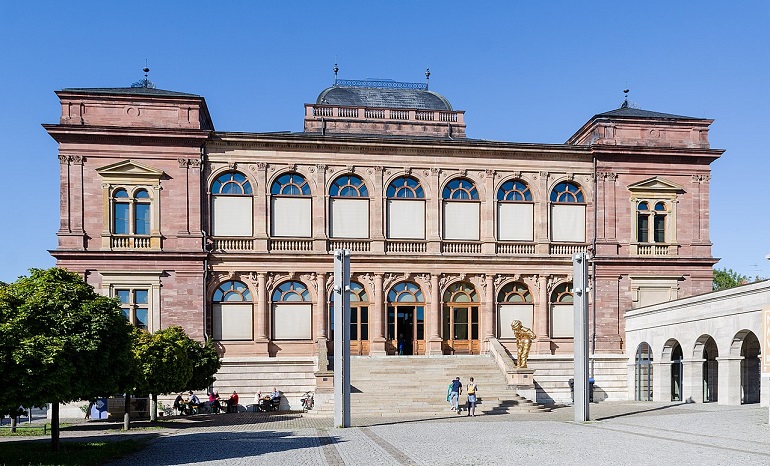
The Museum Neues Weimar, housed in a grand neo-Renaissance building originally opened in 1869 as the Grand Ducal Museum, is one of Germany's earliest museum constructions. This elegant Neo-Renaissance building, designed by Prague architect Josef Zítek, houses a permanent exhibition entitled "Van de Velde, Nietzsche and Modernism around 1900," which explores the vital precursors to the Bauhaus movement through outstanding international works of Realism, Impressionism, and Art Nouveau. The museum's collection illuminates the fascinating period of early modernism in Weimar, featuring works from the Weimar School of Painting and avant-garde pieces supported by influential patron Harry Graf Kessler, ranging from Claude Monet to Max Beckmann.
Central to the experience is the elegant design work of Henry van de Velde, displayed alongside a contemporary intervention by Swiss artist Pipilotti Rist, whose installation "The Room" challenges visitors' bodily perceptions. The museum also features the historic Preller Gallery with its cycle of sixteen frescoes depicting scenes from Homer's Odyssey, and maintains a large hands-on workshop where visitors can engage in bookbinding and woodworking inspired by the exhibition themes. Since 2019, the Museum Neues Weimar has formed part of the "Quartier Weimarer Moderne" alongside the Bauhaus Museum, providing essential context for understanding the cultural and artistic evolution that led to one of the twentieth century's most influential design movements.
Goethe-Nationalmuseum
Housed in Goethe's original residence, this museum offers an immersive experience of the poet's life, combining pristinely preserved living quarters with a rich collection of his art, manuscripts, scientific artefacts, and personal possessions. The museum goes far beyond literature, illuminating Goethe's roles as a statesman, scientist, and collector, making it essential for anyone interested in Weimar Classicism and European intellectual heritage.
Goethe's House
Integral to the Goethe-Nationalmuseum but deserving special mention, Goethe's House stands as a UNESCO World Heritage site decorated and organised by Goethe himself. Visitors can wander through his study, bedrooms, and the beautiful garden, experiencing the personal spaces where much of his creative and intellectual work occurred—a moving pilgrimage for literature enthusiasts.
Schiller-Museum
Dedicated to Friedrich Schiller, one of Germany’s foremost poets, dramatists, and philosophers, this museum encompasses his former home and a modern adjacent building for temporary exhibitions. Visitors can explore reconstructed period rooms, learn about Schiller’s prolific oeuvre and his deep ties to Goethe, and participate in hands-on historical workshops, creating a rich, personal encounter with this literary figure's life and times.
Bauhaus-Museum Weimar
As the birthplace of the Bauhaus movement, Weimar’s museum exhibits the world’s oldest collection of Bauhaus works, from iconic modernist furniture and design objects to original artworks and documents. The museum’s interactive approach provides insight into how Bauhaus revolutionised architecture, art, and daily life in the early twentieth century, appealing to fans of modernism, design, and social history alike.
Weimarhaus
This museum brings Weimar's history vibrantly to life through a theatrical journey featuring dioramas, wax figures, soundscapes, and light effects. Spanning the city’s story from the Stone Age to the classical era, its playful approach transforms historical learning into an engaging, multi-sensory experience especially suited for families and visitors seeking interactive storytelling.
Stadtmuseum Weimar (Weimar City Museum)
Occupying the elegant late eighteenth-century Bertuchhaus, Weimar’s city museum presents the region’s evolution from prehistoric times through Goethe’s era, the Weimar Republic, and beyond. With artefacts, documents, and special exhibitions, it provides vital context for the city’s shifting fortunes and creative achievements, all set in a gracious historic home.
Museum of Prehistory and Early History of Thuringia
Covering 400,000 years of regional history, this museum showcases remarkable archaeological finds, life-size reconstructions, and multimedia displays that chart human settlement from Stone Age hunters to medieval communities. Its broad sweep, modern presentation, and depth of research make it particularly worthwhile for visitors interested in anthropology and early European history.
Deutsches Bienenmuseum (German Bee Museum)
Unique in Germany, this museum explores apiculture’s biological, cultural, and technical heritage, offering a charming blend of engaging exhibits about bees, traditional beehives, and beekeeping lore. The extensive collection, outdoor gardens, children’s activities, and working bee colonies make it a delightful stop for families and anyone curious about the vital role of bees in culture and agriculture.
Local Cuisine
No visit to Weimar would be complete without sampling the famous Thüringer Bratwurst, a seasoned pork sausage grilled over charcoal and often served in a crusty bread roll with tangy mustard. Another local treasure is Thüringer Klöße, traditional potato dumplings that have become a Sunday staple and are frequently enjoyed alongside marinated braised beef. During autumn, be sure to try the Weimarer Zwiebelkuchen, a savoury onion tart that stands at the centre of Weimar’s beloved Onion Market festival. These specialities, accompanied by robust local beers and seasonal treats, capture the spirit and warmth of Weimar’s food culture.
Getting There & Around
By train, Weimar is easily accessible with regular services via the main railway station from major cities such as Frankfurt, Leipzig, Kassel, Berlin, and Düsseldorf. Travellers can also use regional trains connecting Weimar with Erfurt, Jena, Eisenach, and other cities within Thuringia. The main station provides frequent connections and allows for a convenient onward journey within the city by local buses.
By coach or bus, Weimar is served by long-distance bus routes, such as those operated by FlixBus. Buses typically arrive at or near the central railway station, making onward travel handy. The long-distance bus offers an environmentally friendly and practical alternative for those coming from further afield.
By car, Weimar is conveniently located on the A4 motorway, which runs between Frankfurt and Dresden; use exit 49 ‘Weimar’ for direct city access. If coming from the north or south, the A9 motorway (Berlin–Munich) connects via Hermsdorfer Kreuz to the A4. Federal highways B7 and B85 also serve Weimar, providing straightforward routes from surrounding regions.


