



| Contents |
|---|

Introduction
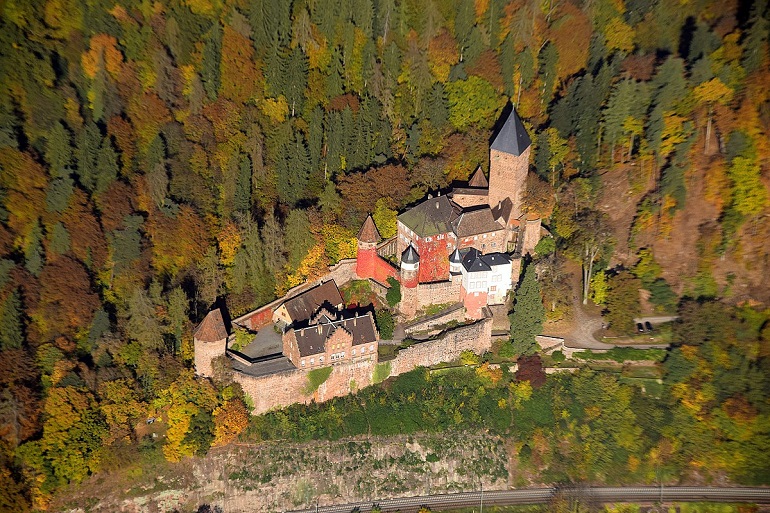
Zwingenberg Castle stands majestically above the River Neckar between Heidelberg and Heilbronn, representing one of the most beautiful fortresses in the Neckar valley. Built on a hill spur approximately 50 metres above the river in the 13th century by the Hohenstaufen ministerialis William of Wimpfen, this well-preserved spur castle occupies a strategic position at the confluence of the steep Wolfschlucht gorge with the Neckar valley. Following its destruction in 1364 during conflicts with robber knights, the castle was reconstructed in 1404 by the brothers Hans and Eberhard of Hirschhorn, whose architectural contributions form the basis of the structure visible today. Since 1808, the castle has remained the private property of the House of Baden, currently serving as the residence of Prince Ludwig of Baden and his family. The castle, recognised as one of the most impressive fortresses in the Neckar valley, hosts an annual opera festival each August in its courtyard, featuring performances of "Der Freischütz" and accommodating up to 850 guests, whilst the adjacent Wolfschlucht gorge provides scenic walking opportunities for visitors.
Interesting Facts about Zwingenberg Castle
- Zwingenberg Castle stands on a steep crag overlooking the River Neckar, making it one of the most picturesque fortresses in the Neckar Valley.
- The castle dates back to the 13th century and was originally built by the ministerialis William of Wimpfen under the Hohenstaufen dynasty.
- After being associated with robber knights, the original Zwingenberg owners were expelled and the castle was destroyed by imperial order in 1363.
- The present structure of the castle largely reflects the 1404 reconstruction led by the Hirschhorn brothers, Hans and Eberhard.
- Since 1808, Zwingenberg Castle has been privately owned by the family of the Grand Duke of Baden, making it a rare example of a fortress still held by aristocratic descendants.
- The chapel at the castle contains the tomb of the Countess of Heydeck, mother of the Count of Bretzenheim, who was conferred the castle in 1778.
- Every summer since 1983, Zwingenberg Castle's courtyard hosts an open-air opera festival, most famously performing Weber’s "Der Freischütz" which was inspired by the nearby romantic gorge.
- The castle is exceptionally well-preserved and, while not regularly open for public tours, offers exterior views and is occasionally used for events.
- A romantic scenic gorge, the Wolfschlucht, lies just behind the castle and is said to have inspired artists and composers.
History
Dating from the Staufer period, the castle's earliest parts were constructed in the 12th or 13th century, probably built by William of Wimpfen, a Hohenstaufen ministerialis. The castle was strategically positioned on a steep crag formed by the confluence of the Wolfschlucht gorge with the Neckar valley, approximately 50 metres above the river. The first documented mention of the castle dates to 1326, when the lords of Zwingenberg, who were vassals to the counts of Hohenlohe, were recorded as the owners.
The castle experienced a turbulent period in the 14th century when the Zwingenberg family became notorious as robber knights. As a consequence of their criminal activities, they were driven from the castle in 1364 when it was conquered and destroyed in the name of the emperor by the united forces of the Palatinate and Württemberg. The fortress and estate were subsequently divided into two equal parts and purchased by the Palatinate and the archbishopric of Mainz. The reconstruction of the castle began in 1404 under the brothers Hans and Eberhard of Hirschhorn, who were enfeoffed with the castle by Mainz and the Palatinate. The building that visitors see today is essentially owed to their reconstruction efforts, and the Hirschhorn family retained ownership for over two centuries.
Following the death of the childless Friedrich von Hirschhorn in 1632, the family line died out, initiating a succession dispute that lasted over a century. Various noble families and rulers controlled the castle through subsequent centuries, including the palatine chancellor Baron von Wieser from 1696 to 1746. In 1778, Karl Theodor of the Palatinate conferred the castle upon his natural son, the count of Bretzenheim, whose mother, the countess of Heydeck, was buried in the castle chapel where her tomb remains today. The castle's modern ownership began in 1808 when the Grand Duke Karl Friedrich of Baden purchased it with his own private means following Napoleon's division of the palatinate. Since then, it has remained the family property of the House of Baden, currently inhabited by Prince Ludwig of Baden and his family. The castle has been extensively renovated and is maintained in excellent condition, though it remains privately owned and not accessible to the public for interior tours.
Description
Zwingenberg Castle, also known as Schloss Zwingenberg, stands as one of the most impressive and well-preserved fortresses in the Neckar Valley. This romantic medieval castle perches majestically on a steep rocky crag on the right bank of the River Neckar, where it cuts through the Odenwald hills in the Baden-Württemberg region of central Germany.
Architectural Setting and Position
The castle presents a commanding presence as a spur castle, strategically built on a hill spur formed by the triangular confluence of the steep Wolfschlucht gorge with the Neckar valley. Rising approximately 50 metres above the river, the fortress enjoys an exceptionally dramatic position that offers breathtaking panoramic views over the surrounding landscape. The best vantage points for appreciating the castle's romantic silhouette are from the opposite bank of the Neckar or from the so-called "Winke boats" that ply the river on sunny days.
Castle Structure and Features
The fortress retains its medieval character whilst being in an unusually good state of preservation. The castle complex showcases architectural elements spanning several historical periods, with the current appearance largely dating from the early 15. The structure includes traditional defensive features typical of German hill castles, with its position naturally fortified by the steep terrain and the confluence of the gorge with the river valley.
The castle boasts a spacious courtyard that serves as the heart of the complex. This atmospheric space can accommodate up to 850 guests and provides an enchanting setting surrounded by historic walls. Behind the main castle buildings lies the romantic Wolfschlucht (Wolf's Gorge), a dramatic ravine that invites visitors for scenic walks through its forest paths and adds to the castle's fairy-tale atmosphere.
Interior and Residential Character
Zwingenberg Castle remains a private residence, currently inhabited by Prince Ludwig of Baden and his family, maintaining its status as family property of the House of Baden since 1808. This continued residential use contributes to the castle's exceptional preservation and authentic lived-in character. The interior combines elements from various historical epochs, including medieval features alongside later refinements.
The castle includes a historic chapel where notable burials have taken place, including that of the Countess of Heydeck, whose tomb still stands today. Various rooms within the castle are available for private events and festivities, allowing visitors to experience the authentic castle atmosphere whilst respecting its status as a private residence.
Cultural Significance and Festival Venue
Since 1983, the castle courtyard has served as the spectacular venue for the annual Zwingenberg Castle Festival during the summer months. The opera "Der Freischütz" by Carl Maria von Weber is performed every second year, with particular significance as the composer is said to have drawn inspiration from the nearby Wolfschlucht gorge. This cultural tradition adds a vibrant contemporary dimension to the historic setting, bringing classical music to life against the backdrop of medieval architecture.
Preservation and Current State
The castle represents a remarkable example of successful historic preservation, maintaining its structural integrity and authentic character across the centuries. Its excellent condition allows visitors to appreciate the full grandeur of medieval fortress architecture, from its defensive positioning to its romantic setting. The ongoing care by the Baden family ensures that this architectural treasure continues to grace the Neckar Valley as one of the region's most photogenic and historically significant landmarks.
Getting There
By train, Zwingenberg Castle (Schloss Zwingenberg) is easily accessible via the S-Bahn network from both Heidelberg and Heilbronn. The journey takes around 30 minutes from either city to Zwingenberg (Baden) station. From the station, it is a straightforward 10-20 minute walk to the castle, crossing the train tracks and following a footpath uphill.
By coach or bus, visitors can reach the nearby towns served by regional bus lines, although direct bus service right to the castle is limited. The most convenient approach is to travel to either Heidelberg or Heilbronn by long-distance coach, then transfer to the S-Bahn for the final leg to Zwingenberg (Baden), followed by a short walk to the site.
By car, from Heidelberg, take the B37 road upstream along the Neckar River, or from Heilbronn follow the B27/B37 downstream; both routes offer scenic drives of about 45 minutes. Parking is available in the village of Zwingenberg or at the train station. From here, the castle can be reached on foot in about 10-20 minutes.
Best Time to Visit
The optimal time to visit Zwingenberg Castle is during the late spring to early autumn months, specifically from May through September, when the region enjoys the most favourable weather conditions. During this period, temperatures range from comfortable 20°C to pleasant 26°C, making it ideal for exploring the castle grounds and hiking through the romantic Wolfsschlucht gorge that lies directly behind the fortress. The castle is particularly enchanting in late spring and early summer when the surrounding Neckar Valley bursts into bloom, whilst September offers the additional allure of autumn colours along the vineyards and forested hillsides. Visitors should be aware that guided tours may be limited during the annual summer opera festival, which typically runs from mid-July to mid-August, when the castle courtyard transforms into an atmospheric open-air theatre. For photography enthusiasts, early morning visits are especially rewarding, as the castle's strategic position on the eastern bank of the Neckar provides stunning sunrise views, and autumn visits offer the possibility of capturing the dramatic morning mists that often rise from the river valley below.