



| Contents |
|---|
Introduction
Located approximately 30 kilometres north of Frankfurt am Main in the fertile Wetterau valley, Friedberg (pop. 31,000) occupies a prominent position on a basalt outcrop along the River Usa just before it joins the Wetter. The town's rich history dates back to Roman times, evidenced by archaeological remains of the ancient Castra Kapersburg, whilst its medieval heritage is preserved in the well-maintained old town featuring traditional half-timbered buildings and remnants of the medieval city walls. Friedberg's most prominent landmark is the imposing former imperial castle complex, which houses both the Adolf-Bartels-Museum and offers panoramic views over the surrounding countryside. Other notable attractions include the Gothic town church, one of Germany's deepest medieval ritual baths (mikveh), remnants of Roman fortifications dating back to the 1st century CE, and the Wetterau-Museum providing insight into local heritage, including the period when Elvis Presley served at the Ray Barracks.
Interesting Facts about Friedberg in der Wetterau
- Friedberg is the district capital of Wetteraukreis in Hesse, set about 30 kilometres north of Frankfurt on the river Usa just before it meets the Wetter.
- The town’s medieval core sits beside one of the largest castle complexes in the German-speaking world, Burg Friedberg, crowned by the 58‑metre Adolfsturm.
- Friedberg became a Free Imperial City in 1211 and historically rivalled Frankfurt with its own major trade fair before fortunes waned.
- The castle and town operated as separate, competing entities for centuries, culminating once in citizens ransacking the castle during their bitter rivalry.
- From the 14th to 15th centuries, a unique “noble republic” of twelve families shared governance of the castle with formalised constitutional roles.
- The Burgraviate of Friedberg functioned as an Imperial Estate, with its constitutional rights reaffirmed repeatedly until dissolution in 1806.
- Elvis Presley served with the US Army at Ray Barracks in Friedberg from October 1958 to March 1960, a link the town still celebrates.
- Friedberg’s central plaza is named Elvis-Presley-Platz, complemented by themed pedestrian lights featuring the singer’s silhouette.
- The Wetterau-Museum in town spans Celtic and Roman eras through the 20th century and includes exhibits on Elvis’s service years.
- Within the castle grounds are preserved Roman bath foundations and a remarkably deep medieval mikveh associated with the town’s Jewish heritage.
- Friedberg hosted the Hessentag state festival twice, in 1966 and again in 1979.
- The long, nearly 700‑metre Kaiserstraße shapes the historic centre and remains a lively shopping spine.
- The surrounding Wetterau plain has long been famed as a fertile “breadbasket” of Hesse, framing Friedberg’s agricultural hinterland.
- The Stadtkirche “Unserer Lieben Frau” stands at about 159 metres above sea level and anchors the town’s skyline.
- Regular guided walks promise “2,000 years of history in 1,000 metres,” threading the castle garden, baths, mikveh and old town.

History
Friedberg in der Wetterau has ancient origins stretching back to Roman times, when it served as a strategic military outpost along the empire's northern frontier. The settlement sat atop a basalt plateau overlooking the Usa River, with archaeological evidence revealing the remains of a Roman military camp that was part of the limes border fortifications and possibly identical to the castellum in monte tauno mentioned in 1st century AD Roman records. Relics of even earlier Mesolithic settlements have been discovered in Bruchenbrücken, a suburb of Friedberg, whilst Roman ruins including public baths (thermae) have been found and preserved within the town. The Roman settlement was abandoned around 260 AD during the retreat of Roman forces to the Rhine frontier.
The medieval period marked Friedberg's transformation into a significant imperial city under the Hohenstaufen dynasty of the Holy Roman Empire. The town was strategically refounded at the crossroads of important trading routes and initially rivalled Frankfurt am Main economically, hosting an important annual trading fair that brought considerable prosperity. In 1211, Friedberg was granted the prestigious status of a Free Imperial City (Freie Reichsstadt). The Imperial Castle of Friedberg, first documented in 1217, was established as a planned foundation by the Staufer dynasty and became the centre of a unique Burgraviate from the 12th century until 1806. This castle was exceptional in that from 1431 onwards, it was the only castle with its own small territory subject directly to the Holy Roman Emperor, featuring a remarkable cooperative constitution where twelve noble families shared governance.
The city's later history was marked by both triumph and tragedy, with its fortunes declining from the 14th century onwards as the Frankfurt Trade Fair overshadowed Friedberg's own commercial activities. Despite economic challenges including devastating fires in 1383 and 1447, epidemics, and emigration of citizens, the town maintained its medieval character and unique political structure. Friedberg was home to a prosperous Jewish community dating back to the 13th century, which was completely destroyed during World War II - many Jews fled to Palestine and the United States before the Holocaust, but all remaining residents were deported to Treblinka in 1942. Today, only the medieval Jewish ceremonial bath (mikveh), old synagogue memorial, and memorial plaques serve as reminders of this lost community, whilst the restored Adolf Tower with its crown and battlements stands as the most prominent feature of the castle complex.
Main Attractions
Altstadt (Old Town)
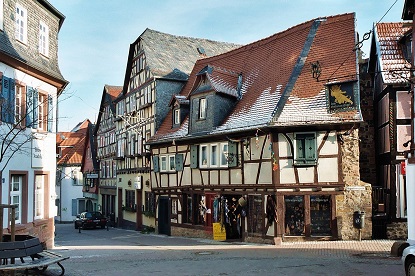
No travel guide to Friedberg is complete without noting the atmospheric Altstadt (Old Town). Its narrow cobbled streets, Renaissance buildings, and half-timbered houses create a living tableau where centuries meet. The Marienplatz, crowned by the stately Rathaus (town hall) and Mary Pillar fountain, recalls the town’s past as an Electorate of Bavaria stronghold and reflects the architectural refinement of the region. The square’s edges are lined with historic breweries, inviting cafés, and lively street scenes that blend tradition with friendly community spirit. Strolling through Friedberg’s Old Town is a journey into its social and artistic heart, where every façade and alley has a tale to tell.
Burg Friedberg
Burg Friedberg is among Germany’s largest medieval castles, its 3.9-hectare expanse dominating the town’s skyline. Founded before 1180 to defend the Wetterau, it became the heart of the uniquely independent Burgraviate, which enjoyed imperial privileges and direct subordination to Holy Roman Emperors. Over centuries, the castle evolved from a fortress into the seat of noble lords, hosting burghers’ houses and civic institutions within its fortified walls. Today, visitors are greeted by monumental gates, half-timbered dwellings, and layered architecture that speaks of its transition from a military bastion to a prestigious noble domain. The complex retains a medieval atmosphere, with winding lanes and preserved ramparts inviting the imagination to wander through epochs of regional power and daily life.
Adolfsturm
Adolfsturm, Friedberg’s iconic tower, punctuates the skyline at nearly 60 metres, making it one of the tallest keeps in all Germany. Constructed around 1347 with ransom proceeds after a medieval feud, it remains the oldest intact medieval structure of the castle. Its distinctive butter-churn crown and four turreted side houses were completed in the late 19th century, blending defensive grandeur with later romanticism. The tower once guarded the castle’s northern gate, overseeing one of its principal entries, and now offers two accessible walkways with commanding views across Friedberg and the Wetterau countryside. Climbing the Adolfsturm is not just a visual treat but an immersion into centuries of stories, strategic significance, and noble self-assertion.
Burggarten
Adjacent to Burg Friedberg, the Burggarten is both a picturesque retreat and an historical landmark. Crafted originally in the 18th century with subsequent landscape redesigns, it combines straight linden avenues and winding paths with breathtaking views over the Wetterau plain. The garden’s mature trees, seasonal flower beds, and tranquil corners invite leisurely strolls and moments of reflection. It has blended baroque motifs with 19th-century landscaping, evolving into a family-friendly oasis for relaxation. Modern improvements ensure accessibility, retaining its appeal for locals and tourists seeking a break from urban rhythms and a touch of courtly serenity.
Schloss Friedberg
Schloss Friedberg, constructed in the 13th century, stands as a testament to the region's rich history, evolving from a fortified residential tower to a grand castle. Initially built around 1230 by the Counts of Andechs, it has changed ownership multiple times throughout the centuries. A significant transformation occurred under the Fieger dynasty, who acquired the castle in 1492 and were great patrons of the arts. This era saw the creation of remarkable frescoes in the Knights' Hall, discovered in 1968, and the "Roman Emperor Room," which features 24 bust portraits of Roman emperors and their wives from the 17th century. After falling into disrepair, the castle was renovated in the mid-19th century by Count Johann Trapp and his son Ludwig. More recently, from 2006 to 2009, extensive yet careful renovations were undertaken, blending modern amenities like internet and heating with the castle's late Gothic, Classical, and Modern interior design. Today, Schloss Friedberg serves as both a private residence for the Trapp family and a unique venue for events and overnight stays, offering guests a private and exclusive historical experience.

St George Fountain (Georgsbrunnen)
The St George Fountain (Georgsbrunnen), set within the castle precincts, is Friedberg’s baroque jewel. Built in 1738 from red Main sandstone, the fountain is topped by a statue of St George vanquishing the dragon—a copy, with the original preserved at the local museum for posterity. Surrounding the base are rich heraldic motifs: the double-headed imperial eagle and thirteen noble coats of arms, rendering homage to the burgrave and his council. In former centuries, the fountain symbolised both prestige and civic order, inspiring awe with its artistry and imperial affiliation. Its location and striking detail make it a focal point for visitors exploring the castle’s heritage and ceremonial core.
Wintersteinturm
For panoramic countryside views and a rewarding outdoor experience, the Wintersteinturm rises to nearly 18 metres atop the Steinkopf massif in the western Wetterau. Rebuilt in 2005, the wooden tower has two viewing platforms, dramatically revealing the region’s rolling fields, distant woods, and—on clear days—the silhouettes of Frankfurt and the Spessart. The walk to Wintersteinturm is a favourite for hiking groups and nature enthusiasts, with trails winding through serene forests before culminating at the summit. There, a summit book awaits climbers eager to document their accomplishment and connection to the landscape.
Elvis Presley Platz
Elvis Presley Platz, while modern in origin, pays tribute to the King of Rock 'n' Roll who spent part of his military service in Friedberg. The square offers shops, cafés, and playful nods to the spirit of 1950s Americana, making it a lively and unique landmark. Visitors will also find rock 'n' roll themed décor blended with traditional German charm, with frequent events and festivals enlivening the space. It serves as a hub for both locals and tourists, illustrating Friedberg’s aptitude for celebrating its diverse legacy—from medieval heritage to pop culture. Photos with Elvis-themed backdrops and Elvis memorabilia add an unexpected twist for music fans and curious explorers alike.
Top Museums
Historical Museums
Wetterau-Museum
The Wetterau-Museum serves as the principal repository of regional history, housing extensive archaeological collections that span from prehistoric times through the modern era. The museum's exhibits chronicle the rich heritage of the Wetterau region, with particular emphasis on Roman settlements, medieval developments, and local cultural traditions. One of its most distinctive features is a dedicated section exploring Elvis Presley's military service in Friedberg during the late 1950s, complete with memorabilia and historical context of the American military presence in the area. The museum's archaeological wing showcases significant finds from regional excavations, including Roman artefacts and medieval relics that illuminate the area's strategic importance throughout history.
Historische Mikwe "Judenbad"
This remarkable historical site preserves one of Germany's best-preserved medieval Jewish ritual baths, dating back to the 13th century. The mikve represents a significant testament to Friedberg's medieval Jewish community and offers visitors insight into Jewish religious practices and daily life during the Middle Ages. The stone-built ritual bath, carved deep into the ground, demonstrates sophisticated medieval engineering and religious architectural principles. The site provides educational context about the Jewish community's role in Friedberg's medieval commercial and cultural development.
Art Museums
Kunstverein Friedberg
The Kunstverein Friedberg functions as the town's contemporary art hub, showcasing rotating exhibitions of modern and contemporary works by both local and international artists. This art association maintains an active programme of exhibitions, artist talks, and cultural events that engage with current artistic movements and social themes. The venue regularly features experimental works, multimedia installations, and traditional fine arts, making it a dynamic space for artistic dialogue and cultural exchange within the region.
Regional Heritage
Museumslandschaft Oberhessen
Operating as part of the broader Upper Hesse museum network, this institution focuses on preserving and presenting the rural heritage and traditional crafts of the Oberhessen region. The museum's collections encompass agricultural tools, traditional handicrafts, and domestic implements that illustrate rural life in Hesse over the centuries. Through its exhibits, visitors gain appreciation for the region's agricultural history, folk traditions, and the evolution of rural communities in central Germany.
Local Cuisine
Among the local specialties are the beloved Handkäs mit Musik, a pungent cheese dish typically served with onions and vinegar, as well as Grie Soß (Green Sauce), a fresh herby condiment served with potatoes or boiled eggs, especially popular in spring. Traditional taverns and restaurants often showcase Schweinebraten (roast pork), and sausages are a staple, with local butchers crafting their own unique varieties. For those with a sweet tooth, apple-based desserts abound, such as Apfelkuchen, drawing from the ample orchards of the Wetterau region. Many establishments pride themselves on sourcing ingredients from surrounding farms, ensuring each meal captures the authentic taste of Friedberg’s rich rural heritage.
Getting There
By train Friedberg in der Wetterau enjoys excellent rail connections, with regular Deutsche Bahn services running every 30 minutes from Frankfurt's main station, taking approximately 27-39 minutes for the direct journey. The town's railway station provides convenient access to the broader German rail network, making it easily accessible from major cities throughout the country.
By bus Coach services operate between Frankfurt and Friedberg, though these take considerably longer than the train at around 1 hour 13 minutes to 1 hour 29 minutes. Local bus services also connect Friedberg with neighbouring towns in the Wetterau region, providing additional transport options for those exploring the wider area.
By car Driving to Friedberg offers flexibility and convenience, with the town situated approximately 29-32 kilometres from Frankfurt via well-maintained motorways and main roads. The journey typically takes around 25 minutes from Frankfurt, making it an excellent base for exploring both the historic Wetterau countryside and the wider Hesse region. The town provides adequate parking facilities for visitors arriving by private vehicle.