| Germany Guide |
|---|
|
| | Top National Parks |
|---|
|
| | German States |
|---|
|
| | Europe Guide |
|---|
|
|
|
|
Baden-Württemberg Travel Guide
Introduction

Baden-Württemberg is third largest German state both in terms of area and population. It was created in December 1951 by the merger of the states of Württemberg-Baden, Württemberg-Hohenzollern and South Baden. Its capital is Stuttgart.
Baden-Württemberg borders on (clockwise from the North) the German states of Rhineland-Palatinate, Hesse and Bavaria, Switzerland, and Alsace in France.
It has a surface area of 35,752 km² (slightly bigger than Belgium), a population of 10,741,000 inhabitants (almost exactly like Belgium). It is divided into 35 districts (Kreise) and 9 independent cities (Stadtkreise).
The Danube, Europe's longest river (outside Russia) has its source in the Black Forest, in the south of Baden-Württemberg.
People in Baden-Württemberg speak four distinct dialects of Upper German : South Franconian (in the northwest, around Heidelberg, Heilbronn and Karlsruhe), Swabian (most of the center and east, including Stuttgart, Ulm and Hohenzollern), Low Alemanic (west and south, from Alsace to Lake Constance) and High Alemanic (in the south-western corner, near Basel and Winterthur).
Famous people from Baden-Württemberg include (chronologically): the mathematician and astronomer Johannes Kepler, the poet and playwright Friedrich Schiller, the philosopher Georg Wilhelm Friedrich Hegel, the engineer and industrialist Gottlieb Daimler, the aircraft manufacturer Ferdinand von Zeppelin, the car engineer Karl Benz, the industrialist and engineer Robert Bosch, the poet and novelist Hermann Hesse, the physicist Albert Einstein, the fashion designer Hugo Boss, Chancellor Helmut Kohl, the tennis player Boris Becker and the tennis player Steffi Graf.
History of Baden-Württemberg
The region was settled in ancient times by various Germanic tribes known collectively as the Swabians (also called Suebi or Suevi or Alamanni). Conquered by Julius Caesar, the area became part of the Roman Province of Gallia Belgica, then to its subdivision of Germania Superior (with its capital in Moguntiacum, present-day Mainz).
Originally a loose confederation of unrelated tribes, the Alamanni underwent coalescence during the 3rd century, and were ruled by kings throughout the 4th and 5th centuries. In 406, some of them joined the Alans and Vandals in the invasion of the crumbling Roman Empire. They crossed the Pyrenees and settled in the Roman province of Gallaecia, were accepted by Emperor Honorius as foederati, and created their own Suebian kingdom of Gallaecia.
In 496, those who had stayed in Swabia were defeated by Clovis I, King of the Franks, at the Battle of Tolbiac. In the 6th and 7th centuries, Swabia became a Frankish duchy, one of the original stem duchies of Germany.
Following the Treaty of Verdun of 843 splitting Charlemagne's Empire between his three grandsons, Swabia was granted to Louis the German, King of East Francia (the precursor of the Holy Roman Empire).
In the 10th century, the Duchy of Swabia comprised most of Baden-Württemberg (except the north), as well as Alsace and northern Switzerland. The region of Heidelberg belonged to Franconia.
Later in medieval times what is now Baden-Württemberg belonged notably to the Palatinate of the Rhine, the Margraviate of Baden, the Duchy of Württemberg, the Duchy of Fürstenberg, the County (then Principality) of Hohenzollern (several subdivisions), as well as various Habsburg fiefs.
The Habsburg family originated in southern Swabia, in present day Switzerland, and progressively expanded their domain until becoming the most powerful monarchy on the continent. The Hohenzollern went on to become Burgraves of Nuremberg, Margraves (then Duke-Electors) of Brandenburg, Dukes (then Kings) of Prussia, and eventually Emperors of Germany.
Napoleon elevated Baden to the Grand Duchy, and Württemberg to a Kingdom. Both became his allies against Prussia. In 1871, the Grand Duchy of Baden and the Kingdom of Württemberg joined the new German Empire.
|
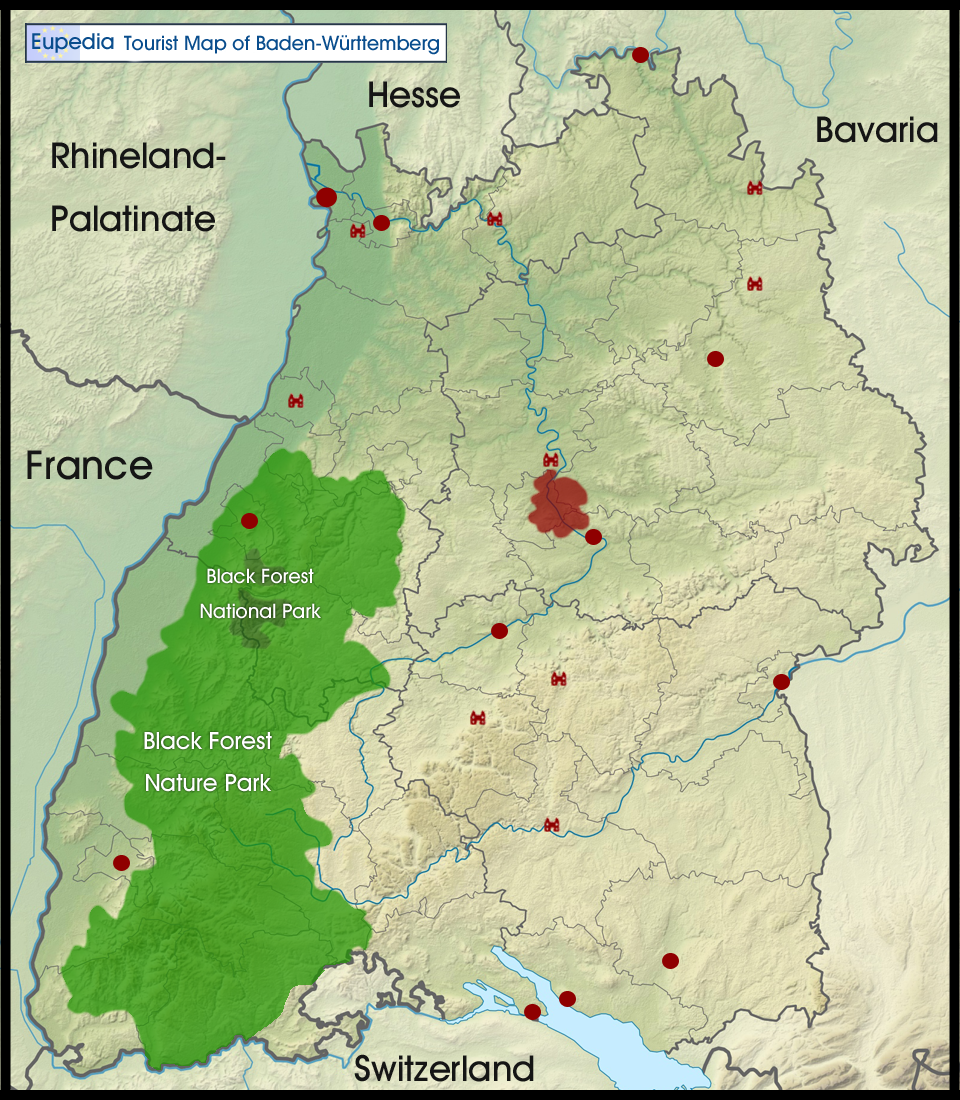
Clickable Tourist Map of Baden-Württemberg
Note that dots, castle icons and national parks are not clickable on the mobile version. Please use the desktop version for optimal navigation.
Blank map of Baden-Württemberg by Grundkarte TUBS, Relief by Alexrk2. Tourist locations by Maciamo. CC BY-SA 3.0.
Attractions
Attractions are listed geographically, from west to east (left to right) and north to south (top to bottom).
Baden
|
Mannheim |
|---|

 Mannheim is a university city located at the confluence of the Rhine and Neckar rivers. Its city centre is distinguished by a unique grid layout, the 'Quadratestadt', where streets are named using a letter-and-number system. Principal landmarks include the vast Mannheim Baroque Palace, which is home to the city's university, and the Art Nouveau Water Tower situated in Friedrichsplatz. The city was a notable centre for classical music through the 18th-century Mannheim School and is associated with key inventions, such as the precursor to the bicycle and the first automobile journey. Alongside its industrial and commercial importance, Mannheim offers considerable green space, most notably within the Luisenpark. |
|
Heidelberg |
|---|

 Heidelberg is a university city located on the River Neckar. Its skyline is defined by the ruins of Heidelberg Castle, a structure with Gothic and Renaissance elements positioned on a hillside overlooking the Altstadt (Old Town). This area contains baroque architecture, cobblestone lanes, and the Karl Theodor Bridge. The city is also the location of Germany’s oldest university, founded in 1386. Across the river, the Philosophers' Walk is a pathway on the Heiligenberg hill that provides a direct view of the castle, the bridge, and the city centre. |
|
Schwetzingen Palace |
|---|
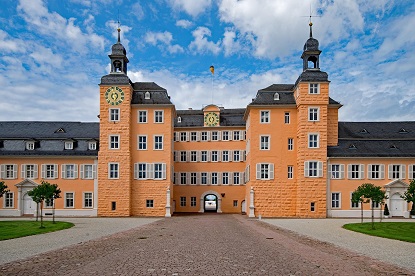
Schwetzingen Palace is an 18th-century baroque summer residence located near Heidelberg, originally built as a moated castle in 1350 and transformed into its current form from 1697 onwards under the Electors Palatine. The palace served as the summer residence for Prince Elector Carl Theodor from 1742 to 1799, during which time it reached its architectural and cultural zenith with the addition of the palace theatre in 1752—Europe's first theatre with galleries and now the oldest surviving example. The complex encompasses over 72 hectares of meticulously preserved gardens that blend French baroque design with later English landscape elements, featuring more than 100 sculptures and exotic architectural follies including a decorative mosque, the Temple of Apollo, and an Italian-style bath house. Today, visitors can explore approximately 30 palace rooms containing original 18th and early 19th-century furnishings, while the palace theatre continues to host performances as part of the annual Schwetzingen Festival, maintaining the site's role as both a significant cultural monument and active venue for the arts. |
|
Black Forest National Park |
|---|

 The Black Forest National Park offers visitors a glimpse into authentic, wild nature across its 10,000 hectares of untamed beauty. This remarkable reserve features mountains exceeding 1,000 metres in height and areas that have developed without human intervention for over a century, providing habitats for unique wildlife such as the peregrine falcon and the pygmy owl. The park has a rich history, with the original dense jungle of beeches and oaks being almost completely cleared by the 1800s due to human settlement, charcoal production, and agriculture, before reforestation began about 250 years ago. Today, visitors can enjoy spectacular views, guided tours, educational events about the forest ecosystem, and numerous outdoor activities including hiking, cycling and rafting. The Triberg Waterfalls, one of the most popular attractions in the Black Forest region, can be explored via well-marked trails that offer scenic lookout points along the cascading falls. |
|
Karlsruhe Palace |
|---|

 Karlsruhe Palace, a significant building in the city of Karlsruhe, was constructed in 1715 as the residence for Margrave Charles III William of Baden-Durlach. The palace is a prime example of baroque architecture and served as the seat of power for the margraves, electors, and grand dukes of Baden until 1918. Today, it is home to the main museum of the Badisches Landesmuseum, which features extensive collections on art and history. The palace stands at the centre of a layout of 32 radiating streets, a design that defines the city's structure. Its garden, the Schlossgarten, is a large park that extends to the north. |
|
Baden-Baden ※ |
|---|

 Baden-Baden, located in the Black Forest region of Germany, is a town renowned for its thermal baths and spa culture. Its history as a health resort dates back to Roman times, with the modern spa town developing significantly in the 19th century. Key attractions include the Caracalla Spa and the historic Friedrichsbad, offering diverse bathing experiences. The town also features a prominent casino, an opera house, and various museums, alongside landscaped parks and gardens. Baden-Baden hosts international festivals and events throughout the year, contributing to its status as a cultural destination. The surrounding Black Forest provides opportunities for outdoor activities, including hiking and exploring natural landscapes. |
|
Freiburg im Breisgau |
|---|

Freiburg im Breisgau is a university city situated on the western edge of the Black Forest. Recognised for its temperate climate and a high number of sunshine hours, the city's reconstructed old town is notable for its Gothic Minster and the unique system of small water channels, the Bächle, that run alongside its streets. The central Münsterplatz hosts a daily market next to the historic Merchants' Hall. Freiburg has also developed a reputation for its advanced environmental practices, particularly in sustainable urban planning and solar energy. The city provides direct access to the hiking trails of the Black Forest and the vineyards of the Baden wine region. |
Other attractions
Europa Park
St. Blasien
West Württemberg
|
Zwingenberg Castle |
|---|

Zwingenberg Castle, located near the Neckar River in Baden-Württemberg, Germany, dates back to the 13th century and is known for its well-preserved medieval architecture. Originally constructed as a defensive fortress, it features characteristic towers, a courtyard, and extensive stone walls. The castle has undergone various modifications over the centuries and today is privately owned, though it periodically hosts cultural events, including an annual opera festival. Sitting amid wooded hills, Zwingenberg Castle can be reached via local walking trails and offers views across the Neckar Valley. |
|
Ludwigsburg Palace |
|---|

 Ludwigsburg Palace, located 12 km north of Stuttgart, is one of the country's largest Baroque palaces, comprising 18 buildings with 452 rooms. Commissioned by Duke Eberhard Ludwig of Württemberg in 1704, its construction spanned several decades, resulting in a complex that showcases a blend of architectural styles, including Baroque, Rococo, and Neoclassicism. The extensive grounds feature the expansive Baroque gardens and the English landscape garden, alongside the smaller Favorite Palace, a former hunting lodge. The palace houses several museums, including a fashion museum and a ceramics museum, and contains the oldest preserved palace theatre in Europe. |
|
Stuttgart |
|---|

Stuttgart, the capital of Baden-Württemberg, is a significant industrial and manufacturing centre, recognised as the home of both Porsche and Mercedes-Benz, with dedicated museums for each brand. The city's landscape is characterised by its location within a valley, with numerous green spaces, including the extensive Schlossgarten that runs through the city centre. Stuttgart is also a notable wine-producing region, with vineyards reaching into the urban area. Its cultural offerings include the Stuttgart State Theatre, which houses the state opera, ballet, and theatre companies, as well as a number of art museums and galleries. The public transport system integrates S-Bahn, U-Bahn, and bus services, providing access throughout the city and surrounding areas. |
|
Esslingen am Neckar |
|---|
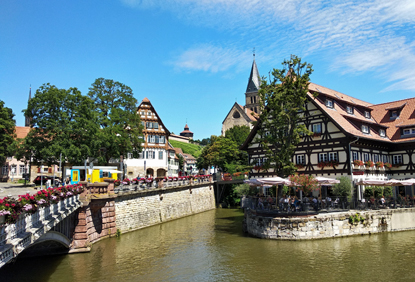
Esslingen am Neckar (pop. 96,000) is a city known for its medieval centre, which contains over 200 well-preserved half-timbered houses, including what is considered to be Germany's oldest complete row of such houses, constructed in the early 14th century. This historic core remained largely undamaged during the Second World War. The main landmarks include the Church of St. Dionysius, which stands on foundations laid in the 8th century, and the Frauenkirche, an important example of late Gothic architecture. The Old Town Hall, first erected in the 15th century, displays a later Renaissance facade and an ornate astronomical clock. Overlooking the town and its surrounding vineyards are the remnants of the Esslingen Castle fortifications, offering views across the Neckar valley. The city also has a long history of wine production and is home to Germany's oldest producer of Sekt, or sparkling wine. |
|
Tübingen |
|---|

Tübingen is a traditional university town located on the River Neckar. The town is known for the Eberhard Karls University, one of Germany's oldest, which gives the area a large student population. Its well-preserved old town (Altstadt) consists of half-timbered houses and cobblestone lanes, with Hohentübingen Castle situated on a hill above the town centre. A common activity is punting on the Neckar in traditional boats called Stocherkähne, which provides views of the waterside houses. |
|
Lichtenstein Castle |
|---|

Lichtenstein Castle is a 19th-century Neo-Gothic structure situated on a cliff in the Swabian Jura, southern Germany. Constructed between 1840 and 1842, its design was directly inspired by Wilhelm Hauff's novel Lichtenstein. The castle stands on the foundations of a medieval fortress, and while it remains the private property of the Dukes of Urach, it is accessible to the public through guided tours. These tours lead through several rooms, which contain collections of historic weapons, armour, and furnishings. From its position, the castle offers commanding views over the Echaz Valley. |
|
Hohenzollern Castle |
|---|

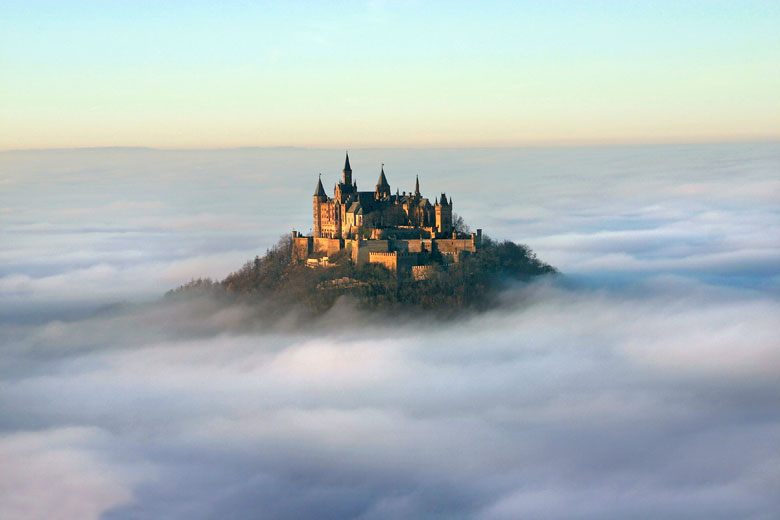
Hohenzollern Castle is located atop Mount Hohenzollern in the Swabian Alps, Germany. The current structure is the third castle to be built on the site, with the first two having been destroyed. Construction of the present-day castle, a notable example of Gothic Revival architecture, was initiated by Crown Prince Frederick William IV of Prussia in the mid-19th century. It was designed to serve as a family memorial for the Hohenzollern dynasty, which ruled Prussia and later Germany until 1918. Today, the castle is a privately owned historic site that functions as a museum, housing a collection of art and historical artefacts related to Prussian history. Visitors can tour the staterooms and view items such as the Prussian Royal Crown and personal effects of Frederick the Great. |
|
Sigmaringen Castle |
|---|

Sigmaringen Castle, the former residence of the Hohenzollern-Sigmaringen sovereigns, is a princely castle situated in the state of Baden-Württemberg, Germany. Its origins trace back to the 11th century, with significant rebuilding and expansion occurring over the centuries, particularly after a fire in 1893. The castle is positioned on a chalk cliff overlooking the Danube River. Still under the ownership of the House of Hohenzollern, the castle is open to the public for guided tours, offering a view into the life of German nobility. Inside, visitors can see a vast collection of arms and armour in the Armoury, one of the largest private collections in Europe, alongside lavishly decorated halls and chambers furnished with original objects from its long history. |
Other attractions
Heilbronn
Reichenau Monastic Island ※
East Württemberg
|
Wertheim am Main |
|---|
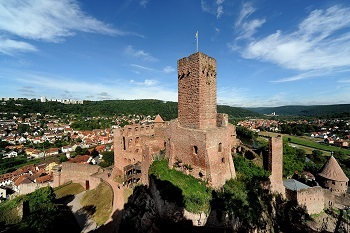
Wertheim am Main (pop. 23,000) is a historic medieval town positioned at the confluence of the Rivers Main and Tauber. The town is characterised by its well-preserved medieval old town (Altstadt), which features a network of narrow streets and numerous half-timbered houses dating from the 16th to 18th centuries, including the notable "Blue House." Overlooking the town from a wooded hillside are the ruins of Wertheim Castle, a stone fortress that dates back to the 12th century. Wertheim is renowned for its glass-making tradition, particularly crystal production, and houses several museums including the Glasmuseum and the Castle Museum. The town also serves as a gateway to the Romantic Road tourist route and offers access to the surrounding Franconian countryside and vineyards. The former Cistercian monastery, Kloster Bronnbach, located nearby, is another significant architectural highlight. |
|
Weikersheim Castle |
|---|

Weikersheim Castle is a Renaissance palace that served as the main residence for the Counts of Hohenlohe until the 18th century. The castle's architecture reflects its development from a medieval moated castle into a Renaissance and later a Baroque residence. Inside, visitors can view the preserved state rooms, including the Knights' Hall, which features a coffered ceiling with hunting scenes, and the Mirror Cabinet. The castle is surrounded by a notable Baroque garden, laid out in a symmetrical design with a central axis. The garden contains numerous statues, including a collection of dwarf figures, and an orangery, reflecting the fashions of the period. The property has been open to the public as a museum since the 20th century, displaying the original furnishings and art collections of the Hohenlohe family. |
|
Langenburg Castle |
|---|
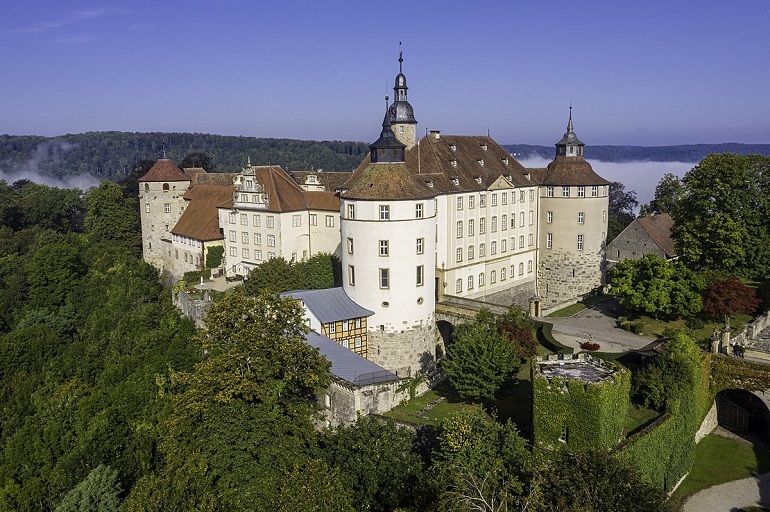
Langenburg Castle, situated on a ridge overlooking the Jagst river valley, has been the seat of the princely Hohenlohe-Langenburg family since the 13th century and remains their primary residence. Originally a mediaeval fortress, the structure was significantly remodelled into a Renaissance palace during the 17th century, with Baroque additions made in the 18th century. Parts of the castle are open to the public, offering guided tours of the state rooms which contain period furnishings and art. Within the castle complex, the former stables house the German Automobile Museum, displaying a collection of historic motor cars. The grounds also include a preserved Baroque garden, and the castle's position provides extensive views of the surrounding countryside. |
|
Schwäbisch Hall |
|---|

Schwäbisch Hall is a town situated in the valley of the River Kocher. Its development was shaped by the production of salt, which brought prosperity and led to its status as a Free Imperial City for five centuries. The town centre is characterised by its medieval and half-timbered buildings, including the large market square, which is dominated by St. Michael's Church and its prominent outdoor staircase. The town also features the Kunsthalle Würth, a gallery for modern and contemporary art, and the Hällisch-Fränkisches Museum, which details regional history. Covered wooden bridges cross the river, connecting the different parts of the old town. |
|
Ulm |
|---|

Located on the banks of the Danube, Ulm was the birthplace of Albert Einstein, a fact commemorated by a memorial fountain in the city. Ulm is most known for the Ulm Minster, a Gothic church that possesses the tallest steeple in the world. The city also features a well-preserved old town, which includes the Fishermen's and Tanners' quarters, characterised by its half-timbered houses, cobblestone streets, and footbridges. Contrasting with the historic architecture is the modern glass and concrete Stadthaus, a centre for events and exhibitions, situated adjacent to the Minster. |
|
Ravensburg |
|---|
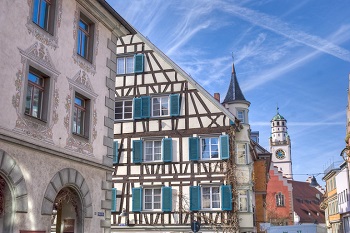
Ravensburg is a city known for its well-preserved medieval town centre. Often called the "City of Towers and Gates," its skyline is defined by numerous historic structures, including the white Mehlsack tower, which offers views across the region, and the Blaserturm, which can be climbed for a closer look at the old town. Historically a Free Imperial City, Ravensburg maintained economic significance for centuries. Today, it is recognised internationally as the home of the puzzle and games company, Ravensburger AG, which was founded here in the 19th century and remains a major local employer. |
|
Konstanz |
|---|

Konstanz, the largest city on Lake Constance, sits on the border with Switzerland and possesses a well-preserved Old Town (Altstadt). This is due to its proximity to Switzerland, which meant it was not bombed during the Second World War. The city's history dates back to Roman times and it was the site of the Council of Constance in the 15th century, which ended the Western Schism. Key landmarks include the Konstanz Minster, a basilica that combines Romanesque and Gothic architectural styles, and the Imperia statue at the harbour entrance, a satirical monument commemorating the Council. The city is also a significant university town, home to the University of Konstanz, and serves as a cultural hub with institutions like the South Westphalia Philharmonic Orchestra and various theatres. Its location on the lake provides opportunities for water sports and access to nearby islands such as Mainau, known for its gardens. |
|
Meersburg |
|---|
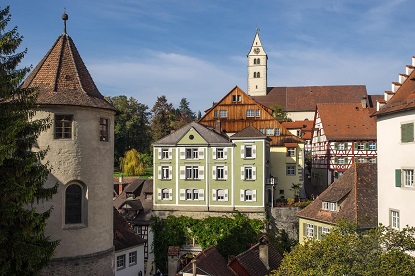
Meersburg (pop. 6,000) is a town situated on the northern shore of Lake Constance (Bodensee in German). he town is renowned for its two contrasting castles: the medieval Burg Meersburg, believed to date from the 7th century and recognised as Germany's oldest inhabited castle, and the baroque Neues Schloss, built between 1712 and 1760 as a former residence of the prince-bishops of Konstanz. The town is divided into an upper town (Oberstadt) and a lower town (Unterstadt), both pedestrianised areas connected by steep streets and stairways, featuring well-preserved medieval architecture including half-timbered houses and cobblestone streets. Meersburg's hillside location is characterised by terraced vineyards that produce local wines, particularly the regional speciality rosé known as "Weissherbst" and pinot noir varieties. The town serves as a gateway to Lake Constance attractions, with regular ferry services connecting to destinations such as Konstanz and the flower island of Mainau, whilst offering panoramic views across the lake towards the German Alps. |
|


 : Local interest
 : Moderately interesting
 : Outstanding place
 : Must-see in the country
 : Top cities in Europe