



| Contents |
|---|

Introduction
Straubing (pop. 47,500), the historic heart of the fertile Gäuboden region, presents a townscape defined by its past as a ducal seat of the Wittelsbach dynasty and a key trading post on the Danube. This legacy is preserved in a remarkably dense and walkable historic centre, where Gothic brickwork stands alongside opulent Baroque and Rococo façades. The city is famous for its 10-day Gäubodenvolksfest, the second largest beer festival in Bavaria after the Oktoberfest. It is held in August and attracts over one million visitors. Notable sights include the Stadtturm (city tower), the Gothic belfry, the Herzogsschloss (ducal palace), the Basilica of St Jacob, and St Peter’s Church.
Interesting Facts about Pisa
- The area of Straubing has been continuously settled since the Neolithic era, making it one of the oldest inhabited regions in Bavaria.
- Straubing was known as Sorviodurum during Roman times and served as a significant Roman military base, with remarkable treasures displayed in the Gäubodenmuseum.
- The city's medieval Gothic town centre features landmarks such as the City Tower (Stadtturm), begun in 1316, and the majestic Basilica of St. Jacob.
- Straubing became the capital of the Duchy of Bavaria-Straubing in 1349 and was one of the five main residences for Bavarian dukes in the Middle Ages.
- The town is famous for the Gäubodenvolksfest, one of the biggest festivals in Bavaria, welcoming over a million visitors every August.
- The Agnes Bernauer Festival, held every four years, reenacts the tragic tale of Agnes Bernauer, whose legendary death is tied to Straubing’s history.
- The Gothic city hall’s medieval roof was partly destroyed in a fire in November 2016, but the structure remains a central civic symbol.
- Straubing’s coat of arms features blue-white diamonds, the plough, and a fleur-de-lys, symbolising its agricultural heritage and connection to the Bishopric of Augsburg.
- The city boasts the only zoo in East Bavaria and is notable for its innovative biotechnology industries and Rhine-Main-Danube Canal port.
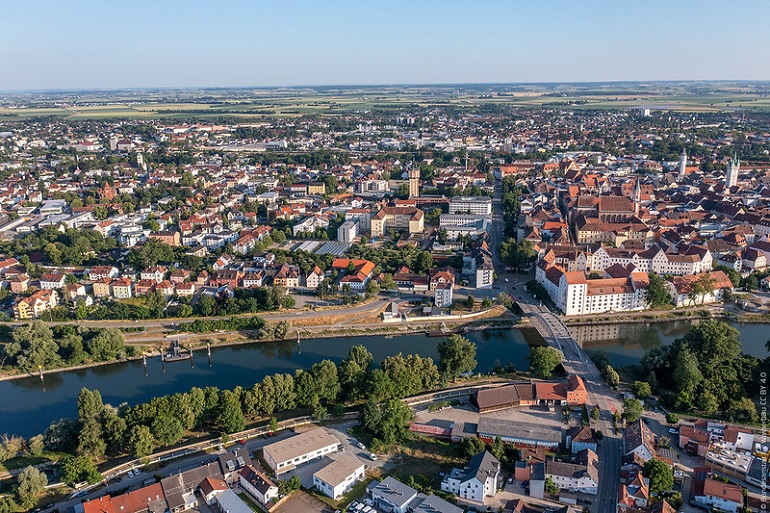
History
The Romans established a significant presence here from 16-14 BCE, calling the settlement Sorviodurum, which served as a vital military support base for over 400 years. The famous 'Römerschatz' (Roman treasure), excavated in 1950 and now displayed in the Gäubodenmuseum, stands as testament to this substantial Roman occupation. Following the empire's collapse, the Bavarii tribe settled in the area, primarily around St. Peter's Church (built in the 9th century), and named the settlement after their leader Strupinga, which eventually evolved into Straubing.
The medieval period marked Straubing's golden age when Duke Ludwig I Wittelsbach of Bavaria founded the 'new town' in 1218. The city reached its political zenith in 1349 when it became the capital of the Duchy of Bavaria-Straubing under Duke Wilhelm I, following the division of Bavaria amongst the sons of Louis IV, Holy Roman Emperor. This duchy, which lasted from 1353 to 1425, extended far beyond Bavaria to include Holland, Hainaut, and Zeeland, making the Straubing dukes some of the most powerful rulers in the Holy Roman Empire. The iconic Stadtturm (city tower), whose foundation stone was laid in 1316, symbolised the city's prosperity, whilst the ducal palace on the Danube served as the seat of government. The duchy came to an end in 1425 with the death of Duke John III, after which the territories were partitioned amongst other Bavarian duchies.
Straubing's later history was marked by both triumph and tragedy, reflecting the broader turbulence of German history. The city suffered during the Thirty Years' War when Swedish forces successfully besieged it in 1633. The Jewish community, which had existed since the 13th century, faced repeated persecution, including a massacre in 1338 following accusations of Host desecration, and expulsion in 1439. The tragic tale of Agnes Bernauer, daughter of an Augsburg barber who married Duke Albert III and was subsequently murdered in 1432 on the orders of Duke Ernest of Bavaria-Munich, remains one of Straubing's most famous historical episodes. During the Second World War, the city endured several American air raids in 1944 and 1945, with the military hospital suffering 80 percent destruction and 45 casualties. More recently, a devastating fire in November 2016 destroyed much of the medieval town hall, though the city has continued to thrive as an important regional centre in the fertile Gäuboden region.
Main Attractions
Stadtturm
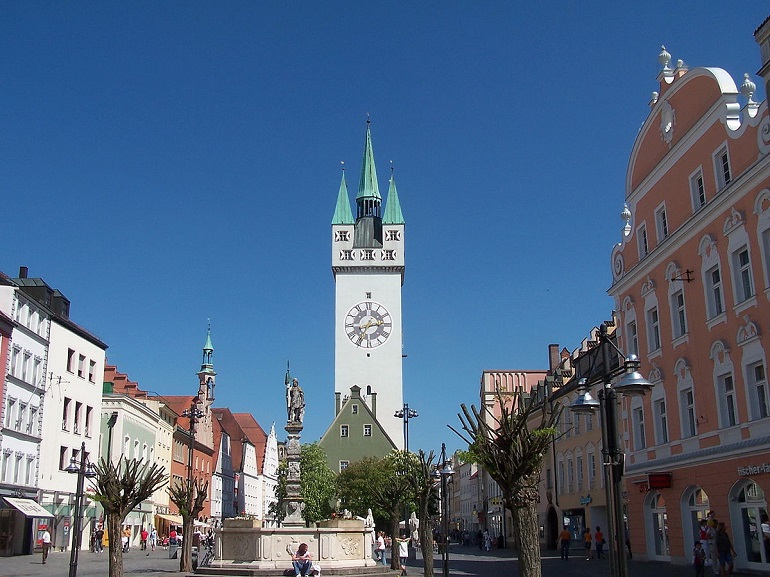
The Stadtturm, or City Tower, is Straubing's most prominent landmark, a 68-metre-tall structure that has defined the city's skyline since its foundations were laid in 1316. Its construction as a freestanding civic watchtower, entirely separate from any church, was a powerful declaration of burgher independence from ecclesiastical authority. The tower was built in several phases over two centuries: the square lower storeys were completed first, followed by the octagonal upper levels, and finally capped in the 16th century with a distinctive green copper dome flanked by four corner turrets. For centuries, a resident tower keeper (Türmer) lived within, tasked with watching for fires and sounding the alarm. Today, the tower still functions as the town's belfry and clock, with four large clock faces serving the city below. Guided tours allow visitors to ascend its 200-plus steps, passing the keeper’s former lodgings to reach the viewing platform, which offers an expansive panorama over the city's red rooftops, the vast Gäuboden plain, and the distant hills of the Bavarian Forest.
Stadtplatz (Ludwigs- und Theresienplatz)
The Stadtplatz is the grand, 600-metre-long central axis of Straubing, established with the founding of the 'Neustadt' (New Town) in 1218 by Duke Ludwig I of Bavaria. The Stadtturm functionally divides this elongated marketplace into two sections: Ludwigsplatz to the west and Theresienplatz to the east. The square remains the city's commercial and social heart, flanked by an impressive, unbroken line of merchants’ houses with characteristic steep gables, a testament to its prosperous trading past. Notable among these buildings is the historic Town Hall (Rathaus), with its Gothic core and grand ceremonial hall. The architectural ensemble is punctuated by elaborate Rococo façades from the 1770s, many designed by the celebrated local stuccoist Matthias Obermayr. Two early-Baroque fountains, the Jakobsbrunnen (1644) and the Tiburtiusbrunnen (1685), honour the city's patron saints and provide focal points within the bustling space, which continues to host daily produce stalls and a large farmers' market every Saturday, maintaining a tradition of commerce that has endured for over 800 years.
Herzogsschloss
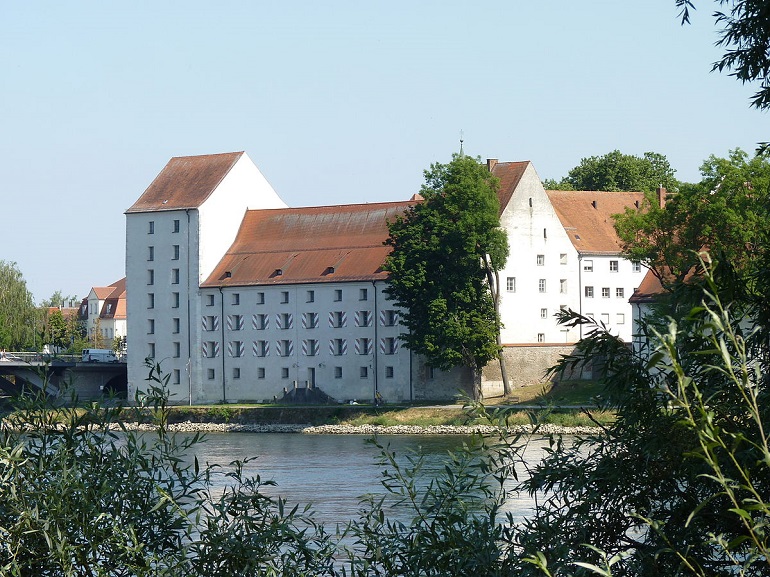
Strategically positioned on the banks of the Danube, the Herzogsschloss (Ducal Castle) was initiated in 1356 by Duke Albrecht I as the primary residence for the newly formed Duchy of Bavaria-Straubing-Holland. This formidable complex comprises four wings arranged around a central courtyard, fortified by two large, imposing towers on the city and river sides. The castle served not only as a residence but also as an administrative centre and ducal mint, hosting significant political events, including imperial diets. Its architectural centrepiece is the magnificent Rittersaal (Knights' Hall), a vast Gothic ceremonial hall added in 1422. Its unsupported timber-beam roof, inspired by Dutch models, is considered a masterpiece of medieval engineering. While the main castle building now houses the Straubing tax office and other judicial functions, the courtyard and Rittersaal are accessible to the public during cultural events. The castle is most famous for its association with the quadrennial Agnes-Bernauer-Festspiele, an open-air historical play performed in the courtyard that recounts the tragic 15th-century story of Duke Albrecht III's common-law wife, who was condemned for witchcraft and drowned in the Danube nearby.
Tiergarten Straubing
Established in 1937 within the city's expansive municipal park, Tiergarten Straubing is a zoological garden covering 18 hectares, committed to conservation, research, and education. The zoo is home to approximately 2,000 animals representing around 200 different species, and it actively participates in over 30 European Endangered Species Programmes for creatures such as the Siberian tiger and the wolverine. The layout features spacious, naturalistic enclosures, including a large African savanna exhibit for zebras and antelopes, and a dedicated house for South American species. A key highlight is the Danubium, a unique complex that combines a tropical house with a large aquarium focused on the ecosystem of the River Danube. This exhibit follows the river's journey from its source in the Black Forest to its delta in the Black Sea, showcasing native fish species like sturgeon and pike. With family-friendly amenities including a large adventure playground and a petting zoo, the Tiergarten provides a full day's educational entertainment and is open 365 days a year, with longer opening hours during the spring and summer months.
Churches
Basilika St. Jakob
The parish church of St. Jakob is the largest ecclesiastical building in Straubing and a pre-eminent example of late-Gothic brick hall church architecture in southern Germany. Construction began around 1400 under the direction of the renowned master builder Hans von Burghausen, who was also responsible for St. Martin's Church in Landshut. Its soaring 89.50-metre tower, completed in the late 16th century, is the city's tallest structure and houses a 49-bell carillon installed in 1999. The interior is a vast, light-filled space, typical of a hall church, where the nave and two side aisles are of equal height, supported by slender pillars that branch into an intricate net-vaulted ceiling. Key treasures include the high altar shrine from 1486 and a remarkable collection of stained-glass windows. Among these, the most celebrated is the "Moses Window" (c. 1500), whose design is attributed to the workshop of Albrecht Dürer. In recognition of its historical and artistic importance, Pope John Paul II elevated the church to the status of a Basilica minor in 1989.
Friedhof St. Peter
The Cemetery of St. Peter is an exceptionally well-preserved historical burial ground, enclosed by its original late-medieval fortified walls. Located south of the city centre, this complex is the site of Straubing's original settlement. At its heart stands the Basilica of St. Peter, a three-aisled Romanesque church dating from the late 12th century, which served as the parish church before the 'Neustadt' was founded. Clustered around the basilica are three small but significant Gothic chapels and over one thousand historic graves marked by wrought-iron crosses and stone monuments spanning the 14th to the 19th centuries. The most famous chapel is the Totentanzkapelle (Chapel of the Dance of Death), built in 1486. Its interior walls are covered with a complete Danse Macabre cycle painted in 1763 by the local artist Felix Hölzl, depicting Death summoning people from all walks of life. Nearby is the Agnes-Bernauer-Kapelle, a memorial chapel commissioned in 1436 by Duke Ernst as an act of atonement for ordering the execution of his son's wife. It contains her red marble memorial slab, a poignant monument to the tragic figure.
Karmelitenkirche Hl. Geist
The Carmelite Church of the Holy Spirit was founded in 1368, with the current three-aisled Gothic hall church consecrated in 1430. Originally the monastery church for the Carmelite order, it also served as the court church for the Dukes of Straubing-Holland, a status confirmed by the presence of several Wittelsbach dynasty tombs. In the early 18th century, the church underwent a profound transformation into a magnificent Baroque pilgrimage site, led by the architect Wolfgang Dientzenhofer. This remodelling saw the Gothic interior overlaid with opulent Baroque elements, including a monumental high-altar wall featuring sculptures by Egid Quirin Asam, one of the foremost artists of the German late Baroque. The centrepiece of worship became the "Madonna von den Nesseln" (Madonna of the Nettles), a miraculous icon that attracted pilgrims from across the region. The interior is further enriched by elaborate stucco work, vibrant ceiling frescoes depicting the history of the Carmelite order, and an ornate Rococo pulpit, creating a space that masterfully blends its Gothic structural origins with a spectacular Baroque overlay.
Jesuitenkirche (Mariä Himmelfahrt)
The Jesuit Church of the Assumption of Mary was the collegiate church of the powerful Jesuit order, which maintained a prominent college in Straubing from 1631 until the order's suppression in 1773. The building itself has a complex history, incorporating the core of a pre-existing late-Gothic church which was comprehensively remodelled into a grand Baroque edifice from 1680 onwards. The transformation created a single-nave church flanked by pairs of side chapels, typical of the Jesuit style designed for effective preaching. The interior is richly decorated with high-quality stucco, likely from the Wessobrunn school of artists, and features a distinctive two-storey gallery at the west end, intended for use by students of the college and for church music. A porch on the façade once provided a direct, covered connection to the adjacent Jesuit college, which now houses the Johannes-Turmair-Gymnasium. After the dissolution of the Jesuit order, the church was transferred to the Knights of Malta before eventually becoming an auxiliary church of the main St. Jakob parish. It is typically open for quiet visits, though access is often restricted to the vestibule behind an iron screen.
Top Museums
Gäubodenmuseum
The undisputed centrepiece of Straubing's museum landscape is the Gäubodenmuseum, housed in a beautifully restored patrician building on Fraunhoferstraße. This remarkable institution presents an unbroken chronological narrative of human history in the Gäuboden region, the fertile Danube basin between Wörth an der Donau and Künzing.
The World-Famous Roman Treasure
The museum's most celebrated attraction is the Straubing Roman Treasure, discovered during construction work in 1950. This extraordinary archaeological find represents one of the most significant Roman discoveries in Germany and comprises the largest known collection of Roman parade armour. The treasure includes magnificent face helmets, horse masks, greaves, bronze statuettes, and iron implements that once formed part of elaborate military ceremonies during the height of Roman power along the Danube frontier.
The Roman collection extends far beyond the famous treasure trove, encompassing weapons, everyday objects, and artefacts that illuminate life in ancient Sorviodurum, as Roman Straubing was known. These items demonstrate the city's crucial role as a military and trading post on the eastern Roman Limes, where a thousand-strong garrison once maintained the empire's northern border.
Comprehensive Historical Narrative
The museum's permanent exhibition follows a carefully structured chronological approach, beginning with prehistoric settlements from the Neolithic period and continuing through Celtic occupation, Roman dominance, and early Bavarian settlement. The "Baiern gefunden!" section reveals the origins of Straubing through rich archaeological finds from Bavarian burial grounds, while the medieval and early modern sections trace the city's development under Elector and King through to the end of the Kingdom of Bavaria in 1918.
A particularly noteworthy section focuses on sacred art and popular piety, presenting a comprehensive overview of religious artistic creation in the Straubing region from Romanesque to Rococo periods. This collection includes outstanding examples of sculpture, painting, and decorative arts that reflect the deep spiritual traditions of the region.
Modern Presentation and Accessibility
The museum excels in its modern approach to displaying historical artefacts. Interactive stations, multimedia presentations, and carefully designed lighting create an engaging experience for visitors of all ages. Many displays are positioned at wheelchair-accessible heights, and the museum provides audio guides and Braille signage to ensure universal access. The innovative presentation includes reconstructed burial scenes showing skeletons laid out with their original grave goods, allowing visitors to understand ancient burial customs in vivid detail.
NAWAREUM: Germany's Pioneer in Sustainability Education
Representing Straubing's commitment to contemporary issues, the NAWAREUM stands as Germany's first hands-on museum dedicated to sustainability. Opened in February 2023, this cutting-edge institution occupies a modern building whose very construction demonstrates sustainable building practices.
Interactive Learning Environment
The NAWAREUM transforms complex environmental topics into engaging, tactile experiences across three floors. Visitors encounter themes including climate change, renewable resources, plant biology, and renewable energy through innovative interactive stations, walk-in plant cells, and multimedia installations. The museum's crown jewel is a wooden slide that carries visitors between floors whilst symbolising the playful approach to serious environmental education.
Building as Exhibit
The museum building itself serves as a living demonstration of sustainable construction. Its façade features 79 untreated larch trunks from Bavarian State Forests, whilst the structure incorporates various renewable energy sources for its power needs. The surrounding museum garden provides visitors with hands-on experience of renewable raw materials, featuring diverse plant species used for food, textiles, energy, and medicinal purposes.
Educational Innovation
The NAWAREUM's exhibition design caters to different age groups, with dedicated sections for children aged 6-12 marked by diamond symbols, whilst the main exhibition targets adults and children over 12. Interactive game tables developed in collaboration with Ars Electronica Solutions demonstrate renewable energy concepts through strategic gameplay, allowing visitors to experience energy transition challenges in an engaging format.
Blue Brix Straubinger Wunderwelten: Miniature Marvel
The Blue Brix Straubinger Wunderwelten represents South Germany's largest miniature railway and model exhibition. This family-friendly attraction combines traditional model-making craftsmanship with modern entertainment technology across 730 square metres of meticulously detailed displays.
Elaborate Model Landscapes
The exhibition features four distinct model railway installations spread across two floors. The ground floor houses the "Nordsee-Alpen" (North Sea to Alps) layout, a 440-square-metre H0-scale installation that takes visitors on a journey through Germany in miniature. This section includes over 1,600 metres of track with more than 100 computer-controlled locomotives representing 175 years of railway history.
The Straubing section provides a detailed recreation of the city's historic centre, complete with the distinctive city tower, town hall, water tower, and ducal castle. Visitors can observe a miniature version of the famous Gäuboden folk festival and the city's beloved zoo, all crafted with extraordinary attention to detail.
Modern Entertainment Elements
Beyond traditional model railways, Blue Brix incorporates contemporary attractions including a virtual reality coaster, 5D cinema experiences, and the innovative Laser-CLOU labyrinth where visitors must navigate through laser beams. The facility also features a children's play area with wooden railway systems and the Rainbow Saloon, where visitors can digitally animate their own coloured drawings.
Bajuwarium Erlebniswelt: Living History in Miniature
The Bajuwarium Erlebniswelt presents Bavaria's history through an extraordinary 1:87 scale miniature world that continues to grow before visitors' eyes. This unique attraction combines historical education with the fascination of precision model-making, featuring nearly 12,000 miniature inhabitants across various themed sections.
Dynamic Displays
The museum's signature feature is its 30-minute day-night cycle that transforms the miniature landscapes, revealing different aspects of life in historical Bavaria. Operating trains, lorries, and buses create movement throughout the displays, whilst approximately 40 interactive buttons allow visitors to activate various scenes and mechanisms.
The primary module showcases Straubing's zoo, the ducal castle, and a fully functional Gäuboden folk festival, complete with miniature beer tents and carnival rides. Future expansion plans envision the entire state of Bavaria represented through additional modules, making this a continuously evolving exhibition.
Specialised Collections and Exhibition Spaces
Straubing's museum landscape extends beyond major institutions to include several specialised venues that explore particular aspects of local culture and history.
Weytterturm Exhibition Space
The Weytterturm, one of Straubing's surviving medieval defence towers, now serves as an exhibition venue for local artists. This circular tower, part of the city's 15th-century fortification system, provides an atmospheric setting for contemporary art displays that create dialogue between historical architecture and modern creative expression.
Spitaltor and Bürgerspital Complex
The Spitaltor represents a fascinating fusion of medieval and early Baroque architecture. This essentially medieval gatehouse received an elaborate early Baroque façade in 1628, featuring coats of arms and obelisks celebrating the elevation of Bavaria to electoral status during the Thirty Years' War. The adjacent Bürgerspital complex includes a three-part Gothic hall and the Spitalkirche zur Heiligen Dreifaltigkeit, which contains a remarkable nativity altar with monumental folk art scenes.
Local Cuisine
Local establishments take pride in serving regional classics such as Schweinebraten (roast pork with crackling), accompanied by Reibeknödel (potato dumplings) and tangy sauerkraut, as well as Brotzeit Brettl – a rustic platter of local farmer’s bread, assorted cold sausages, smoked ham, cheese, and pickles, perfect for sharing with a fresh Bavarian beer. For those with a sweet tooth, the city’s renowned Agnes Bernauer cake, featuring rich almond cream and fluffy sponge, is not to be missed. Straubing’s cuisine reflects its agricultural heritage and offers a warm invitation to experience genuine Bavarian hospitality through food.
Getting There & Around
By train, Straubing is easily accessible from major Bavarian cities such as Munich and Regensburg, with regular regional trains connecting the town to these hubs. The journey from Munich typically takes just under two hours with a change, and trains run frequently throughout the day, arriving at Straubing’s centrally located station.
By coach or bus, Straubing can be reached using intercity and regional coach services, most notably with FlixBus, which provides routes connecting Straubing with cities such as Regensburg, Nuremberg, and Berlin. The central bus station is conveniently located close to the train station, making transfers straightforward and adding flexibility for those preferring road travel.
By car, travellers should take the A3 motorway and exit at Kirchroth/Straubing, continuing on the B20 following signs towards the town centre. The road network is well-developed, making Straubing an easy drive from many locations across Bavaria and southern Germany.


