Germany Guide  |
|---|
|
| | Top German Cities |
|---|
|
| | Top National Parks |
|---|
|
| | Photos |
|---|
|
| | German States |
|---|
|
| | Europe Guide |
|---|
|
| | Travel Tools |
|---|
|
|
|
|
Saxony-Anhalt Travel Guide
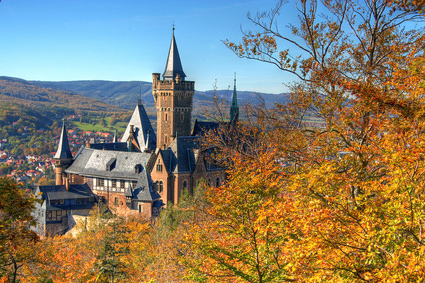 Wernigerode Castle in the Harz mountains. Wernigerode Castle in the Harz mountains.
Introduction

Saxony-Anhalt was the most industrialised region of the German Democratic Republic. The reunification of Germany caused the closing of many factories, which reduced pollution, but swelled the unemployment figures dramatically. Economic plight has prompted half a million people to leave the state since 1990.
Nevertheless, Saxony-Anhalt is full of good surprises for visitors. The beautiful Harz mountains, with its half-timbered towns and its majestic castles, is one of Germany's most touristic region. The numerous palaces and English styles parks and gardens around Dessau are UNESCO World Heritage Sites, as are Dessau's Bauhaus buildings. The Saale-Unstrut valley, in the southeast part of the state, produces most of Germany's sparkling wine.
Saxony-Anhalt covers an area of 20,447 km² (7,895 sq mi), approximately the same size as Slovenia or Israel, and has a population of 2.34 million (a bit more than Slovenia).
Famous people from Saxony-Anhalt include (chronologically): Holy Roman Emperor Otto I, the religious reformer Martin Luther, the composer Georg Friedrich Händel, the philosopher Novalis, the founder of modern geography Carl Ritter, the philosopher Friedrich Nietzsche, the Nobel Prize physicist Polykarp Kusch, and the Nobel Prize biologist Christiane Nüsslein-Volhard.
The present British and Belgian royal families descend in patrilineal line from the House of Wettin, which originated in the village of the same name along the Saale River.
History of Saxony-Anhalt
The region comprising modern Saxony-Anhalt traces its origins to Old Saxony, which was conquered by Charlemagne in 804 and incorporated into the Carolingian Empire as the Duchy of Saxony. Saxony emerged as one of the powerful stem duchies of the Holy Roman Empire, with Duke Henry I (Henry the Fowler) elected German king in 919 and his son Emperor Otto I founding a monastery in Magdeburg in 937, which later became an archbishopric in 968. Following conflicts with Emperor Frederick I, the duchy was partitioned around the late 12th and early 13th centuries into numerous smaller states, including the Principality of Anhalt. The ducal title passed to the Ascanian Bernhard of Anhalt, and after his death in 1212, his son Henry established Anhalt as a county, which was elevated to a principality in 1218. Anhalt was subsequently divided in 1252 into Anhalt-Aschersleben, Anhalt-Bernburg, and Anhalt-Zerbst, with numerous additional divisions creating Anhalt-Köthen, Anhalt-Dessau, and other territories over the centuries. Meanwhile, the Duchy of Saxony was separated in 1296 into Saxe-Lauenburg and Saxe-Wittenberg, with the latter receiving the electoral dignity through the Golden Bull of 1356 and becoming the Electorate of Saxony.
Saxony-Anhalt became the epicentre of the Protestant Reformation in the 16th century, forever altering European religious history. Martin Luther, born in Eisleben in 1483, famously nailed his 95 theses to the door of Wittenberg Castle Church in 1517, challenging Catholic Church practices and igniting a religious movement that reshaped the continent. Luther spent much of his life in Wittenberg as a professor and monk, writing revolutionary theological works in his home (now the Luther House museum) and was eventually buried inside the Castle Church alongside fellow reformer Philipp Melanchthon. Wolfgang of Anhalt, known as "The Confessor," became prince of Anhalt-Köthen in 1508 and was the second ruler in the world to introduce the Reformation in his territory, co-signing the Augsburg Confession in 1530. After the dissolution of the Holy Roman Empire in 1806, the remaining Anhalt divisions—Bernburg, Dessau, and Köthen—were elevated to duchies by Napoleon, whilst the Electorate of Saxony became a kingdom. Following the Battle of Leipzig in 1813, Prussia occupied large portions of Saxony's territory, and in 1815 these areas were merged with the former Duchy of Magdeburg and other territories to form the Prussian Province of Saxony.
The 19th and 20th centuries brought dramatic transformations to the region, as the separate Anhalt duchies were reunited in 1863 to form a single Duchy of Anhalt with its capital at Dessau. The Industrial Revolution brought significant economic change, particularly to Halle and the "Chemical Triangle," establishing Saxony-Anhalt as a centre of industrial production and agricultural development. Following Germany's defeat in World War I, Anhalt became the Free State of Anhalt within the Weimar Republic, whilst the Province of Saxony continued as part of Prussia. World War II devastated the region, with the majority of Magdeburg and other cities destroyed by bombing. After the war, the Soviet occupation authorities formed the state of Saxony-Anhalt in 1945 from the former Province of Saxony and Anhalt, which became part of the German Democratic Republic (East Germany) in 1949. The state was dissolved in 1952 and replaced with the districts (Bezirke) of Magdeburg and Halle under Communist rule, which saw industrial expansion particularly in the chemical industry but less attention to cultural heritage. Following German reunification on 3 October 1990, Saxony-Anhalt was re-established as one of five new states (Länder) of the Federal Republic of Germany, re-emerging to showcase its rich historical heritage and numerous UNESCO World Heritage Sites.
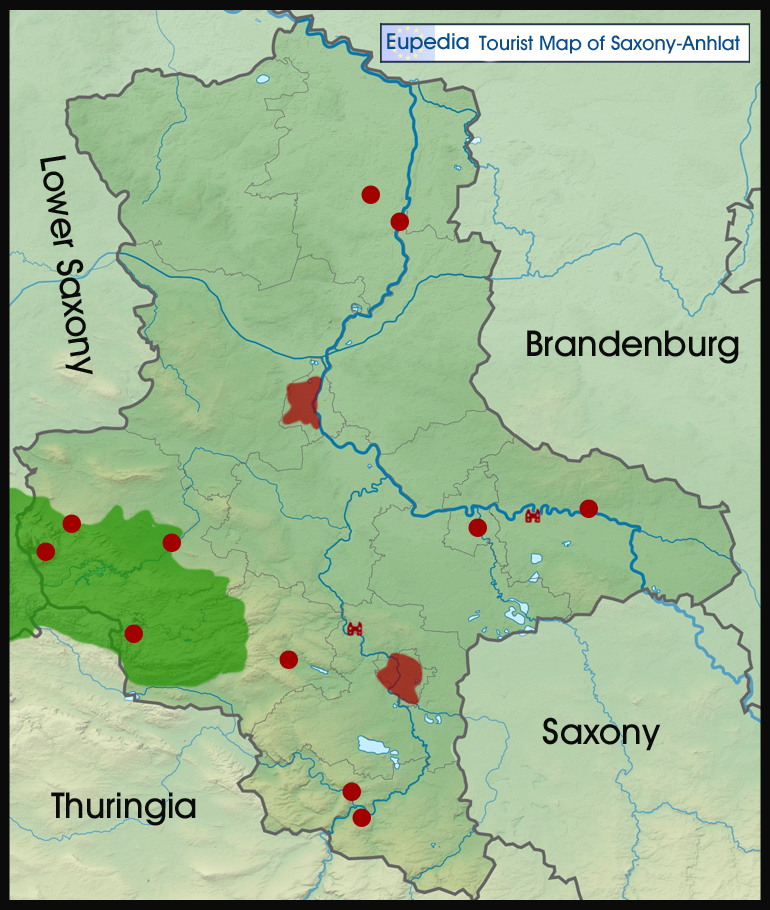
Clickable Tourist Map of Saxony-Anhalt
Note that dots, castle icons and national parks are not clickable on the mobile version. Please use the desktop version for optimal navigation.
Blank map of Saxony-Anhalt by Grundkarte TUBS, Relief by Alexrk2. Tourist locations by Maciamo. CC BY-SA 3.0.
Attractions
Harz Mountains
| Quedlinburg ※ |
|---|

 Quedlinburg (pop. 23,000), a UNESCO World Heritage site nestled at the northeastern edge of the Harz Mountains in Germany, boasts over 1,000 years of rich history. The medieval town is renowned for its exceptional collection of 2,069 well-preserved half-timbered houses spanning eight centuries, making it one of Germany's largest area monuments covering nearly 90 hectares. The town's skyline is dominated by the Castle Hill ensemble, featuring the Renaissance castle and the Romanesque Collegiate Church of St. Servatius, which houses valuable religious artefacts and serves as the burial site of King Henry the Fowler and Queen Mathilde. |
| Stolberg |
|---|

 Founded in the year 1000 as mining settlement deep in the Harz mountains, Stolberg (pop. 1,300) became the seat of a county in 1210, then of the Principality of Stolberg-Wernigerode. The pocket-sized town is dominated by the grand Renaissance castle. The town is known for its cohesive ensemble of half-timbered houses. |
| Schierke |
|---|

 Schierke (pop. 750) is a pretty mountain village set in the upper Harz at roughly 580–650m elevation in the valley of the Cold Bode river. It borders the Harz National Park and serves as a base for hikes to the Brocken, the range’s highest peak at 1,141m. The Brocken Railway, one of three tourist metre gauge railways in the Harz mountains, has a station 100 metres above the village. |
| Wernigerode |
|---|

 Wernigerode (pop. 32,000), known as "the colourful town of the Harz Mountains," is a picturesque destination located on the northern edge of the Harz Mountains in Germany. This charming town is renowned for its well-preserved historic centre featuring lavishly restored half-timbered houses and cobbled streets. Dominated by the majestic Wernigerode Castle, which was originally a medieval fortress dating back to the 12th century, the town offers visitors a glimpse into 800 years of history. Wernigerode received its town charter in 1229 and developed as a significant trading hub. Today it serves as an ideal base for exploring the Harz region, whether by the historic steam-powered Harz Narrow Gauge Railways, hiking trails, or road. |
| Harz National Park |
|---|

 Harz National Park, established in 2006 as the first national park in Germany to span two federal states, offers visitors a legendary mountain wilderness with diverse ecological systems. The park features the impressive Brocken peak (1,142m), unique microclimates that create distinct vegetation zones, and a comprehensive network of well-maintained trails for hiking, biking and cross-country skiing. History enthusiasts will appreciate the area's rich mining heritage, which has shaped the landscape for centuries and led to parts of the region being declared UNESCO World Heritage. The park provides excellent visitor facilities, including several National Park Visitor Centres with interactive exhibitions on natural history and cultural topics, where rangers offer guided tours through the forest wilderness. Beyond nature, visitors can experience thrilling attractions such as Germany's longest swing bridge over the Rappbodetalsperre and a kilometre-long Mega Zipline, making Harz a perfect destination for both nature lovers and adventure seekers. |
Other attractions
Gernrode
Thale
Elbe Valley
| Dessau ※ |
|---|

Between 1925 and 1933 Dessau (pop. 80,000) was the focal point of the modernist Bauhaus school of architecture and art. Many fine examples of Walter Gropius' buildings can be visisted, some decorated by Kandisky, Klee, and other masters. All are listed by the UNESCO. The city also borders the Dessau-Wörlitz Garden Realm, an 18th-century landscape ensemble recognised by UNESCO, complementing its Bauhaus World Heritage status. |
| Dessau-Wörlitz Garden Realm ※ |
|---|

The Dessau-Wörlitz Garden Realm stands as a magnificent testament to 18th-century landscape design, philosophy, and cultural vision. Spanning approximately 142 square kilometres along the Elbe and Mulde rivers in central Germany, this extraordinary cultural landscape represents one of Europe's most significant achievements in landscape architecture. Recognized as a UNESCO World Heritage Site since 2000, the Garden Realm exemplifies the philosophical principles of the Age of Enlightenment through its harmonious integration of art, education, and economy. Created under the visionary leadership of Prince Leopold III Friedrich Franz von Anhalt-Dessau (1740-1817), this remarkable ensemble of parks, palaces, and gardens embedded within the natural floodplain landscape offers visitors an unparalleled journey through history, architecture, and horticultural innovation. |
| Stendal |
|---|

Lined with half-timbered houses, Stendal (pop. 40,000) is a pleasant historic town and the unofficial capital of the rural Altmark region. Once a prominent member of the Hanseatic League, until the plague and the Thirty Years' War put and end to its prosperity in the 17th century. Stendal is noted for its brick Gothic architecture and well-preserved medieval core. The compact old town centres on the Marktplatz with its town hall and the Roland statue, while major landmarks include St Mary’s Church with twin spires, the cathedral of St Nicholas with notable stained glass, and surviving city gates such as the Uenglinger Tor. |
| Wittenberg ※ |
|---|

Wittenberg holds exceptional significance as the birthplace of the Protestant Reformation, where Martin Luther famously nailed his 95 Theses to the Castle Church door in 1517, fundamentally changing Christianity across Europe. Visitors can explore the Castle Church where Luther is buried, the Lutherhaus museum in his former residence, and St. Mary's Church where he preached, alongside the home of fellow reformer Philipp Melanchthon. The town's compact historic centre features well-preserved Renaissance architecture, cobblestone streets, and the innovative Luther 1517 panorama experience that recreates 16th-century Wittenberg in vivid detail. Beyond its Reformation heritage, the former electoral seat of Saxony offers cultural attractions including professional theatre, music festivals, and the unique Hundertwasser School, whilst its riverside setting along the Elbe provides a pleasant backdrop for exploring this historically significant university town that fundamentally shaped religious and intellectual development in Europe. |
| Tangermünde |
|---|

 Tangermünde (pop. 10,000) is a walled medieval town at the confluence of the Elbe and the Tanger Rivers. Preferred residence of Emperor Charles IV (1316-1378), then of the Hohenzollern electors of Brandenburg, Tangermünde combines Romanesque and Brick Gothic architecture and timber-framed houses. The integrally preserved 14th-century brick city walls were erected in 1300 and reach a height of 10 to 15 metres. |
| Magdeburg |
|---|

 Magdeburg (pop. 242,000) is the capital of Saxony-Anhalt and its largest city. Founded by Charlemagne, and favoured residence of Emperor Otto I, Magdeburg was one of Germany's most important medieval cities. Its medieval town laws, known as the Magdeburg Rights, were copied in most of Central and Eastern Europe. Wholly rebuilt after WWII, mostly in concrete, modern Magdeburg is an industrial city with few sights apart from its cathedral, one of the oldest in the country and the first built in Gothic style. |
Saale Valley
| Naumburg ※ |
|---|

Naumburg (pop. 33,000) is a charming town known primarily for its imposing cathedral. Built in the 12th century, it is a magnificent example of the transition from Romanesque to Gothic styles. It features some of Germany's oldest stained-glass windows and is unique for having two choirs. The cathedral is also famous for its sculptural works created by the Naumburg Master, a medieval sculptor whose identity remains uncertain but whose work is highly regarded for its naturalism and emotional expression. The Naumburg sculptures include life-sized portraits of important donors, known as the founder figures, such as the Patron Saint Elisabeth and Ekkehard and Uta. The cathedral was inscribed as a UNESCO World Heritage site in 2018. |
| Freyburg |
|---|
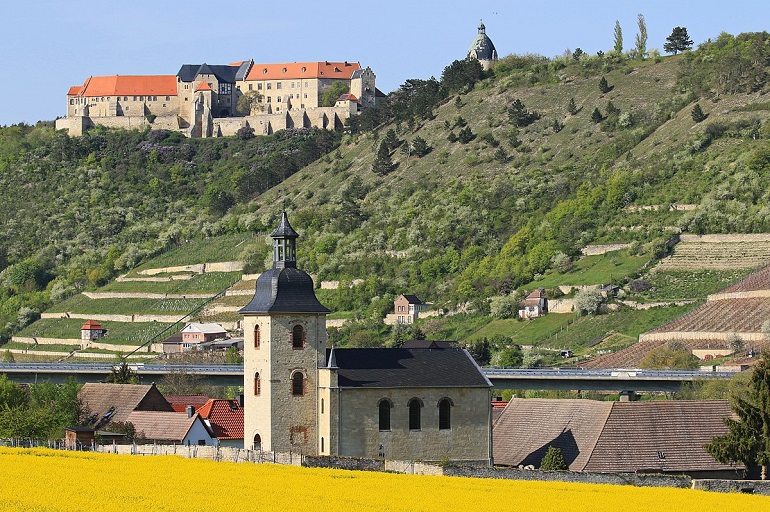
Freyburg (pop. 4,500) lies at the centre of the Saale-Unstrut, the northernmost wine growing region in Europe. Overlooked by Neuenburg Castle and slopes of vineyards, Freyburg is home to one of the world's largest wine companies, Rotkäppchen-Mumm, which holds half the market for sparkling wine in Germany (the equivalent of one third of France's champagne production). A wine festival is held every September. |
| Eisleben ※ |
|---|
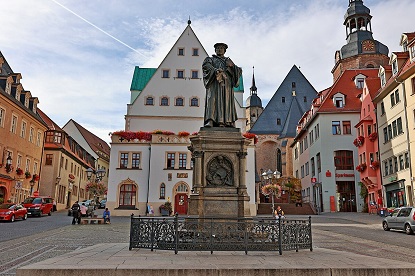
Eisleben (pop. 22,500), officially known as Lutherstadt Eisleben, is a town in the German state of Saxony-Anhalt. It is most famous as the hometown of Martin Luther, the key figure in the Protestant Reformation. The town contains the house where Luther was born in 1483 and the house where he died in 1546, both of which are now UNESCO World Heritage sites. Other significant landmarks associated with him include St. Peter and Paul's Church, where he was baptised, and St. Andrew's Church, where he preached his last sermons. For centuries, the town's economy was also dominated by copper-shale mining, an industry that significantly shaped its development and history. |
| Halle an der Saale |
|---|

State capital and chemical powerhouse under the GDR, Halle (pop. 226,000) is a clashing mix of graceful historical buildings and modern eyesores. The city's name derives from the Celtic word for salt, and Halle's saltworks operated for over 1000 years until 1869. The compact historic centre features the Marktplatz with its five-tower skyline, the Red Tower and Market Church, and sites linked to Martin Luther. Cultural institutions are prominent, including the Handel House museum in the birthplace of George Frideric Handel, the Opera, and the Moritzburg Museum of Art in a former episcopal palace. |
| Wettin Castle |
|---|
![Wettin Castle (photo by David Meisel [Parexus at de.wikipedia] - CC BY-SA 2.0 Germany license)](https://cache.eupedia.com/images/content/wettin-1.jpg)
Wettin Castle serves as the ancestral seat of the House of Wettin, one of Europe's oldest dynasties whose descendants include the current British and Belgian royal families. The 11th-century fortress features impressive 2-meter thick walls, a Knights Templar Chapel, and offers panoramic views across the Saale Valley. Today the rebuilt ruins house an art school and café, blending medieval architecture with contemporary use whilst preserving its thousand-year royal heritage that shaped European monarchy. |
Other attractions
 Rudelsburg Castle
|


 : Local interest
 : Moderately interesting
 : Outstanding place
 : Must-see in the country
 : Top cities in Europe