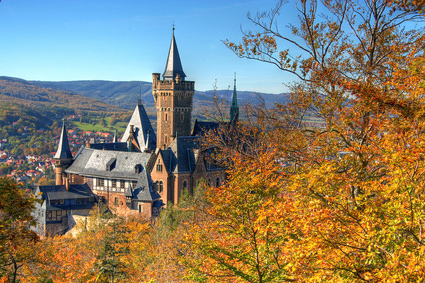
| Contents |
|---|

Introduction
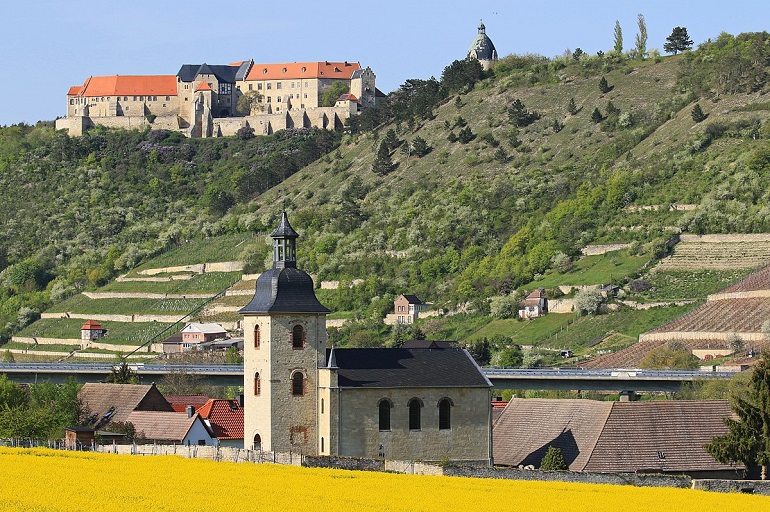
Freyburg (pop. 4,500) lies at the centre of the Saale-Unstrut, the northernmost wine growing region in Europe. Overlooked by Neuenburg Castle and slopes of vineyards, Freyburg is home to one of the world's largest wine companies, Rotkäppchen-Mumm, which holds half the market for sparkling wine in Germany (the equivalent of one third of France's champagne production). A wine festival is held every September.
The main attractions in Freybburg are the medieval Neuenburg Castle, and a compact historic centre with preserved walls and the early Gothic St Mary’s Church. The town is associated with Friedrich Ludwig Jahn, a pioneer of modern gymnastics who lived and is buried here, and it forms part of the UNESCO-listed cultural landscape around Naumburg Cathedral and the rivers Saale and Unstrut.
Interesting Facts about Freyburg
- Freyburg sits on the River Unstrut and is famed for its terraced vineyards in the Saale–Unstrut wine region, one of Europe’s northernmost wine-growing areas.
- The town’s skyline is dominated by Neuenburg Castle, a vast 11th–12th century hilltop fortress founded by Ludwig der Springer.
- Freyburg is closely linked to Friedrich Ludwig Jahn, the “father of gymnastics,” who lived and is buried here, with a historic gymnasium preserved in his honour.
- It hosts the Winzerfest each September, celebrating local wines and sparkling wines with parades, tastings, and cellar tours.
- Rotkäppchen-Mumm, one of the world’s largest sparkling wine producers, has its historic cellars and headquarters in Freyburg.
- Parts of Freyburg, including Neuenburg Castle and surrounding cultural landscape, are included in the UNESCO-listed Saale–Unstrut medieval cultural landscape.
- The Church of St Mary (St Marien) and preserved sections of medieval town walls reflect Freyburg’s planned High Middle Ages town layout.
- A mild river-valley microclimate and heat-retaining limestone soils help grapes ripen successfully at this high latitude.
- The nearby Zscheiplitz monastery complex overlooks the Unstrut valley and aligns with historic vineyard vistas unchanged since the Middle Ages.
- Freyburg is sometimes nicknamed the “Tuscany of the North” for its sunlit slopes, stone terraces, and wine culture.
History
FFounded in the late 12th century by Herman I from the Ludovingian dynasty, Freyburg developed at the foot of Neuenburg Castle to support the increased population and to provide necessities for the castle while also securing passage and revenues along the Unstrut River. Its very name, incorporating “frey” meaning “free”, references the royal freedoms granted to Freyburg upon its establishment—a sign of the high-standing ambitions of its rulers. Much of the original medieval layout can still be seen today, with the splendid early Gothic church of St. Mary, authentic city walls, and an old market square reflecting its carefully planned High Medieval origins.
One of Freyburg’s most commanding landmarks is Neuenburg Castle, constructed around 1090 by Count Ludwig the Springer. This imposing fortress, remarkable for being five times larger than Wartburg Castle, features impressive medieval fortifications, a double chapel, and the mighty tower known as “Dicker Wilhelm”. Neuenburg Castle served both as a military stronghold and as a symbol of the Ludowings’ status in the region, welcoming notable historical figures such as King Henry I and Emperor Friedrich Barbarossa. The nearby Benedictine monastery of Zscheiplitz, built around 1200, further underscores the area’s medieval religious and cultural significance.
Freyburg is also celebrated for its long-standing wine-growing tradition, set in the terraced vineyards of the Schweigenberge, which have been cultivated since the Middle Ages and are still predominantly tended by local residents. In the 19th century, Freyburg became known as the home-in-exile of Friedrich Ludwig Jahn, founder of modern gymnastics, who is buried in the town. Today, Freyburg is a beloved tourist destination, famous for its charming old town, well-preserved castle, and as the headquarters of one of the world’s largest wine companies. It forms part of the UNESCO World Heritage–listed “Naumburg Cathedral and the High Medieval Cultural Landscape of the Rivers Saale and Unstrut,” representing the cultural exchanges, Christianisation, and societal developments that shaped Central Europe during the High Middle Ages.
Main Attractions
Neuenburg Castle
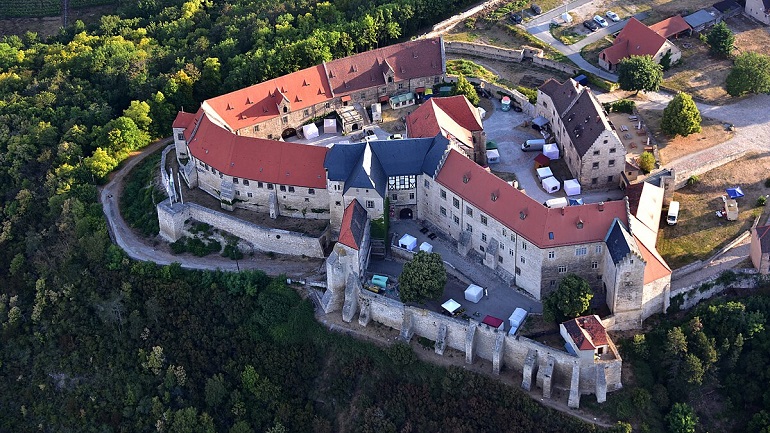
Neuenburg Castle crowns the hill above Freyburg and was founded around 1090 by Count Ludwig the Springer. Once the seat of a medieval court and later a hunting residence, it retains Romanesque and Gothic features. Guided tours lead through the keep, chapel and courtyard, and the battlements provide wide views over the Saale-Unstrut vineyards.
Sankt Marien Kirche (St Mary's Church)
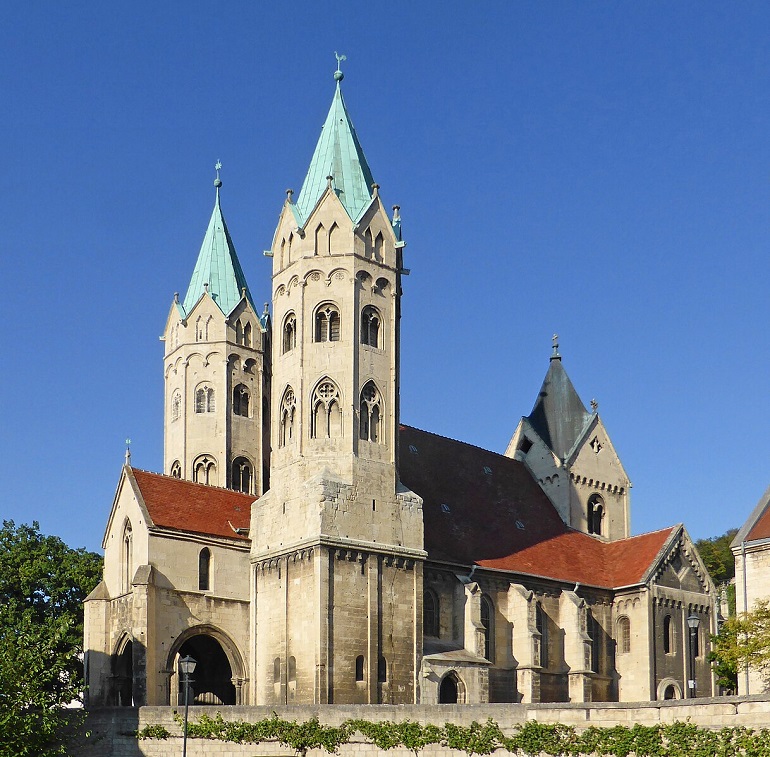
The Church of Saint Mary dates from the early 13th century and exemplifies transitional Romanesque-Gothic architecture. Its squat twin towers, rib-vaulted nave and carved portal reflect the town’s medieval prosperity, while the interior still serves an active parish with regular services and organ concerts.
Market Square
The cobbled Market Square is bordered by colourful half-timbered houses and wine taverns. Weekly produce stalls and seasonal fairs animate the space, which also hosts the annual Wine Festival that celebrates Freyburg’s status in the Saale-Unstrut wine region.
Town Hall
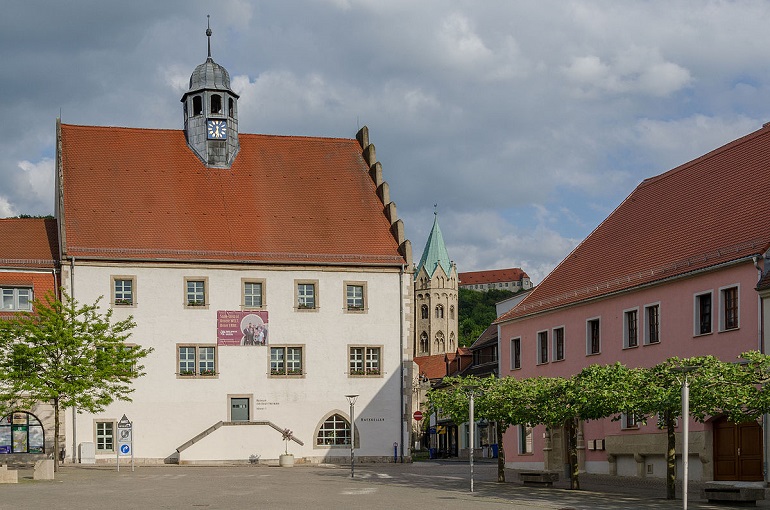
Freyburg’s Renaissance-style Rathaus on the Market Square was completed in 1552 and features a stepped gable, arcaded ground floor and slate-tiled clock tower. It remains the seat of local government and a focal point of civic events.
Rotkäppchen Sparkling Wine Cellars
Operating since 1896, the Rotkäppchen cellars showcase Germany’s best-known sparkling wine. Visitors descend into kilometre-long tunnels to see fermentation halls and the giant oak barrel that once held the equivalent of 160 000 bottles. Tours explain traditional bottle fermentation and finish with a tasting of Saale-Unstrut vintages.
Jahndenkmal
This monument on Schweigenberg hill honours Friedrich Ludwig Jahn, the local-born “father of German gymnastics”. A stone column topped with a bronze figure commemorates his promotion of physical education in the 19th century and doubles as a viewpoint over the Unstrut valley.
Friedrich Ludwig Jahn Memorial Gymnasium
The half-timbered hall where Jahn taught gymnastics around 1825 survives as a protected building near the town centre. Its vaulted interior still hosts local sports clubs and exhibitions on Jahn’s life, illustrating the town’s lasting role in German physical culture.
Tote Täler an der Unstrut
The “Dead Valleys” south of Freyburg form a limestone nature reserve of dry ravines and calcareous grassland. Way-marked trails pass rare orchids, juniper bushes and exposed karst formations, offering walkers a contrast to the surrounding vineyards.
Top Museums
Friedrich-Ludwig-Jahn-Museum
The Friedrich-Ludwig-Jahn-Museum stands as the town's most distinctive cultural institution, housed within the former residence of the "Father of Gymnastics" himself. This remarkable museum occupies a house that Jahn personally constructed between 1838-1839 at the foot of the historic Neuenburg Castle.
The museum offers visitors an intimate glimpse into the life of Friedrich Ludwig Jahn, the founder of the German gymnastics movement. The permanent exhibition presents a comprehensive portrayal of Jahn as a man of his time, complete with his character traits and views that were typical of his era. This thoughtful approach allows visitors to gain a deeper understanding of both the historical figure and the societal conditions of 19th-century Germany.
Among the museum's most treasured possessions are personal items that belonged to Jahn and his family, including a unique four-player chess game, his personal notebook, walking stick, tobacco pipe, and pouch. These intimate objects provide visitors with a tangible connection to the daily life and habits of this influential historical figure.
The museum houses an impressive collection of over 15,000 objects, archives, photographs, and books, making it the largest sports history collection in Saxony-Anhalt. The institution actively collects materials related to Jahn's life and work, the history of his reception, and the development of gymnastics as both a sport and a political, national, social, and educational phenomenon from the early 19th century to the present day.
The museum complex includes several historic buildings that form part of the Jahn memorials. These comprise the residential house, a memorial gymnasium built in 1894, a hall of honour constructed in 1903, and a courtyard of honour created in 1936. This ensemble represents a unique collection of buildings dedicated to gymnastics history found nowhere else in the world.
Neuenburg Castle Museum
Perched majestically above Freyburg, Neuenburg Castle houses several museum exhibitions within its medieval walls. This mighty fortress, commissioned by Louis the Springer, served to bolster the Ludovingians' claim to power in the eastern part of their domain.
The castle museum features permanent exhibitions focusing on the colourful history contained within these ancient walls. Visitors can explore displays dedicated to Thuringian nobility, providing insight into the aristocratic life of medieval Germany. The castle also houses a Wine Museum that celebrates the region's long-standing viticultural tradition, as Freyburg sits within the Saale-Unstrut wine region, one of Germany's northernmost wine-growing areas.
One of the castle's most remarkable features is its Timekeeping Exhibition, which explores the fascinating subject of pocket watches and historical timekeeping methods. This unique collection demonstrates the technological advances in measuring time throughout the centuries.
The castle's architectural highlights include a splendidly ornamented double chapel dedicated to Saint Elizabeth of Thuringia, who lived here from 1224-25. This Romanesque gem represents some of the finest religious architecture of the period. The well-preserved residential tower, known as "Dicker Wilhelm," takes visitors directly into the private world that existed alongside courtly life.
Within the museum, visitors can discover unique everyday objects from medieval times, including toys and clothing that tell their own stories of life in a medieval castle. The castle also features technologically advanced latrines that demonstrate the sophisticated engineering of the period.
For younger visitors, the museum offers a playfully designed "Children's Chambers" where children can experience what it was like to be the lord or lady of the castle for a day.
Local Cuisine
Freyburg, the heart of the Saale-Unstrut wine country, pairs its elegant cool-climate whites and crisp sekt with regional fare that celebrates river, forest and garden alike, from delicate pike and smoked trout to autumnal game with juniper and mushrooms. Classic wine-tavern plates lean simple and seasonal—fresh cheeses like Harzer Roller alongside charcuterie, sourdough and pickles—designed to flatter mineral-driven Müller-Thurgau, Silvaner and Pinot Blanc from the sun-warmed limestone terraces. Spring menus spotlight asparagus served with butter or hollandaise, while hearty sides such as Thüringer Klöße appear with roasts and braises as the vineyards turn to harvest. Sweet finishes often draw on orchard fruit—think Kirschkuchen—with local sparkling wines offering a lively counterpoint, and tastings or vineyard picnics fold in regional bites to underscore the town’s deep food-and-wine rhythm.
Getting There
By train Freyburg (Unstrut) has its own regional rail station with services that typically connect via nearby Naumburg(Saale) Hbf, placing the town within easy rail reach of hubs such as Leipzig and Berlin through Deutsche Bahn regional and long-distance links.
By coach or bus Regional buses link Freyburg with Naumburg(Saale) Hbf, from where broader coach options operate to larger cities; planning tools for Saxony-Anhalt public transport can help map bus-train combinations for the most convenient door-to-door journey.
By car Freyburg sits south-west of Leipzig in the Saale-Unstrut wine region, reachable in under an hour from Leipzig by road, with straightforward access from the wider German motorway network before continuing on regional roads into the town.
| Travel destinations in Saxony-Anhalt | ||||||||||||||
|---|---|---|---|---|---|---|---|---|---|---|---|---|---|---|
|
|
|
|
| ||||||||||
|
|
|
|
| ||||||||||
|
|
|
| |||||||||||