



| Contents |
|---|

Introduction
The Augustusburg Palace (Schloss Augustusburg in German) and and its hunting lodge of Falkenlust (Jagdschloss Falkenlust in German) are amongst the most impressive princely residences in Germany, and have been listed as a UNESCO cultural World Heritage Site since 1984.
Interesting Facts about Augustusburg Palace
- Augustusburg Palace in Brühl is celebrated as one of the earliest and finest examples of Rococo architecture in Germany.
- The palace was commissioned in 1725 by Clemens August, Archbishop and Elector of Cologne from the Wittelsbach dynasty, as his favourite residence.
- Its magnificent marble and stucco grand staircase was designed by Balthasar Neumann, renowned for its sweeping curves and opulent frescoes.
- The palace’s enchanting gardens were designed by Dominique Girard, a pupil of Versailles' André Le Nôtre, and are among the most authentic French formal gardens outside France.
- Augustusburg Palace, together with the nearby Falkenlust hunting lodge, was inscribed as a UNESCO World Heritage Site in 1984.
- The palace complex sits on the grounds of a former medieval moated castle, whose remains were incorporated into the later building.
- Falkenlust Lodge, built specifically for falconry, was inspired by Munich's Amalienburg hunting lodge and features unique mirrored rooms and a blue-tiled staircase.
- The palace gardens feature intricate “embroidery” parterres with fountains, broderies, and mirror pools, all flanked by lime tree avenues.
- Augustusburg Palace served for many decades as a reception venue for the Federal President and Government of Germany following World War II.
- The entire ensemble seamlessly unites architecture, sculpture, painting, and landscape into a masterwork of 18th-century princely residence.
History
The Baroque palaces were built at the beginning of the 18th century by the archbishop of Cologne, Clemens August of Bavaria (1700-1761) of the Wittelsbach family. The construction of Augustusburg began in 1725 under the supervision of the architect Johann Conrad Schlaun.
In 1728, Belgian-born architect François de Cuvilliés was commissioned to work on Augustusburg alongside Schlaun. Cuvilliés had previously been appointed court architect of Munich by Clemens August's father, Maximilian II Emanuel, Elector of Bavaria (1662-1726), who was also the last Governor of the Spanish Netherlands and duke of Luxembourg.
The palace's imposing staircase was designed by Johann Balthasar Neumann, while the gardens are the work of Frenchman Dominique Girard.
Falkenlust was built by François de Cuvilliés from 1729 to 1740. Its style was inspired by that of the Amalienburg hunting lodge in the park of Nymphenburg Palace in Munich - a former work of Cuvilliés.
Until 1994, Augustusburg has been used as a reception hall for guests of state by the German President. It has been open to tourists since 2001.
Augustusburg Palace and its parks also serve as a venue for the Brühl Palace Concerts.
Description
The Palace Structure
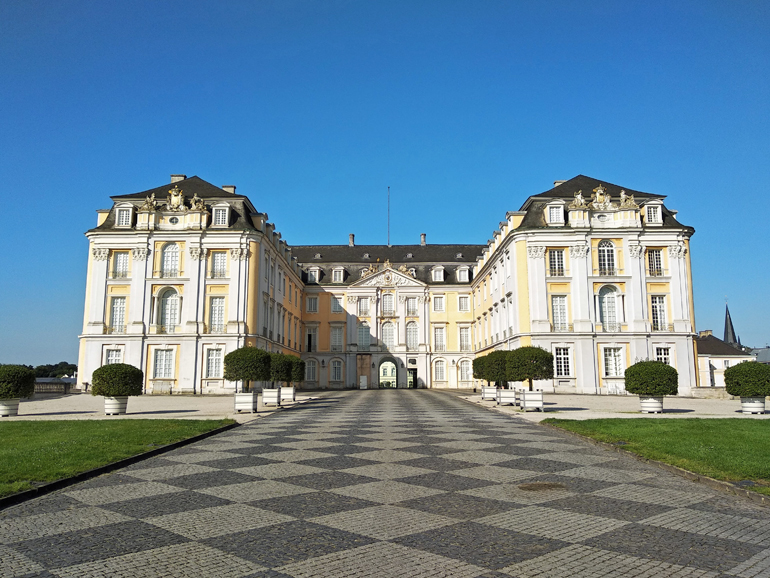
The imposing yellow-rendered palace presents itself as a majestic U-shaped structure with three main storeys and two levels of attics. The three wings are constructed of brick with roughcast plaster, creating the palace's distinctive creamy yellow exterior that immediately captures the eye. This horseshoe configuration, unusual for the baroque period, creates a welcoming embrace that draws visitors into the palace's grand courtyard. The central building is crowned with a copper-clad dome, whilst the flanking wings extend gracefully outwards, their facades punctuated by tall windows that flood the interiors with natural light.
The palace's exterior showcases meticulous attention to detail, with intricate carvings, sculptures, and decorative elements adorning the walls. Towers rise majestically from the corners, adding to the castle's sense of grandeur and dominance over the surrounding landscape. A distinctive feature is the asymmetrical window arrangement in the side wings – a result of the palace being built upon the foundations of a medieval castle, which was unusual for baroque architecture where symmetry was typically paramount.
Two elegant orangeries adjoin the main building on the north and south sides, adding to the palace's impressive scale. The southern orangery includes an oratory connected to the palace, whilst and exhibition spaces.
The Grand Staircase
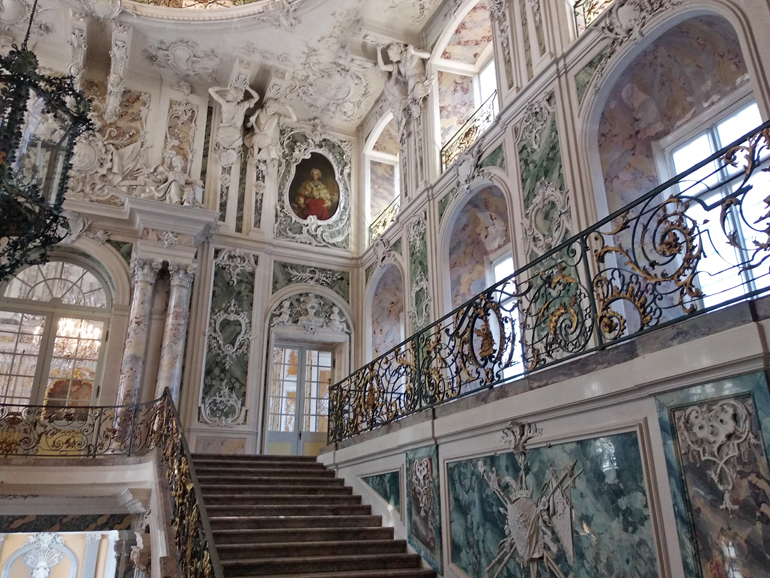
The palace's crown jewel is undoubtedly the magnificent ceremonial staircase, designed by the celebrated architect Balthasar Neumann between 1740 and 1746. This breathtaking creation serves as the perfect introduction to the palace's splendour, greeting visitors as they arrive in the central courtyard and step through the main entrance.
The staircase represents a masterpiece of baroque theatricality and spatial illusion. Its sweeping curves and dynamic movement create a sense of ascending grandeur, with elaborate marble and stucco work that draws the eye upwards towards the heavens. The structure cleverly combines real marble flooring with 'stucco marble' on the walls and ceiling – an even more expensive technique than using genuine marble, as it allows for complete control over patterns and colours.
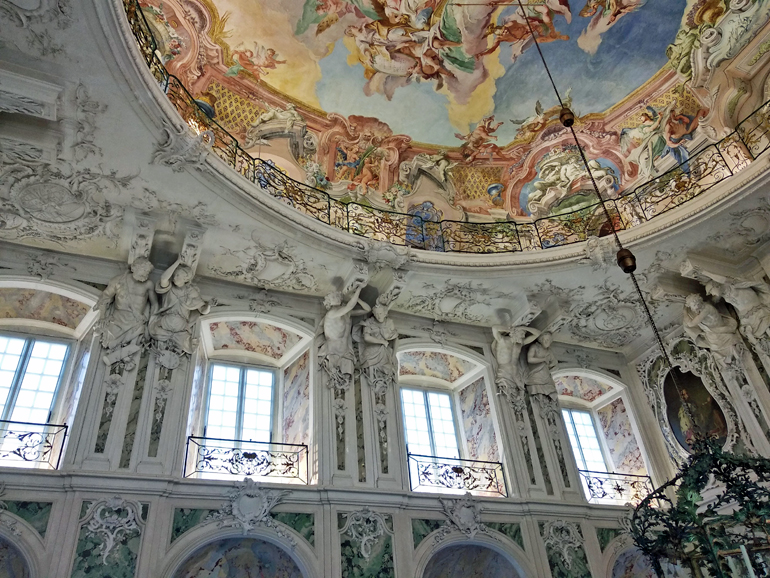
Jasper columns and elegant caryatids frame the staircase, whilst the balustrades are adorned with intricate gold-leaf detailing. The entire composition culminates in Carlo Carlone's extraordinary ceiling fresco, a masterpiece of trompe-l'œil painting that creates the optical illusion of a curved dome on what is actually a flat ceiling. Remarkably, this impressive fresco was completed by Carlone and his two assistants in just two weeks.
Interior Splendour
Beyond the grand staircase, the palace interior unfolds as a carefully orchestrated sequence of magnificent state rooms, each more ornate than the last. Every chamber reflects the refined tastes and extravagant lifestyle of its former residents, with walls adorned by gold-leaf decorations, intricate stucco work, and sumptuous furnishings.
The state rooms showcase the finest examples of German rococo design, characterised by light pastel colours, delicate ornamental details, and an emphasis on elegance over ostentation. Embossed leather wallpaper adds tactile luxury to many rooms, whilst Venetian chandeliers cast sparkling light across gilded surfaces. The interiors feature an extraordinary collection of decorative arts, including Dutch Delft tiles, Chinese lacquerwork, silk wall coverings, and decorative motifs inspired by Asian art.

The Yellow Apartment, serving as the private residence of the elector, exemplifies early rococo style with its sophisticated colour palette and refined decorative scheme. The garden room on the first floor is particularly striking, decorated in yellow and green stucco marble and articulated by elegant pilasters, with ceiling frescoes by Carlo Carlone adding to its splendour.
Each room has been carefully designed with its own distinct character and colour palette, from intimate private chambers to grand reception halls intended to impress visiting dignitaries. The preservation is remarkable – most of the paintings, floors, and fixtures remain original to the palace, having been well-maintained throughout its history and largely spared from wartime damage.
The Gardens and Park
The palace is set within equally magnificent grounds that showcase the finest traditions of European garden design. The formal baroque gardens, created by Dominique Girard beginning in 1728, represent one of the most authentic examples of 18th-century French garden architecture outside of France.
The centrepiece of these gardens is an ornamental parterre featuring intricate broderie patterns created from delicate boxwood hedges, interspersed with patches of grass and coloured gravel. These almost filigree-like flower beds are framed by borders planted with summer blooms that flower from May to October in a strict rhythm of colour and design. Round and quatrefoil fountain basins punctuate the parterre, creating delightful water features that add movement and sound to the garden composition.
The spectacular Mirror Pool serves as the garden's focal point, its still waters perfectly reflecting the palace facade. This large square pool is fed by an elegant cascade flowing from a circular basin crowned with an impressive fountain. Lateral avenues lined with lime trees lead to the bosquets – small formal tree plantations that include intimate garden rooms and additional fountains.
Beyond the formal baroque sections, the extensive parkland was redesigned in the 19th century by Peter Joseph Lenné in the fashionable English landscape style. This transformation, commissioned by Prussian King Frederick William IV, created a picturesque alternation of woodland and meadows, crossed by winding paths and dotted with two island ponds connected by streams.
Architectural and Artistic Heritage
Augustusburg Palace represents the collaborative genius of Europe's finest 18th-century artists and craftsmen. The palace's design evolved through the hands of multiple architects, beginning with Johann Conrad Schlaun in 1725 and continuing under François de Cuvilliés from 1728, who transformed the project into one of the most glorious residences of its time.
The magical interplay of architecture, sculpture, painting, and garden design makes the palace a masterpiece of German rococo. The building showcases innovations in baroque design whilst simultaneously pioneering the lighter, more graceful rococo style that would influence princely courts across Germany for generations.
The palace served as more than just a residence – it was a stage for 18th-century European court life, where music filled the halls and elaborate entertainments took place. In more recent times, from 1949 to 1996, the palace served as a representative venue for the German Federal President and Government, hosting distinguished guests including Queen Elizabeth II, Nelson Mandela, and Mikhail Gorbachev.
Today, Augustusburg Palace continues to enchant visitors as a living museum, offering an authentic glimpse into the opulent world of 18th-century aristocratic life whilst standing as an enduring testament to the artistic achievements of the rococo period.
Getting There
By train Augustusburg Palace is conveniently reached by regional train from Cologne or Bonn. Take the RB 48, RE 5, or MRB 26 from either city to Brühl station, which is just a five-minute walk from the palace entrance. Trains run frequently, making this the most straightforward public transport option.
By coach or bus Several local and regional buses and coaches serve Brühl, with stops at Brühl Bahnhof and Brühl Mitte, both within a short walk of the palace. Look for lines such as 935, SB91, SB93, and others depending on your departure point; live transit apps can help with planning your journey.
By car Arriving by car is easy via the A555 (Cologne–Bonn) or A61 (Koblenz–Mönchengladbach), continuing onto the A553 towards Brühl-Ost/Wesseling. Follow local signs to "Augustusburg.” Ample car parking is available near the palace grounds.
Best Time to Visit
The optimal time to visit Augustusburg Palace in Brühl is during the spring and summer months from May through September, when the weather is most favourable and the magnificent French Baroque gardens are at their absolute finest. The palace enjoys a temperate maritime climate with mild temperatures and moderate rainfall throughout the year, making May to September particularly appealing for visitors seeking pleasant weather with average daytime temperatures ranging from 20°C to 25°C and fewer rainy days. The palace's stunning formal gardens, designed by Dominique Girard in 1728, truly come alive during these warmer months when the intricate boxwood parterres are bordered by vibrant summer blooms that flower from May through October in carefully choreographed colours. The early spring period, particularly April and May, offers the delightful spectacle of the gardens awakening from winter, whilst the summer months provide the perfect conditions for exploring both the palace's opulent Rococo interiors on guided tours and strolling through the expansive English landscape park that connects Augustusburg to the smaller Falkenlust hunting lodge. Visitors should note that the palace operates on seasonal schedules, remaining open from March through November but closing entirely during the winter months of December, January, and February, making the warmer seasons not just preferable but essential for access to this UNESCO World Heritage masterpiece.
| Travel destinations in North Rhine-Westphalia | ||||||||||||||
|---|---|---|---|---|---|---|---|---|---|---|---|---|---|---|
|
|
|
|
| ||||||||||
|
|
|
|
| ||||||||||
|
| |||||||||||||


