



| Contents |
|---|

Introduction
Situated 50 km west of Bremen, Oldenburg (pop. 176,000) is the historical seat of the eponymous duchy. The House of Oldenburg gradually ascended the thrones of Schleswig-Holstein, Scandinavia, Russia, Greece and the United Kingdom, making it one of Europe's most influential Royal Houses. Unfortunately the city doesn't have much to show for it, apart from its charming late Renaissance ducal palace, housing the interesting State Museum.
Interesting Facts about Oldenburg
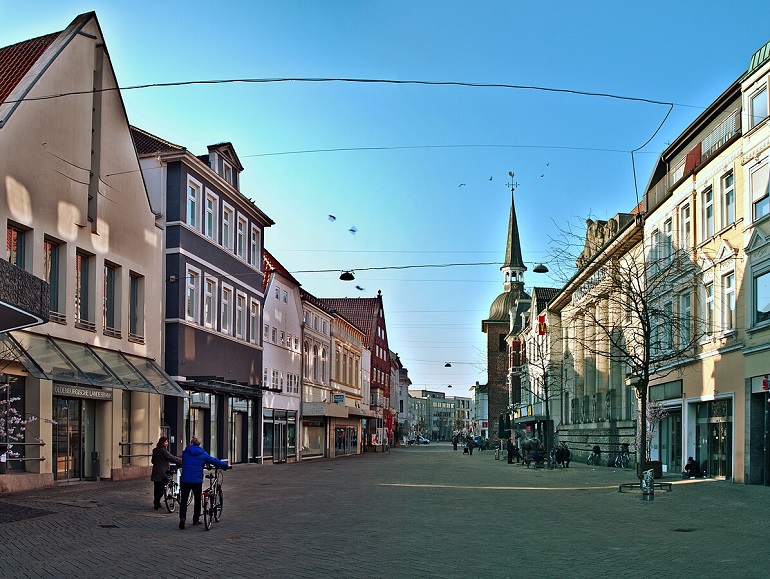
- Oldenburg was the first city in Germany to establish a large pedestrian-only zone, introduced in 1967.
- Oldenburg is officially styled “Oldenburg (Oldb)” to distinguish it from Oldenburg in Holstein.
- The city was the residence and administrative centre of the counts, dukes and later grand dukes of Oldenburg until 1918.
- Oldenburg suffered relatively little destruction in the Second World War, helping preserve much of its urban fabric.
- The Lappan bell tower is one of Oldenburg’s most recognisable landmarks and among its oldest surviving structures.
- Oldenburg lies on the River Hunte and at the Küsten Canal, linking inland waterways between the Weser and Ems.
- The grand ducal palace (Schloss Oldenburg), now a state museum, showcases neoclassical architecture in a distinctive yellow hue.
- Oldenburg hosted one of Germany’s earliest strong electoral gains for the Nazis in 1932, making the state a troubling early stronghold.
- The Carl von Ossietzky University of Oldenburg, founded in 1973, gives the city a vibrant student and research presence.
- With a population around 170,000, Oldenburg ranks among the largest cities in Lower Saxony while retaining a compact, walkable centre.
- The city is known for cycling, greenery and waterways, offering kayak-friendly routes and easy access to parks and the StadtHafen.
- Oldenburg was incorporated into Lower Saxony in 1946 after serving as the capital of the former Free State of Oldenburg.
- Historic setbacks in 1667—a devastating plague followed by a great fire—led to later rebuilding in a classicist style.
- Today Oldenburg is a regional hub for conventions, culture and sport, with strong ties to printing, services and renewable energy.
History
Medieval Origins and Early Development
The ancient city of Oldenburg traces its origins to the 8th century, with archaeological finds pointing to early settlement in the region. First documented as "Aldenburg" in 1108, the settlement began as a fortress castle built strategically on a hill above the marshy Hunte valley. The fortress served as both protection and a toll house for the Counts of Oldenburg on the vital trade route connecting Bremen and Westphalia to Frisia. This advantageous position at a ford of the navigable Hunte river helped establish Oldenburg's importance as a trading centre, with the ancient road still running through the modern city in a north-south direction, evident in street names like Lange Strasse and Damm. The city became the seat of the House of Oldenburg, a Frisian princely family that would eventually rise to European prominence when Christian I was elected King of Denmark in 1448.
Danish Rule and Napoleonic Period
In 1667, Oldenburg fell under Danish crown rule through inheritance, beginning over a century of foreign governance that significantly impacted the city's fortunes. The period proved challenging, with the city suffering considerable economic and political decline, compounded by devastating events including a disastrous plague epidemic and the Great Fire of 1676 that destroyed much of Oldenburg. The Danish viceroys, who resided in the city until 1773, showed little interest in the town's restoration, allowing it to languish. Danish rule finally ended in 1773 when Oldenburg returned to local governance under Friedrich August of Holstein-Gottorp, becoming the centre of a duchy stretching from the coast to Dümmer lake. However, the city's trials continued during the Napoleonic Wars, when from 1810 to 1813 Oldenburg was incorporated into the French Empire and briefly known as "Le Vieux-Bourg".
Modern Transformation and Nazi Era to Present
The 19th and early 20th centuries brought renewed prosperity as Oldenburg evolved from a duchy to a Grand Duchy (1815-1918) and then a Free State (1918-1946) following the abdication of Grand Duke Frederick Augustus II in November 1918. Tragically, Oldenburg gained the dubious distinction of being the first German state to put the Nazi Party in power through electoral success, with the party receiving 48.4% of the vote in May 1932 state elections. This led to the implementation of devastating policies, including campaigns of Aryanisation that forced Jewish residents to sell their properties at steep discounts. After World War II, during which the city suffered only 1.4% destruction from bombing, Oldenburg became part of the British occupation zone and absorbed approximately 42,000 refugees, raising its population above 100,000. In 1946, the Free State of Oldenburg was dissolved and incorporated into the newly formed federal state of Lower Saxony, where it continues to serve as an important regional administrative centre with a current population of 172,759.
Main Attractions
Schloss Oldenburg (Oldenburg Palace)
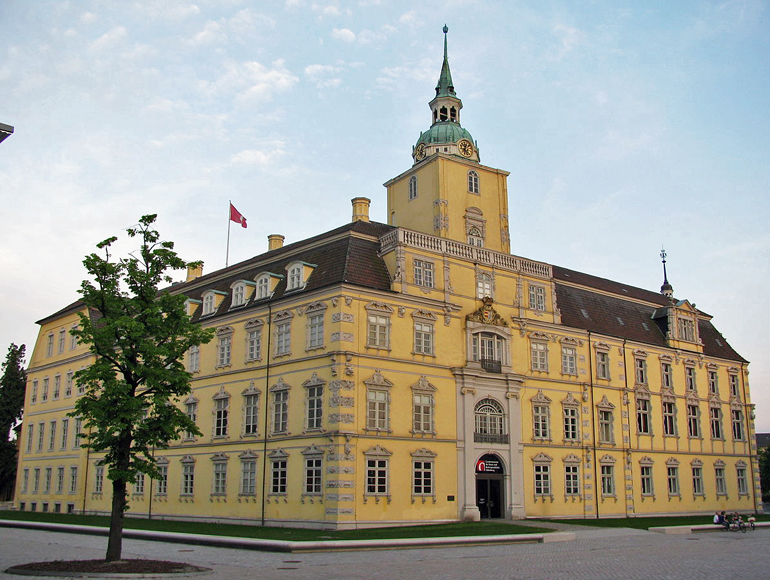
Schloss Oldenburg, the ducal palace situated in the city centre, is a prominent architectural landmark dating mainly from the early 19th century, though its origins trace back to earlier defensive structures. The palace features neoclassical elements and was historically the residence of the Counts, Dukes, and Grand Dukes of Oldenburg. Surrounded by landscaped gardens and close to both the Schlossgarten and Schlossplatz, the palace today serves as a venue for public events and displays, preserving its role as a focal point in Oldenburg’s cultural and historical landscape.
Oldenburger Schlossgarten
Oldenburger Schlossgarten is a 16ha English-style landscape garden initiated in the early 19th century by Duke Peter Friedrich Ludwig, characterised by winding watercourses, mature trees, and rhododendrons considered among the oldest of their kind in Germany; it is directly adjacent to the historic ducal residence area.
Wachhaus (Palace Guardhouse)
The Palace Guardhouse (Wachhaus) stands by the Oldenburg Palace complex and represents the former ducal guard facilities; its preserved façade forms part of the ensemble around Schlossplatz, illustrating the residence-era urban layout linked to the nearby gardens and river approaches.
St Lamberti Church
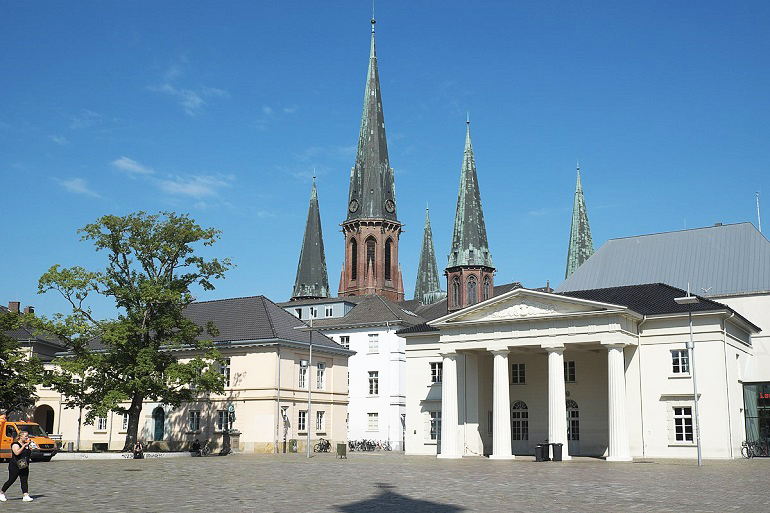
St Lamberti Church anchors the central market square with a five-tower silhouette and an 86m height, serving as a key landmark beside the Old Town Hall and the city’s main marketplace activities on market days. The church’s position defines the civic core, with regular markets and public life concentrated around the square immediately south of the town hall.
Oldenburgisches Staatstheater (Oldenburg State Theatre)
Oldenburgisches Staatstheater is the historic state theatre west of the Old Town Hall, representing the city’s principal performing arts venue and a key civic building within the compact inner city’s cultural axis near the market square and church.

Altes Rathaus (Old Town Hall)
The Old Town Hall (Altes Rathaus) occupies the traditional administrative centre; the original Renaissance town hall from 1635 was replaced in 1888 by the current building with neo-Renaissance and neo-Gothic elements, positioned just north of St Lamberti and adjacent to the state theatre.

Landtag (Old Parliament)
The Landtag building in Oldenburg served as the seat of the parliament for the Grand Duchy and later the Free State of Oldenburg until its dissolution in 1933. Situated near Oldenburg Palace, the neoclassical building was constructed in the 19th century to accommodate legislative functions, reflecting the city's political significance within Lower Saxony. Today, the structure is primarily used for administrative or cultural purposes, with its façade and surrounding area retaining historical importance as part of Oldenburg’s governmental and architectural heritage.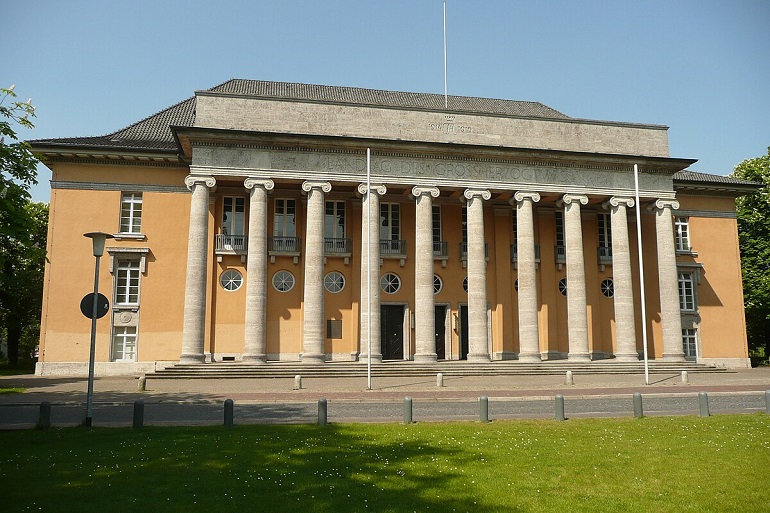
The Pulverturm (Powder Tower)
The Pulverturm (Powder Tower) is the last surviving element of Oldenburg’s former fortifications, a 16th-century defensive structure that remained when the city walls were removed; it sits close to the palace complex and the Schlossgarten, illustrating the city’s early modern military past.
The Lappan
The Lappan is a late-medieval bell tower from the 1460s at the start of Langenstraße, originally attached to a Heilig-Geist chapel and hospital that disappeared after the Reformation and a 1676 city fire; it later gained a Baroque dome in 1709 and today stands as a central transport and meeting point.
Top Museums
Art and Cultural History
State Museum for Art and Cultural History (Landesmuseum für Kunst und Kulturgeschichte)
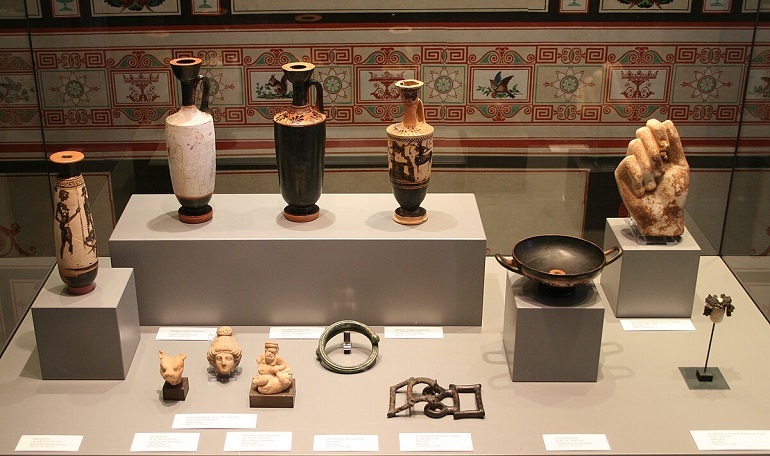
Spread across three closely clustered venues—the Castle (Schloss Oldenburg), the Augusteum, and the Prinzenpalais—this museum complex forms the city’s cultural backbone. The Castle sets the tone with an elegant sweep through decorative arts and regional cultural history: think medieval manuscripts, carved ivory, Art Nouveau ensembles, and Bauhaus design, framed by interiors that reveal Oldenburg’s ducal past in Rococo, Historicist, and Classicist flourishes. The Augusteum focuses on Old Masters, notably Dutch and German painting from the 15th to 19th centuries, offering a measured, contemplative experience with strong art-historical context. The Prinzenpalais pivots to modern art, drawing a clean line from 19th-century developments into 20th-century movements; it’s where the collection loosens its collar and explores impression to modernism with fresh perspective. Together, the trio provides a panoramic view from antiquity to Pop, and from courtly splendour to contemporary design.
Prinzenpalais
Though integrated into the State Museum for Art and Cultural History, the Prinzenpalais merits its own mention as a focused venue for 19th- and early 20th-century art. The displays are calibrated to show the period’s transitions—how light, colour, and subject matter evolved from academic traditions toward modern sensibilities. For visitors keen on a tight, well-edited encounter with the foundations of modern art, the Prinzenpalais is a rewarding stop.
Augusteum
Dedicated to Old Masters, the Augusteum offers a classical museum experience with a regional accent. Expect paintings where devotional subjects, portraiture, and genre scenes invite slow, absorbing viewing. The curation underscores technique and school, making it an excellent place to anchor broader explorations of European art history within a local collection.
Schloss Oldenburg
More than a backdrop, the Castle is a protagonist in Oldenburg’s story. The residence of the Earls, Dukes, and Grand Dukes, it layers mediaeval fortification, 17th-century expansion, Rococo adornment, and 19th-century Historicist interiors. Its galleries of applied arts and cultural history gain resonance from their setting: the architecture sharpens the sense of time travel, linking courtly life to the objects on display.
Nature, Science, and Technology
State Museum for Nature and Man (Landesmuseum Natur und Mensch)
A multidisciplinary museum where archaeology, natural history, and ethnology are woven into an immersive narrative about north-western Germany’s landscapes and lifeworlds. Permanent galleries are scenographically designed—moors, coasts, marshes, and geest are not simply explained but evoked—so that geology, botany, fauna, and human settlement interlock convincingly. Expect an atmospheric journey from peatland secrets to tidal flats, with archaeological finds grounding the story in long arcs of habitation and exchange. It’s the best place in Oldenburg to grasp how the region’s environment shaped its cultures—and vice versa.
Oldenburg Computer Museum (Oldenburger Computer-Museum)
A hands-on homage to the age of home computing, distinguished by the fact that much of the collection is operational. Instead of peering at inert machines under glass, visitors can engage directly with classic systems—an experience that fuses nostalgia with media archaeology. The museum narrates technological evolution through interaction: feel the keyboards, see the CRT glow, and experience software and interfaces as they were. It’s as much about design and ergonomics as it is about processing power—a playful, surprisingly reflective window onto how everyday computing took hold.
Graphic Arts
Horst Janssen Museum
A singular destination for the graphic arts, dedicated to Horst Janssen (1929–1995), one of Germany’s most distinctive draughtsmen and printmakers. The museum delves into the artist’s virtuosity on paper—etching, wood engraving, drawing, watercolour—while also probing the persona behind the work through thoughtfully curated temporary exhibitions. Janssen’s range is striking: fine, razor-sharp line drawings sit alongside expressive late watercolours; anecdotal woodcuts balance unsettling self-portraits and florals. The emphasis on the tactile, technical richness of paper-based media makes this museum both intimate and exacting, ideal for those who enjoy close looking.
City and Community
City Museum Oldenburg (Stadtmuseum Oldenburg)
Currently undergoing redevelopment, the City Museum traditionally complements the state institutions with a civic lens: urban history, local art, and thematic exhibitions that stitch Oldenburg’s social fabric into accessible narratives. When open, it’s the place to find the city’s self-portrait—street plans, photography, everyday objects, and cultural threads that don’t always fit grand narratives but define lived experience.
Artothek Oldenburg
An art-lending institution rather than a museum in the strict sense, the Artothek captures Oldenburg’s participatory ethos. With a large, regionally attuned collection, it encourages direct engagement with contemporary art—sometimes literally inviting visitors to demystify sculpture and design through closer, tactile encounters. For those who like their culture interactive and community-rooted, it’s a charming addition to an itinerary.
Local Cuisine
Visitors to Oldenburg should try Grünkohl mit Pinkel, a beloved winter speciality of kale slow-cooked with smoked sausage, as well as Labskaus, a robust sailor’s dish made from corned beef, potatoes, and beetroot, served with gherkins and pickled herring. Local menus often feature snirtjebraten, a fragrant pork roast traditionally stewed with onions and spices, while fresh North Sea fish such as plaice and herring are popular in restaurants and markets. To accompany these meals, the area’s rustic breads and regional beers add to the authentic Oldenburg culinary experience.
Getting There
By train, Oldenburg is well connected through regional and long-distance lines, with frequent services linking the city to Bremen, Hanover, and Hamburg, making it an easy and efficient choice for travellers.
By coach or bus, long-distance services operate from major German cities and stop at Oldenburg’s central bus station, conveniently located near the railway station in the heart of the city.
By car, Oldenburg is easily accessible via the A28 and A29 motorways, offering smooth travel from nearby metropolitan centres and making it a straightforward drive into the city.


