



| Contents |
|---|
Introduction
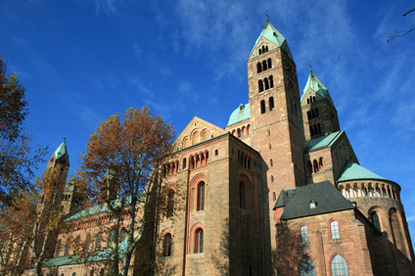
Dominated by its UNESCO-listed Romanesque cathedral, Speyer (pop. 51,000) is one of Germany's oldest cities and the resting place of eight medieval emperors and kings of the Salian, Staufer and Habsburg dynasties. Visitors to Speyer can explore a mix of medieval streets, museums, and cultural landmarks, including the Technik Museum Speyer and the Jewish Courtyard. The city’s location makes it a convenient starting point for exploring the Rhine Valley and the Palatinate wine region.
Speyer was the seat of the Imperial Chamber Court between 1527 and 1689, and also held 50 sessions of the Imperial Diet. The First Diet of Speyer (1526) decreed toleration of Lutheran teaching, soon revoked by the Second Diet of Speyer (1529). The latter diet led to the Protestation at Speyer the same year, during which 6 princes and 14 Imperial Free Cities protested against the anti-Reformation resolutions. It is from this event that the term 'Protestantism' was coined.
Interesting Facts about Speyer
- Speyer is one of Germany’s oldest cities, originally founded as a Roman military outpost called Noviomagus around 10 BCE.
- The monumental Speyer Cathedral, consecrated in 1061, is the largest Romanesque church in the world and a UNESCO World Heritage Site.
- Eight Holy Roman Emperors and German kings are buried in the crypt beneath the cathedral, making it the most significant royal burial ground in Germany.
- The term “Protestant” has its roots in the city, originating from the Protestation at the Diet of Speyer in 1529, where German princes objected to restricting Lutheran practices.
- Speyer’s Altpörtel, a medieval city gate, is one of the largest and best-preserved town gates in Germany and remains a striking part of the city’s skyline.
- In 1689, much of Speyer was destroyed during an invasion by French troops in the Nine Years' War, leading to its later reconstruction in the Baroque style.
- The Jewish community in Speyer, dating back to 1084, made the city a key centre of Jewish scholarship and culture during the Middle Ages; its historic Jewish courtyard is a UNESCO World Heritage Site.
- Unlike many German cities, Speyer’s medieval streetscape survived World War II largely intact, preserving its historic atmosphere.
- Speyer was a free imperial city for over 500 years, giving it unique autonomy within the Holy Roman Empire from 1294 to 1797.
- The Technical Museum Speyer, opened in 1991, is now a major attraction, housing everything from vintage aircraft to space shuttles.
History
Speyer stands as one of Germany's most ancient cities, with its remarkable history spanning over two millennia. The settlement began in 10 BCE when Roman legions established a military camp between what is today the Bishop's Residence and City Hall, making it one of the earliest Roman fortifications on the northeastern frontier of their empire. Initially known as Noviomagus, the town later evolved into Civitas Nemetum in the 4th century, named after the Germanic Nemetes tribe that inhabited the region. By 150 CE, the settlement appeared on the world map of the Greek geographer Ptolemy, demonstrating its growing significance. After the original Roman town was destroyed in the 5th century during the Migration Period, the Franks re-established the settlement in the 7th century under the name Spira, derived from a nearby Frankish village called villa Spira. The town's strategic position on the Rhine ensured its continued importance as trade routes reopened and new settlements flourished in the surrounding area, including Altspeyer, Winternheim, and Marrenheim.
The medieval period marked Speyer's golden age as a centre of imperial power within the Holy Roman Empire. In 1024, Conrad II of the Salian dynasty was elected King of Germany near Oppenheim, and he subsequently chose Speyer as his favoured residence, earning him the nickname "Conrad the Speyerer". The most significant architectural achievement of this era began in 1030 when Conrad II commissioned the construction of Speyer Cathedral on the site of a former smaller church. This monumental Romanesque basilica, featuring four towers and two domes, became the largest church of its time and served as the primary mausoleum for the Salian dynasty, ultimately housing the tombs of eight German emperors and kings. The cathedral remains the largest surviving Romanesque church in the world and achieved UNESCO World Heritage status. Speyer's importance was further solidified in 1111 when Henry V granted the city the Great Freedom Charter, making it the first city in the Holy Roman Empire where citizens received personal freedoms and protection of property rights. By 1294, Speyer had achieved the coveted status of a Free Imperial City, answering directly to the Holy Roman Emperor rather than local lords.
The city's significance in European religious and political history reached its zenith during the Reformation period. Speyer hosted numerous Imperial Diets, most notably those of 1526 and 1529, which proved pivotal in shaping the course of Christianity in Europe. The 1526 Diet granted interim toleration of Lutheran teaching and worship, whilst the 1529 Diet witnessed the famous Protestation at Speyer, where Lutheran states formally protested against anti-Reformation resolutions. This historic event gave birth to the term "Protestant", forever linking Speyer to the religious transformation of Europe. The city was also home to one of medieval Europe's most prominent Jewish communities, established in 1084 when Jews fleeing persecution in Mainz and Worms found refuge under the protection of Bishop Rüdiger Huzmann. Together with Mainz and Worms, Speyer formed the cultural triangle known as the ShUM cities, representing the heart of Ashkenazi Jewish civilisation. However, this thriving community met a tragic end in 1349 during the Black Death persecutions. From 1527 to 1689, Speyer served as the seat of the Imperial Chamber Court, cementing its role as a judicial centre of the empire. The city's fortunes took a dramatic turn in 1689 when French troops under Louis XIV devastated the town during the Nine Years' War, forcing extensive reconstruction. Despite periods of French occupation from 1792 to 1814 and subsequent incorporation into Bavaria in 1816, Speyer has preserved its historical character and celebrated its 2000th anniversary in 1990.
Main Attractions
Speyer Cathedral
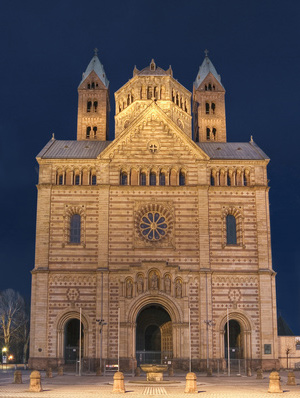
The Imperial Cathedral Basilica of the Assumption and St Stephen, as it is officially known, is the largest and most magnificent of the three Imperial Cathedrals (Kaiserdom, the two others being Mainz and Worms).
Emperor Conrad II started its construction in 1030 on the site of a former basilica. It was consecrated in 1061.
With a length of 134 metres and a width of 43 metres, Speyer Cathedral is one of Europe's largest Romanesque churches, along with Santiago de Compostela in Spain, Cluny Abbey in France, and Durham Cathedral in England, which were all build later, towards the end of the 11th century.
The cathedral was added to the UNESCO World Heritage List in 1981.
Maximilianstrasse
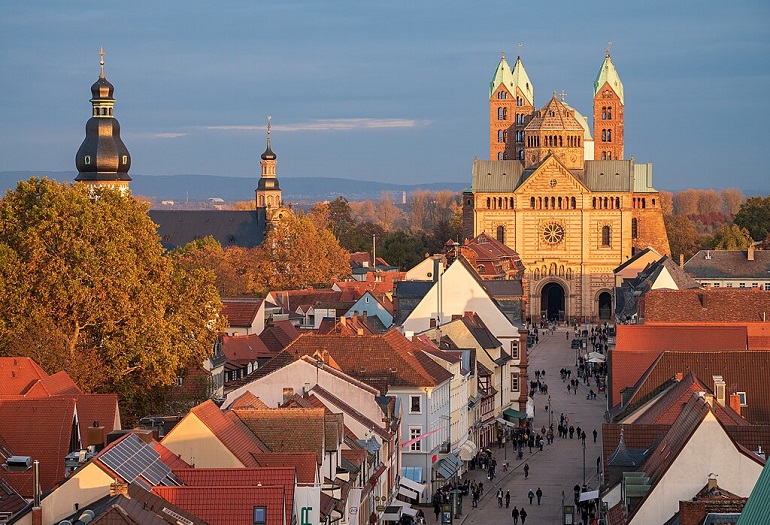
Maximilianstrasse is Speyer's central, pedestrianised main street, running between the Altpörtel and the cathedral. It is lined with deeply restored Baroque houses, each bearing historical inscriptions, which reflect centuries of local trade and prosperity. The street serves as a hub for shopping, dining, and community events such as the town’s weekly markets and festive celebrations. Historically, it was the Via Triumphalis, used by emperors to enter the cathedral, and was also the primary commercial artery of Speyer.
Altpörtel
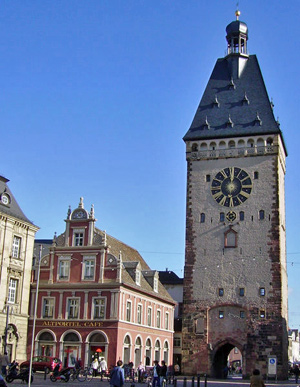
Altpörtel, also known as the Old Gate, is the medieval western city gate and one of Germany’s tallest and most significant city gates, standing at 55 metres. Built between 1230 and 1250, it remains a testament to Speyer’s city fortifications that once included 68 towers. The city-facing side is ornate, while the countryside side is simpler, featuring arrow slits for defence. The gate survived the city’s destruction during the War of the Palatinate Succession in 1689. A curiosity on its northern side, the “Speyer standard shoe”, served as the traditional measurement for merchants.
The Rathaus
The Rathaus, or City Hall, is a stately building in the late Baroque style, constructed between 1712 and 1726. It stands on the site of the former municipal chancery which was destroyed in 1689. For much of the 18th and 19th centuries, it served as the residence for the city's leaders. Its architecture is representative of the reconstruction period that followed the destruction of the city, favouring stone over the timber-framed houses that were common before.
The Alte Münze
The Alte Münze, or Old Mint, is located on Maximilianstrasse, marking the midpoint between the Altpörtel and the cathedral. The original medieval minting house on this site was destroyed in the city-wide fire of 1689 and was replaced by the current structure in 1748. Over the years, the building has fulfilled various roles, including being a shop, warehouse, and administrative building. In 1874, a third gabled floor was added to the structure.
The Rhine Promenade
The Rhine Promenade offers a pleasant riverside walkway between the Old Town and the river. Recently renovated, the promenade features scenic views of passing ships, landscaped paths, and access to Speyer’s oldest beer garden, The Old Hammer. With several cafes and restaurants along the route, visitors can relax and enjoy local dishes overlooking the Rhine. In the warmer months, the promenade includes a sandy beach area that is ideal for leisure and sunbathing.
Sealife Speyer
Sealife Speyer is a large aquarium located on the Rhine river, featuring over 3,000 marine creatures from 250 different species housed in more than 40 tanks. A journey through the attraction follows the course of the Rhine from its source to the North Sea, continuing into the Mediterranean and tropical oceans. Key features include the "World of Corals" exhibit, an eight-metre-long underwater glass tunnel through a 320,000-litre ocean tank, and interactive touch pools. A notable resident is "Marty," a green sea turtle who was rescued after an injury and now lives in the aquarium.
Domgarten Park
Domgarten Park, also known as Cathedral Garden, is the largest park in Speyer and links the Rhine River promenade with the cathedral and historic centre. Founded in 1821, the park provides green space with fountains, sculptures based on ancient Germanic legends, and play areas for children. It is a major spot for relaxation and offers some of the best views of the cathedral, particularly from the Mount of Olives sculpture group, which depicts a scene from the New Testament and originally formed part of the cathedral’s cloister.
The Gedächtniskirche
The Gedächtniskirche, or Memorial Church of the Protestation, commemorates the Protestant declaration at the Diet of Speyer in 1529. Built between 1893 and 1904, it stands as the main Protestant church in the region, featuring a 100-metre-high tower, the tallest church spire in the Palatinate. The church was constructed in the neo-Gothic style, with prominent stained-glass windows illustrating scenes from the Protestant Reformation and German biblical history. Statues of Martin Luther and Protestant princes adorn the entrance, and the church regularly hosts organ concerts, boasting the largest organ in southwest Germany.
Top Museums
Technik Museum Speyer
The Technik Museum Speyer is a huge transportation museum, sporting a vast collection of old cars and motorbikes, fire engines, locomotives, aircrafts and ships. The most impressive exhibits include a U9 submarine, an Antonov AN-22 cargo plane, a Boeing 747 Jumbo Jet, and even a space shuttle! The museum’s vast and interactive displays bring engineering alive for all ages—a slight drawback for visitors less interested in technology, but a must for families, engineering buffs, and the simply curious.
Historical Museum of the Palatinate
Known in German as the Historisches Museum der Pfalz, this regional museum is a centrepiece of Speyer’s cultural landscape. The museum offers an impressive tour through the Palatinate’s history, from prehistoric times to the modern era. With engaging permanent exhibitions covering topics like the Roman period, the ‘Cathedral Treasure’, and winemaking traditions, it appeals to both history aficionados and families, thanks to its thoughtful children’s offerings and rotating special exhibitions. The breadth of artefacts can feel overwhelming, but the clear presentation helps foster genuine appreciation for regional heritage. Notable exhibits include:
- The Golden Hat of Schifferstadt, a large thimble-shaped artefact from the Bronze Age covered with sheets of gold.
- The oldest unopened wine bottle in the world (dating from the 3rd century) in the Wine Museum subsection.
- The episcopal treasury recovered from the cathedral in the 20th century. It includes medieval relics from Holy Roman Emperors.
Museum SchPIRA
Nestled in the heart of the old Jewish quarter, Museum SchPIRA focuses on Speyer’s once-flourishing Jewish community. With evocative archaeological finds such as original synagogue remnants, gravestones, and the exceptionally preserved mikveh (ritual bath), it provides invaluable insight into Jewish life in medieval Europe. The museum’s intimate scale allows for a focused visit, although some non-German speakers might find occasional language limitations; nonetheless, it’s an essential stop for anyone interested in religious and cultural history.
Feuerbach House
Dedicated to the influential artist Anselm Feuerbach and his remarkable family, the Feuerbach House is set in the painter’s birthplace and showcases over thirty of his original works, documents, and memorabilia. Its serene Baroque garden and the building’s historic charm set a distinctive tone. The on-site wine bar adds an extra dimension, inviting guests to linger and reflect. While modest in scale, the museum’s ambience and personal stories will resonate with art lovers and anyone keen on 19th-century German cultural history.
Purrmann House
Housed in an atmospheric historic building, this museum celebrates the life and work of Hans Purrmann, a leading German colourist and protégé of Henri Matisse, as well as his artist wife Mathilde Vollmoeller-Purrmann. Its well-curated permanent collection includes paintings, watercolours, and fascinating personal artefacts, offering insight into modernist art and a slice of early 20th-century European creative life. The museum is comparatively compact and some displays are in German, but its focused exhibits and friendly staff make it a delightful stop for art enthusiasts.
Local Cuisine
The city's signature dish is the renowned Saumagen (stuffed pig's stomach), a mixture of lean pork, sausage meat, potatoes, onions and aromatic spices served in slices with sauerkraut and mashed potatoes. Food enthusiasts can savour other local specialities including Dampfnudeln (steamed dumplings with crispy crusts) served with wine or vanilla sauce, Flääschknepp (meat dumplings) accompanied by sharp horseradish sauce, and the iconic Pfälzer Dreifaltigkeit (Palatinate Trinity) combining Saumagen, bratwurst and liver dumplings. The region's traditional use of marjoram as a distinctive seasoning gives dishes their characteristic bold flavour, whilst seasonal specialities like Grumbeersupp mit Quetschekuche (potato soup with plum cake) and Zwiebelkuchen (onion tart) paired with Federweisser (new wine) showcase the city's connection to local produce and wine culture. Modern restaurants in Speyer have elevated these traditional dishes whilst maintaining their authentic character, making the city an excellent destination for experiencing genuine Palatine gastronomy.
Getting There & Around
Speyer is located 20 km west of Heidelberg, 20 km south of Mannheim and 40 km north of Karlsruhe.
By train Speyer is well connected by Germany’s extensive rail network, with frequent regional trains running to and from major nearby cities such as Mannheim and Heidelberg. Travellers can easily reach the city via regular services operated by Deutsche Bahn, arriving directly at Speyer Hauptbahnhof. The journey from Frankfurt Airport to Speyer by train is especially convenient, taking just over an hour, and there are also efficient connections from other German and European cities—sometimes requiring a change in Mannheim or Karlsruhe. Timetables and routes are reliable, making arrival by train a straightforward option.
By coach or bus Scheduled long-distance buses serve larger towns close to Speyer, such as Heidelberg or Mannheim. From these points, local buses or trains provide a simple onward journey into Speyer itself. While there are not always direct long-distance coach routes into Speyer, travellers enjoy good links to nearby transit hubs, where they can transfer to local services for the final stretch of their trip. The P7 P+R car park "Festplatz" in Speyer offers dedicated areas for coach and bus parking, making arrivals by group coach easy to manage.
By car Speyer is accessible from the surrounding region and further afield thanks to the convenient location near the Autobahn A61. Motorists will find the drive from Frankfurt Airport takes approximately one hour, with clear signposts guiding cars from the motorway right into the city. Ample parking is available, including designated car and coach spaces at the Technik Museum Speyer and throughout the city. Travelling by car provides the flexibility to explore Speyer at your own pace, with straightforward routes from all directions.
| Travel destinations in Rhineland-Palatinate | ||||||||||||||
|---|---|---|---|---|---|---|---|---|---|---|---|---|---|---|
|
|
|
|
| ||||||||||
|
|
|
|
| ||||||||||
|
|
| ||||||||||||


