



| Contents |
|---|

Introduction
Jasmund National Park is located on the Jasmund peninsula on the island of Rügen, Germany's largest island. It is the country's smallest national park, covering an area of 3,003 hectares (30 km²). It is famous for its 118-metre-high chalk cliffs, the so called Königsstuhl ("King's chair"), the largest of their kind in Germany. Inland from the coast, the park contains extensive, ancient beech forests, which are part of the transnational UNESCO World Heritage Site known as the Ancient and Primeval Beech Forests of the Carpathians and Other Regions of Europe. A network of hiking trails provides access to the cliffs and the woodlands.
Geography and Landscape
Overview
Jasmund National Park occupies the north-eastern tip of Rügen, Germany’s largest island, on the Baltic Sea. It is the country’s smallest national park, yet its coastline and inland plateau present a striking interplay of chalk cliffs, beech-clad heights, and tranquil lagoons. The park’s landscapes have been shaped by glacial forces, marine erosion, and the continual movement of chalk and flint, creating a coastal scene that is both dramatic and delicate.
Chalk Cliffs and Coastline
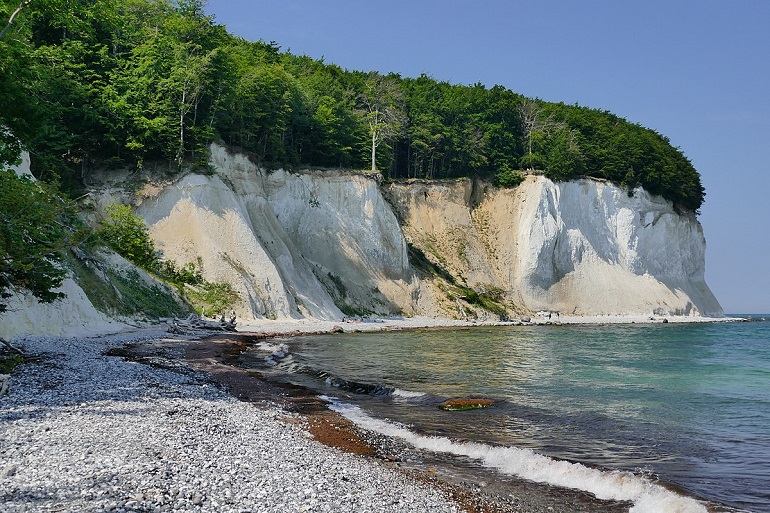
- The park is best known for its gleaming white chalk cliffs, which rise steeply above the Baltic and run in a scalloped line along the coast. Iconic viewpoints such as the Königsstuhl (King’s Chair) and the Victoria-Sicht offer commanding vistas across the sea and the curving shoreline.
- These cliffs are composed of Cretaceous chalk infused with bands of flint. The chalk is relatively soft and subject to constant erosion, leading to periodic cliff falls that reshape beaches and reveal fresh layers of stone and fossils.
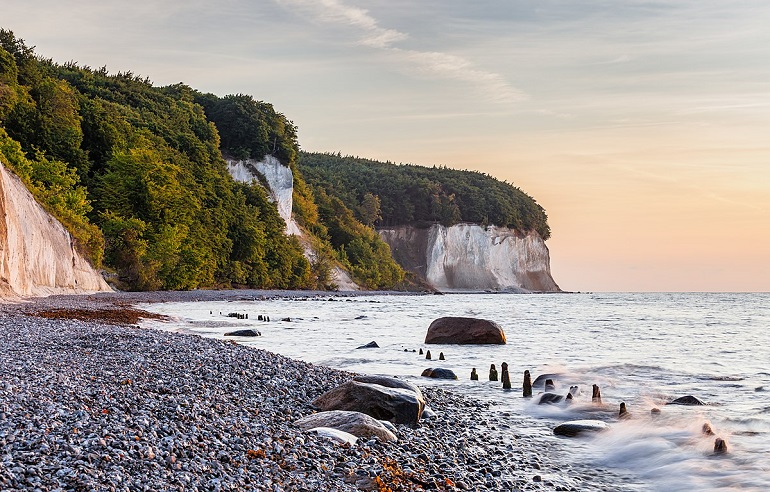
- At the base of the cliffs, the narrow shore alternates between shingle, flint-strewn stretches, and pockets of sand. Fallen chalk blocks and flint nodules give the beach a rugged character, while the water’s milky turquoise hue reflects suspended chalk particles.
Plateau and Relief
- Above the cliffs lies the Jasmund plateau, a gently undulating tableland cut by shallow dry valleys and small ravines that drain towards the coast. The plateau’s elevation provides sweeping sea views and a sense of openness that contrasts with the sheer drops along the edge.
- The terrain bears the imprint of the last Ice Age: moraines, glacial sands, and clays underlie much of the ground, with the chalk bedrock close to the surface along the coast and occasionally exposed inland.
Glacial Heritage and Geology
- Jasmund’s foundations were laid by advancing and retreating ice sheets, which deposited the chalk-rich strata and sculpted the headland into a series of ridges and depressions.
- Flint bands within the chalk weather out into smooth, dark pebbles that collect on beaches. Erosion also exposes fossil-bearing layers, with occasional finds of ancient marine life embedded in the chalk.
Water Features and Coastal Dynamics
- The Baltic Sea continuously carves the cliffs, creating a dynamic shoreline where headlands are undercut and slopes slump seaward. After storms, the beaches often change shape, and new landslides can appear.
- Small brooks and seasonal streams descend the plateau in shallow gullies, sometimes vanishing into the porous chalk before re-emerging lower down. Wet hollows and minor ponds occur where impermeable layers trap water.
- On the landward side of the peninsula, calmer waters form bodden-like inlets beyond the park’s core cliffs, giving way to reed-fringed shores and sheltered bays outside the most exposed sections.
Viewpoints and Landmarks
- The Königsstuhl forms the park’s most celebrated promontory, with an observation area set back from the cliff edge for panoramic sea views.
- Victoria-Sicht offers a classic perspective of the chalk wall and the bay’s elegant curve, particularly striking in low, slanting light.
- The cliff-top path traces the escarpment, with occasional detours to safe viewpoints, while access to the shore is via steep stairways or ravines at designated points.
Beaches and Shore Access
- The shoreline is primarily pebbly, with interludes of sand depending on recent erosion and sediment movement. Walking here involves navigating flint shingle and driftwood, especially beneath active cliff faces.
- Access points are limited to maintain safety, as rockfalls are a natural and unpredictable feature of the coast. Tides are generally moderate, but waves and wind can quickly alter local conditions.
Human Imprint and Landscape Management
- Infrastructure within the park is designed to protect the fragile cliff environment while enabling appreciation of the scenery. Paths are clearly marked, and barriers guide visitors away from unstable edges.
- Historic quarrying of chalk once took place on Rügen, though within the park the landscape is now conserved, allowing natural processes—particularly coastal erosion—to proceed with minimal interference.
Sense of Place
- Jasmund’s character is defined by the contrast between the quiet, rolling plateau and the abrupt plunge of the coastline. The luminous white of the chalk against the Baltic’s shifting blues and greys creates a landscape of stark beauty.
- The ever-changing nature of the cliffs—calving, slumping, and reforming—gives the park a palpable sense of movement and time, with views that can subtly transform from season to season and after each storm.

Flora and Fauna
Jasmund National Park presents one of Germany's most remarkable natural landscapes, where ancient beech forests meet dramatic chalk cliffs above the Baltic Sea. This small but diverse protected area harbours an extraordinary variety of wildlife and plant species, making it a fascinating destination for nature enthusiasts.
Flora: Ancient Beech Forests and Rare Plants
The dominant vegetation consists of magnificent beech forests (Fagus sylvatica), which comprise approximately 80% of the park's woodland. These represent the largest contiguous beech forest on the Baltic coast, covering some 2,100 hectares. The Baltic wood barley beech forest predominates, accompanied by specialised orchid beech forests on the steep limestone escarpments.
The park's diverse habitats support numerous rare plant species. Water-filled dells and hollows, many formed as ice-age dead-ice holes, create perfect conditions for black alder, European crab apple, wild service tree, and ancient yews. The limestone environment provides ideal growing conditions for several remarkable orchid species, including the rare lady's-slipper orchid (Cypripedium calceolus), red helleborine (Cephalanthera rubra), and fragrant orchid (Platanthera bifolia).
Other notable flora includes the giant horsetail and coralroot, whilst the forest understorey features holly (Ilex aquifolium) and hepatica (Anemone hepatica). The dynamic chalk cliff environment creates unique conditions where open areas, bushland, and primeval forest form a fascinating mosaic.
Fauna: From Sea Eagles to Grey Seals
Birds
The park's avian diversity is particularly impressive. The white-tailed eagle (Haliaeetus albicilla), Germany's largest bird of prey, nests in the Stubnitz forests and can regularly be spotted soaring above the cliffs. The dramatic chalk cliffs provide crucial breeding habitat for peregrine falcons (Falco peregrinus), which nest on the cliff faces alongside colonies of house martins (Delichon urbicum).
The ancient beech forests support numerous woodland species, including the black woodpecker (Dryocopus martius), lesser spotted woodpecker (Dendrocopos minor), and wood warbler (Phylloscopus sibilatrix). Rarer species include the red-breasted flycatcher (Ficedula parva) and greenish warbler (Phylloscopus trochiloides), with the latter being one of the few places in Germany where this species breeds annually.
Mammals
Several large mammals roam the park's forests, including roe deer, red deer, fallow deer, and wild boar. Interestingly, the park is also home to raccoons, which have established themselves on Rügen since escaping from zoo enclosures in the mid-20th century.
The park supports ten species of bats, with whiskered bats and lesser noctule bats being particularly important. Along the coastline, visitors may encounter grey seals, Germany's largest natural predator, and with luck, spot harbour porpoises in the offshore waters.
Reptiles and Amphibians
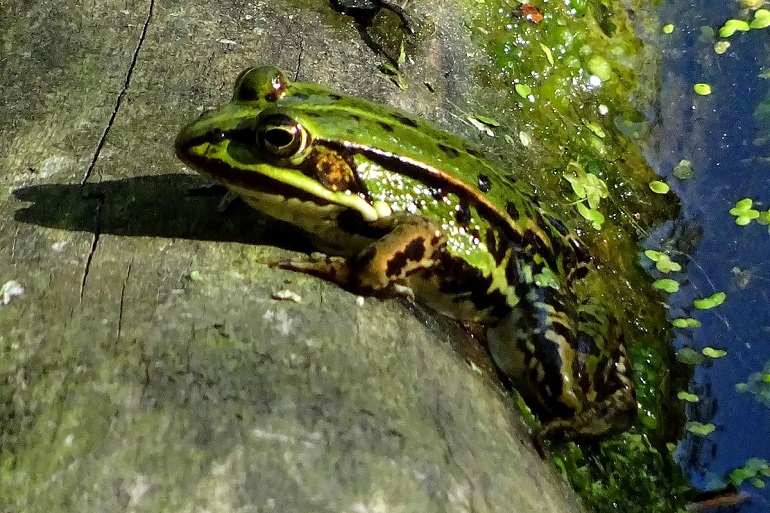
The diverse habitats support several reptile species, including forest lizards, green snakes, adders, and smooth snakes. The park's wetland areas provide habitat for amphibians such as crested newts, fire-bellied frogs (Bombina bombina), and agile frogs.
Aquatic Life
The park's waterways host native freshwater fish, including crayfish and brown trout, whilst the surrounding Baltic Sea waters support salmon and sea trout populations.
Conservation Significance
This remarkable diversity stems from the park's complex geological foundation and varied habitats, ranging from nutrient-poor to nutrient-rich soils, and from dry limestone areas to damp mires. The interplay between the ancient chalk geology, glacial history, and Baltic Sea influence has created conditions supporting over 10,000 species of plants, animals, and fungi.
The park's protection, dating back to 1929, ensures these ancient beech forests continue their natural development, providing visitors with a glimpse into what Germany's primeval forests once looked like whilst safeguarding this unique ecosystem for future generations.
Activities and Attractions
Jasmund National Park offers a remarkable array of activities and attractions that showcase its unique landscape of towering chalk cliffs, ancient beech forests, and pristine Baltic Sea coastline. Located on the Jasmund peninsula of Rügen island, this 3,100-hectare park presents visitors with exceptional opportunities to explore one of Europe's most distinctive natural environments.
The Iconic Chalk Cliffs
The park's most famous feature is undoubtedly its gleaming white chalk cliffs that rise dramatically up to 118 metres above the Baltic Sea. These magnificent formations, created over 70 million years ago during the Cretaceous period, continue to evolve through natural erosion processes that retreat the coastline by approximately 30 centimetres annually. The Königsstuhl stands as the most celebrated of these cliffs, offering visitors spectacular panoramic views from its new suspended skywalk, which opened in 2023. This viewing platform provides a fascinating perspective of the white rocks, emerald forests, and azure sea below.
The chalk formations extend over a remarkable 15-kilometre stretch from Sassnitz to the municipality of Glowe, creating an ever-changing landscape where visitors can observe geological processes in action. After periods of erosion, the distinctive chalk milk phenomenon occurs when broken chalk dissolves into the Baltic Sea, creating an impressive natural spectacle particularly visible during winter and spring months.
Multiple Viewpoints Along the Coast
Beyond the famous Königsstuhl, numerous strategically positioned viewpoints offer unique perspectives of the chalk cliff formations. The Wissower Klinken provides stunning views of chalk cliffs where the highest points have dramatically broken off, creating a testament to the ongoing natural forces shaping this coastline. The Ernst-Moritz-Arndt viewpoint offers another exceptional vantage point, whilst the Auguste-Victoria viewpoint presents visitors with arguably the finest perspective of the Königsstuhl itself.
The Kieler Ufer section features a spectacular waterfall cascading down the chalk cliffs, accessible via steep stairs that descend to the beach level. From this unique vantage point, visitors can appreciate the full majesty of the waterfall against the white cliff backdrop—a perspective impossible to achieve from the top of the cliffs.
Ancient Beech Forests
Jasmund National Park protects one of the world's last intact ancient beech forests, designated as a UNESCO World Heritage site in 2011. These primeval woodlands, some over 700 years old, cover the Stubnitz plateau and create a mystical atmosphere with their towering canopies and dappled sunlight. The forest ecosystem spans 2,100 hectares within the park, representing the largest contiguous beech forest on the Baltic coast.
Walking through these ancient woodlands offers visitors an immersive experience in one of Europe's most pristine forest environments, where the interplay of light and shadow creates an almost cathedral-like ambience amongst the towering beech trees. The forest floor, carpeted with decades of fallen leaves, provides natural cushioning for hikers whilst creating a distinctive earthy fragrance that combines with the salt air from the nearby Baltic Sea.
Comprehensive Hiking Trail Network
The Hochuferweg (High Shore Walk)
The Hochuferweg represents the park's premier hiking experience, offering the longest marked walking trail within Jasmund National Park. This spectacular coastal path spans the park's entire 15-kilometre coastline, with various sections catering to different fitness levels and time constraints. The most popular segment runs from Sassnitz to Königsstuhl, covering approximately 8 kilometres and taking 3-4 hours to complete at a leisurely pace.
This magnificent route leads hikers directly along the steep chalk cliffs through the ancient beech forest, providing constant opportunities to witness the dramatic interplay between forest and sea. The path alternates between firm forest floor and chalky surfaces near cliff edges, requiring sturdy hiking boots with excellent grip. The trail features an elevation gain of approximately 280-300 metres, making it suitable for intermediate to experienced hikers.
The Hochuferweg offers an unparalleled hiking experience, combining coastal drama with forest tranquillity. The trail provides regular glimpses of the sea through the forest canopy and emerges at spectacular viewpoints where hikers can fully appreciate the magnitude of the chalk formations. The route passes through sections where the ancient beech trees create natural archways overhead, whilst the sound of waves crashing against the chalk cliffs below provides a constant acoustic backdrop.
Extended Hochuferweg Routes
For more ambitious hikers, the complete Hochuferweg can be extended to create challenging day-long adventures. A particularly popular route covers 13.6 kilometres in approximately 3 hours and 49 minutes, featuring 280 metres of elevation gain and descent. This intermediate-level trail offers the most comprehensive coastal experience, passing through all major viewpoints and providing extensive exposure to both the cliff formations and the UNESCO World Heritage beech forest.
An alternative 13.4-kilometre route takes approximately 3 hours and 40 minutes to complete, with slightly less elevation gain at 210 metres. This variation provides similar spectacular views whilst being marginally more accessible to less experienced hikers.
Königsstuhl Direct Routes
For those seeking a shorter but equally rewarding experience, several direct routes to Königsstuhl offer perfect introductions to the park's highlights. The most accessible option begins from Parkplatz Hagen, requiring only 45 minutes each way to reach the famous chalk cliff formation. This 3-kilometre trail is suitable for most fitness levels and provides an excellent combination of beech forest walking and dramatic coastal views.
A slightly longer variation from Hagen extends to 4.09 kilometres, taking approximately 1 hour and 5 minutes to complete. This route features minimal elevation changes, making it particularly suitable for families or visitors with mobility considerations.
Victoria Viewpoint Trail
The Victoria Viewpoint Trail presents one of the park's most scenic moderate hikes, covering 9 kilometres over approximately 3 hours. This point-to-point route begins in Sassnitz and leads through the UNESCO World Heritage beech forest, passing multiple spectacular viewpoints before culminating at the Victoria viewpoint, which offers arguably the finest perspective of the Königsstuhl.
The trail features 394 metres of elevation gain and follows clearly marked blue and white trail markers. Approximately 95% of the route traverses unpaved surfaces through the ancient woodland, providing an authentic forest hiking experience. The path crosses the Kollicker Bach stream and offers opportunities to explore side trails to additional viewpoints.
Jasmund Cliff Comprehensive Hike
The Jasmund Cliff Hike offers a 7-kilometre intermediate route that takes approximately 3 hours to complete. This trail provides a comprehensive exploration of the park's cliff formations whilst maintaining manageable distances and elevation changes. The route offers spectacular coastal views combined with immersive woodland sections through the ancient beech forest, making it an ideal compromise between the shorter direct routes and the challenging full Hochuferweg.
Forest Interior Loop Trails
Several shorter loop trails wind through the interior beech forests, ranging from 3 to 6 kilometres in length. These routes typically take 1-2 hours to complete and offer visitors the opportunity to experience the mystical atmosphere of the ancient woodland without the dramatic coastal elements. These trails are particularly popular during warmer months when the forest canopy provides welcome shade and temperatures can be 5-10 degrees cooler than in exposed coastal areas.
The forest loops showcase the remarkable biodiversity of the ancient beech ecosystem, passing areas where rare orchid species flourish and offering opportunities to observe the complex forest floor ecology that has developed over centuries of undisturbed growth.
Multi-Day Hiking Options
For serious hiking enthusiasts, the park forms part of longer regional trail networks. The Caspar David Friedrich routes commemorate the famous Romantic painter's journeys across Rügen, with the Fifth Rügen Journey covering 112.7 kilometres over multiple days and the Fourth Rügen Journey extending 137.3 kilometres. These challenging routes incorporate the Hochuferweg as key segments within much larger coastal and inland hiking adventures.
Trail Infrastructure and Navigation
All major hiking trails throughout the park feature comprehensive signage systems with distinctive white and blue markers, ensuring easy navigation for visitors of all experience levels. Orientation points are strategically positioned across the park, providing clear location references and emergency contact information. Distance markers help hikers track their progress, whilst informational panels at key points provide insights into the local ecosystem, geological processes, and cultural heritage.
The trail system accommodates wheelchairs and pushchairs on selected routes, particularly the approach paths to the Königsstuhl visitor centre, though the majority of coastal paths remain unsuitable due to uneven terrain and safety considerations near cliff edges.
Guided Tours and Educational Programmes
Daily guided tours with qualified park rangers operate throughout the summer months, departing from various locations including Lohme, Hagen, Sassnitz, and the National Park Centre itself. These expertly led excursions, typically lasting 2-3 hours, offer detailed insights into the park's ecosystem, geological processes, and conservation efforts.
Specialised programmes cater to different interests, including geological tours focusing on chalk cliff formation, botanical walks highlighting the ancient beech forest ecosystem, and cultural heritage tours exploring the area's significance to Romantic artists like Caspar David Friedrich. Evening programmes during summer months take advantage of extended daylight hours and often conclude with spectacular sunset views from the chalk cliffs.
Educational Trails and Interpretation
Self-guided educational trails throughout the park feature informational panels and interactive elements designed to enhance visitors' understanding of the natural environment. These trails combine recreational hiking with educational content, covering topics such as forest succession, coastal erosion processes, and wildlife adaptation strategies.
The Michael-Otto-Haus provides additional educational resources and serves as an alternative starting point for several hiking routes. This facility focuses particularly on conservation efforts and the ongoing research programmes within the park.
Photography and Artistic Opportunities
Jasmund National Park offers exceptional opportunities for landscape photography, particularly during the golden hours of early morning and late afternoon when soft light illuminates the white chalk cliffs and filters through the beech forest canopy. The constantly changing weather conditions create dramatic lighting effects, with morning mist often rising from the Baltic Sea to create ethereal atmospheres around the cliff formations.
The park's association with Romantic art, particularly the works of Caspar David Friedrich, continues to inspire contemporary artists and photographers. Many of the viewpoints that inspired Friedrich's famous paintings remain accessible, allowing visitors to experience the same perspectives that influenced some of Germany's most celebrated artistic works.
Access Points and Transportation
Primary Access Routes
The park offers multiple access points to accommodate different hiking preferences and abilities. Parkplatz Hagen provides the most direct vehicle access to Königsstuhl, with a 3-kilometre hiking trail leading directly to the main attraction. This option suits visitors with limited time or mobility considerations.
Sassnitz harbour serves as the traditional starting point for the complete Hochuferweg experience, offering the full 8-kilometre coastal journey to Königsstuhl. This route provides the most comprehensive park experience but requires significantly more time and physical fitness.
Public Transportation Options
Regular bus services connect the park with major towns across Rügen island, including Binz, Sassnitz, and Bergen. Shuttle bus line 23 operates between Sassnitz and the National Park Centre during peak seasons, providing convenient transportation for visitors completing point-to-point hiking routes.
The bus services accommodate hikers planning one-way routes, allowing visitors to walk the full Hochuferweg from Sassnitz to Königsstuhl and return by public transport rather than retracing their steps.
Safety and Preparation Guidelines
Essential Equipment
Sturdy hiking boots with excellent grip are absolutely essential for all cliff-side trails, as surfaces alternate between firm forest paths and potentially slippery chalk areas. Waterproof clothing provides protection against rapid weather changes common along the exposed Baltic coastline.
Visitors should carry at least 1.5 litres of water per person, as hydration stations are limited throughout the park. Mobile phone coverage is generally reliable, but emergency contact information is prominently displayed at major trailheads and junctions.
Safety Considerations
The chalk cliffs remain actively eroding, making edges unstable and potentially dangerous. All safety barriers and marked boundaries must be strictly observed, as cliff collapses can occur without warning. Children require constant supervision in cliff areas, and pets must remain on leads throughout the park.
Weather conditions can change rapidly along the coast, with strong winds and sudden rain squalls common. Hikers should monitor weather forecasts and be prepared to adjust plans accordingly, particularly during autumn and winter months when storm conditions can make coastal paths dangerous.
The constantly evolving nature of the chalk cliffs means that the landscape never appears identical from visit to visit, making return trips equally rewarding as the coastline continues its natural transformation processes. Jasmund National Park provides an extraordinary opportunity to witness the dynamic relationship between geological forces, ancient forests, and marine environments, offering visitors a profound connection with some of Europe's most pristine and scientifically significant natural landscapes.
Accommodation
Camping and Nature-Based Stays
For those seeking an authentic connection with nature, several camping facilities are strategically positioned within and around the national park boundaries. These sites provide an excellent base for exploring the famous Königsstuhl cliffs whilst enjoying the tranquillity of the surrounding woodland. Family-run camping grounds offer modern amenities including clean sanitary facilities, electricity connections, and on-site refreshment options, with many featuring direct access to hiking trails that lead to the park's most spectacular viewpoints.
The camping experience here is particularly well-suited to motorhome travellers and those with caravans, though tent pitches are readily available. Most sites operate seasonally from late March through October, with advance booking recommended during peak summer months. Prices typically range from €26-32 per night for a standard pitch including two adults, vehicle, and electricity.
Hotels and Guesthouses
The nearby harbour town of Sassnitz serves as the primary accommodation hub for park visitors, offering everything from budget-friendly guesthouses to mid-range hotels. Properties here provide excellent access to both the national park and the historic chalk coast, with many establishments featuring Baltic Sea views and proximity to the town's charming old quarter.
Typical amenities include complimentary Wi-Fi, breakfast service, and parking facilities, with room rates generally falling between £75-180 per night depending on the season and room category. Several properties pride themselves on their traditional German hospitality, offering regional cuisine and local knowledge to enhance guests' exploration of the area.
Self-Catering Apartments and Holiday Homes
Holiday apartments represent a popular choice for families and longer stays, providing the flexibility of self-catering whilst maintaining proximity to the park's attractions. These accommodations are scattered throughout the Jasmund peninsula, with many offering panoramic countryside or sea views.
Properties typically feature fully equipped kitchens, private terraces or gardens, and comfortable living spaces designed for relaxation after days spent hiking the coastal paths. Many are situated within walking distance of the Königsstuhl visitor centre and the network of forest trails that characterise this protected landscape.
Unique Accommodations
For those seeking something rather special, the area boasts several distinctive lodging options including historic castle hotels and converted manor houses. These properties often feature extensive grounds, fine dining restaurants, and architectural details that reflect the region's rich cultural heritage.
Additionally, bed and breakfast establishments provide intimate accommodation experiences, often run by local families who offer insider knowledge about hidden gems within the national park and surrounding areas.
Location Considerations
Most accommodations are concentrated in the villages of Sassnitz, Lohme, and Hagen, each offering different advantages. Sassnitz provides the most comprehensive amenities and transport connections, whilst Lohme offers a more intimate coastal village atmosphere with direct cliff-top access. Hagen serves as an excellent base for those prioritising immediate access to forest hiking trails.
The proximity to public transport links makes car-free visits entirely feasible, with regular bus services connecting accommodation areas to major park attractions and trailheads. Many properties offer bicycle rental services, providing an eco-friendly means of exploring the peninsula's quieter corners.
Gastronomy
Coastal flavours and local catch
- The Baltic coast defines much of the park’s gastronomy, with dishes built around freshly landed fish such as herring, cod, and flatfish, often prepared simply to foreground the delicate, briny sweetness of the catch.
- Smoking and curing are time-honoured techniques, yielding robust flavours well suited to the sea air—expect flaky smoked fillets, pickled specialities, and fish soups that balance richness with herbal freshness.
Island produce and forest notes
- Rügen’s fertile soils support potatoes, brassicas, and root vegetables that feature prominently, frequently paired with tangy dairy, horseradish heat, and garden herbs.
- The park’s beech woods inspire seasonal menus: wild mushrooms in late summer and autumn, berries and orchard fruit in compotes and cakes, and occasional game-influenced flavours in colder months.
- Grains and rustic breads provide earthy counterpoints to seafood and preserves, often served with butter or soft cheeses from nearby dairies.
Traditional techniques, modern restraint
- Cooking draws on northern German traditions—marinating, pickling, and slow-braising—tempered by a light, coastal touch that keeps dishes clean and bright.
- Sauces are typically herb-led rather than heavy; dill, parsley, and chives are common, with mustard and vinegar lending gentle sharpness.
Sweet finishes and afternoon culture
- Cakes and pastries play a cherished role, particularly in the mid-afternoon coffee-and-cake ritual. Expect seasonal fruit tarts, yeast cakes, and nutty biscuits that pair well with a seaside stroll.
- Desserts often highlight apples, berries, and plums, presented simply to showcase freshness.
Beverages with a regional accent
- Crisp northern beers, light and food-friendly, are widely poured, alongside ciders and fruit-based soft drinks that reflect the island’s orchards.
- Herbal teas and locally inspired infusions suit cooler, windy days on the cliffs; in warmer months, sparkling waters and spritzed fruit juices are popular refreshers.
Dining settings and rhythms
- Eating in and around the park tends to be relaxed and scenic—think woodland edges, cliff-top viewpoints, and breezy coastal paths providing the backdrop.
- Menus follow the seasons closely. Spring brings tender greens and the first herbs; summer leans into salads and grilled fish; autumn emphasises mushrooms, roots, and hearty soups; winter pivots to warming stews and preserves.
- Portions are generous but not heavy, designed for active days of walking and cycling.
Practical tips for visitors
- Embrace the daily catch: opting for the “catch of the day” is a reliable way to experience peak freshness.
- Look for seasonal specials: mushrooms in autumn, berry desserts in summer, and robust soups when the winds pick up.
- Expect straightforward, ingredient-led cooking: presentation is typically unfussy, with flavour and provenance taking centre stage.
- Consider picnics: local bakeries, farm produce, and smoked fish travel well and make for memorable meals at designated viewpoints.
Getting There and Around
How to Get to Jasmund National Park
- By Car: From mainland Germany, drive to Stralsund and cross the Rügen Bridge to access the island. Signage guides you onwards to Jasmund National Park, with ample parking available at sites like Parkplatz Hagen and near the Königsstuhl visitor centre.
- By Train: Regular trains travel from major cities—such as Berlin and Hamburg—to Bergen, the island's chief town. From Bergen, transfer to a local train heading to Sassnitz, which lies at the park's edge.
- By Bus: Sassnitz railway station and harbour offer connections via bus (notably line 23 and 14) to the park centre and the Königsstuhl National Park Centre. Buses may run infrequently, so plan ahead if relying on public transport.
- By Plane: The nearest major airports are Hamburg and Berlin, both offering onward rail and car hire options for reaching Rügen and Jasmund National Park.
Getting Around and Exploring the Park
- By Foot: Walking is the best way to enjoy Jasmund National Park. Numerous marked trails suit a range of abilities, from leisurely loops to longer hikes. The acclaimed Hochufer trail provides spectacular views over the Baltic coastline and chalk cliffs, while routes from Parkplatz Hagen offer a combination of verdant beech forests and seascapes. Most routes are well signposted—photograph trail maps at the outset to aid navigation.
- By Bicycle: Cycling is permitted on selected trails and offers an alternative way to traverse the woodland and visit key sights including the UNESCO-listed beech forest.
- Facilities: Key trailheads like Parkplatz Hagen feature information boards, toilets, and refreshments, ideal for starting your day. The Königsstuhl National Park Centre provides further details about trails, nature, and park conservation.
- For Families: The park caters well to families with pram-friendly paths, playgrounds, and picnic areas.
- Accessibility: Major entrances and certain parking areas are wheelchair accessible.
When visiting, keep in mind that public transport schedules are limited and advance planning is helpful, especially if you hope to avoid longer walks from Sassnitz. Hiring a car broadens your options for exploring not just Jasmund National Park, but the scenic island of Rügen as a whole.
Best Time to Visit
Jasmund National Park offers a dramatically different experience depending on when you visit, making timing crucial for your trip to Germany's smallest national park. Each season brings its own character to the iconic white chalk cliffs and ancient beech forests.
Summer: Peak Season Beauty and Crowds
June through August represents the park's busiest period, and for good reason. The weather is at its most reliable, with temperatures reaching a comfortable 20-22°C and the longest daylight hours of the year. The Baltic Sea is at its warmest, and the beech forests are in full, lush green splendour.
However, this popularity comes at a cost. With nearly one million visitors annually, summer sees the heaviest crowds, particularly from German and Scandinavian holidaymakers. The car parks fill quickly, and the famous viewpoints can become quite congested, especially around midday. If you're set on a summer visit, arrive early in the morning - ideally by 10:30am - to enjoy the trails and clifftop views with significantly fewer people.
Spring and Autumn: The Sweet Spot
April through May and September through October offer perhaps the most rewarding visits to Jasmund. Spring brings wildflowers carpeting the forest floor and fresh green leaves creating a vibrant canopy against the stark white cliffs. The weather begins to warm, though it can still be unpredictable in northern Germany.
Autumn proves equally spectacular, with the ancient beech forests transforming into a tapestry of golden and amber hues that create a stunning contrast against the chalk cliffs. September often provides the best balance of pleasant weather and manageable crowds, whilst October offers the peak autumn colours, though expect windier conditions.
Both seasons see significantly fewer visitors than summer, allowing for a more peaceful experience of the park's natural beauty.
Winter: Solitude and Dramatic Moods
November through March transforms Jasmund into an entirely different world. Whilst the weather can be harsh and unforgiving, with temperatures often dropping well below freezing, winter offers the park's most solitary and atmospheric experience.
The chalk cliffs take on a particularly dramatic character during winter storms, with fog rolling through the forests and the Baltic Sea churning below. Fresh snowfall can create an almost ethereal landscape, and the park becomes remarkably quiet. December and January are particularly peaceful, though you'll need to be prepared for challenging weather conditions and shorter daylight hours.
Winter is ideal for those seeking solitude and don't mind bundling up for the cold Baltic winds.
Weather Considerations
The park's location on the Baltic coast means weather can be unpredictable throughout the year. Even in summer, don't expect guaranteed sunshine - pack layers and waterproof clothing regardless of season. The coastal position makes the area particularly windy during autumn, winter, and spring, which can make the cliffs feel more dramatic but also more challenging to navigate.
May and October often provide the best compromise between decent weather and fewer crowds, though both months can still be quite variable.
Practical Timing Tips
Regardless of season, early morning visits consistently offer the best experience. Not only will you encounter fewer people, but the morning light on the white cliffs can be particularly photogenic. The park is accessible year-round, with well-marked trails suitable for hiking in all seasons, though winter conditions may require more careful planning and appropriate gear.
Each season at Jasmund offers something unique - from summer's reliable warmth and long days to winter's stark, solitary beauty. Your ideal time depends on whether you prioritise good weather and full accessibility or prefer the romance of fewer crowds and dramatic seasonal moods.
Conservation and Responsible Tourism
A Fragile Natural Heritage
Jasmund National Park, Germany's smallest national park, encompasses an exceptional spectrum of habitats that require careful protection. The park's remarkable diversity stems from the complex interplay of climate, relief, and soil conditions, which together support a rich flora and fauna across its mere 3,003 hectares. At the heart of conservation efforts lies the UNESCO World Heritage designation – 493 hectares of the park's ancient beech forests have been part of the "Ancient Beech Forests and Primeval Beech Forests of the Carpathians and Other Regions of Europe" since 2011.
Understanding the Dynamic Landscape
The park's most famous feature – the gleaming white chalk cliffs – presents both conservation challenges and opportunities. These cliffs, which retreat approximately 30 centimetres annually, are in constant flux due to natural erosion. The active chalk coast creates an ever-changing habitat that supports species such as sand martins and peregrine falcons, whilst the ongoing erosion process contributes chalk milk to the Baltic Sea, creating impressive natural spectacles particularly visible in winter and spring.
The ancient beech forests have remained largely untouched throughout history, as their steep slopes made commercial exploitation economically unviable. This fortunate circumstance has preserved pristine woodland that now serves as a living testament to Central Europe's natural heritage.
Conservation Priorities
Water Balance Protection
A key conservation goal focuses on protecting the park's near-natural water balance. Over 100 smaller and larger moors are distributed throughout the area, including spring, flow-through, kettle, and marshy moors. Many of these moorland areas have previously been drained by human intervention, prompting an ongoing moor revitalisation programme to restore their function as healthy habitats for species such as marsh irises, cotton grass, sundew, and fire-bellied toads.
Marine Conservation
The park extends 500 metres into the Baltic Sea, protecting submarine chalk ridges, algae-covered boulder fields, mussel beds, sandbanks, and mudflats. This brackish water environment supports an unusual mixture of marine and freshwater species, including the grey seal, one of the park's largest aquatic inhabitants.
Responsible Tourism Guidelines
Path Adherence and Safety
Staying on designated paths is fundamental to responsible park visitation. The soft chalk material, particularly in slope areas, makes climbing extremely dangerous and is strictly prohibited within the national park. Visitors should use only designated descents and maintain distance from the unstable cliff edges, where erosion regularly causes chalk chunks to break away and landslides to occur. The high bank path offers the safest route for hiking above the dangerous cliff areas.
Leave No Trace Principles
The park operates under the motto "Take nothing with you and leave nothing behind". This extends to:
- Waste management: Visitors must carry all rubbish home, as bins are limited to park entrances and visitor centres to prevent wildlife interference.
- Natural preservation: Collecting mushrooms, plants, or fossils is strictly forbidden to avoid habitat disturbance.
- Wildlife respect: Maintaining distance from animals and avoiding noise ensures safe encounters for both visitors and wildlife.
Restricted Activities
Several activities are prohibited within the protected area to maintain ecological integrity:
- Swimming and fishing are not permitted in the sensitive Baltic Sea zone.
- Drone flights are banned throughout the national park.
- Dogs must remain on leads at all times, with waste bags disposed of only at designated facilities.
Sustainable Visitation
Despite attracting one million visitors annually, the park maintains its conservation focus through careful management. The Königsstuhl National Park Centre provides educational exhibits about nature conservation, whilst the newer Skywalk Königsstuhl offers panoramic views with minimal environmental impact.
Seasonal considerations can enhance responsible tourism:
- Winter visits offer spectacular foggy forests with fewer crowds.
- Spring provides excellent shore exploration opportunities with smaller visitor numbers.
- Autumn showcases stunning forest colours against white cliffs.
- Summer, whilst gorgeous, brings peak visitor pressure.
Transportation within the park follows sustainable principles – private vehicles can only park at designated edge locations, with shuttle buses providing access to the park centre. A gravel biking path, established in 2019, offers an environmentally conscious alternative for exploring the area.
Balancing Access and Protection
Jasmund National Park demonstrates that conservation and tourism can coexist when visitors understand their role as temporary custodians of this remarkable landscape. The park's management philosophy recognises that education and responsible access help build support for long-term conservation efforts, whilst strict adherence to guidelines ensures the protection of this fragile ecosystem for future generations.
By following established guidelines and embracing the leave-no-trace philosophy, visitors contribute to the preservation of Germany's smallest yet most precious national park, ensuring that its ancient forests, dynamic cliffs, and diverse wildlife continue to thrive in their Baltic Sea setting.

Visitor Centres and Educational Facilities
Nationalpark-Zentrum Königsstuhl (Königsstuhl National Park Centre)
The Nationalpark-Zentrum Königsstuhl is the principal visitor centre for Jasmund National Park, set beside the famous chalk cliff of the Königsstuhl on Rügen’s Stubbenkammer, and serves as the hub for orientation, exhibitions, and ranger-led activities within the park. Opened in 2004 and operated by a non-profit company backed by WWF Germany and the town of Sassnitz, it welcomes hundreds of thousands of visitors annually and is regarded as one of Germany’s most popular national park centres.
- Location and access: The centre sits at Stubbenkammer near the cliff-top, with direct car access restricted; most visitors arrive via the large Hagen car park and a dedicated shuttle bus (route 19), or by hiking through the park. Bus links also run from Sassnitz (route 23).
- Opening times: Open daily all year (closed only on Christmas Eve), with seasonal hours: Nov–Mar 10:00–17:00; Apr, May, Sep, Oct 09:00–18:00; Jun–Aug 09:00–19:00. Last exhibition entry is one hour before closing; the last multivision cinema show starts 20 minutes before closing.
- Admission: Adults €12; children (6–14) €6; family ticket €25; under-6s free. Tickets include the Skywalk, the interactive exhibition, cinema, guided tours and discovery stations on the grounds.
- Accessibility: The outdoor area and Skywalk are barrier-free; lifts provide access to all exhibition spaces. The shuttle bus from Hagen is low-floor and suitable for wheelchairs.
What to See and Do
- Skywalk Königsstuhl and cliff-top vistas: The centre provides access to the Königsstuhl viewing platform and the new Skywalk, delivering dramatic views over the chalk coast and Baltic Sea from Germany’s highest chalk cliff section.
- Interactive “journey through time” exhibition: Over 2,000 m² of multimedia displays trace the formation of the chalk coast, the region’s geology and Ice Age history, and the flora and fauna of the Jasmund peninsula. Children’s hands-on areas and themed “time travel” routes make it engaging for all ages.
- Multivision cinema: A 180° film experience immerses visitors in the park’s landscapes and UNESCO-protected ancient beech forests, using large-scale imagery to convey the ecological value and emotional appeal of Jasmund.
- Outdoor learning area: A 28,000 m² grounds includes playful educational stations, such as a climbing forest and interpretive installations that introduce species, habitats, and cultural heritage (including references to Caspar David Friedrich’s iconic Rügen paintings).
- Ranger tours and walks: Free guided walks are offered, along with themed tours that vary by season. Well-marked hiking routes include an inland loop through lakes and ancient beech stands and the clifftop Hochuferweg between the Königsstuhl and Sassnitz for ever-changing views of the chalk coast.
- Safety guidance: Visitors are advised to remain on marked trails, using the Hochuferweg rather than walking beneath the cliffs due to risk of chalk collapses.
Practicalities
- Facilities: Bistro with regional fare, stepless outdoor areas, accessible WCs, and staffed assistance for visitors with limited mobility.
- Getting there: Park at Hagen and ride the shuttle, or hike 3 km from Hagen or 8 km from Sassnitz via signed trails. Limited on-site access exists for blue badge holders and coaches.
- When to visit: Early arrivals often enjoy a quieter exhibition experience, especially in peak season.
Educational Focus and UNESCO Beech Forests
Jasmund’s UNESCO-listed Ancient and Primeval Beech Forests are a core theme of the centre’s interpretation, with exhibits and films that explain the global significance of Europe’s last remnants of unaltered beech ecosystems and how the park protects them. The centre’s mission is explicitly educational: presenting the park’s natural processes and inviting low-impact enjoyment, while fostering awareness of conservation responsibilities from exhibition content through to sustainable operations on site.
Tips for Travellers
- Combine a visit to the centre with the Hochuferweg for classic cliff views and interpretive stops; factor in time for the Skywalk and the cinema for a complete introduction before heading onto the trails.
- Use public transport and the shuttle to reduce traffic near the cliffs, and check seasonal opening hours to time entry and film screenings comfortably.
- Families will find age-appropriate activities both indoors and in the outdoor learning area, and most experiences are included in the admission price.


