



| Contents |
|---|

Introduction
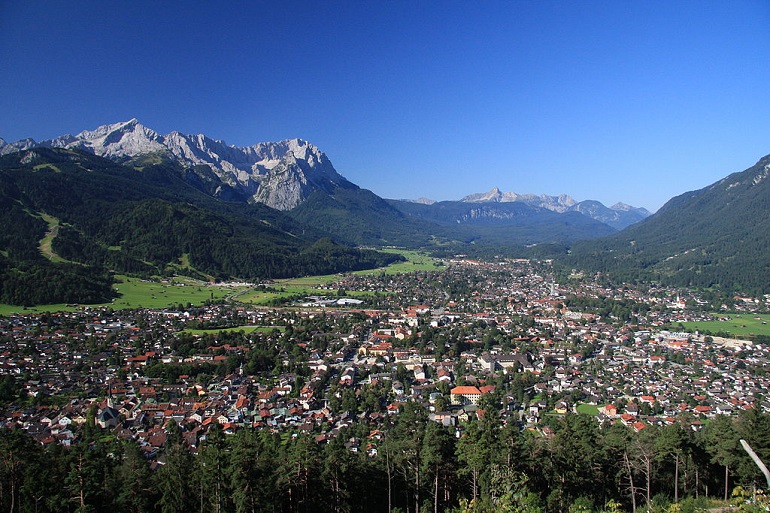
Garmisch-Partenkirchen (pop. 27,000) is one of Germany's most famous ski resorts and hosted the 1936 Winter Olympics. The town lies at the foot of Zugspitze, Germany's highest mountain at 2961 m (9714 ft). The town remains a popular destination for skiing, snowboarding, and hiking. Garmisch and Partenkirchen were separate towns until they were combined in 1935. The area also offers access to alpine lakes, traditional Bavarian architecture, and a historic town centre. Well-connected by rail and road, it serves as both a year-round resort and a gateway to the surrounding Alps.
Interesting Facts about Garmisch-Partenkirchen
- Garmisch-Partenkirchen hosted the 1936 Winter Olympics, which was the first time alpine skiing appeared in the Games.
- The town lies at the foot of Zugspitze, which at 2,962 metres is Germany’s highest mountain.
- Garmisch and Partenkirchen were separate towns until 1935, when they were forcibly merged to host the Olympics.
- Partenkirchen traces its roots to the Roman settlement of Partanum, with its main street following the ancient Roman trade route.
- You can still see dairy cows being herded through the streets in the early morning and evening, a charming local tradition.
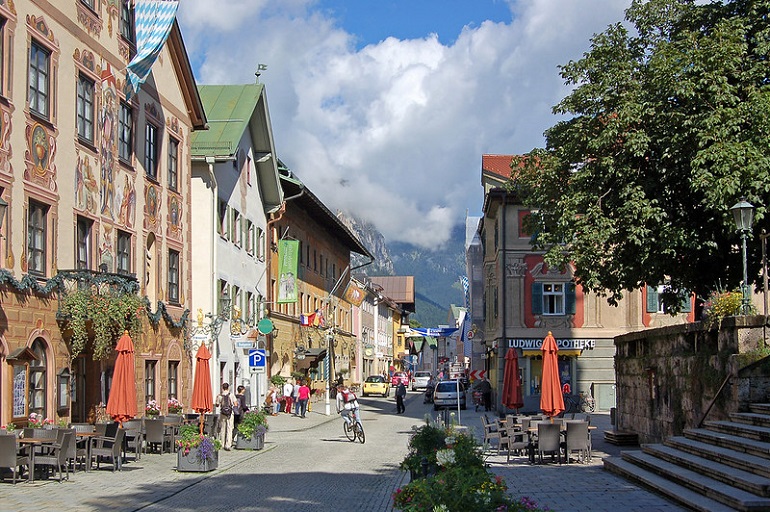
- The historic Ludwigstraße in Partenkirchen is lined with picturesque buildings, shops, and cafés, reflecting traditional Bavarian charm.
- Garmisch-Partenkirchen is famous for its painted houses, decorated with colourful “Lüftlmalerei” murals depicting local life and folklore.
- The town is a mecca for winter sports, offering over 60 kilometres of pistes and hosting the prestigious New Year’s Ski Jump event.
- Partnach Gorge, a natural wonder, offers spectacular walks along dramatic rock formations and icy waterfalls throughout the year.
- The Werdenfels Museum and Aschenbrenner Museum showcase regional costumes, handicrafts, and even nativity scenes, capturing the local culture.
- Visitors can reach the summit of Zugspitze by cogwheel railway, which offers panoramic views across four countries.
History
The history of Garmisch-Partenkirchen spans over two millennia, with its two halves following remarkably different paths before their forced union in 1935. Partenkirchen boasts the more ancient heritage, originating as the Roman town of Partanum around 15 CE. Built as a crucial waystation on the Via Raetia trade route connecting Venice to Augsburg, the settlement's main thoroughfare, Ludwigsstrasse, still follows the original Roman road. The town was first documented under the name Barthinchirchen in 1130 and evolved into a regional centre of commerce and craftsmanship during the medieval period, receiving market rights in 1361. In contrast, Garmisch began as a Germanic settlement called Germaneskau ("German District") around 802 CE, suggesting that a Teutonic tribe established themselves in the western end of the valley some eight centuries after the Romans had colonised the eastern portion.
From the late 13th century onwards, both communities fell under the dominion of the prince-bishops of Freising as part of the County of Werdenfels, a arrangement that persisted until Bavaria's secularisation in 1803. The region was administered by a Pfleger (caretaker) from the imposing Werdenfels Castle, perched on a crag north of Garmisch. However, the valley endured centuries of hardship following the decline of overland trade after European expansion to the Americas in the 16th century. The swampy valley floor proved difficult to cultivate, whilst bears, wolves, and lynx posed constant threats to livestock. The population suffered periodic epidemics, including devastating outbreaks of bubonic plague in the 1630s, and the region witnessed horrific witch trials between 1589 and 1596, during which 63 people—over 10% of the population—were executed at Werdenfels Castle. The castle became so associated with terror that it was abandoned in the 17th century and largely demolished in the 1750s, with its stones repurposed to construct the baroque Neue Kirche (New Church) on Marienplatz, completed in 1752.
The separate identities of Garmisch and Partenkirchen were forcibly merged on 1 January 1935 when Adolf Hitler compelled their respective mayors to combine the two market towns in preparation for hosting the 1936 Winter Olympics. This union occurred against the wishes of local residents, who had decisively rejected the proposal in a referendum. Partenkirchen suffered additional setbacks with devastating fires in 1811 and 1865 that destroyed most of its original buildings. The 1889 completion of the railway line to Munich marked a turning point, attracting artists and holidaymakers to both communities and reversing centuries of economic decline. Following World War II, the town served as a recreational centre for U.S. military personnel, and whilst the communities remain officially united, residents maintain their distinct identities through separate ski clubs, yodel societies, and fire brigades, with the mayoral position shared between representatives from both halves of the town.
Main Attractions
Zugspitze
Is Germany’s highest mountain, rising to 2,962 metres on the border between Germany and Austria. The summit can be accessed from Grainau via the Seilbahn Zugspitze, a modern cable car departing from near Lake Eibsee, or by the historic rack railway operated by the Bayerische Zugspitzbahn, which traverses a 4.5-kilometre tunnel to the Zugspitzplatt plateau. From the summit, visitors can observe panoramic views across four countries and over 400 surrounding peaks, and in winter the site encompasses Germany’s only glacier ski region with twenty kilometres of pistes and dedicated toboggan runs. The summit station also houses two restaurants and exhibition spaces, while in summer a circular glacier hiking trail leads past Germany’s highest chapel, Maria Heimsuchung.
Partnachklamm
Is a narrow limestone gorge carved by the Partnach River in the Reintal valley near Garmisch-Partenkirchen, extending for 702 metres and reaching depths of up to 80 metres. A safeguarded walkway, tunnels and bridges allow visitors to traverse the dramatic rock walls and waterfalls throughout the year, with emergency lighting and intercom systems ensuring safety. Since its designation as a natural monument in 1912, access is controlled by a ticket barrier at the gorge entrance, with opening hours from 08:00 to 18:00 in summer and 09:00 to 17:00 in winter.
Olympic Ski Jump
Stands at Karl-und-Martin-Neuner-Platz as a modern sporting facility reconstructed in 2007 on the site of the original 1920s jump. The structure comprises a 60-metre tower and a total height of 149 metres, featuring a 100-metre inrun and a viewing terrace overlooking the ski stadium. Guided tours operate weekly, and an on-site zip-line offers an aerial experience adjacent to the tower.
Wankbahn
Is a cable car that ascends Mount Wank to a summit plateau at approximately 1,780 metres above sea level, providing views across the Garmisch basin and the Wetterstein range. The lower station lies in Partenkirchen and the ten-minute gondola ride transports passengers over forested slopes and alpine meadows. From the upper station, a network of hiking trails and paragliding launch points connects visitors to panoramic vistas and a mountain restaurant serving regional cuisine.
Eckbauer
Refers to a mountain summit at 1,236 metres, accessible by the Eckbauerbahn cable car departing from the Olympic Ski Stadium. The summit hosts a traditional alpine café and serves as the starting point for intermediate-level hiking routes into the Wetterstein foothills. In winter the slopes around Eckbauer accommodate family-friendly skiing, while in summer the area forms part of longer circuits linking to the Partnach Gorge and neighbouring peaks.
Riessersee
Is a natural lake situated south of Garmisch-Partenkirchen at an altitude of 750 metres, set within a protected landscape and open to swimming and boating during the warmer months. A circular trail of approximately 2.5 kilometres provides lakeside walking and cycling, while fishing is permitted under regional regulations. In winter the lake surface often freezes sufficiently for ice-skating, and adjacent spa facilities date from the early twentieth century.
Historische Ludwigstraße
Is the principal thoroughfare of Partenkirchen, dating from the late medieval period and characterised by traditional Bavarian facades and frescoed townhouses. Running east–west through the old quarter, the street is lined with artisan shops, cafés and traditional inns housed in buildings originally established during the seventeenth and eighteenth centuries. Pedestrianised since the 1980s, it serves as the cultural heart of the town and hosts seasonal markets and civic events.
Pfarrkirche St. Martin
Is a Baroque parish church located at Marienplatz in Garmisch, constructed in 1733 on the foundations of a fifteenth-century chapel. The interior is noted for its stucco work, ceiling frescoes and an ornate high altar, while the exterior features an onion-shaped dome and Alpine stone masonry. The church remains in active use for regular worship services and hosts occasional classical music concerts.
Wallfahrtskirche St. Anton
Is a Baroque pilgrimage church situated on a hillside above Partenkirchen, dedicated to Saint Anton and dating from the early eighteenth century. The church features an onion dome and interior frescoes by Johann Evangelist Holzer, while its approach via the Philosophenweg path includes Stations of the Cross carved into the landscape. The site continues to attract local pilgrims for annual feast day observances and remains accessible by footpath throughout the year.
Graseckseilbahn
Is a historic cable car that connects the entrance of the Partnach Gorge to the mountain farms of Mount Graseck over a 520-metre track, originally installed in 1953. The ride affords views across the upper Loisach valley and delivers visitors to a mountain restaurant noted for traditional Bavarian fare. The lower terminus is located adjacent to the Partnachklamm entry, facilitating combined gorge and summit excursions within a single itinerary.
Top Museums
Werdenfels Museum
A cornerstone for exploring local heritage, the Werdenfels Museum resides in a charming 17th/18th-century merchant’s house and takes you on a journey through roughly 7,000 years of history. Its extensive exhibitions cover the cultural story of the Werdenfels region, from prehistoric artefacts to folk art, sacred objects, traditional costumes, and even a reconstructed violin maker’s workshop. The museum delights in detailing both the rural and bourgeois ways of life, with interactive and artistic presentations, carnival masks, and an experience trail that especially engages families and children. Particularly notable are its special exhibitions, which combine contemporary art with historical collections, offering fresh perspectives on tradition and history. Some information is available in English, ensuring an accessible experience for most international visitors.
Museum Aschenbrenner
Ideal for lovers of fine craftsmanship and nostalgic charm, the Museum Aschenbrenner captivates with its collections of porcelain, dolls, and nativity scenes. Renowned for its meticulous displays, the museum features porcelain pieces by acclaimed artisans from Meissen and beyond, elegant French fashion dolls, classic play dolls by Käthe Kruse, and intricate nativity dioramas representing a variety of artistic styles. Its modern setting is child-friendly, with interactive activities and exhibits suitable for families. The museum also hosts several guest exhibitions annually, ensuring there is always something new to discover. Its accessible design and family-oriented approach make it a welcoming site for visitors of all ages.
Höllentalklamm Museum
Nestled at the gateway to the dramatic Höllental Gorge, this compact museum blends natural history with human endeavour, offering an in-depth look at the formation of the Höllental and the bold construction of the gorge walkways. Exhibits include geological samples, archival photographs, and tools, conveying the saga of mining, alpine exploration, and the local alpine club. Particularly appreciated by hikers, the museum enriches walks through the gorge with fascinating background information about the region’s geology and the challenges faced during the construction of the scenic paths. Although primarily in German, the visuals make it accessible and enjoyable for non-German speakers as well.
Historic Olympia Bobbahn am Riessersee (Bob Museum)
For those intrigued by winter sport and Olympic history, the Bob Museum at Riessersee presents a unique retrospective of bobsledding, centred around the original bobsleigh track of the 1936 Winter Olympics. Visitors can view an impressive collection of 17 historic bobsleighs spanning several decades, alongside memorabilia, original film footage, and detailed information about the evolution of this thrilling sport. The track itself, recognised for its demanding curves and storied past, can be partially explored on foot—an experience that combines cultural discovery with scenic beauty. This museum appeals particularly to sports enthusiasts and those interested in Garmisch-Partenkirchen’s Olympic legacy.
Richard Strauss Institute
Music lovers shouldn’t miss the Richard Strauss Institute, located in the composer’s one-time villa. This institution honours the life and work of Richard Strauss, providing a glimpse into one of Germany’s most renowned musical figures. The institute houses a permanent exhibition, concert hall, library, and archive, and regularly hosts concerts and the annual Richard Strauss Festival. The setting offers both cultural and historical enrichment, especially for those interested in classical music and its local connections.
Local Cuisine
Local specialities such as Weißwurst (white sausage), Bratwurst, and Schnitzel are staples, often enjoyed with a soft Brezen (pretzel) and tangy sauerkraut. Traditional meals are rounded off perfectly by a sweet plate of Kaiserschmarrn, a fluffy shredded pancake, or a comforting Bavarian cream dessert. Cosy inns and beer gardens throughout the town serve these classics alongside robust regional beers, offering a genuine taste of Bavaria after a day exploring the mountains.
Getting There & Around
By train, Garmisch-Partenkirchen is easily accessible with direct connections from major German cities like Munich, as well as regular regional and long-distance services from across the country. The town’s main station is located centrally, and trains run frequently, allowing for a comfortable and straightforward journey.
By coach or bus, several companies such as FlixBus and Oberbayernbus provide direct and connecting services from nearby cities, including Munich and Innsbruck. Coaches tend to stop at the main station in Garmisch-Partenkirchen, making onward travel into town or to local attractions simple and convenient.
By car, Garmisch-Partenkirchen is reached via the A95 motorway from Munich, which leads directly to the B2 highway taking you into the heart of town. Approaching from the south, follow the E533 and then the B2 federal road. Be aware that during peak seasons, the roads can be busy, and planning an early or off-peak arrival may help avoid delays.


