



| Contents |
|---|

Introduction
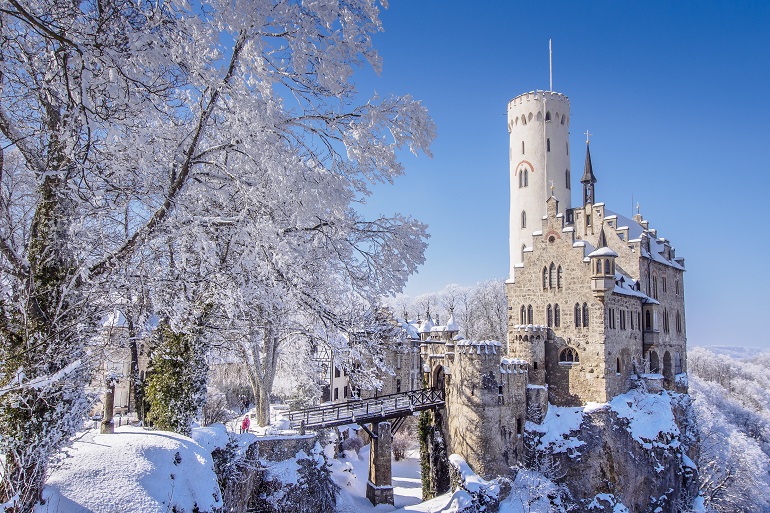
The perfect romantic castle, set high in the Swabian Alb overlooking the Echaz valley, Lichtenstein Castle (Schloss Lichtenstein) is a Neo-Gothic folly erected on medieval ruins overlooking a steep cliff at 817 metres above sea level overlooking the Echaz valley. Built between 1840 and 1842 by Count Wilhelm of Württemberg, Duke of Urach, the castle was inspired by Wilhelm Hauff's 1826 romantic novel "Lichtenstein" and designed by architect Carl Alexander Heideloff to resemble a medieval knight's fortress. Though appearing ancient, the current structure stands on the foundations of a 14th-century castle, with the name "Lichtenstein" meaning "shining stone" in German, referring to the light-coloured limestone cliffs on which it is perched. Often called the "fairy-tale castle of Württemberg," this privately owned castle remains in the possession of the Dukes of Urach and houses a collection of medieval weapons, armour, and historical artefacts whilst offering visitors guided tours of both its neo-Gothic interior and dramatic clifftop setting in the Swabian Alps.
Interesting Facts about Lichtenstein Castle
- Lichtenstein Castle, often called the "fairytale castle of Württemberg," is perched dramatically atop an 800-metre-high cliff in the Swabian Alb region of Germany.
- The current neo-Gothic structure was constructed between 1840 and 1842, inspired by Wilhelm Hauff's 1826 novel "Lichtenstein".
- While the castle looks medieval, it is actually quite young, having been built on the ruins of earlier fortresses dating back to around the year 1200.
- The castle is still privately owned today by the Dukes of Urach, descendants of the original builder, and remains open for public tours.
- Count Wilhelm of Württemberg, later Duke of Urach, commissioned Lichtenstein Castle as a romantic retreat rather than a fortress, filling it with his collection of medieval arms and armour.
- During World War II, an American tank shell hit the central tower, and you can still see evidence of this on the castle walls today.
- Lichtenstein Castle features a chapel with beautiful 14th-century stained-glass windows and paintings by Michael Wohlgemuth, Albrecht Dürer's teacher.
- The castle is smaller than many German castles and is sometimes affectionately nicknamed “Neuschwanstein’s Little Brother” due to its picturesque and romantic style.
- Guided tours of the castle showcase historic rooms, centuries-old armour, and secret passageways leading to the dungeons.
- The impressive site and architecture have made Lichtenstein Castle a much-loved tourist destination, attracting visitors from around the globe.
History
The origins of Lichtenstein Castle trace back to the early 12th century, when a medieval fortress was constructed around 1100 on the escarpment above the River Echaz in southwestern Germany. This original castle served as the ancestral seat of the Lords of Lichtenstein, a noble family of ministerials who held significant influence in the region under the counts of Achalm and later the counts of Württemberg. However, the castle's strategic position made it a frequent target of conflict. The original fortress suffered a tumultuous fate, being completely destroyed twice - first during the imperial civil war of 1311, and again by the citizens of the Free Imperial City of Reutlingen between 1377 and 1381, due to ongoing hostilities between the lords and the neighbouring city. Following the second destruction, a new medieval castle was erected in 1390 approximately 500 metres from the ruins of the old one, on the same site where today's castle stands. This new fortification was considered one of the most impressive structures of the Late Middle Ages, incorporating advanced defensive features such as early casemates that made it nearly impregnable.
Despite its formidable defences, the medieval castle's importance gradually declined after it ceased to serve as a ducal seat in 1567, and the structure fell into disrepair. The castle's fate was sealed when the last member of the Lichtenstein family died in 1687 during the Great Turkish War, after which the Tyrolean line of the Habsburg family took control. Their coat of arms - a pair of golden angel wings on a blue background - remains displayed in the castle's great hall to this day. The deteriorating structure eventually came into the possession of King Frederick I of Württemberg in 1802, who dismantled the entire medieval castle to its foundations and replaced it with a simple hunting lodge. This hunting lodge remained on the site for several decades until Count Wilhelm of Württemberg, who later became the first Duke of Urach, decided to transform the location into something far more extraordinary.
The current neo-Gothic castle that visitors see today was constructed between 1840 and 1842, inspired by Wilhelm Hauff's 1826 romantic novel "Lichtenstein". Count Wilhelm, passionate about medieval arts, arms, and armour, commissioned architect Carl Alexander Heideloff to create an accurate emulation of a medieval castle that would serve both as a residence and museum for his substantial collection. The construction utilised the ancient foundations of the 1390 castle and rose up to three storeys, complete with a curtain wall and courtyard. In 1857, additional defensive features were added, including a barbican and sprawling outer bailey with corner bastions and turrets. The castle was inaugurated in 1842 with King Frederick I present at the ceremony, and in 1869 it became the official residence of the Dukes of Urach. Between 1898 and 1901, the final elements of the present structure were completed, including the Ducal Palace and the old groundskeeper's house. Despite suffering damage during World War II, the castle has undergone extensive restoration work, with major renovations taking place in 1980, 1998, and 2002, ensuring its preservation as a remarkable example of 19th-century romantic architecture.
Description
Location and Setting
Lichtenstein Castle stands majestically on a dramatic cliff face in the Swabian Alps, approximately 817 metres above sea level and 250 metres above the Echaz valley below. The castle overlooks the picturesque Echaz valley near the village of Honau in the Baden-Württemberg region of southern Germany. The structure appears to defy gravity as it sits precariously on the edge of pale limestone cliffs, creating one of the most photogenic and fairy-tale-like castle settings in all of Germany.
The name "Lichtenstein" derives from the German words "licht" meaning "light" and "stein" meaning "stone," referring to the bright limestone cliffs upon which the castle is built. When sunlight strikes the pale stone, the entire structure seems to glow, perfectly embodying its name of "shining stone."
Architecture and Design
Lichtenstein Castle represents a stunning example of 19th-century neo-Gothic architecture, completed in 1842 under the direction of architect Carl Alexander Heideloff. The current structure was built by Count Wilhelm of Württemberg, later Duke of Urach, who was inspired by Wilhelm Hauff's romantic novel "Lichtenstein" published in 1826.
The castle's design deliberately evokes the romanticism of medieval knights' castles, complete with crenellated walls, pointed turrets, and Gothic Revival elements that pay homage to the Middle Ages whilst incorporating 19th-century romantic sensibilities. The structure comprises four interconnected buildings linked by defensive walls that follow the natural contours of the cliff face.
The White Tower
Perhaps the most striking architectural feature is the castle's distinctive white tower, which consists of six and creates a dramatic contrast against the darker stone elements of the complex. The tower includes decorative elements such as a chimney shaped like a horse's head and contains beautiful fireplaces within its chambers.
Exterior Features
The castle's exterior showcases classic Gothic Revival elements including pointed arches, decorative battlements, and ornate stonework. A narrow causeway connects the main keep to the outer buildings, whilst the broad stone walls appear to meld seamlessly into the cliff face below. The main entrance features an impressive portcullis - a heavy metal gate that can be raised and lowered - which immediately transports visitors back to medieval times.
Castle Grounds and Courtyard
The castle complex is surrounded by well-maintained grounds that include a romantic inner courtyard, providing intimate spaces for visitors to explore. The courtyard offers multiple vantage points from which to appreciate the castle's architecture and the surrounding Alpine landscape.
A particularly notable feature is the bridge that connects the main castle building to the rest of the grounds. This bridge provides some of the most spectacular photographic opportunities, offering stunning views of the castle perched dramatically on its cliff-side perch. The bridge viewpoint has become a favourite spot for visitors seeking that perfect fairy-tale photograph.
The castle grounds also include the Gerobau, which houses a chapel, and extensive gardens that complement the romantic atmosphere of the setting. The grounds provide multiple walking paths and viewpoints, allowing visitors to appreciate different perspectives of both the castle and the sweeping views across the Echaz valley and Swabian Alps beyond.
Interior Spaces
Whilst photography is not permitted inside the castle, the interior rooms are renowned for their elaborate decoration and authentic period furnishing. The castle houses several notable chambers, each reflecting the 19th-century romantic interpretation of medieval life:
Principal Rooms
The Royal Chamber served as the resting place for visiting nobility and features sixteen historical portraits, including those of Count Ulrich and Duke Ludwig. The room contains a mirror with a bullet hole, a poignant reminder of damage sustained during the Second World War.
The Knights' Room, formerly used as a dining room, showcases portraits of Duke Wilhelm and features a meticulously crafted marble table polished to such perfection that it appears to be covered with glass. This room exemplifies the attention to detail and craftsmanship that characterises the entire castle.
The Heraldic Room displays painted shields near the ceiling and houses four malachite objects gifted by Tsar Alexander II, alongside paintings by the noted artist Zeitblom.
The Chapel
The castle's chapel represents perhaps the most beautiful interior space, featuring stunning 14th-century stained-glass windows and paintings by Michael Wohlgemuth, who was Albrecht Dürer's teacher. The chapel houses a beautiful Pietà and a painting depicting the death of the Virgin surrounded by the twelve apostles. Gilded medallions adorning the vault add to the chapel's spiritual grandeur.
The Armoury
The armoury houses a fascinating collection of medieval weapons and armour, including a harquebus, various firearms, pistols, a sword from 1540, helmets, gunpowder horns, and a bronze rifle from the 19th century. Some armour pieces are over 400 years old, and the room also features the summit of the Lichtenstein Rock, a white stone formation that adds to the room's unique character.
Additional Chambers
The Taproom, historically used to celebrate returns from hunting expeditions, features hunting scenes, a wooden clock, and a large champagne glass gifted by Princess Theodolinde from Lauchtenberg to her husband, Duke Wilhelm. A secret passage from this room leads to the castle's dungeons, providing visitors with a thrilling glimpse into the castle's more mysterious aspects.
The Corner Room houses mortuary masks of notable historical figures including Napoleon I, Duke Wilhelm, and poets Goethe, Schiller, and Uhland, along with a precious antique sewing machine.
Views and Surroundings
One of Lichtenstein Castle's greatest attractions is the breathtaking panoramic views it offers across the surrounding landscape. From various vantage points around the castle grounds, visitors can admire sweeping vistas of the Echaz valley, the rolling hills of the Swabian Alps, and the dense forests that characterise this region of Baden-Württemberg.
The castle's elevated position provides particularly spectacular views during different seasons - from the lush green landscapes of spring and summer to the golden and orange foliage of autumn, and even the snow-capped vistas of winter when the surrounding peaks are dusted with snow.
The forested landscape surrounding the castle creates a perfect backdrop for the neo-Gothic structure, reinforcing its fairy-tale appearance and providing excellent opportunities for photography from multiple angles and distances.
Visitor Experience
The castle offers both exterior exploration of the grounds and guided interior tours. The courtyard and castle grounds are freely accessible and provide excellent opportunities to appreciate the architecture and views without entering the building itself. For those wishing to explore the interior, guided tours lasting approximately 30 minutes take visitors through the castle's historic rooms and chambers.
The entire castle complex can be explored in a relatively short time - most visitors find that 15 to 30 minutes suffices for exploring the exterior grounds, whilst those taking the interior tour and fully exploring the surroundings might spend up to two hours at the site.
Getting There
By train From Stuttgart Hauptbahnhof, take a train to Reutlingen Hauptbahnhof, with trains departing regularly. At Reutlingen, walk to the nearby bus station and take a local bus to Honau. From the Honau stop, expect a scenic walk of 45 minutes to 1 hour up to Lichtenstein Castle. Alternatively, during Sundays and public holidays (May–October), some bus services will bring you closer to the castle car park, reducing your walking time.
By bus Regular regional buses run from Reutlingen and surrounding towns. If travelling from Stuttgart, you may need to transfer at intermediate towns such as Bernhausen or Reutlingen. Most bus journeys involve a final stop at Honau, from which the climb to the castle begins on foot.
By car The drive to Lichtenstein Castle is straightforward from Stuttgart, Tübingen, or nearby cities, and roads are well signposted. Simply follow the B27, B312, and then B313 roads towards the village of Honau, then look for signs to Schloss Lichtenstein. Ample parking is available near the castle grounds, from which a short, accessible footpath (approximately three minutes) leads to the entrance. If these car parks are full, several alternative car parks are located within a 10–20 minute walk.
Best Time to Visit
The optimal time to visit Lichtenstein Castle is during late spring through early autumn, specifically from April to October, when the castle enjoys its longest opening hours and most favorable weather conditions. Summer months from June to August offer the warmest temperatures and brightest blue skies, making them particularly popular with visitors, though you should expect larger crowds during this peak season. For a more tranquil experience with equally pleasant weather, consider visiting during the shoulder seasons of spring (April-May) and autumn (September-October). Autumn is especially magical when the surrounding Swabian Alps burst into vibrant oranges and yellows as the leaves change, creating a spectacular backdrop for this fairy-tale castle perched dramatically on its clifftop. The castle remains closed during January and February due to the harsh winter conditions at its elevated position 817 meters above sea level, where heavy snow and freezing winds make access challenging. While winter visits are possible from March onwards, the weather can be unpredictable with limited daylight hours, making spring through autumn the most rewarding time to experience this romantic Gothic Revival masterpiece in all its glory.


