



| Contents |
|---|

Introduction
Cologne (pop. 1,025,000; urban 3.5 million), or Köln in German, is the fourth largest city in Germany. Located on the Rhine river in North Rhine-Westphalia, it's a vibrant metropolis known for its Gothic World Heritage Site cathedral, the Kölner Dom, which took over 630 years to complete. Founded during the Roman Empire, Cologne has a rich history spanning centuries, with architectural heritage ranging from pre-Christian times to strikingly modern buildings. The city boasts twelve Romanesque churches, over 40 museums and 100 art galleries, including the Museum Ludwig with its impressive collection of Pop Art. Cologne is famous for being the birthplace of Eau de Cologne perfume in the 18th century, its buzzing nightlife supported by a large student population, and its joyous Carnival celebrations. With its friendly locals, excellent public transport connections to nearby European cities, and attractions like the Chocolate Museum, Cologne offers visitors a perfect blend of historical significance and contemporary culture.
Interesting Facts about Cologne
- Cologne Cathedral, a UNESCO World Heritage Site, took over 600 years to complete with construction spanning from 1248 to 1880.
- The iconic Kölsch beer can only be brewed within Cologne’s city limits under strict regional protection laws.
- During Cologne’s famous Carnival celebrations, over 300 tonnes of sweets are thrown to crowds during the Rosenmontag parade.
- The world-famous Eau de Cologne (Kölnisch Wasser) was first created in 1709 by the Italian perfumer Giovanni Maria Farina (1685-1766). He named it after the Rhenish city where he was born.
- The city originated as a Roman military settlement called Colonia Claudia Ara Agrippinensium in 50 CE.
- Cologne’s sewer system features an underground chamber with crystal chandeliers installed for Kaiser Wilhelm II’s 1890 visit.
- The Hohenzollern Bridge is adorned with over 40,000 love locks left by romantic couples from around the world.
- The local dialect is known as Kölsch, and belongs to the Ripuarian Franconian variety of German. The famous local beer is also named Kölsch and is sold under a dozen of different labels.
- Deutzer Brücke and Severinsbrücke bridges over the Rhine are nearly identical twins, creating symmetrical cityscape views.
- Postal code 50667 became famous as the title of Germany’s longest-running daily soap opera set in the city.
- The narrowest house in Cologne’s Old Town measures just 2.03 metres wide – narrower than a London double-decker bus.
- Cologne’s Chocolate Museum features a three-metre-high chocolate fountain visitors can dip waffles into.
- The city’s medieval Old Town contains 12 magnificent Romanesque churches built between 1150-1250.
- University of Cologne, founded in 1388, remains Germany’s second-largest university with over 50,000 students.
- Street artist Thomas Baumgärtel has marked over 3,000 cultural venues worldwide with his signature spray-painted banana symbol.
- Former Chancellor Konrad Adenauer invented a soy-based sausage during food shortages while serving as Cologne’s mayor.
- Cologne is an important media centre, with several radio and television stations based in the city, including RTL and Westdeutscher Rundfunk (WDR).
- Beneath Cologne University lie 215 metres of authentic mining tunnels used for engineering training since the 1930s.
- The 155m-high Colonia-Hochhaus was tallest all-residential building in Europe from its completion in 1973 until 2001, when it was surpassed by another tower in the city, the KölnTurm (165.48 metres with antenna).

Cologne skyline at night.
History
The Ubii, a Germanic tribe, established the first permanent settlement on the site of Cologne in 38 BCE. The Romans called it by the Latin name of Oppidum Ubiorum (literally "Ubii settlement"). The Romans granted it the status of city in 50 CE and renamed it Colonia Claudia Ara Agrippinensium
From 260 to 271 Cologne was the capital of the Gallic Empire under Postumus, Marius and Victorinus. In 310 under Constantine a bridge was built over the Rhine at Cologne.
Maternus, who was elected as bishop in 313, was the first known bishop of Cologne. The city was the capital of a Roman province until occupied by the Franks in 459. In 785, Cologne became the seat of an archbishopric.
From the 9th century until 1806, the Archbishop of Cologne was one of the seven prince-electors (i.e. members of the electoral college electing the Holy Roman Emperor).
Archbishop Rainald of Dassel gave the relics of the Three Wise Men to the cathedral in 1164, and the city quickly became a major place of pilgrimage in Europe, playing a significant economic and political role in the local history. Cologne also preserves the relics of Saint Ursula and Albertus Magnus.
Cologne was a member of the Hanseatic League and became an Free Imperial City in 1475. It was a major harbour and transportation hub upon the Rhine.
Since the second half of the 16th century the archbishops were taken from the powerful House of Wittelsbach, who also ruled over Bavaria and the Electoral Palatinate, and provided many Prince-Bishops of Liège, among others. Due to the free status of Cologne, the archbishops were normally not allowed to reside in the city. They had their official residence in Bonn from 1597 to 1794, and from 1729 also kept a magnificent private palace in Brühl.
The French occupied Cologne from 1798, and in 1801 incorporated the German territories on the left bank of the Rhine to the French Republic, as part of the Roer Department (with Aachen as capital). The Holy Roman Empire was dissolved by Napoleon in 1806, and Cologne lost its privileges of Free City. The region was annexed to the Kingdom of Prussia after the Congress of Vienna in 1815, but the Napoleonic Code remained in use in Rhineland until the year 1900.
In World War II, Cologne endured exactly 262 air raids by the Western Allies, which caused approximately 20,000 civilian casualties and completely wiped out the centre of the city. By the end of the war, the population of Cologne was reduced by 95%, due to a massive evacuation of people.
After the war, Düsseldorf was chosen as the state's capital, and Bonn as the federal capital, leaving Cologne in between those two major administrative centres. Konrad Adenauer (1876-1963) became the first post-war mayor of Cologne in 1945, before being elected as the first chancellor of West Germany in 1949.
In 1975, the population of Cologne exceeded 1 million people for about one year, but has diminished to slightly underneath since then.
Attractions
If there is one sight that should not be missed in Cologne, it is undeniably the cathedral. The city having been left into a pile of rubble at the end of WWII, there are virtually no other historical buildings, apart from a few reconstructed ones (notably the twelve Romanesque churches). The other reason to visit Cologne is for its amazing array of museums.
The main shopping street is Hohe Strasse ("High Street"), in front of the cathedral. It is one of the most important in the country. Other shopping areas include the Schildergasse, the Apostelnstrasse, Ehrenstrasse, and Rudolfplatz.
Cologne Cathedral
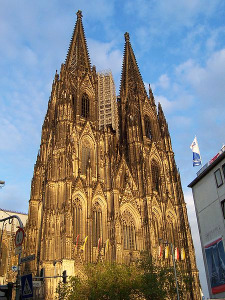
Known in German as the Kölner Dom (or more officially as Hohe Domkirche St. Peter und Maria), this marvel of Gothic architecture took over 600 years to complete.
The construction began in 1248 on the site of older buildings, including a Roman-era church, and a Carolingian cathedral. Most of the edifice was built by 1473, apart from the towers. Some work proceeded intermittently until 1560, then all work stopped until the 19th century due to lack of funds. Driven by a romantic enthusiasm for the Middle Ages, the Prussian Court decided to complete the cathedral in 1842. At enormous expenses (over US$ 1 billion in today's money), the completion of Germany's largest cathedral was eventually celebrated under the patronage of Kaiser Wilhelm I.
The imposing 144.5m-high twin spires made it the tallest structure in the world between 1880 and 1884, when it was surpassed by Ulm Cathedral. The interior closely resemble that of Amiens Cathedral, on which it was modeled.
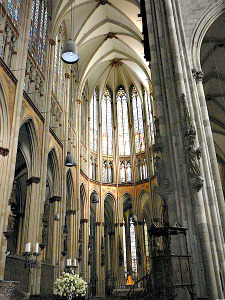
The Treasury of the Cathedral (Domschatzkamer) is exceptional. The masterpiece is the 12th-century Shrine of the Three Kings, said to contain the bones of the Magi. Parts of the shrine were designed by the famous medieval goldsmith, Nicholas of Verdun. It is acclaimed as one of the best example of Mosan art, and is said to be the largest reliquary in the western world. Near the sacristy is the 10th-century Gero-Kreuz is the oldest large crucifix north of the Alps.
The cathedral has twelve church bells. The oldest is the 3.8-tonne Dreikönigenglocke ("Bell of the Three Kings"), cast in 1418 and installed in 1437. The largest one, the 24-tonne St. Petersglocke ("Bell of St. Peter"), was cast in 1922 and is the largest free-swinging bell in the world.
The cathedral suffered fourteen hits by aerial bombs during World War II but did not collapse, and everything was repaired by the end of 1956. It has been listed as a World Heritage Site by the UNESCO since 1996. It is the seat of the Archbishop of Cologne, founded in 88 C.E.
Romanesque Churches
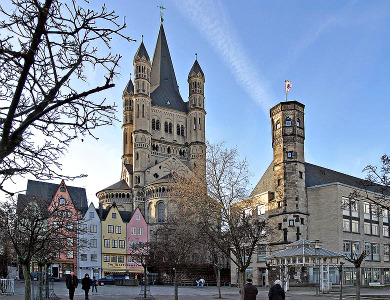
Cologne's architectural golden age was undoubtedly the 11th, 12th and 13th centuries, when its 12 Romanesque churches were constructed, namely : St. Andreas, St. Aposteln, St. Cäcilien, St. Georg, St. Gereon, St. Kunibert, St. Maria im Kapitol, St. Maria Lyskirchen, Groß St. Martin, St. Pantaleon, St. Severin, and St. Ursula.
All but one (St. Maria Lyskirchen) were very badly damaged during WWII, and reconstruction lasted until the 1990's. The most impressive by its size is Gross St. Martin, on the Fischmarkt, between the town hall and the Rhine.
The prize for the most richly decorated interior goes to St. Gereon, which is also the oldest of the 12 (along with St. Severin), founded as a chapel in the 4th century on a Roman graveyard.
Roman Cologne
Cologne was once the largest ancient city north of the Alps. Most of what has survived from this period is now in the Roman-Germanic Museum (see below). The southern wall of the museum has two Roman wells, as well as what is left of the Roman harbour street.
A few ruins of larger structures are still scattered around the city. The foundations and side arch of Roman North Gate are between the cathedral and the Tourist Information Centre.
300m south of the Roman-Germanic Museum once stood the Praetorian Palace (Praetorium). Its foundations are now underneath the medieval town hall (Rathaus), where you can also witness the Roman engineering of the municipal sewage system.
Segments of the Roman city wall can be seen west of the Zeughaus (housing the Cologne City Museum), in the so-called Burgmauer ("fort wall") and Am Römerturm ("at the Roman tower") streets.
Sections of the 95km long Eifel aqueduct are still visible on Friesenplatz (1km due west of the cathedral, in the so-called Belgisches Viertel or "Belgian district"). This aqueduct, constructed in 80 C.E., was one of the longest in the Roman Empire. It brought water all the way from the Ardennes Forest near the present-day Belgian border.
Top Museums
Art Museums
Museum Ludwig
A Treasure Trove of Modern and Contemporary Art
Museum Ludwig stands as one of Europe's most significant repositories of modern and contemporary art. Established in 1976 following a generous donation of 350 works by Peter and Irene Ludwig, this architectural marvel adjacent to Cologne Cathedral houses an impressive collection that spans multiple artistic movements. The museum boasts the world's third-largest collection of Pablo Picasso's works, comprising approximately 900 pieces that showcase the artist's diverse styles and periods. Equally impressive is its collection of Pop Art, the largest outside the United States, featuring seminal works by Andy Warhol, Roy Lichtenstein, and Claes Oldenburg.
The museum's comprehensive collection also includes significant works of Russian avant-garde, German Expressionism, and abstract art. Visitors can admire masterpieces by Kandinsky, Chagall, and Ernst, alongside contemporary installations and photography. The museum regularly rotates its permanent collection and hosts temporary exhibitions that explore cutting-edge themes in contemporary art. Museum Ludwig's commitment to representing diverse artistic voices makes it an essential destination for art enthusiasts seeking to understand the evolution of modern artistic expression.
Wallraf-Richartz Museum
A Journey Through European Art History
As Cologne's oldest museum, the Wallraf-Richartz Museum offers visitors a comprehensive journey through European art history from the Middle Ages to the early 20th century. Founded in 1824 following a bequest by Franz Ferdinand Wallraf, the museum's collection was later enhanced by Johann Heinrich Richartz's funding for a dedicated building. The museum's medieval collection is particularly noteworthy, featuring masterpieces of Cologne School painting, including Stephan Lochner's iconic "Madonna in the Rose Bower," often referred to as the "Kölsche Mona Lisa."
The Baroque section showcases works by Rubens, Rembrandt, and Murillo, while the museum's Impressionist and Neo-Impressionist collection ranks among Germany's finest, with paintings by Monet, Renoir, Degas, van Gogh, and Cézanne. The museum's chronological arrangement allows visitors to trace the development of European painting techniques, themes, and styles across centuries. Each gallery is thoughtfully curated to provide context and insight into the artistic movements represented. The museum's elegant modern building, opened in 2001, provides an ideal setting for appreciating these masterpieces, with natural light enhancing the viewing experience of works spanning seven centuries of artistic achievement.
Kolumba
Where Ancient Meets Contemporary
Kolumba, the art museum of the Archdiocese of Cologne, represents a remarkable architectural and curatorial achievement that bridges ancient and contemporary art and architecture. Designed by renowned Swiss architect Peter Zumthor and opened in 2007, the building itself is a masterpiece that incorporates the ruins of the Gothic St. Columba church, destroyed during World War II. Zumthor's design creates a contemplative space where light filters through perforated grey brick walls, creating an atmosphere of serene reflection.
The museum's unique approach eschews traditional chronological or thematic organisation, instead creating thoughtful juxtapositions between religious artefacts from late antiquity and works by contemporary artists. Medieval sculptures might be displayed alongside modern installations, inviting visitors to discover unexpected connections across two millennia of artistic expression. The collection includes paintings, sculptures, and decorative arts that explore spirituality, human experience, and artistic innovation. A highlight is the archaeological zone in the building's lower level, where visitors can walk among the foundations of Roman and medieval structures. Kolumba offers a meditative museum experience that encourages slow looking and contemplation, making it distinctly different from other cultural institutions in Cologne.
Historical Museums
Romano-Germanic Museum
Cologne's Roman Heritage Preserved
Dedicated to preserving and showcasing Cologne's rich Roman heritage, the Romano-Germanic Museum offers a fascinating glimpse into the city's ancient past. Built directly atop the ruins of a Roman villa, the museum's most spectacular exhibit is visible before even entering—the magnificent Dionysus Mosaic, which once adorned the villa's dining hall, can be seen through the museum's ground-floor windows. This intricate mosaic, dating from the 2nd century CE, remains in its original location, with the museum constructed around it.
Inside, visitors encounter an unparalleled collection of Roman artefacts, including the world's largest collection of Roman glass vessels, exquisite jewellery, and everyday items that paint a vivid picture of life in Colonia Claudia Ara Agrippinensium (Roman Cologne). The museum's collection spans 100,000 years of settlement history in the Rhineland, from prehistoric times through the Roman era and into the early Middle Ages. Particularly impressive is the tomb of legionary Poblicius, a monumental 15-metre high funeral monument reconstructed from original fragments. Through these artefacts, the museum illustrates Cologne's significance as one of the most important cities in the northern Roman Empire and its role as a cultural and commercial crossroads.
NS Documentation Centre
A Sobering Memorial to Dark Times
Housed in the former Gestapo headquarters at EL-DE Haus, the NS Documentation Centre serves as a powerful memorial and educational institution dedicated to examining Cologne's history during the Third Reich. The building itself stands as a stark reminder of Nazi terror, with its basement containing ten prison cells where the Gestapo interrogated and tortured political opponents, Jews, and other persecuted groups. The walls of these cells bear moving inscriptions left by inmates—messages of despair, hope, and resistance that provide haunting testimony to human suffering and resilience.
The museum's permanent exhibition, "Cologne in National Socialist Times," presents a comprehensive examination of how the Nazi regime transformed everyday life in the city, from the rise of National Socialism to the aftermath of World War II. Through photographs, documents, personal testimonies, and multimedia presentations, visitors gain insight into how ordinary citizens responded to fascism—whether through participation, accommodation, or resistance. The centre also houses an extensive archive and library for scholarly research and regularly hosts temporary exhibitions, lectures, and educational programmes that connect historical events to contemporary issues of human rights, democracy, and social justice. As both a memorial and a place of learning, the NS Documentation Centre fulfils the vital role of ensuring that the darkest chapter of German history is neither forgotten nor repeated.
Cologne City Museum
Tracing the Evolution of a Historic Metropolis
The Cologne City Museum (Kölnisches Stadtmuseum) offers a comprehensive exploration of Cologne's urban development from its Roman foundation to the present day. Housed in the historic Zeughaus, a former arsenal dating from the 16th century, the museum presents the city's 2,000-year history through a rich collection of artefacts, models, paintings, photographs, and multimedia displays.
The museum's chronological exhibition guides visitors through key chapters in Cologne's history: its prosperity as a medieval trading centre and free imperial city, its religious significance as a pilgrimage destination, its industrial revolution transformation, the devastation of World War II, and its subsequent reconstruction and evolution into a modern cultural metropolis. Highlights include detailed historical city models showing Cologne at different periods, the original head of the Richmodis statue from the historic town hall, and the museum's collection of carnival memorabilia that illustrates the importance of this tradition to Cologne's cultural identity. Through personal stories and everyday objects alongside significant historical artefacts, the museum creates a multifaceted portrait of urban life across centuries, revealing how Cologne's distinctive character has been shaped by its diverse inhabitants and historical circumstances.
Specialty Museums
Chocolate Museum (Schokoladenmuseum)
A Sweet Cultural Experience
For those with a sweet tooth, the Chocolate Museum offers a delightful and educational experience on the peninsula of Rheinauhafen. Established in 1993 by Hans Imhoff, a local chocolate manufacturer, this unique museum traces the 5,000-year history of chocolate from its origins with the Olmecs, Maya, and Aztecs of Mesoamerica to its transformation into the beloved treat we know today. The museum explores chocolate's journey from a bitter ceremonial drink to a global commodity, examining its cultural significance across different societies and eras.
A highlight of any visit is the working chocolate factory, where visitors can observe the entire production process from cocoa bean to finished chocolate bar. The museum's tropical greenhouse houses cacao trees, allowing visitors to see the source of chocolate in its natural environment. Perhaps the most popular feature is the spectacular 3-metre tall chocolate fountain, where visitors can sample wafers dipped in liquid chocolate served by a staff member in traditional gold-embossed uniforms. Beyond the sensory pleasures, the museum addresses serious topics such as fair trade practices and sustainable cultivation of cacao. Interactive exhibits, historical artefacts, and vintage chocolate advertisements make this museum appealing to visitors of all ages, offering both entertainment and insight into one of the world's most beloved foods.
Fragrance Museum Farina House
The Birthplace of Eau de Cologne
Located in the world's oldest fragrance factory still in operation, the Fragrance Museum Farina House offers a unique olfactory journey through the history of perfumery. The museum occupies the original production site where Italian perfumer Johann Maria Farina created his revolutionary scent "Eau de Cologne" in 1709—a fresh, citrus-based fragrance inspired by an Italian spring morning that would change perfumery forever and make the city's name synonymous with fine fragrances worldwide.
Guided tours take visitors through elegantly restored baroque rooms where the original fragrance was produced and sold to European aristocracy, including clients such as Napoleon, Mozart, and various royal houses. The museum showcases historical production methods, with displays of original equipment, formulas, and correspondence that illustrate how Farina's creation became the world's first celebrity fragrance. Visitors learn about the complex art of perfume composition and the cultural history of scent while experiencing historical fragrance samples that demonstrate how olfactory preferences have evolved over centuries. The museum's knowledgeable guides explain how Farina's innovative approach to creating lighter, fresher scents represented a significant departure from the heavy, musky perfumes previously favoured by European nobility, ultimately influencing the entire trajectory of modern perfumery.
Rautenstrauch-Joest Museum
Exploring World Cultures
The Rautenstrauch-Joest Museum, Cologne's ethnographic museum, offers visitors a fascinating journey through the cultural diversity of our world. Founded in 1901 with the private collection of Wilhelm Joest and expanded by his sister Adele Rautenstrauch, the museum moved to its current purpose-built facility in 2010. Rather than presenting cultures as exotic curiosities, the museum takes an innovative approach that explores universal human themes across different societies, encouraging visitors to reflect on cultural similarities and differences.
The museum's permanent exhibition, "People in Their Worlds," is divided into thematic sections that examine topics such as living environments, religious practices, concepts of death and the afterlife, and forms of artistic expression. Through approximately 65,000 objects from Oceania, Africa, Asia, and the Americas, visitors can explore diverse cultural solutions to common human challenges. Particularly noteworthy are the museum's collections of ceremonial masks, textiles, and ritual objects. Interactive multimedia displays and immersive environments—such as reconstructions of traditional dwellings—create engaging experiences that appeal to multiple senses. The museum also addresses critical issues such as colonialism, cultural appropriation, and the ethical questions surrounding ethnographic collections, positioning itself as a forum for intercultural dialogue and understanding in our increasingly globalised world.
Museum of Applied Arts (MAKK)
Celebrating Design Excellence
The Museum of Applied Arts (Museum für Angewandte Kunst Köln) houses an impressive collection of decorative arts spanning from the Middle Ages to the present day. Established in 1888, the museum occupies an elegant Bauhaus-inspired building in the heart of Cologne. Its extensive collection showcases the evolution of design across different periods and cultures, with particular emphasis on furniture, ceramics, glass, metalwork, and textiles.
The museum's chronologically arranged galleries allow visitors to trace the development of design movements, from Gothic and Renaissance treasures to Art Nouveau, Bauhaus, and contemporary design. Particularly noteworthy is the museum's collection of 20th-century design, featuring iconic pieces by designers such as Charles and Ray Eames, Verner Panton, and Dieter Rams. The MAKK also houses an exceptional collection of European porcelain, including rare pieces from Meissen and Sèvres. Through its thoughtfully curated displays, the museum illustrates how utilitarian objects can embody artistic excellence and reflect broader cultural values and technological innovations of their time. Regular special exhibitions explore contemporary design themes, making connections between historical craftsmanship and current design challenges.
Museum of East Asian Art
Treasures from China, Japan, and Korea
The Museum of East Asian Art (Museum für Ostasiatische Kunst) holds the distinction of being the first specialised museum of its kind in Germany. Founded in 1909 by Adolf Fischer and his wife Frieda, passionate collectors of Asian art, the museum houses an exceptional collection of art from China, Japan, and Korea spanning over 5,000 years. The museum's elegant modernist building, designed by Japanese architect Kunio Maekawa, provides an appropriately serene setting for appreciating these cultural treasures.
The Chinese collection includes exquisite ceramics from the Neolithic period to the Qing Dynasty, ancient ritual bronzes, jade carvings, and classical paintings and calligraphy. The Japanese section features outstanding ukiyo-e woodblock prints, samurai armour, lacquerware, and Buddhist sculptures. The Korean collection, though smaller, contains fine examples of celadon pottery and paintings. The museum's displays are arranged to highlight the aesthetic principles and philosophical concepts that underpin East Asian artistic traditions, helping Western visitors understand these works in their cultural context. Through its collection and educational programmes, the museum serves as an important bridge between Eastern and Western cultural understanding, revealing the sophisticated artistic achievements of these ancient civilisations.
Local Cuisine
Cologne's culinary landscape offers a delightful array of traditional dishes that reflect the city's rich heritage and cultural influences. Visitors should not miss trying Himmel un Ääd (Heaven and Earth), a hearty combination of black pudding, fried onions, mashed potatoes and apple sauce that symbolises the connection between earth and heaven. The famous Rheinischer Sauerbraten, a tender marinated beef dish typically served with potato dumplings and red cabbage, is considered particularly delicious in Cologne. For a quick bite, sample Halver Hahn, which despite its name isn't chicken but a rye bread roll with Gouda cheese and mustard. Potato lovers will appreciate Reibekuchen (also known as Rievkooche), crispy potato fritters often enjoyed with apple sauce, especially popular during Christmas time. Don't overlook Kölsche Kaviar, Cologne's ironic take on caviar, which is actually blood sausage served with mustard and rye bread. All these local specialties pair perfectly with a glass of Kölsch, the city's famous local beer, creating an authentic taste of Cologne's food culture.
Shopping
Cologne offers diverse shopping experiences across its vibrant city centre. The most visited shopping streets include Schildergasse and Hohe Straße, both pedestrianised thoroughfares dating back to Roman times. Schildergasse features major department stores like Galeria Kaufhof and the architecturally striking Weltstadthaus, home to Peek & Cloppenburg clothing store, which resembles a glass whale. For more upscale shopping, visit Mittelstraße, Ehrenstraße and Breite Straße, which offer boutiques selling fashion, jewellery and home furnishings. Shopping centres include Neumarkt Galerie (recognisable by its upside-down ice cream cone roof), Köln Arcaden and Rhein-Center with over 100 shops each. For local markets, visit Wilhelmsplatz for fresh produce (Monday-Saturday) or explore the Christmas markets that appear throughout the city during the festive season. Most shops in central areas open Monday to Saturday from 10:00-18:00, with extended hours until 20:00 on main shopping streets.
Nature in and around Cologne
Cologne offers a variety of natural attractions for outdoor enthusiasts. The Stadtwald Forest, a 200-hectare park in the Lindenthal district, provides meadows for picnics, ponds for boating, and groves of native trees. It also houses the Lindenthal Zoo, where visitors can observe over 250 animals. Along the Rhine, the Rhine Promenade is a popular spot for strolls, offering picturesque views of the city's skyline. Just outside Cologne, the Rhineland Nature Park presents diverse landscapes including forests, rivers, lakes, and volcanic hills. This park spans nine different natural areas, each with its own unique features and activities. For those seeking a more rugged experience, the Wahner Heide nature reserve offers adventurous exploration opportunities. Within the city, the Rheinpark serves as a green oasis, perfect for sunny days and relaxation.
Getting There & Around
Getting to Cologne
Cologne is easy to reach by air, rail, coach, or car, with the main rail gateway right in the historic centre beside the cathedral for quick onward connections.
By air
Cologne Bonn Airport (CGN) has its own integrated railway station serving S-Bahn, regional, and occasional ICE services, with the platforms a short walk from both terminals.
The S19 S-Bahn line runs directly between the airport and Köln Hauptbahnhof and operates day and night at frequent intervals, providing a simple, step-free route into the city centre.
Two major alternatives are Düsseldorf Airport (DUS), which has frequent direct ICE and regional trains to Cologne’s central stations, and Frankfurt Airport (FRA), whose long-distance station offers fast ICE links to Köln Hbf.
By train
Köln Hauptbahnhof (Köln Hbf) sits in the heart of the city next to Cologne Cathedral and within a short stroll of the Rhine, making arrivals and departures especially convenient.
Long‑distance ICE/IC/EC trains link Cologne with major German cities, with extensive onward connections nationwide and into neighbouring countries via high‑speed routes.
From Brussels, direct Eurostar‑operated Thalys and ICE services reach Cologne in about 1 hour 50 minutes, arriving city‑centre to city‑centre at Köln Hbf.
From the airport to the centre
The S19 S-Bahn runs through Cologne Bonn Airport and directly to Köln Hbf, offering all‑night service alongside frequent daytime departures.
The airport rail station is clearly signposted from Arrivals, so it is straightforward to roll luggage to the platforms and board a direct train into town.
Coach travel
Intercity coaches serve central stops around Breslauer Platz/Hauptbahnhof, adjacent to the main station and linked to local Stadtbahn lines for onward travel.
Services also use additional city stops depending on the operator and route, so it is worth confirming the exact Cologne stop when booking.
By car
Cologne is encircled by major motorways, including the A1, A3, and A4, with signed city approaches and access corridors even where the low‑emission zone applies.
The short A559 connects the A59 corridor to the A4 near the city and airport, providing a useful southern approach to Cologne and its trade fair grounds.
Note that central Cologne is a designated low‑emission zone, and vehicles entering this area must comply with local environmental sticker rules and permitted access routes.
Useful tips
- Cologne has two principal rail hubs: central Köln Hbf and across‑the‑river Köln Messe/Deutz; check which station a long‑distance train uses for the most convenient arrival.
- From Düsseldorf Airport, direct ICE and regional trains reach Köln Hbf or Köln Messe/Deutz in roughly 35–50 minutes, with departures throughout the day.
- Frankfurt Airport’s long‑distance station offers direct ICE services to Cologne in under an hour, useful for intercontinental arrivals.
- Köln Hbf is steps from the cathedral and minutes from the Rhine promenade, so walking to central hotels and sights is often the quickest option.
Getting around Cologne
Cologne is compact and well-connected, so getting around is straightforward by tram, light rail, bus, bicycle, taxi, or on foot from the cathedral-centred core. The integrated transit network means most sights are a short hop apart, and riverside paths make walking and cycling particularly pleasant.
Public transport
The backbone is the KVB-operated Stadtbahn (light rail/tram) plus buses, with frequent services across the inner districts and tunnels through the centre for quick cross-town journeys. S-Bahn and regional trains complement this for faster hops between neighbourhoods and nearby towns.
Tickets and passes
Single, short-hop, and day options are available across the VRS network; tickets must be valid for the correct zones and, if printed or paper, stamped before boarding where required. The KölnCard includes unlimited local public transport for 24 or 48 hours along with discounts at attractions, useful for busy sightseeing days.
Apps and planners
The KVB app and DB Navigator provide live departures, door-to-door routing, disruption alerts, and mobile ticketing. Journey planners recognise stop names in German and English, and QR codes at many stops link to real-time boards.
Night travel
On weeknights, services taper after midnight with limited late trips, while weekend nights see through-the-night lines and night buses on core corridors. If travelling late, plan ahead and use live data to confirm the next departure.
Walking
The historic centre around the cathedral, Old Town, and riverside promenades is highly walkable, and many hotels sit within a 10–20 minute stroll of key museums and breweries. Bridge pavements make it easy to cross the Rhine on foot for views back to the skyline.
Cycling and micromobility
KVB-Rad bike share covers most central districts with docks and free-float parking zones, and the riverside paths offer flat, scenic riding. E‑scooters operate under local rules; park in designated areas and avoid pedestrian-only promenades.
Taxis and ride‑hailing
Taxis queue at major hubs like the Hauptbahnhof and the cathedral, and licensed ride‑hailing via apps (including Uber and local services) is widely available. Card payments are common, though it helps to confirm in advance.
Special routes
The seasonal Kölner Seilbahn cable car glides over the Rhine between Zoo/Flora and Rheinpark, doubling as a scenic cross‑river link on fair‑weather days. Riverboats primarily run sightseeing services, but some short hops can be handy for reaching riverside districts.
Accessibility
Many central stations and vehicles offer step‑free access, lifts, and level boarding, with network maps highlighting barrier‑free stops. If assistance is needed, plan routes via accessible interchanges and allow extra time for platform changes.
Driving and parking
A low‑emission zone covers central Cologne, and on‑street parking is regulated; look for signed multi‑storey car parks around the ring roads. Park‑and‑ride sites near Stadtbahn/S‑Bahn stations can simplify trips into the centre.
Quick tips
- Validate paper tickets before boarding; mobile tickets are time‑stamped automatically.
- For cross‑river trips, compare Stadtbahn bridges, S‑Bahn, and a short walk over the Hohenzollern or Deutz bridges.
- Use live boards during events and rush hours, and consider cycling along the Rhine to avoid road delays.
Best Time to Visit
The best time to visit Cologne is from mid-May to mid-September, when the weather is mild and pleasant. During this period, temperatures typically range from 19°C to 25°C, making it ideal for exploring the city on foot and enjoying outdoor activities. July and August are the warmest months, but they can also be quite busy with tourists. For those seeking a quieter experience with fewer crowds, consider visiting in September or early October when the weather is still agreeable and the autumn colours begin to emerge. However, Cologne offers unique experiences throughout the year, such as the world-famous Carnival in February and the enchanting Christmas markets in December. Regardless of when you choose to visit, it's always wise to pack a light jacket and an umbrella, as Cologne's weather can be unpredictable with occasional rain showers.
| Travel destinations in North Rhine-Westphalia | ||||||||||||||
|---|---|---|---|---|---|---|---|---|---|---|---|---|---|---|
|
|
|
|
| ||||||||||
|
|
|
|
| ||||||||||
|
| |||||||||||||


