



| Contents |
|---|
Introduction
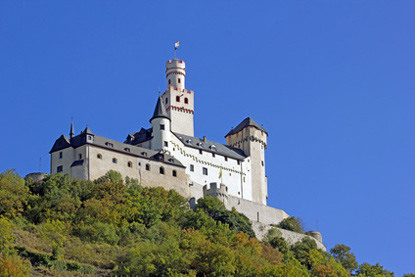
Perched high above the banks of the Rhine River, Marksburg Castle is an utterly captivating example of medieval fortress architecture. Its striking silhouette stands guard over the charming town of Braubach, offering dramatic views and a deep sense of the region’s legendary romance. Marksburg is the only hilltop fortress on the Middle Rhine has never been destroyed. Originally constructed as a stone keep around 1100 by the Eppstein family and expanded in the early 12th century, it served to protect the town and oversee customs duties on Rhine traffic. Unlike many Rhine castles built as palatial residences, Marksburg functioned primarily as a defensive stronghold, later adapting its walls and towers to withstand artillery in the 15th century. Since 1900 it has been owned and preserved by the German Castles Association and today offers guided tours through its authentic medieval interiors, including the bergfried, chapel, knights’ hall and armory, set within the Upper Middle Rhine Valley UNESCO World Heritage Site.
Interesting Facts about Marksburg Castle
- Marksburg Castle is the only hilltop castle on the Rhine to have never been destroyed in its over 700-year history.
- The castle sits 90 metres above the picturesque town of Braubach, offering dramatic views of the Rhine valley.
- Originally named Burg Braubach, it was first mentioned in records in 1231, though its oldest stonework dates back to the 12th century.
- Marksburg was built primarily as a defensive fortress, rather than a royal residence, which contributed to its longevity and preservation.
- The chapel within the castle is dedicated to St Mark, from whom the castle takes its name.
- Its distinctive keep, known as a "bergfried," was designed in the style of a butter-churn tower—a unique architectural feature.
- The castle’s sloped stone stairs were intentionally carved rough to prevent knights’ horses from slipping in the rain.
- Marksburg Castle was used as a prison and later as a home for disabled soldiers during the 19th century.
- In March 1945, the castle suffered minor damage from American artillery during World War II but remained largely intact.
- Today, Marksburg Castle serves as the headquarters for the German Castles Association, which works to preserve historic fortifications across Germany.
History
Originally constructed by the powerful Eppstein family in the early 12th century, the castle began as a stone keep around 1100 before being expanded into a full fortress by 1117 to safeguard Braubach and control vital customs duties along the river. The earliest surviving written reference to the Marksburg dates from 1231. Over the centuries, the castle changed hands among several noble families, notably passing in 1283 to Count Eberhard of Katzenelnbogen, whose family initiated significant expansions and improvements during their lengthy stewardship.
Throughout the 14th and 15th centuries, the Counts of Katzenelnbogen reinforced the Marksburg’s military defences, adapting the site to withstand evolving warfare technology. After 1479, ownership was transferred to the Landgraves of Hesse, who continued reinforcing the fortress by adding bastions and artillery batteries suitable for cannon—a forward-thinking measure that likely helped the castle avoid the devastation suffered by other Rhine fortresses during the Thirty Years’ War. Remarkably, the Marksburg retained much of its authentic medieval character through subsequent centuries, despite later additions during the 17th and 18th centuries.
Following the dissolution of the Holy Roman Empire in 1806, Napoleon granted the castle to the Duke of Nassau, repurposing it as a prison and lodging for retired soldiers. It became Prussian property after the Austro-Prussian War of 1866. In 1900, the Prussian state sold Marksburg to the German Castles Association, marking a new era focused on preservation and public history. The castle endured shellfire damage from American forces in March 1945 during World War II, but it was faithfully restored. Today, Marksburg Castle is not only a fascinating museum dedicated to medieval life but also the headquarters of the German Castles Association, playing a central role in conservation and educational initiatives.
Description
Atmosphere and Architecture
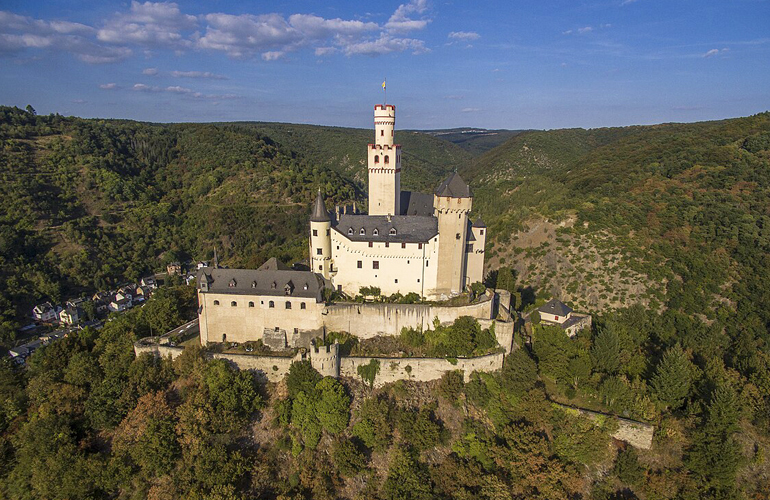
The castle’s powerful stone walls and towers seem to spring organically from the rocky crag. Visitors enter through an arched gateway, passing thick defences before emerging into a series of courtyards ringed by weathered ramparts. Bastions and battlements abound, evoking chivalric legends and tales of knights and nobles.
A warren of stairways and corridors connects the various keeps and wings, all constructed in a harmonious tangle that reveals the structure’s evolution over centuries. The imposing bergfried (central tower) rises above the castle, its distinctive butter-churn top visible from miles around.
Interior Highlights
Inside, the castle impresses with rooms authentically furnished to bring the medieval period to life. Walk through ancient kitchens with their huge hearths, admire stone-vaulted wine cellars, and explore grand halls complete with heraldic banners and antique weaponry. Armouries display an extensive collection of arms and suits of armour, many striking in their craftsmanship and preservation.
Chambers range from austere guards’ quarters to more opulent living spaces, such as the Knight’s Hall and the romantic ladies’ parlour. Decor throughout is evocative of the period, with wood panelling, decorative stonework, and atmospheric lighting.
Scenic Views and Surroundings
Marksburg commands breathtaking panoramas over the twisting river and lush vineyards that characterise the Rhine Gorge. The ramparts and parapet walks reveal sweeping views, with paths encircling the towers for even more vantage points — ideal for photographers and lovers of spectacular scenery.
The surrounding landscape further enhances the experience: terraced hillside vineyards, forests, and the picturesque town below combine to create an idyllic setting.
Visitor Experience
A visit to Marksburg Castle is truly immersive. Informative displays in multiple languages provide context for the castle’s rooms and artefacts. Guided tours enhance the journey, helping guests uncover hidden corners and stories as they explore. The castle is well maintained, with clear signage and accessibility improvements sensitively incorporated into the ancient structure.
Gift shops offer keepsakes and regional products, while a quaint café provides refreshments — perfect for pausing and soaking in the ambience of this marvellous stronghold.
Getting There
By train Travellers can take a regional train from Koblenz to Braubach station, with frequent services operating daily. From Braubach, it is about a 30-minute walk to Marksburg Castle, mostly uphill through the forest. This walk offers scenic views but is best suited to those comfortable with a moderate climb.
By bus or coach Regular buses link Koblenz with Braubach, making this a convenient alternative to the train, especially for those preferring to avoid crowds. Some coaches—such as those operated by river cruise tours—can drop passengers at the castle’s parking area. However, from the parking lot, all visitors must walk the last short stretch uphill to the entrance.
By car Marksburg Castle is easily accessible from the B42; simply follow signs for Braubach and then “Marksburg”. There is a spacious parking area close to the castle, and from there, visitors need only a brief uphill walk to reach the main gate. This option offers the greatest flexibility and ease for those travelling at their own pace.
Best Time to Visit
The ideal time to visit Marksburg Castle is in spring (April to June) or autumn (September to early October), when the weather is pleasantly mild and the guided‐tour groups are smaller, allowing a more leisurely exploration of its medieval courtyards, armory and ramparts. During these shoulder seasons, the surrounding vineyards awaken with fresh greenery or glow with golden hues, and you can savour uninterrupted views over the Rhine Valley without the peak‐season crowds of July and August. Winter visits (November to February) are also possible, but opening hours are reduced and the air turns crisp, so for the fullest experience with comfortable walking conditions and regular English tours, aim for spring or autumn.
| Travel destinations in Rhineland-Palatinate | ||||||||||||||
|---|---|---|---|---|---|---|---|---|---|---|---|---|---|---|
|
|
|
|
| ||||||||||
|
|
|
|
| ||||||||||
|
|
| ||||||||||||


