| Contents |
|---|
Introduction
Darmstadt (pop. 165,000) is the historical capital of the County of Hessen-Darmstadt, then the Grand Duchy of Hesse from 1806. It is one of few German cities which does not lie close to a river, lake or coast.
Darmstadt was dubbed "city of science" thanks to its celebrated Technical University and the numerous aerospatial and engineering centres, such as European Space Operations Centre. (ESOC), EUMETSAT and GSI.
The city features numerous examples of Jugendstil (Art Nouveau) architecture, most notably in the Mathildenhöhe district, now a UNESCO World Heritage Site. Visitors to Darmstadt can explore a range of museums, green spaces such as the Herrngarten, and a vibrant city centre, making it a practical base for both cultural and educational pursuits in the region.
Interesting Facts about Darmstadt
- Darmstadt is famously known as the "City of Science" due to its concentration of universities, research institutes, and technology companies.
- The Mathildenhöhe district, featuring striking Art Nouveau architecture, is a UNESCO World Heritage Site and was home to a significant artists' colony in the early 20th century.
- The European Space Operations Centre (ESA ESOC), which controls numerous European spacecraft, is headquartered in Darmstadt.
- Several new chemical elements, including darmstadtium (named after the city), were discovered at the GSI Centre for Heavy Ion Research in Darmstadt.
- Darmstadt was once the capital of the Grand Duchy of Hesse and later the People's State of Hesse, making it rich in historical and architectural heritage.
- The city is home to the world's oldest pharmaceutical company, Merck, which remains its largest employer.
- The Russian Chapel in Darmstadt was built for the last Tsar of Russia and stands on Russian soil specially transported to the city.
- The Messel Pit Fossil Site, a UNESCO World Heritage Site near Darmstadt, is world-famous for its exceptionally well-preserved fossils, providing insights into early mammalian history.
- Darmstadt boasts one of Germany's largest Art Nouveau (Jugendstil) districts, attracting art and architecture enthusiasts.
- The city was granted its rights as a market town in 1330 and has over 700 years of recorded history.
- The Frankenstein Castle near Darmstadt is believed to have inspired elements of Mary Shelley's famous novel, "Frankenstein".
- The annual Heinerfest is a popular city festival, reflecting the cheerful spirit of Darmstadt’s residents.
History
Darmstadt, the former capital of the Grand Duchy of Hesse, boasts a rich history spanning nearly a millennium. The settlement was first established by the Franks in the 8th or 9th century, with the name "Darmundestat" appearing in historical documents towards the end of the 11th century. The city was granted its charter and city rights in 1330 by Holy Roman Emperor Ludwig the Bavarian, at which time it belonged to the Counts of Katzenelnbogen, who built a small castle with a moat on the site of today's much larger palace. When the house of Katzenelnbogen became extinct in 1479, Darmstadt passed to the Landgrave of Hesse, and in 1567 it became the capital of the newly formed Landgraviate of Hesse-Darmstadt when Landgrave Georg I established it as his primary residence.
The city experienced significant growth and transformation during the 19th century under the rule of Landgrave Ludwig X, who became Grand Duke Ludwig I when Hesse-Darmstadt was elevated to a grand duchy in 1806 after joining Napoleon's Confederation of the Rhine. The grand duke granted the region its first constitution in 1820 and oversaw the construction of the new town, with the population swelling from just over 10,000 to 72,000 inhabitants by the century's end. Industrialisation brought rapid expansion, particularly in chemicals and machinery manufacturing, whilst the arrival of the railway in 1846 connected Darmstadt to Frankfurt and Heidelberg. The establishment of a polytechnical school in 1877, which later became the Technical University of Darmstadt (TU Darmstadt), further cemented the city's reputation as a centre of learning and innovation.
Darmstadt's cultural significance reached its zenith in the early 20th century when Grand Duke Ernst Ludwig established the renowned Artists' Colony on Mathildenhöhe in 1899, transforming the city into one of Europe's foremost centres of Jugendstil (Art Nouveau). This period also saw scientific breakthroughs, including chemist Anton Kollisch's first synthesis of MDMA (ecstasy) whilst working for the pharmaceutical company Merck in 1912. The city's administrative boundaries expanded in 1937 to include neighbouring Arheilgen and Eberstadt, areas with their own ancient histories dating back to the 5th and 8th centuries respectively. From 1919 to 1945, Darmstadt served as the capital of the People's State of Hesse, though the city suffered significant damage during World War II before being rebuilt whilst preserving many of its historic landmarks.
Main Attractions
Marktplatz (Market Square)
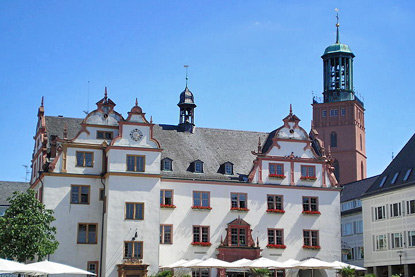
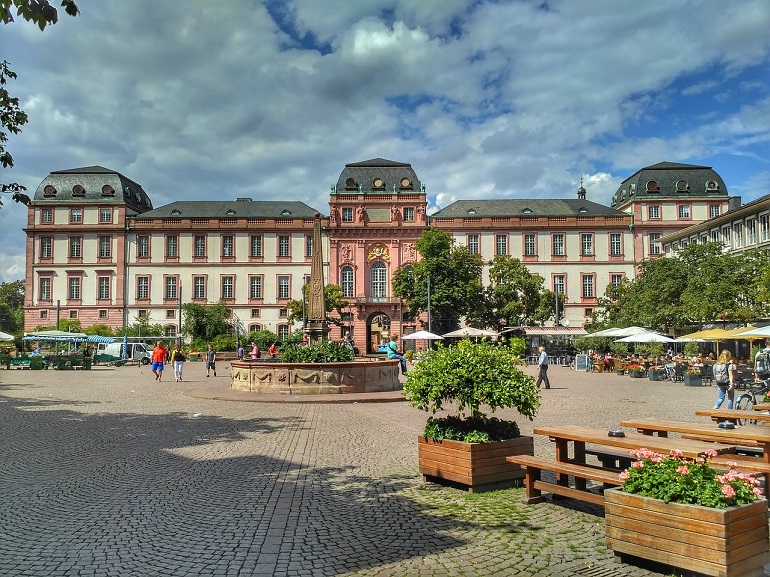
The Marktplatz has been the historic heart of Darmstadt since the city was granted its town charter in 1330, serving as the site for weekly markets and annual fairs. As probably the oldest square in the city, it is centrally located next to the Residenzschloss (Darmstadt Palace). For centuries, the market fountain was the town's sole public water supply. The square was heavily damaged during the Second World War; afterwards, only the historic buildings on the south side, including the 16th-century Renaissance-style Old Town Hall (Altes Rathaus), were reconstructed. The Old Town Hall now houses the city's registry office and a restaurant with its own brewery. The opposite side of the square features modern post-war architecture. Today, the Marktplatz remains a bustling centre of city life, hosting markets every Wednesday and Saturday, as well as seasonal events like the annual Christmas market. It is surrounded by cafes, restaurants, and shops, making it a social and commercial hub.
Institut Mathildenhöhe
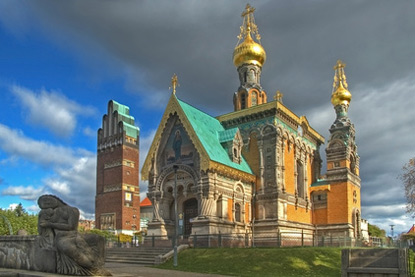
The Institut Mathildenhöhe, recognised as a UNESCO World Heritage Site, stands as Darmstadt's most significant cultural landmark. This hilltop artists' colony was established in 1899 by Grand Duke Ernst Ludwig of Hesse and became a pivotal centre for the Art Nouveau movement, known locally as Jugendstil. The complex features the distinctive Hochzeitsturm (Wedding Tower), built in 1908 with its characteristic five-fingered silhouette that has become the city's symbol. The tower was constructed to commemorate the Grand Duke's marriage to Princess Eleonora and offers panoramic views over Darmstadt from its 48-metre height. The site also includes the Exhibition Hall, which opened alongside the tower in 1908 and continues to host contemporary art exhibitions. Various artists' houses designed by their original residents dot the colony, including the Ernst Ludwig House from 1901, which served as the community's central workspace. The Russian Chapel, built in 1899 for the Grand Duke's Russian wife, features golden domes that blend Russian Orthodox architecture with Art Nouveau elements. Most buildings survived the Second World War, providing visitors with a rare complete view of early 20th-century Art Nouveau architecture.
Waldspirale
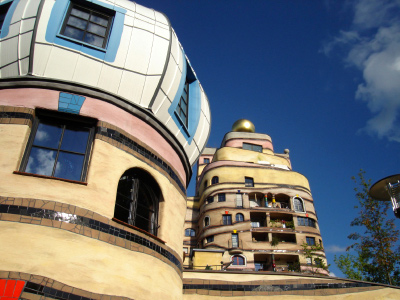
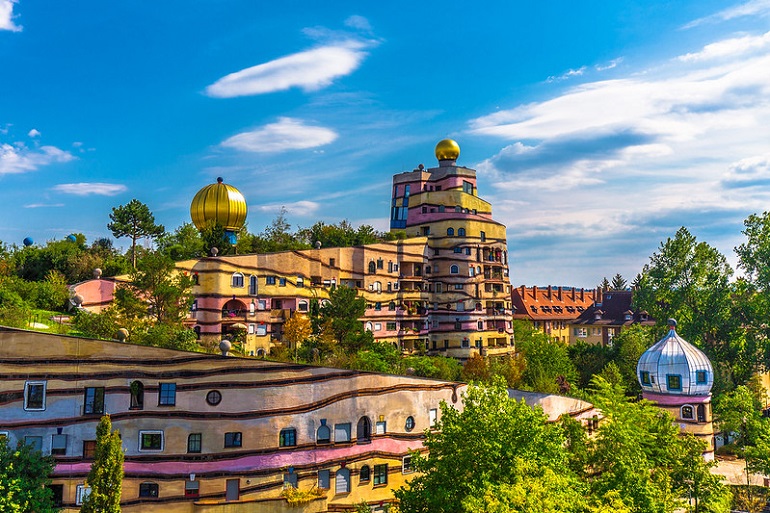
One of Germany's, and indeed Europe's most outlandish piece of architecture is the Waldspirale ('forest spiral'), a colourful residential building complex designed by Austrian artist Friedensreich Hundertwasser and completed in 2000. Located in Darmstadt's Bürgerparkviertel, the complex contains 105 apartments and looks like a modern version of the house of cake and confectionery in Hansel and Gretel, with a dollop of Arabian Nights atmosphere. The buildings have green roofs, and all the windows (over one thousand of them) are uniquely shaped. The building features an undulating facade with no straight lines, embodying Hundertwasser's philosophy that straight lines are ungodly. Organic architecture principles govern the building's design, incorporating irregular windows, grass-covered roofs, and planted terraces that create a harmonious relationship between the structure and nature. The exterior walls display vibrant colours including pink, green, yellow, and blue, creating what visitors often describe as an other-worldly appearance against Darmstadt's traditional German architecture. The building serves as both a residential complex and an architectural landmark, attracting visitors interested in contemporary design and sustainable building practices. The surrounding area includes small cafes and shops that complement the artistic atmosphere of this unique housing project.
Luisenplatz and Langer Ludwig
Luisenplatz forms the heart of Darmstadt and serves as the city's primary public square and transport hub. The square, named after Grand Duchess Luise of Hesse-Darmstadt, showcases architectural evolution from the 18th century to the present day. The central monument, affectionately known as "Langer Ludwig" (Long Ludwig), is a 39-metre column erected in 1844 to honour Grand Duke Ludwig I, the first Grand Duke of Hesse. The bronze statue at the monument's summit overlooks daily life in the plaza, whilst detailed reliefs at the base depict scenes from Ludwig's reign. The surrounding buildings represent different architectural periods, including preserved Art Nouveau facades from the early 1900s contrasting with post-war structures. The modern Luisencenter shopping mall, built in 1977, occupies the eastern side of the square. Trams and buses converge at Luisenplatz, making it the city's main public transport interchange, cleverly integrated into the square's design whilst maintaining its historic character. The monument is accessible to visitors from April to October on the first Saturday of each month, offering city views from the 30-metre-high viewing platform after climbing 172 steps.
Park Rosenhöhe
Park Rosenhöhe, situated on a hillside location that provides elevated views over Darmstadt, represents one of the city's premier green spaces. The park was originally developed as part of the Grand Ducal estate and later became a public garden that combines formal landscaping with natural woodland areas. Rose gardens form the centrepiece of the park, featuring extensive collections of various rose species that bloom throughout the growing season, creating spectacular displays of colour and fragrance. The park includes the mausoleum of the Hessian Grand Ducal family, a neoclassical structure that serves as the final resting place for members of the ruling dynasty. Landscaped pathways wind through different sections of the park, connecting formal gardens with more naturalistic areas that include mature trees and meadows. The elevated position provides visitors with panoramic views across Darmstadt and the surrounding Hessian countryside. Children's play areas and picnic facilities make the park suitable for family visits, whilst the formal sections offer peaceful environments for contemplation and relaxation.
Herrngarten and Prinz George Garten
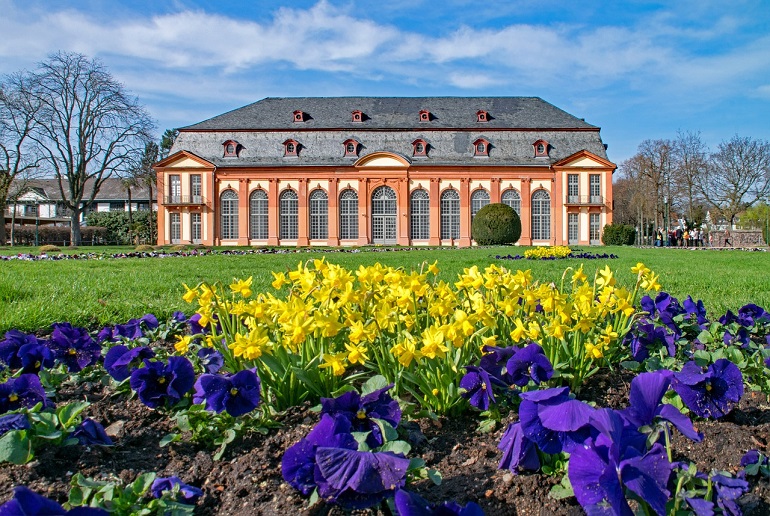
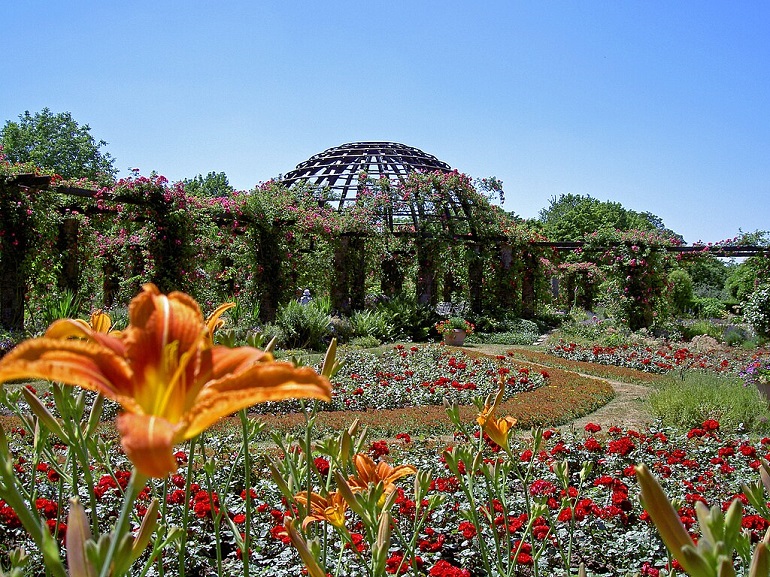
The Herrngarten, positioned behind the Hessisches Landesmuseum, represents Darmstadt's largest central park and serves as a significant green lung within the urban environment. This sprawling city park features mature trees that create spectacular blossom displays during spring months, complemented by an extensive network of pathways suitable for walking, jogging, and cycling. Statues and monuments throughout the park commemorate various historical figures and events significant to Darmstadt's development. Two dedicated children's play areas provide recreational facilities for younger visitors, whilst open lawn areas accommodate various outdoor activities and events. The adjacent Prinz George Garten forms a distinct section within the larger park complex, featuring a magnificent walled rose garden that displays numerous varieties in formal landscaped beds. The park serves as a popular gathering place for locals and visitors, offering respite from urban activity in a setting that combines natural beauty with cultural significance. The grounds remain open throughout the year, providing seasonal attractions from spring blossoms to autumn foliage displays.
Darmstadtium
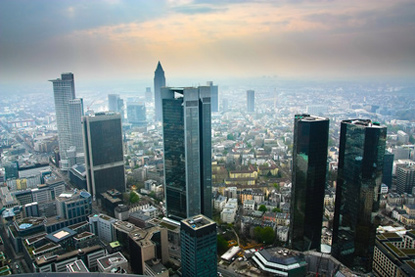
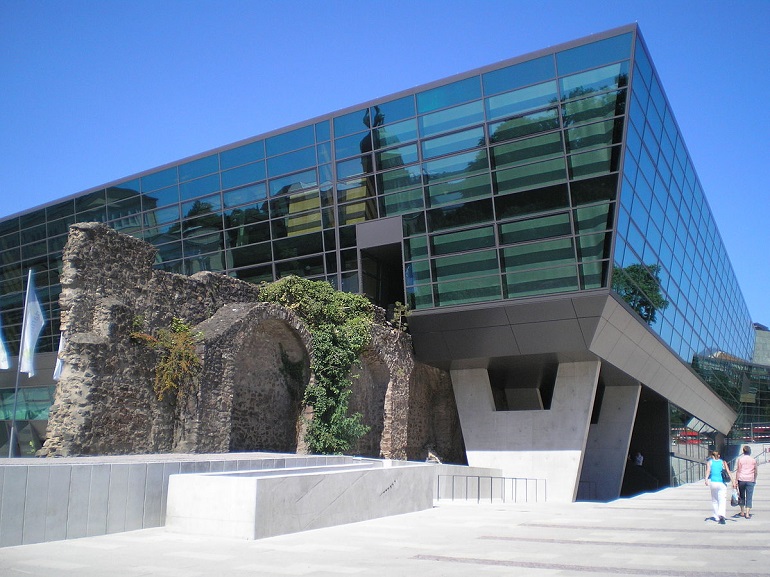
The Darmstadtium serves as Darmstadt's modern science and congress centre, representing the city's commitment to contemporary architecture and technological advancement. This facility hosts a diverse range of events including scientific conferences, cultural performances, exhibitions, and corporate gatherings. The building's contemporary design contrasts with Darmstadt's historical architecture whilst maintaining harmony with the urban environment through thoughtful integration of modern materials and traditional proportions. The centre features multiple halls and meeting rooms equipped with advanced audiovisual technology, making it suitable for international conferences and presentations. The main auditorium accommodates large audiences for concerts, theatrical performances, and major lectures, whilst smaller spaces provide intimate settings for specialised meetings and workshops. The facility's location within Darmstadt's city centre ensures convenient access via public transport and integration with the broader cultural district. The Darmstadtium regularly hosts events related to space technology and scientific research, reflecting Darmstadt's status as a centre for aerospace industry and research institutions. The venue contributes to the city's cultural calendar through its programming of arts events, conferences, and public lectures.
Weißer Turm
The Weißer Turm (White Tower) is an historic building that was once part of Darmstadt’s medieval fortifications. Standing close to the city centre, the tower was later converted into a bell tower and is now used for exhibitions and guided tours. Its distinctive silhouette is easily recognisable from various points around Darmstadt.
Jagdschloss Kranichstein
Jagdschloss Kranichstein, located approximately five kilometres northeast of Darmstadt's centre, serves as a Renaissance hunting lodge dating from the 16th century. Built in 1578, this complex consisted of three wings arranged in a U-shape around a central courtyard, designed as the hunting retreat for the Landgraves of Hesse-Darmstadt. The architecture reflects its practical purpose, combining comfortable living quarters with facilities specifically designed for hunting parties. The lodge features original period rooms with intact furniture and decorations that provide insight into aristocratic life during the Renaissance and subsequent centuries. The complex sits within a wooded area that maintains the natural environment essential to its original hunting function. Later centuries brought various additions and modifications to the main building, creating an architectural timeline that spans several hundred years. The surrounding grounds include landscaped gardens and woodland paths that were historically used for hunting expeditions and continue to provide pleasant walking routes for modern visitors.
Stadtkirche
The Stadtkirche stands as Darmstadt's principal Protestant church, with origins dating back to its initial construction as a chapel before evolving into a parish church. Following the Reformation, the building assumed its current role as a Lutheran town church, becoming central to the city's religious life. The church's most significant historical feature lies beneath the main structure, where the crypt serves as the burial place for the nobility of Hessen-Darmstadt since the times of Landgraf Georg I. This underground chamber contains elaborate tombs and memorial sculptures that document centuries of regional aristocratic history. The church building itself displays architectural elements from various periods, reflecting modifications and restorations undertaken over several centuries. The interior features traditional Lutheran design principles with emphasis on acoustic properties suitable for both worship services and musical performances. The church holds particular geographical significance as the centre point from which distances to and from Darmstadt are measured, marked by the trigonometric point number one. The building continues to serve its original religious function whilst also operating as a historical monument that provides insight into the region's ecclesiastical development.
Water Tower
The distinctive Water Tower, constructed in 1910 by architect Friedrich Mettegang, exemplifies Art Nouveau architectural principles matching the nearby main railway station. Originally designed to supply water to locomotives and railway operations, the tower served essential infrastructure needs until its decommissioning in the late 20th century. The structure was scheduled for demolition in 1978 but was saved through private ownership by musician and architect Albrecht Pfohl, who acquired it in 1986. The tower now functions as a protected historical monument, repurposed as a studio and event venue that accommodates corporate gatherings for groups ranging from 20 to 90 people. The building's impressive internal levels provide versatile spaces suitable for various types of events, from intimate meetings to larger celebrations. The Art Nouveau styling features decorative elements typical of the period, including ornamental stonework and curved architectural details that complement the tower's functional design. The structure stands as a testament to successful adaptive reuse of industrial heritage, transforming a utilitarian building into a unique cultural venue whilst preserving its historical significance.
Waldkunstpfad
The Waldkunstpfad, or Forest Art Path, offers a unique combination of nature and outdoor art installations. Located in the forested areas surrounding Darmstadt, the trail features numerous sculptures and site-specific works by international artists. This outdoor gallery integrates contemporary artistic ideas with the natural landscape.
Top Museums
Hessisches Landesmuseum Darmstadt
This extensive institution is celebrated for its remarkable breadth, uniting world-class collections spanning art, cultural history, and natural sciences. Highlights include masterpieces by Brueghel and Rembrandt, the famed 'Block Beuys' contemporary art installation, Art Nouveau treasures, and notable fossils from Messel. Its grand architectural spaces and encyclopaedic displays make it unmissable for anyone interested in the arts, natural history, or the evolution of culture.
Palace-Museum Darmstadt
Housed within the imposing Renaissance and Baroque palace in the city centre, the museum guides visitors through the storied past of the House of Hesse and the region via evocative period rooms, fine art, tapestries, and artefacts. Its atmospheric setting and regular special exhibitions make it particularly appealing for those who enjoy historical interiors and the aristocratic heritage of Hessen.
Kunsthalle Darmstadt
A flagship for modern and contemporary art, the Kunsthalle stands out for its minimalist post-war architecture and dynamic programme of rotating exhibitions. It provides a platform for both established and emerging artists, hosting thought-provoking installations, events, and artist talks, making it ideal for contemporary art enthusiasts and those seeking engagement with current cultural currents.
Darmstadt-Kranichstein Railway Museum
As the largest railway museum in Hesse, this institution is paradise for railway aficionados and families alike. Located in a former depot, it showcases over 200 historical locomotives and carriages, operational steam engines, model railways, and interactive displays detailing the development of rail transport. The working facilities and special steam excursions offer a unique, hands-on connection to industrial history and regional technology.
Atelierhaus Darmstadt
Managed by local artists, the Atelierhaus is both a contemporary exhibition venue and a living creative hub. Regularly hosting group shows, multimedia installations, and events such as the 'Art & Book' Biennale, it offers visitors an intimate look at artistic process and experimentation, with opportunities for direct dialogue with resident artists—a must for those interested in the pulse of the local art scene.
Darmstadt Art Archive
Specialising in the documentation and preservation of visual arts from Darmstadt and its surroundings, this archive is invaluable for those interested in researching the city’s creative past and the legacy of local artists. It differentiates itself through its focus on artist archives, making it particularly significant for scholars, students, or anyone intrigued by the evolution of Darmstadt's art community.
Local Cuisine
Visitors should savour Handkäse mit Musik, a tangy cheese delicacy often served with onions, vinegar, and bread, which embodies the region’s rustic appeal. Another treat, Frankfurter Rippchen, features succulent pork ribs typically enjoyed with sauerkraut and mashed potatoes. For something comforting, the hearty Grüne Soße—a cold, herby green sauce usually paired with boiled eggs and potatoes—is a cherished favourite among locals. The area is also known for its robust apple wine, a staple accompaniment to many meals and a true taste of Hessian hospitality.
Shopping
Darmstadt provides a balanced mix of shopping options across the city centre. The Luisencenter serves as the main shopping hub with 60 shops, cafés and restaurants spread across 16,000 square metres, whilst independent retailers dominate the pedestrianised Wilhelminenstraße and Schulstraße, where owner-operated boutiques, specialist stores and local businesses create a more personalised shopping experience. The weekly market takes place on Wednesdays, Fridays and Saturdays from 8am to 2pm at the market square, offering fresh produce and regional specialities. For broader retail needs, shoppers can access the LOOP5 shopping centre in nearby Weiterstadt. Opening hours for most shops are Monday to Saturday 10am-8pm, with limited Sunday shopping available at the main railway station.
Nature in and around Darmstadt
The region around Darmstadt features several notable natural sites: the Messel Pit Fossil Site, a UNESCO World Heritage oil-shale quarry 9 km north- of the city that preserves 47-million-year-old Eocene fossils; the extensive Geo-Naturpark Bergstraße-Odenwald, a 3,800 km² UNESCO Global Geopark spanning river plains and forested highlands with a dense network of walking and cycling routes; the Felsenmeer near Lautertal, a two-kilometre slope of weather-rounded diorite boulders formed by ancient geological processes and now popular for scrambling; and the Kühkopf-Knoblochsaue Nature Reserve, Hesse’s largest protected floodplain, which safeguards riparian forests, traditional orchard meadows and numerous bird species along a former Rhine meander.
Getting There & Around
By train, Darmstadt is well connected to the German and European rail network, with high-speed ICE, IC, and EC trains stopping at the main station. There are excellent regional links to Frankfurt, Wiesbaden, Mannheim, Heidelberg and more, making train travel a convenient choice. From Frankfurt Main Station, trains reach Darmstadt in about 20 minutes. International travellers can easily change at major hubs like Frankfurt or Mannheim to arrive in Darmstadt.
By coach or bus, several long-distance coach services operate routes to Darmstadt from major European cities, with comfortable amenities. Buses typically stop at the central railway or bus station, and the city’s location in the Rhine-Main region allows for frequent connections from places such as Amsterdam or Brussels, with direct services available. Once at the station, local buses and trams are readily available for onward travel within the city.
By car, Darmstadt is directly accessible via the A5 and A67 motorways, which intersect just west of the city. From these Autobahns, signs point drivers towards Darmstadt/Stadtmitte (city centre), making for straightforward access by road. The city also benefits from a well-signposted local road network, and parking facilities are available at key locations, enabling visitors arriving by car to reach central attractions with ease.
Best Time to Visit
The optimal time to visit Darmstadt is late spring through early autumn, specifically from May to September, when the city experiences its most pleasant weather and vibrant cultural scene. During this period, daytime temperatures range from a comfortable 18°C to 25°C, with July and August being the warmest months reaching up to 26°C. The weather is particularly delightful from mid-June to early September, offering the perfect conditions for exploring Darmstadt's outdoor attractions such as the UNESCO World Heritage Site Mathildenhöhe, the beautiful parks like Rosenhöhe with its extensive rose gardens that bloom spectacularly between June and September, and the numerous cultural festivals that animate the city. Summer brings excellent festivals including the popular Heinerfest in early July and the music-focused Schlossgrabenfest in June, whilst the extended daylight hours - up to 16 hours in June - provide ample time for sightseeing. Although summer is the busiest tourist season with higher accommodation prices, the city's outdoor dining, numerous cultural events, and the ability to fully appreciate its architectural gems in comfortable weather make it well worth the premium. Spring (April-May) offers a lovely alternative with mild temperatures around 15-19°C and fewer crowds, though visitors should be prepared for occasional rainfall.