



| Contents |
|---|

Introduction
Husum (pop. 24,000) is a small harbour town on the North Sea coast, which makes a convenient base to explore the North Frisian islands and the Wadden Sea National Park. The town was the birthplace of the novelist Theodor Storm, who coined the epithet "the grey town by the sea".
The compact centre features a working inner harbour, gabled merchants’ houses, and the NordseeMuseum, while Schloss vor Husum, a 16th-century castle with a baroque garden, sits a short walk away. In late March, the grounds of Schloss Husum are covered by a huge carpet of purple crocuses, well worth a detour in your are in the region.
Interesting Facts about Husum
- Husum is the capital of the Nordfriesland district on Germany’s North Sea coast and is nicknamed “the grey town by the sea” by its native author Theodor Storm.
- The devastating “Grote Mandrenke” storm tide of 1362 reshaped the coastline and carved out Husum’s inland harbour, turning it into a maritime town.
- Theodor Storm, a leading figure of German realism, was born in Husum in 1817 and popularised the town in his works.
- Husum hosts the annual international festival “Raritäten der Klaviermusik” (Rarities of Piano Music), founded in 1986 and renowned among piano aficionados.
- The town stands at the gateway to the Wadden Sea UNESCO World Heritage Site, blending maritime life with protected tidal flats and nature experiences.
- St Mary’s Church in Husum is cited as one of Schleswig-Holstein’s most important Classicist buildings on the town’s culture trail of 32 sites.
- Husum Castle sits in a park famous for its spectacular crocus bloom, and the venue also hosts concert series and the Pole-Poppenspäler-Tage puppet theatre festival.
- The inner harbour reaches almost to the Marktplatz and even features the historic Nordertor restaurant ship, among Germany’s oldest floating eateries.
- Husum’s history records major inundations in 1634 and 1717, underlining the town’s long struggle with North Sea storm tides.
- The tidal range at Husum is among the larger in the German Bight at roughly 3.50m, shaping local water levels during extreme storms.
History
Medieval Origins and Early Development
Husum's history begins in the thirteenth century, with the town first mentioned as "Husembro" in 1252 during the tragic death of King Abel of Denmark, who was murdered whilst attempting to suppress a Frisian revolt at the bridge over the Husumer Au. The settlement's name derives from the word root "hus", meaning houses or settlement, and by 1409 the name "Husum" was formally recorded. The town appeared on the renowned Carta Marina in 1539 in the Frisian form of "Husem". During these early centuries, Husum developed gradually as an inland settlement, not yet positioned directly upon the North Sea coast, with its first church constructed in 1431.
The Transformative Storm Surge and Maritime Rise
The most pivotal moment in Husum's history occurred in 1362 with the catastrophic "Grote Mandrenke" storm surge, which fundamentally transformed the town's geography and fortune. This devastating flood carved out the inland harbour and created a navigable connection between the Mühlenau valley and the sea, instantly transforming Husum from an inland settlement into a coastal port town. The resourceful inhabitants seized this opportunity to establish a marketplace, initiating a remarkable economic upturn. Between 1372 and 1398, Husum experienced rapid population growth, leading to the founding of two neighbouring villages: Oster-Husum (East-Husum) and Wester-Husum (West-Husum). The town received significant privileges including Wisby rights in 1582 and municipal privileges from Alexander, Duke of Schleswig-Holstein-Sonderburg, in 1603. Maritime trade flourished following the granting of market rights in 1465, establishing Husum as an important transhipment port.
Economic Fluctuations and Modern Development
Husum's prosperity faced severe setbacks during the seventeenth century, beginning with another devastating storm surge in 1634 that destroyed much of the island of Strand (present-day Nordstrand), effectively eliminating the town's agricultural hinterland. Additional flooding in 1717 compounded these difficulties, whilst increasing competition from rival ports such as Tönning and Friedrichstadt, combined with the wars of the seventeenth and early eighteenth centuries, contributed to the end of Husum's initial golden age. Recovery began in the second half of the nineteenth century through the cattle trade, with the port being expanded and the town's connection to the railway network transforming it into a centre of North German cattle commerce. The closure of the cattle market in 1970 allowed for further urban expansion on vacant land, and in 1971, Husum became the capital of the newly formed district of North Frisia, serving a catchment area of approximately 100,000 inhabitants and establishing its role as the principal administrative centre for the region.
Main Attractions
Husum Castle (Schloss vor Husum)
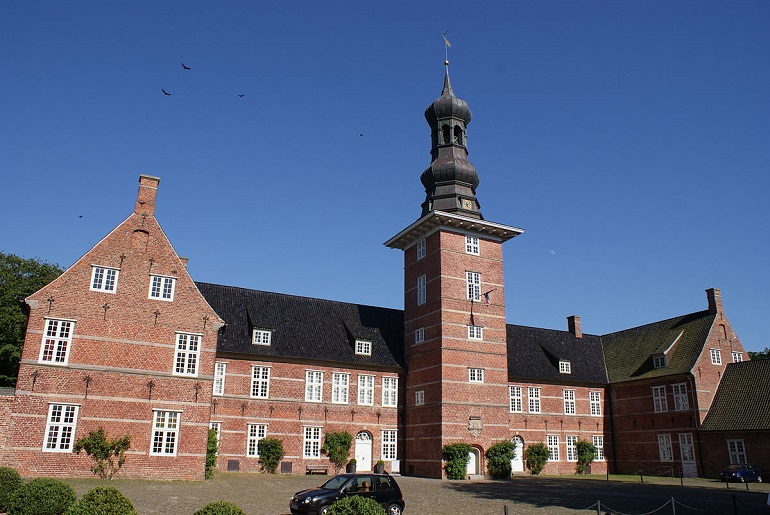
Located in the heart of Husum, Husum Castle is a striking Renaissance structure built in the 16th century as a residence for the Duke of Schleswig-Holstein-Gottorf. The castle, surrounded by a landscaped park known for its vibrant crocus bloom each spring, features distinctive Dutch architectural influences. Although its interiors are partially used for cultural events today, visitors can explore the gardens, the outer courtyards, and the palace itself from the outside, gaining a sense of the town's ducal heritage.
The Husum Harbour
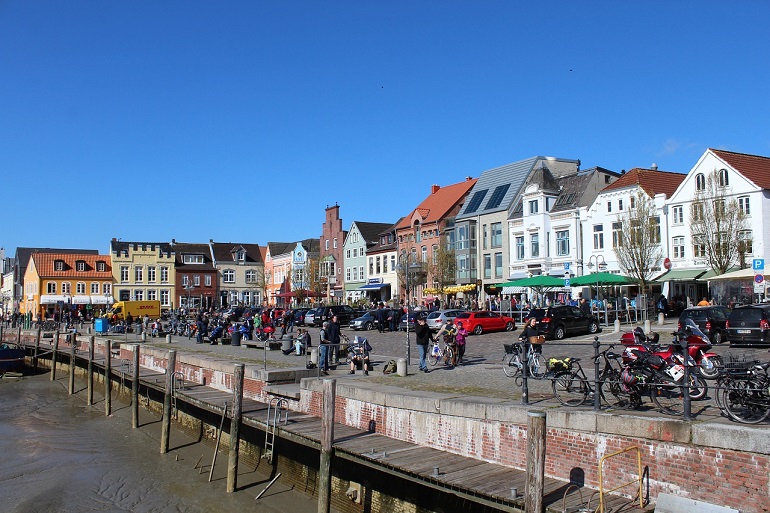
Husum Harbour is an active tidal port centrally positioned within the town, offering visitors an authentic glimpse of maritime life. Historically a trading and fishing hub, the harbour remains lined with colourful buildings and classic fishing boats. The promenade provides opportunities for watching local vessels come and go, and several cafes and restaurants enable visitors to savour fresh North Sea specialities while enjoying harbour views.

The Market Square (Marktplatz)
Serving as the focal point of Husum's old town, the Market Square is a spacious cobblestone plaza, framed by period townhouses and the imposing grey silhouette of St Clement's Church. The square has hosted a weekly market for centuries, where regional produce, crafts and local delicacies can be found. Seasonal events, including the annual crocus blossom festival and Christmas market, take place here, making it a lively spot to observe local culture and daily life.

St Clement's Church (St. Marienkirche)
St Clement's Church is a prominent late-Baroque Evangelical Lutheran church adjacent to the Market Square. Built between 1829 and 1833 after the collapse of its predecessor, the church's tall tower and ornate stucco interior render it notable within the townscape. The church is still active as a place of worship and is valued for its acoustics, sometimes hosting concerts and choral performances.

The Shipping Museum's Historic Museum Ships
Moored permanently along the harbour's quay are several historical ships associated with the Shipping Museum, though the vessels themselves are open for viewing from the outside. Notable examples include the old coastal cargo ship "Theodor Storm" and traditional cutters that once worked the North Frisian waters. These ships provide insight into Husum's seafaring past and the North Sea's traditional working vessels.
Ostenfelder Bauernhaus (Ostenfeld Farmhouse)
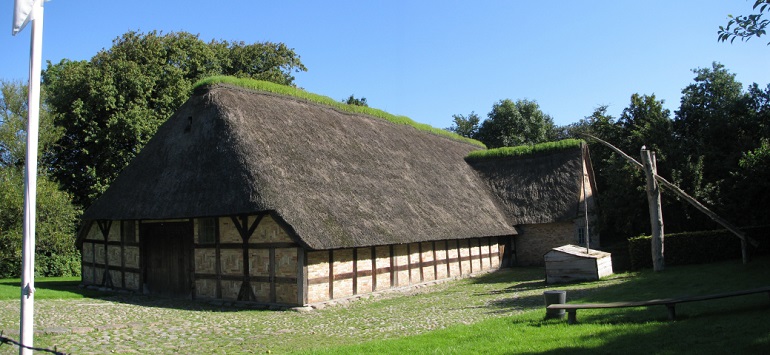
One of the oldest open-air farmhouses in Germany, the Ostenfelder Bauernhaus was originally built in 1617 near Ostenfeld and was relocated to Husum in the late 19th century. Its thatched roof, timber construction, and smoke-blackened interior give visitors a view into pre-modern rural North Frisian life. While closely associated with ethnographic collections, the building itself is the attraction: an authentic example of vernacular architecture and historical local living conditions.
The Nationalpark-Haus Husum
Situated close to the harbour, the Nationalpark-Haus Husum is the visitor centre for the Schleswig-Holstein Wadden Sea National Park. While the centre itself has exhibitions and educational programmes, the real attraction lies outside in the nearby tidal flats or "Wattenmeer". Organised mudflat walks and nature tours set off from Husum, offering opportunities to observe the unique ecosystem, migratory birds, and the tidal landscapes characteristic of the region.
Top Museums
Nationalpark-Haus Husum
Nationalpark-Haus Husum presents exhibitions on the ecology and wildlife of the Wadden Sea National Park. Visitors can explore interactive displays focused on local flora and fauna, as well as the conservation efforts in the region.
NordseeMuseum Husum
NordseeMuseum Husum is dedicated to the culture and natural history of the North Sea coast. The museum showcases artefacts and stories illustrating the area's relationship with the sea, featuring guided tours, workshops, and even live performances.
Schiffahrtsmuseum Nordfriesland
Schiffahrtsmuseum Nordfriesland is a maritime museum chronicling the region's shipping and seafaring traditions. It exhibits ship models, nautical instruments, and historic documents, offering insight into North Frisia's maritime past.
Museum Roter Haubarg
Museum Roter Haubarg, set in a classic thatched-roof farmhouse just outside Husum, provides a glimpse into rural life and architecture in the region. Its exhibits include historical furnishings and agricultural implements.
Schloss vor Husum
Schloss vor Husum combines history and culture within a 17th-century castle. Its museum features displays on Husum's history and regional customs, while the castle itself is surrounded by beautifully kept formal gardens and hosts cultural events.
Theodor-Storm-Haus
Theodor-Storm-Haus celebrates the legacy of the famed writer Theodor Storm. The carefully preserved historic house contains artefacts, manuscripts, and personal effects from Storm's life, giving visitors an intimate look at his work and environment.
Weihnachtshaus
Weihnachtshaus is a unique museum devoted to the history and traditions of Christmas celebrations. It houses an extensive collection of festive decorations and artefacts, offering year-round immersion in Yuletide culture.
Local Cuisine
Local specialities make the most of freshly caught fish and regional ingredients, with dishes such as Matjes herring, prepared with onions, apples, and cream, and Grünkohl mit Pinkel, a hearty kale dish paired with smoked sausage, particularly popular in the colder months. Visitors can also savour Labskaus, a sailor’s stew of corned beef, potatoes, beetroot, and herring, often topped with a fried egg, as well as sweet indulgences like Pharisäer coffee, rum-laced coffee served under a cap of whipped cream, said to have originated in Nordstrand near Husum. Traditional North Frisian influences combine with modern twists, making Husum’s culinary scene both comforting and distinctive.
Getting There
By train Husum is well connected by rail, with regular services from Hamburg taking you through scenic North Frisian landscapes before arriving directly at Husum’s central station, which is within easy walking distance of the harbour and town centre.
By coach or bus Long-distance coaches run to nearby hubs such as Hamburg or Kiel, from where regional buses or trains can take you onward to Husum, making this a comfortable option for those who prefer overland travel.
By car Driving to Husum is straightforward, with motorway access leading towards the North Frisian coast; the journey offers the flexibility to explore the surrounding countryside, villages, and coastline at your own pace.
| Travel destinations in Schleswig-Holstein | |||||||||||
|---|---|---|---|---|---|---|---|---|---|---|---|
|
|
|
| ||||||||
|
|
|
| ||||||||


