



| Contents |
|---|

Introduction
Formerly part of Thuringia, Coburg (pop. 26,500) was one of the capitals of the Duchies of Saxe-Coburg-Saalfeld and of Saxe-Coburg-Gotha from 1764 to 1918. The latter branch inherited through marriages the Kingdoms of Great Britain, Belgium, Bulgaria and Portugal. The main sights in town are the Coburg Citadel, one of Germany's largest castles, and the Ehrenburg, a Baroque palace remodelled in Gothic Revival by Duke Ernst I.
Interesting Facts about Coburg
- Coburg is renowned as the birthplace of Prince Albert, husband to Queen Victoria of Great Britain, forging a historic link between the British Royal Family and Germany.
- The imposing Veste Coburg, one of Germany’s largest castles, dominates the town and housed Martin Luther for several months in 1530.
- Coburg only became part of Bavaria through a popular vote in 1920, after centuries as the seat of the Duchy of Saxe-Coburg and Gotha.
- The town hosts the International Samba Festival every July, which is the largest samba festival outside Brazil, earning Coburg the nickname “Europe's Capital of Samba”.
- Coburg’s famous bratwurst is traditionally roasted over pinecones and served in a small bun—unique in both method and flavour.
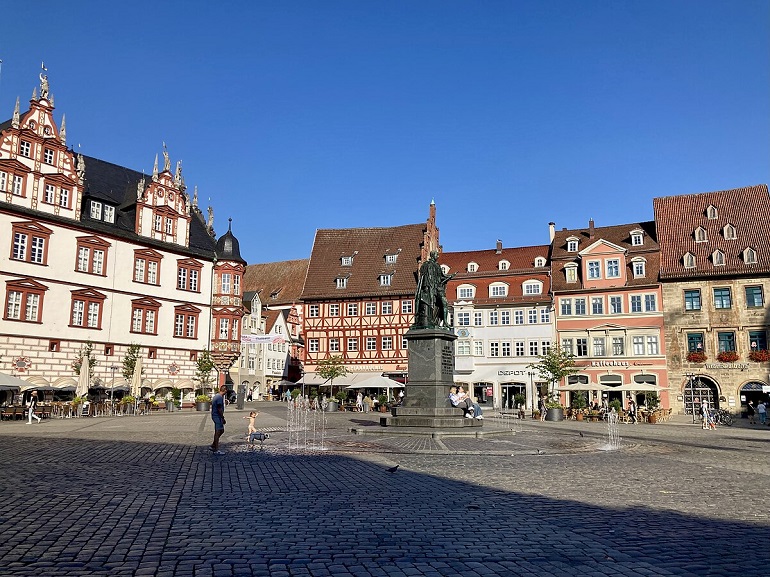
- The birthplace of the “Fränkische Krone” (Franconian Crown), the market square of Coburg offers splendid 360° views of historic half-timbered and rococo buildings.
- The Ehrenburg Palace, with its neo-Gothic façade, once served as a city residence for Coburg’s dukes and was a favoured retreat for Queen Victoria.
- The historic old town escaped major wartime damage, allowing visitors to experience authentic Gothic, Renaissance, and Baroque architecture.
- Some believe that the hot dog was invented in Coburg by local butcher Johann Georghehner in the 17th century, challenging Frankfurt’s claim.
- Coburg Peak, a mountain in Antarctica, is named after the town in honour of its connections to the Bulgarian royal house of Saxe-Coburg-Gotha.
History
Coburg's recorded history begins in 1056 when it was first mentioned in a monastic document, though an earlier settlement called Trufalistat existed on the site. Originally an imperial possession in the 10th century, the town's name may derive from "cow borough," reflecting its early agricultural significance. The strategically positioned Veste Coburg, with its oldest remains dating to the 12th or 13th century, came into the possession of the House of Henneberg in 1248 before passing to the House of Wettin in 1353 through marriage. The castle gained particular historical significance in 1530 when Martin Luther spent six months there during the Diet of Augsburg, continuing his German Bible translation whilst his liege lord attended the imperial diet. In 1596, Coburg achieved new prominence when it was elevated to the capital of the newly created Duchy of Saxe-Coburg under Duke John Casimir, marking the beginning of its golden age as a princely residence.
Throughout the 17th and 18th centuries, Coburg flourished as one of the capitals of the Duchy of Saxe-Coburg-Saalfeld (1699-1826) and later the Duchy of Saxe-Coburg-Gotha (1826-1918). The House of Wettin transformed Coburg into a European powerhouse through strategic marriages rather than military conquest, earning the motto "Others may wage war. You, fortunate Coburg, marry!" Their matrimonial diplomacy was extraordinarily successful, placing Coburg descendants on royal thrones across Europe, most notably Prince Albert, who married Queen Victoria of Great Britain. Under Duke Ernest Frederick, who moved his capital from Saalfeld to Coburg in 1764, the town underwent significant urban development. The medieval fortifications were demolished in the early 19th century and replaced with parks, whilst the ducal residence was relocated from the Veste to the Renaissance palace of Ehrenberg, which was later rebuilt in Gothic Revival style.
The 20th century brought dramatic changes to Coburg's political landscape and tragic chapters in its history. Notably, Coburg gained the unfortunate distinction of being the first German town where the Nazi Party won an absolute majority in municipal elections in 1929, and the first to make Adolf Hitler an honorary citizen in 1932. The town's Jewish community, which had existed since the 14th century and numbered 233 residents by 1933, faced systematic persecution that culminated in deportations to concentration camps between 1941 and 1942. After World War II, which Coburg survived largely undamaged, the town faced new challenges as it became part of Bavaria and West Germany whilst being surrounded on three sides by East German territory during the Cold War. This unique position, cut off from much of its natural hinterland by the Iron Curtain, shaped Coburg's development throughout the second half of the 20th century as it integrated over 15,000 refugees and adapted to its new role within the Federal Republic of Germany.
Main Attractions
Veste Coburg
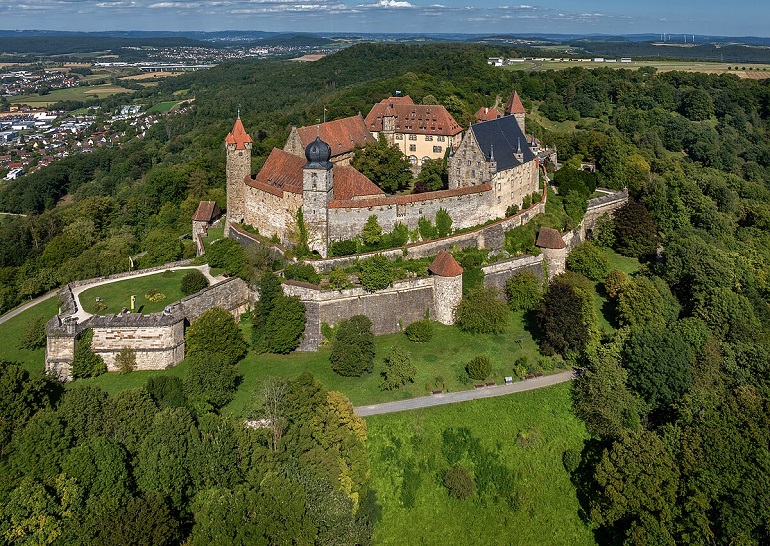
Perched prominently atop a hill, 167 metres above the town centre, Veste Coburg stands as one of Germany’s most remarkably preserved medieval fortresses, its origins first documented as early as 1056. Over subsequent centuries, particularly between the 15th and 17th centuries, it underwent significant expansion and fortification, evolving into an almost impregnable stronghold. A pivotal historical moment occurred in 1530 when Martin Luther sought refuge within its secure walls for six months, using the fortress as a safe haven to observe the Diet of Augsburg from a distance and to complete crucial theological writings, including his translation of portions of the Bible. This period is still commemorated today by the “Lutherstube” rooms located within the upper ward, which remain accessible to visitors. The extensive complex encompasses approximately 25,000 m² and retains impressive defensive structures such as the Bärenbastei and Hohe Bastei, formidable bastions that were strategically added during extensive Renaissance modernisations to counter advancements in artillery warfare. The panoramic views from the fortress over the surrounding Franconian landscape are also a significant draw, offering a sweeping vista that underscores its strategic importance throughout history.
Schlossplatz
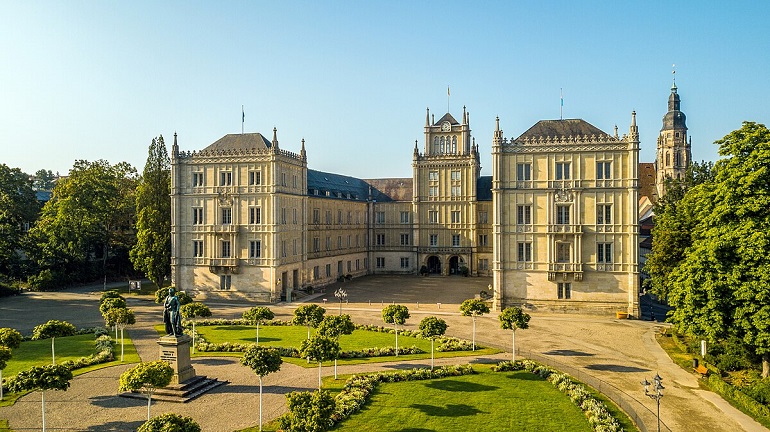
Laid out meticulously between 1825 and 1849 under the patronage of Duke Ernst I, Schlossplatz forms a grand and formal forecourt to the magnificent Ehrenburg Palace. This expansive square is a prime example of 19th-century historicist town planning, clearly reflecting the influential designs of prominent figures such as Karl Friedrich Schinkel and landscape designer Peter Joseph Lenné. The broad, meticulously maintained gravel expanse is elegantly framed by significant architectural landmarks: the Landestheater, completed between 1837 and 1840, with its neoclassical facade; an arcaded retaining wall that gracefully leads into the Hofgarten; and the stately Palais Edinburgh. At its very heart stands Ludwig Schwanthaler’s imposing 1847 bronze statue of Duke Ernst I, positioned within a meticulously designed circular flower parterre that adds a touch of natural beauty to the formal setting. Schlossplatz is not merely a historical space but also a dynamic venue, frequently hosting large open-air events, including the lively summer Schlossplatzfest and various components of the internationally renowned Samba Festival, underscoring its enduring role as a significant public space.
Ehrenburg Palace
Constructed between 1543 and 1547, Ehrenburg Palace served as the opulent town residence for Duke Johann Ernst, occupying three prominent wings on Schlossplatz. It earned the distinguished name “Palace of Honour” from Emperor Charles V, a testament to the fact that its construction was notably achieved without resorting to forced labour. Tragically, a destructive fire in 1690 necessitated extensive rebuilding, during which the palace was enriched with magnificent Baroque state rooms, including the breathtaking Hall of Giants, renowned for its intricate stucco work and grand scale. Between 1810 and 1840, the renowned Prussian architect Karl Friedrich Schinkel undertook a significant redesign of the exterior, refacing it in an elegant Neo-Gothic sandstone style. Concurrently, the interiors were lavishly remodelled by André-Marie Renié-Grétry in the sophisticated French Empire style, reflecting contemporary tastes. Ehrenburg Palace remained the principal ducal residence until the dissolution of the monarchy in 1918, bearing witness to centuries of ducal life and state affairs within its hallowed halls.
Hofgarten
The Hofgarten, a verdant expanse spanning 26 hectares, provides a picturesque link between Schlossplatz and the fortress ridge. Its origins trace back to 1680-1682 when Duke Albrecht commissioned its creation as a terraced Dutch-style pleasure garden. Over a century later, from 1816 onwards, the court gardener Carl Friedrich Christian masterfully reshaped it into a more naturalistic landscaped park, aligning with the prevailing Romantic aesthetic of the era. The gently rising pathways now meander through a serene landscape featuring ornamental ponds, diverse specimen trees, and gradually ascend the 167 metres in altitude towards the Veste. This elevated position affords numerous scenic viewpoints over Coburg and its surroundings, offering tranquil spots for contemplation. Within the park, visitors can discover several notable monuments, including the impressive equestrian statue of Duke Ernst II and two charming 1754 garden pavilions that add to the historical ambiance of the grounds. The Hofgarten provides an idyllic setting for leisurely strolls and peaceful enjoyment of nature.
Marktplatz
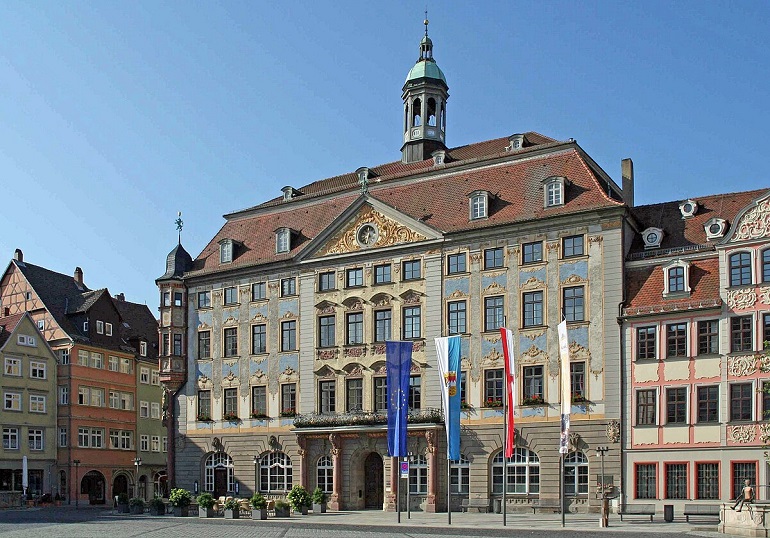
Coburg’s Marktplatz, or Market Square, established in the early 15th century, continues to serve as the vibrant epicentre of civic life within the town. It is intricately connected to the historic old town by a network of seven narrow alleys, and its surface, paved with cobblestones installed shortly after its creation, echoes centuries of footsteps. Dominating the square are several architecturally significant buildings, including the late-Renaissance Stadthaus, distinguished by its characteristic corner oriels, and the colourfully painted Rathaus, the historic town hall. A bronze monument honouring Prince Albert, a native of Coburg, has proudly stood at the centre of the square since 1865. The Marktplatz remains a bustling hub of commerce and community, hosting lively produce markets twice a week and transforming into a magical setting for the annual Christmas market, thereby continuing its centuries-old tradition as a vibrant trading and social gathering place. The square's lively atmosphere and historical charm make it a focal point for both residents and visitors.

St Moriz Church
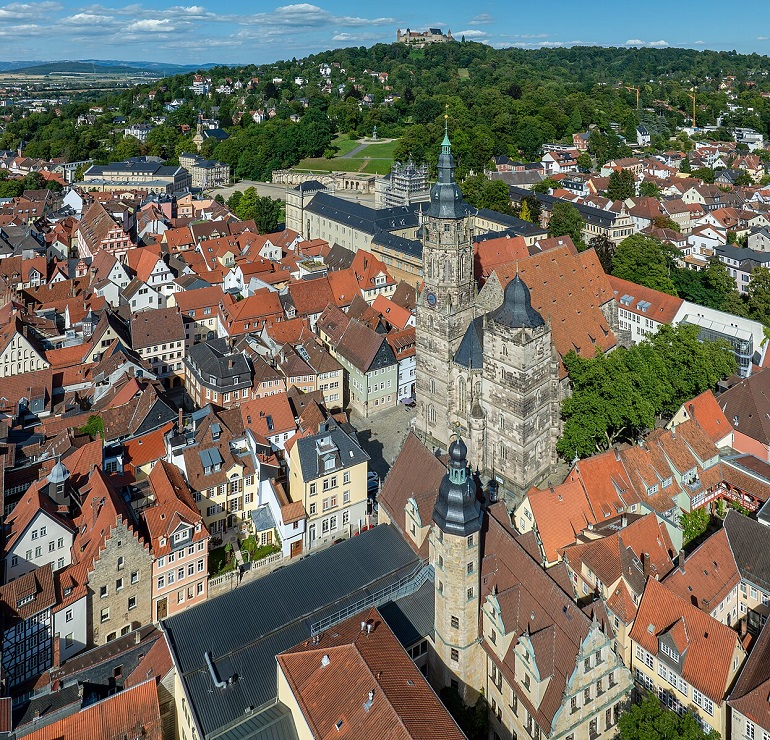
St Moriz Church, Coburg’s oldest surviving ecclesiastical structure, traces its origins back to approximately 1310. It was progressively completed as a distinguished late-Gothic hall church, notably featuring asymmetrical twin towers, with its final form achieved by 1586. This church holds particular historical significance for its connection to the Reformation; Martin Luther himself preached from its pulpit seven times during Easter in 1530, a period that significantly reinforced Coburg’s strong commitment to the Reformation movement. The interior of the church is marked by impressive artistic and historical elements, most notably a monumental 13-metre alabaster epitaph commemorating Duke Johann Friedrich II, installed in 1598, which majestically dominates the choir. The Baroque interior scheme, thoughtfully added between 1740 and 1742, has been remarkably preserved, offering a glimpse into the aesthetic sensibilities of that era. Furthermore, a 1989 Schuke organ, which ingeniously re-uses pipework dating back to the 18th century, continues to fill the historic space with its rich sounds, contributing to the church's enduring spiritual and cultural legacy.
Top Museums
Orientation: Coburg’s Museum Landscape
Coburg’s principal museums cluster around three historic axes. High above the town, Veste Coburg houses world-class art collections. At the foot of the hill, the neo-Gothic Ehrenburg Palace reveals 450 years of princely interior design. Just beyond the old walls lie thematic museums: natural history in the Hofgarten, archaeology beneath the Kirchhof, rural folklore in nearby Ahorn, cutting-edge glass in Rödental’s Schlosspark, and an interactive chronicle of German marksmanship at Schloss Callenberg. Together they deliver a panorama of Franconian and European culture unrivalled for a city of Coburg’s size.
Comparative Snapshot
| Museum | Primary Focus | Stand-out Objects/Features | Architectural Setting |
|---|---|---|---|
| Kunstsammlungen der Veste Coburg | Renaissance to nineteenth-century art, armour, glass | Cranach and Dürer panels; 2,700 Venetian glasses; two of the world’s oldest carriages | One of Germany’s best-preserved medieval fortresses dominating the town skyline |
| Naturkunde-Museum Coburg | Earth sciences, evolution, ethnology | 12 m mineral cave; Neanderthal family diorama; 20,000 Jurassic fossils | Purpose-built 1913 museum in the English-style Hofgarten |
| Ehrenburg Palace (Schlossmuseum) | State apartments, dynastic art | Hall of Giants with 28 atlas figures; Queen Victoria’s bedroom; Cranach gallery | Neo-Gothic façade by K. F. Schinkel wrapped around a Renaissance–Baroque core |
| Deutsches Schützenmuseum | History of German shooting guilds | 1720 “Roter Mann” target; Pierre de Coubertin pistols; full Olympic torch set 1936-2008 | West wing of romantic Schloss Callenberg overlooking the Goldbergsee |
| European Museum of Modern Glass | Studio and contemporary glass | Coburg Glass Prize works; large-scale installations; 500-piece ceramic study collection | Light-filled glass pavilion opposite Rosenau Orangery in Rödental |
| Alte Schäferei – Gerätemuseum | Rural technology, folklore | 30,000 farm & craft tools; live Coburg Fox sheep in summer | 1713 baroque sheepfold ensemble with barn, bakehouse and orchard |
| Grabungsmuseum Kirchhof | Medieval archaeology | Foundations of a 13th-c. Benedictine chapel; high-medieval graves; gaming counters | Sub-basement of the municipal offices on the former St Moriz churchyard |
| Coburger Puppenmuseum (closed 2022) | Historic dolls & dollhouses | 2,000 dolls (1800-1960); 50 doll’s houses; Doty-Award creations by Carin Lossnitzer | Protected merchant’s house where poet Friedrich Rückert once lived |
Kunstsammlungen der Veste Coburg
Historical Context
Perched 167 metres above the town, Veste Coburg—nicknamed the “Franconian Crown”—grew from medieval fortress into a romanticised castle under the dukes’ 19th-century restorations. Since 1839 its halls have displayed the ducal art trove, opening them to the public decades before many state galleries followed suit.
Collections & Highlights
- German Renaissance masters: Panels by Lucas Cranach the Elder, Albrecht Dürer and Matthias Grünewald anchor the painting galleries.
- Prints & drawings: An international Kupferstichkabinett charts five centuries of works on paper.
- Venetian glass: Approximately 2,700 pieces form one of Europe’s richest ensembles outside Venice, spanning Baroque balustrade goblets to Art Deco vases.
- Arms & armour: Gothic helmets, richly etched pistols and parade breastplates illustrate elite martial culture.
- Historic vehicles: Two late-15th-century carriages—among the world’s oldest—plus Baroque sleighs glint in vaulted stables.
Architectural Notes
Visitors traverse courtyards ringed by bastions later romanticised with pointed arches and oriels. The Intarsia Hunting Room (1632) wraps guests in walnut marquetry depicting stags and hounds, epitomising princely field sport imagery.
Insider Tips & Curiosities
Martin Luther spent six months here in 1530, translating biblical texts whilst awaiting news from the Augsburg Diet; a small exhibition recounts his sojourn.
Naturkunde-Museum Coburg
Genesis of a Landesmuseum
Founded in 1844 by Prince Albert and Duke Ernst II, the museum crystallised a ducal passion for natural history. Its 1913 building, crowned by an observatory dome, was then the largest German museum new-build for science displays.
Galleries to Explore
- Earth & Evolution: A winding 12 m mineral cave leads from glittering amethysts to Triassic footprints.
- Triassic–Jurassic Coburg: 20,000 fossils narrate the region’s deep past, including petrified tree trunks 210 million years old.
- Rocky Mountains Hall: Dioramas bring puma and moose into Franconian proximity.
- Human Origins: A Neanderthal family huddles round a campfire, echoing Victorian anthropology’s fascination.
- Ethnology Wing: Oceania clubs, Sumatran textiles and West African masks hint at global collecting networks fostered by royal diplomacy.
Did You Know?
Queen Victoria commissioned four bird vitrines from renowned taxidermist Henry Ward, now gleaming in the Herzogin-Auguste-Saal.
Ehrenburg Palace (Schlossmuseum)
From Monastery to Neo-Gothic Jewel
Duke Johann Ernst replaced a dissolved Franciscan friary with his new town residence between 1543 and 1547, allowing the court to descend from the fortress. After a devastating fire, Duke Albrecht draped Baroque stucco over its walls (1690), while Duke Ernst I refashioned the exterior in English-inspired Gothic Revival from 1810 under the prodigy Karl Friedrich Schinkel.
Interior Highlights
- Hall of Giants: Twenty-eight stucco atlantes shoulder a gilded ceiling in a festival space built for Habsburg-scale diplomacy.
- State Apartments: André-Marie Renié-Grétry blended French Empire elegance—ebonised furniture, ormolu clocks, silk-draped walls—into Coburg’s ceremonial route.
- Queen Victoria’s Bedroom: The monarch’s frequent visits are immortalised in a rosewood four-poster and family portraits linking Coburg to Windsor.
- Art Galleries: Works by Lucas Cranach and Dutch Golden Age masters hang alongside Romantic landscapes favoured by Duke Ernst II.
Architectural Layering
The palace’s three sides form an open U-shape facing Schlossplatz; crenellated turrets conceal Renaissance staircases and a hidden court chapel.
Deutsches Schützenmuseum at Schloss Callenberg
A Living Chronicle of the German Schützenwesen
Opened in 2004, the museum revives a collection lost during Nazi confiscations and wartime bombing. Interactive screens and a laser archery simulator translate centuries of citizen marksmanship into contemporary play.
Star Exhibits
- “Roter Mann” Target (1720): A crimson-painted figure from Kronach, emblematic of 18th-century competitive shooting culture.
- Coubertin Pistols: Two flintlocks owned by the Olympic Games’ founder link shooting to global sport history.
- Olympic Torches: Every summer torch from 1936 Berlin to 2008 Beijing flickers in one display, tracking design, politics and flame technology.
Schloss Callenberg Setting
The Westphalian-style castle, once a hunting seat of Duke Ernst II, still belongs to the ducal family, its rose garden and chapel offering reflective pauses between martial exhibits.
European Museum of Modern Glass
Context & Architecture
Opened in 2008 opposite Schloss Rosenau’s orangery, the linear glass-and-steel pavilion floods the displays with natural light, creating shifting reflections against the surrounding parkland.
The Collection
- Studio Glass Movement: Ground-floor cases march decade by decade from 1960s experimental vessel forms to post-modern sculptural pieces.
- Coburg Glass Prize Core: Winning works from competitions in 1977, 1985, 2006, 2014 and 2022 map European innovation in colour layering, cold-working and casting.
- Large-Scale Installations: Towering spirals and neon-lit sheets exploit the pavilion’s 7 m ceiling.
- Ceramic Study Collection: 500 objects by 250 artists underpin dialogues between fired clay and molten glass.
Experiential Touches
A glass staircase itself becomes an exhibit, revealing bubbles and striations frozen during pouring—proof of material and craftsmanship in perfect tension.
Alte Schäferei – Gerätemuseum des Coburger Landes
Pastoral Time Capsule
This 1713 sheepfold complex, laid out for 500 wintering animals, now houses one of Bavaria’s largest folklore collections—around 30,000 artefacts. The cobbled yard, bakehouse and orchard evoke pre-industrial agrarian life.
Exhibition Themes
- Agriculture & Animal Husbandry: Butter churns, scythes and flax brakes illustrate cyclical labour rhythms.
- Rural Craftsmanship: A double-barn stages live demonstrations—basket weaving, slate-roofing, wooden wheel making—during seasonal fairs.
- Domestic Interiors: Painted wardrobe fronts and dowry chests reveal regional design motifs such as tulips and stylised hearts.
- Shepherding Archive: Oral histories, wage records and patterns for woollen jerkins document a now-rare occupation.
Living Heritage
Coburg-Fox sheep graze in summer, their russet fleece echoing the surrounding Streuobstwiesen blossom.
Grabungsmuseum Kirchhof
Unearthed Faith & Fortification
During 1988 construction works engineers uncovered the chapel foundations of a 13th-century Benedictine propstei and an adjoining cemetery. The city responded by embedding a compact museum into the new office basement, opened in 1994.
Displays
- Exposed Masonry: Visitors stand beside original ashlar walls marked with masons’ symbols and mediaeval graffiti.
- Burial Finds: Child and adult skeletons with grave goods—ceramic rosary beads, pewter pilgrim badges—shed light on lay piety.
- City Defences: A slice of Coburg’s early curtain wall emerges beneath glass flooring, juxtaposing sacred and military roles of the precinct.
Interpretive Innovation
A 2025 student-produced audioguide animates dig diaries and 3-D reconstructions, testifying to ongoing public archaeology.
Coburger Puppenmuseum (Closed 2022)
Rise and Fall of a Niche Treasure
Founded in 1987 upon the Lossnitzers’ private hoard, the museum expanded to 33 period rooms, winning international acclaim for doll artistry. Visitor numbers dwindled, and logistical constraints in the listed Rückertstraße house—narrow staircases, lack of group space—prompted the city to close the site at 2022’s end. Negotiations aim to rehome the 2,000 dolls and 50 dollhouses within the district, preserving narratives of Franconian toy manufacture.
Thematic Trails & Combined Experiences
Glass & Art Duo
Pair the European Museum of Modern Glass with the Veste’s Venetian glass halls to span six centuries of the material’s evolution in a single day.
Courtly Life Continuum
A route from Ehrenburg Palace’s formal staterooms through Schloss Callenberg’s private salons and on to Veste Coburg’s fortified apartments traces ducal taste from Renaissance confidence to Romantic nostalgia.
Nature, Farming & Science
Walk the Hofgarten between Naturkunde-Museum and Alte Schäferei’s rural archive to contrast scientific taxonomy with lived agro-ecology.
Practical Pointers (Non-Schedule)
- Topography: Expect a steep ascent to the Veste; a woodland footpath grants dramatic approach views.
- Language & Labels: Major museums provide English texts; smaller sites often rely on German panels—carry a translation app for Kirchhof and Alte Schäferei.
- Combined Tickets: A joint pass for Veste Coburg, Ehrenburg Palace and Schloss Rosenau streamlines multi-site visits whilst supporting conservation.
- Seasonal Events: Alte Schäferei’s Schaffest in July weaves sheep-shearing, wool-spinning and music into living heritage.
Local Cuisine
Coburg is famed for its Coburger Bratwurst, a coarse, flavourful sausage traditionally roasted over a pinecone fire, which imparts a unique, smoky taste. No meal is complete without Coburger Rutscher, exceptionally soft potato dumplings that simply melt on the plate and are typically served alongside hearty Franconian roasts with rich gravy. For those with a sweet tooth, Coburger Schmätzchen are a must-try: these tender lebkuchen biscuits, made from honey, almonds, and spices, are a historic delight often decorated with a touch of gold leaf. Wash it all down with a refreshing local brew from one of the region’s many breweries or try the distinctive Hof-Likör, a secret-recipe herbal liqueur that rounds off any meal with a spicy, aromatic kick. Local dining promises a true taste of Upper Franconia’s abundance and tradition.
Getting There & Around
By train, Coburg is well connected to major cities including Munich, Nuremberg and Berlin via high-speed ICE trains, making travel by rail particularly convenient and comfortable. Several direct and regular services arrive at Coburg’s main station from key Bavarian and German destinations, allowing for an easy onward journey into the heart of town.
By coach or bus, various regional and long-distance services operate to Coburg, although using the train is generally more convenient and faster for most visitors. Within the town and county, a comprehensive bus network ensures regular connections, with urban lines running throughout the day and on-demand services available in the evenings.
By car, Coburg is easy to reach as it sits near several major motorways. The A73 motorway offers direct access from both the north and south. Drivers can also use routes such as the A9 from Munich-Nuremberg-Berlin and the A3 from Nuremberg-Würzburg. Once in Coburg, there are plenty of convenient parking options close to the town centre, making it stress-free for motorists.


