



| Contents |
|---|

Introduction
A major stop on the Fairy-Tale Road, Hamelin (Hameln in German ; pop. 56,000) is forever associated with the medieval story of Pied Piper of Hamelin. Popularised by the the Brothers Grimm, Goethe and Robert Browning in the 19th century, the legend tells how in the 13th century a piper hired for his rat-catching skills lured all the town's rodent into the Weser River with his magic pipe. When the town folk refused to pay for his services, Pied Piper led all the local children to drown in the river too.
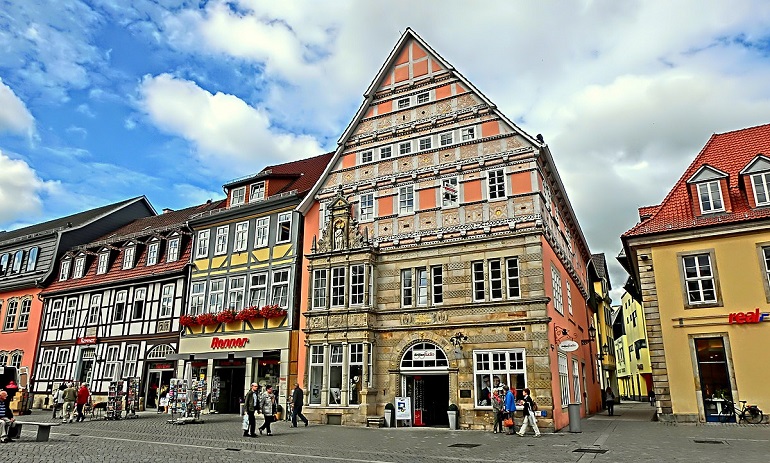
Hamelin's compact Old Town features well-preserved Renaissance and half-timbered buildings such as the Hochzeitshaus (Wedding House) and the Pied Piper’s House, alongside notable churches including St Boniface Minster.
Interesting Facts about Hamelin
- Hamelin is world-famous for the legend of the Pied Piper, a story dating back to 1284, which tells of a rat catcher who led away the town’s children after being cheated of his fee.
- The tale of the Pied Piper is memorialised with painted rats on the cobblestone streets and a Renaissance-era Pied Piper’s House in the centre of town.
- Hamelin boasts a charming and exceptionally well-preserved old town, featuring magnificent timber-framed and sandstone buildings from the Renaissance period.
- The town originated around the Abbey of St Boniface, founded by monks in the late 8th century, and its Minster is one of the oldest churches in the region, dating back over 1,200 years.
- For centuries, Hamelin was a minor member of the Hanseatic League, a medieval commercial and defensive confederation of merchant guilds.
- Once surrounded by massive fortifications, Hamelin earned the nickname “Gibraltar of the North” in the 18th century, before its walls were demolished by Napoleonic troops.
- The town is set in the scenic Weser Uplands, making it an ideal base for hiking, cycling, and river tours.
- Visitors can follow a special “rat trail,” with rat symbols embedded in the paving stones, guiding them to key attractions linked to the famous fable.
- The local museum houses a collection dedicated to the ratcatcher legend, and public performances and festivals relive the tale each year.
- Hamelin’s former prison became infamous after World War II, as it was used by British occupation authorities in the prosecution and execution of war criminals.
History
Hamelin's origins can be traced back to the early medieval period, beginning with the establishment of a monastery as early as 851 CE. The town developed around the Abbey of St. Boniface, which was founded by monks from Fulda at the end of the 8th century. Archaeological evidence suggests that people have inhabited this area since the Stone Age, with structural ruins dating back to the 8th century. By the 12th century, what had started as a monastic settlement had evolved into a proper town. The settlement was granted a charter around 1200 and remained a market centre dependent on the Abbey of Fulda until 1259. During this period, Hamelin passed to the dukes of Brunswick and eventually became a member of the prestigious Hanseatic League in the 15th and 16th centuries.
The most famous event in Hamelin's history occurred in 1284, when the legendary incident involving the "Pied Piper" is said to have taken place. This event, which may be based on actual historical circumstances, has been recorded in various forms throughout the centuries. One of the earliest surviving pieces of evidence is a portion of the town gate from 1556, which bears an inscription stating that 272 years earlier, a magician had led 130 children away from the city. Whilst the traditional tale speaks of a rat-catcher who led children away after the townspeople refused to pay him, modern historians suggest this may actually reference the eastward migration and colonisation efforts of the time, where young adults from Lower Saxony were recruited to settle in regions such as Moravia, East Prussia, and Pomerania. The theory gains credence from the fact that family names common to Hamelin appear with surprising frequency in areas near Berlin, particularly in Uckermark and Prignitz.
Hamelin's strategic importance grew significantly when it became a fortified border town of the Principality of Calenberg in 1664, marking the beginning of its greatest period of prosperity. In 1705, the town became part of the newly created Electorate of Hanover when it was inherited by George Louis, Prince of Calenberg, who later became King George I of Great Britain. The town was so heavily fortified with four surrounding fortresses that it earned the nickname "Gibraltar of the North". However, this military significance came to an abrupt end in 1806 when Hamelin surrendered without resistance to Napoleon's forces following his victory at the Battle of Jena-Auerstedt. The French subsequently demolished the town's historic walls, guard towers, and three of the fortresses, though the citizens later built a sightseeing tower called the Klütturm in 1843 from the ruins of Fort George. In 1867, Hamelin became part of the Kingdom of Prussia after Hanover's annexation following the Austro-Prussian War.
Main Attractions
The town bathes in the atmosphere of the fairy tale, and in the summer, every Sunday, the tale is performed by actors in the centre. The comic musical Rats is also performed in Wednesday afternoons.
Many of Hamelin's façades are richly ornated in a distinctive Renaissance style, dating mostly from the late 16th century to early 17th century. Among notable buildings let's note the Leist-Haus (1585-1589), the Rattenfaengerhaus (1603), the Dempter-Haus (1607), the Hochzeitshaus (1610-1617) as well as the older, timber-framed Bürgerhus (1560).
Hamelin Old Town
Hamelin's historic Old Town is the main attraction for visitors to this Lower Saxon town. The centre showcases beautifully restored half-timbered and sandstone buildings, many dating to the Renaissance period. The architectural highlights include Osterstraße and the Pferdemarkt square, which form the heart of the town. Between these points, narrow winding alleyways house cafés, inns, beer gardens and shops. The Old Town features numerous buildings with rich ornamental and figural decoration, including the Stiftsherrenhaus from 1558 and the Leisthaus from 1587/89. Visitors can follow the painted rat trail on the cobblestones, which guides them to the main attractions throughout the town.
Leist-Haus
Built between 1587 and 1589 for the patrician and grain merchant Gerd Leist, the Leist-Haus is a prominent Weser Renaissance town house. The façade includes characteristic period details such as carved heads intended as protective symbols. It is linked by a bridge to the neighbouring Stiftsherrenhaus, and together the buildings accommodate the Hamelin Museum.

Hochzeitshaus (Wedding House) and Glockenspiel
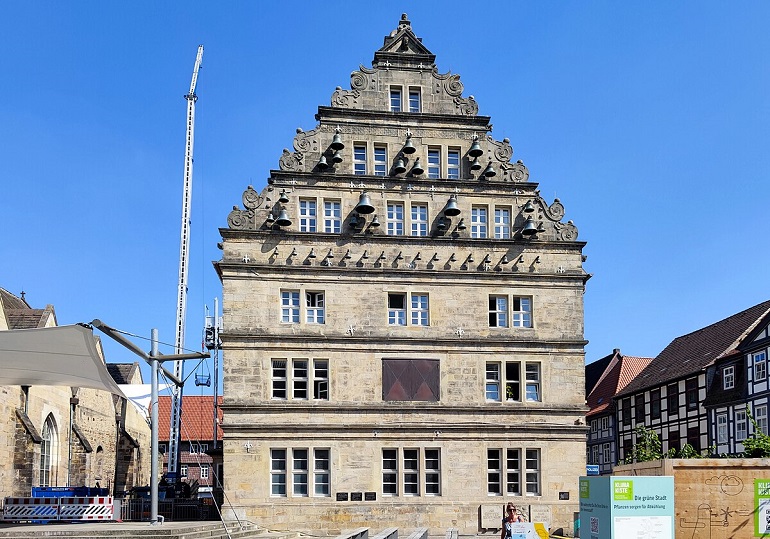
The Hochzeitshaus is a significant Renaissance building that houses the famous Rattenfänger Figuren- und Glockenspiel on its western gable. This mechanical carillon tells the story of the Pied Piper through figurines that appear when the bells chime. The glockenspiel operates at specific times daily: 13:05, 15:35 and 17:35, with additional performances at 09:35 (Pied Piper song) and 11:35 (Weser River song). When the bells ring, the piper first appears leading rats, followed by a darker-looking piper leading children from the town, except for a blind and lame child who remain behind.
Rattenfängerhaus (Pied Piper's House)
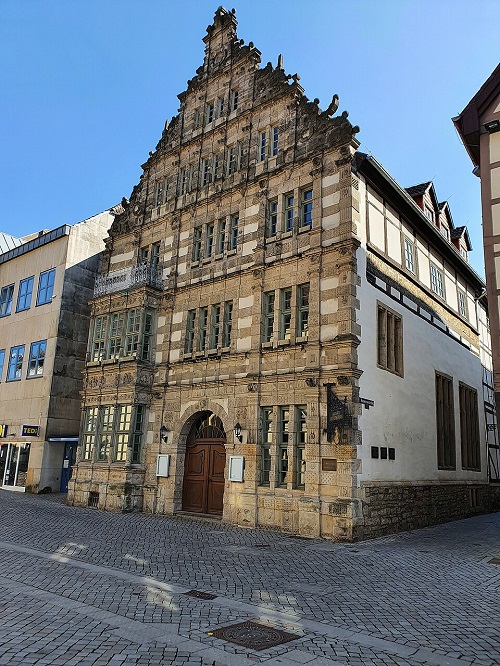
The Rattenfängerhaus stands at number 23 Osterstraße and is one of Hamelin's largest and prettiest Renaissance buildings. This stately building features an inscription on its façade that refers to the disappeared children from the legendary Pied Piper tale. Built in the Renaissance style, the house now accommodates an Indian restaurant but retains its historical significance as a memorial to the events of 1284. The façade bears a placard with text relating to the legend, making it a key landmark for visitors following the Pied Piper theme throughout the town.
Dempter-Haus
The Dempter-Haus stands on the Pferdemarkt (Horse Market) and is a notable example of the Weser Renaissance architectural style. Its richly decorated façade contributes to the historic streetscape of the square, which has served as a central point in Hamelin since the Middle Ages.
Bürgerhus
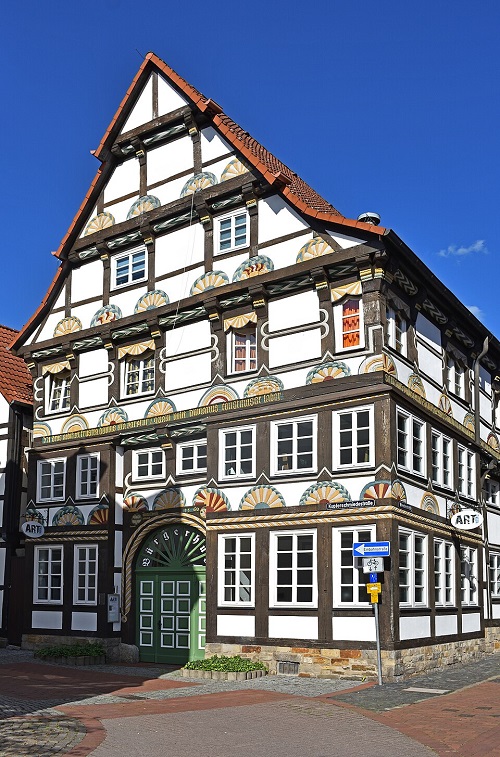
Located on Kupferschmiedestraße, the Bürgerhus is a half-timbered house constructed in 1560. It was built for the von Hollenstedt family, who were members of the town council. The building is a representative example of 16th-century burgher residential architecture in Hamelin.
St. Boniface Minster
St. Boniface Minster is Hamelin's oldest church, dating back to the ninth century. Located a short distance from the town centre, this historic church offers visitors a peaceful retreat from the busier central attractions. The Minster is situated near Europaplatz Park, providing an opportunity for visitors to enjoy quiet walks with views over the water. The church represents one of the town's most significant religious buildings and offers insight into Hamelin's medieval heritage beyond the Pied Piper legend.
Marktkirche St. Nicolai
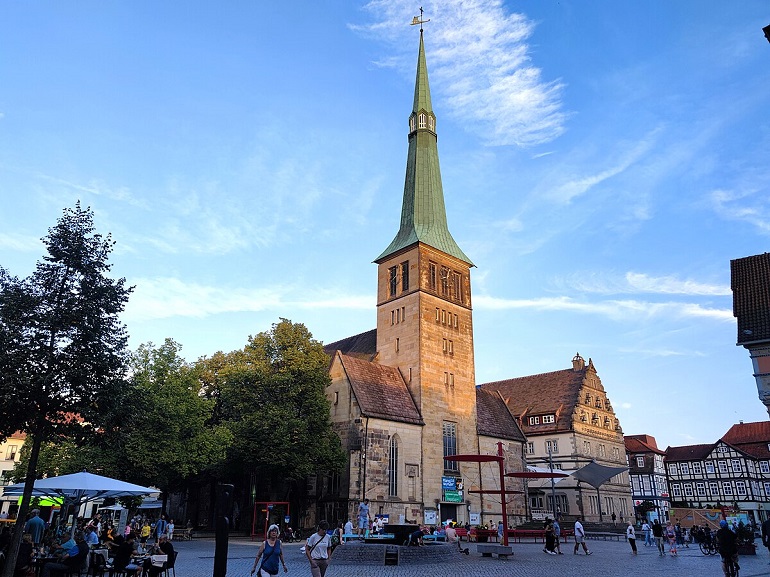
The Marktkirche St. Nicolai serves as one of Hamelin's prominent religious buildings in the town centre. This church features a tower that visitors can climb for elevated views over the historic town. The church contains Pied Piper-themed elements, including a glass window depicting the legendary figure. The building represents the town's religious heritage and provides another perspective on Hamelin's architecture beyond the secular Renaissance buildings. The tower climb offers panoramic views across the Old Town's rooftops and the surrounding Weser Upland landscape.
Pied Piper Open-Air Performance
During the summer months, Hamelin hosts free outdoor performances relating to the Pied Piper legend. Every Sunday at noon, a play about the Pied Piper is performed near the town hall, drawing local families and visitors to the benches arranged for viewing. Additionally, the musical "Rats" is staged every Wednesday at 16:30. These performances feature local participants, including children in rat costumes, creating an authentic community atmosphere. The shows provide entertainment whilst bringing the famous legend to life in the town where it originated.
Pied Piper Statue and Fountains
Throughout Hamelin, visitors encounter multiple statues and fountains dedicated to the Pied Piper legend. The main Pied Piper statue stands on Osterstraße, surrounded by café tables and chairs, making it a popular photo opportunity. Additional Pied Piper landmarks include classical fountains on Osterstraße and at the City Hall Court. The Market Church also features a glass window depicting the Pied Piper. These monuments are distributed throughout the town centre, and visitors can spot representations of the piper on various building façades.
Die Insel (The Island)
The small island in the River Weser is accessible via the Rattenbrücke (Rat Bridge), which features a large golden rat sculpture on top. The island offers a peaceful park setting with beautiful views of both the river and the town. Visitors can take short walks around the island's parkland and visit the beer garden with its extensive garden area. The island also houses a centuries-old lock, adding historical interest to the natural setting. This location provides an ideal spot for relaxation away from the more crowded town-centre attractions.
Top Museums
Museum Hameln
Hamelin’s principal museum occupies two impressive Weser Renaissance buildings in the heart of the old town—the Leisthaus and the neighbouring Stiftsherrenhaus—whose ornate façades are attractions in their own right and set the tone for a visit steeped in regional heritage. Inside, a modern permanent exhibition spread across roughly 1,200m² traces the town’s story from its earliest settlements through the Middle Ages, Reformation, Weser Renaissance prosperity, fortification era, industrialisation, tourism, and 20th-century upheavals, blending political history with everyday life.
A dedicated section explores the world-famous Pied Piper legend, presenting early textual references, artworks, film and musical adaptations, and the tale’s evolution into a tourism icon, alongside a notable trove of illustrated children’s books from around the world. The museum’s distinctive centrepiece is a mechanical Pied Piper theatre—an imaginative, kinetic installation that retells the story with playful theatricality and modern flair, designed to engage visitors of all ages. Outstanding exhibits include the Hamelin Missal of 1480 and two angel candlesticks from Nuremberg’s Vischer workshop, which anchor the collection’s craftsmanship and devotional art; together they illuminate the religious and artistic culture that shaped the Weser region.
Interpretation here is deliberately hands-on: drawers to open, shutters to peek behind, and other tactile elements encourage exploration, while contemporary media lend context without overwhelming the historic ambience of the galleries. The result is an accessible, family-friendly journey through Hamelin’s past that balances scholarly substance with vivid storytelling.
- Architectural setting: Leisthaus and Stiftsherrenhaus, key Weser Renaissance landmarks in the pedestrian zone.
- Scope: City and Weserbergland history across six levels; curation ranges from medieval urban life to post-war redevelopment.
- Pied Piper focus: Dedicated gallery, extensive collection, and a unique mechanical theatre experience.
- Highlight objects: Hamelin Missal (1480) and Vischer workshop angel candlesticks.
- Experience design: Interactive features and modern media for an engaging, multi-sensory visit.

Automobil-Museum at Hefehof
Located near the train station, this specialised museum tells the fascinating story of how Hamelin nearly became the home of Volkswagen. The museum showcases the Colibri and Sperber vehicles that revolutionised automotive construction in the area. Visitors can discover how these innovative aluminium-bodied cars and their advanced compressor motors represented a significant chapter in German automotive history.
Die bewegliche Letter
Adjacent to the Automobil-Museum, this printing museum offers insight into the "black magic" of bringing information to paper. The collection features original old print shops and historical printing equipment, including an Apple Macintosh computer used by the local newspaper, bridging the gap between traditional and modern printing methods.
Nearby Attractions
For those willing to venture slightly beyond Hamelin's borders, the surrounding area offers additional museums in Hamelin-Tündern, including specialised collections focusing on tractors, firefighting, minerals, industrialisation, and local castles. These venues provide a broader perspective on the region's diverse cultural and industrial heritage.
Local Cuisine
Among the local specialities, you’ll find Welfenspeise, a silky dessert of two distinct layers representing the House of Welf, and the ever-popular Schlachteplatte, a generous platter of assorted sausages, pork, and sauerkraut. Traditional dishes such as Grünkohl mit Pinkel—kale served with a smoky sausage—are especially popular during the colder months. The cuisine also features fresh breads, local cheeses, and regional pastries, all best savoured in one of Hamelin’s cosy taverns or family-run restaurants.
Getting There
By train Hamelin is well connected by rail, with the Hannover S-Bahn S5 running every 30 minutes from Hannover Hauptbahnhof (and onward to Hannover Airport), plus additional S51 services at peak times; there are also hourly regional trains on the Weser-Bahn (RB77) linking Hamelin with Hildesheim, Elze and Löhne, and the bus station sits directly beside the railway station for easy onward connections.
By coach or bus Long-distance coach links may be limited directly into Hamelin, but regional and city buses hub at the Busbahnhof beside the rail station, offering convenient local connections across Hamelin-Pyrmont and to nearby towns; note that some Sunday morning services may be sparse, so check timetables in advance.
By car Driving is straightforward via the A2 and A7 motorways towards Hannover, then using feeder routes and federal roads into the Weserbergland: from the A2, a common approach is to exit near Rehren and continue on the B83 along the Weser valley to Hamelin, with alternative approaches from the A7 via Hannover depending on origin.


