



| Contents |
|---|

Introduction
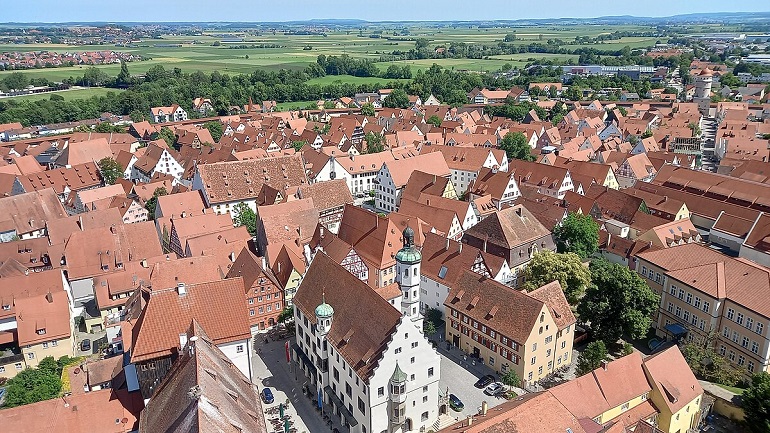
Nördlingen (pop. 20,500) is a medieval town that is uniquely situated entirely within the Ries impact crater, a depression left by a meteorite some 15 million years ago. It is one of only three towns (along with Rothenburg and Dinkelsbühl) in Germany with a completely intact city wall, which dates back to the 14th century. Visitors can walk the full 2.7-kilometre circuit of these fortifications, offering views of the historic town centre's red-tiled roofs and narrow streets. At the heart of the town is St. Georg's Church, whose 90-metre bell tower, nicknamed the "Daniel", provides a panoramic view that extends to the crater's rim.
Interesting Facts about Nördlingen
- Nördlingen sits entirely inside a vast meteorite crater, the Nördlinger Ries, formed about 15 million years ago.
- The town's medieval city walls are fully intact, making Nördlingen one of only three towns in Germany where you can walk the entire perimeter.
- Many of Nördlingen’s buildings are constructed with rock containing millions of tiny diamonds, created by the meteorite impact.
- The 90-metre-high tower of St George’s Church, known as "Daniel", offers panoramic views and is also built from the diamond-rich suevite rock.
- A tower keeper still calls out “So G’sell so” nightly from the Daniel, continuing a centuries-old tradition.
- The Ries Crater Museum in town explains the geology and cosmic history behind the area’s unique formation.
- Nördlingen starred in the final scene of the movie Willy Wonka & the Chocolate Factory (1971), due to its perfectly circular shape.
- The city wall stretches for about 2.7 kilometres, includes five city gates and twelve towers, and is freely accessible on foot.
- Nördlingen features the Scharlachrennen, a horse racing event first held in 1463 and still celebrated today.
- The town is one of Germany’s few cities whose streetscape and historic core have remained largely unchanged since the Middle Ages.
- American astronauts trained in the Nördlinger Ries crater before their lunar missions, learning about impact geology.
- In the Thirty Years’ War, two major battles were fought at Nördlingen, significantly shaping the town’s history.
History
Nördlingen's remarkable history stretches back far beyond its first recorded mention in 898 as "Nordilinga". The area has been continuously inhabited since the Palaeolithic period, with archaeological discoveries in the nearby Ofnet Caves revealing 33 human skulls dating to the 7th millennium BCE, arranged concentrically and covered in red ochre. The Romans established a civilian settlement (vicus) here in 85 CE, which thrived until 259-260 CE when it was destroyed during the Germanic Alemanni conquest. Following the Roman withdrawal, Alemannic peoples settled the region during the 6th and 7th centuries, gradually adopting Christianity under the Merovingian dynasty. The town's unique circular layout stems from its extraordinary geological foundation—it sits within a crater formed 15 million years ago when a meteorite struck the earth at 70,000 kilometres per hour, creating the 25-kilometre-wide Nördlinger Ries.
Nördlingen's golden age began in 1215 when Emperor Frederick II granted it city rights and imperial city status within the Holy Roman Empire. That same year saw the construction of the first city walls, whilst 1219 marked the inaugural Nördlinger Pfingstmesse (Pentecost fair), which became one of southern Germany's most important supraregional trade fairs. The town's strategic position at the crossroads of major trade routes—linking Frankfurt and Würzburg to Augsburg, and Nuremberg to Ulm—transformed it into a bustling commercial centre for grain, livestock, textiles, furs, and metal goods. Following a devastating fire in 1238, the city recovered and expanded significantly. In 1327, the present-day circular wall was constructed, quadrupling the size of the enclosed area and creating the 2.7-kilometre fortification that remains completely intact today. Construction of the iconic St. George's Church, with its 90-metre "Daniel" tower, began in 1427 and was completed in 1505.
The Thirty Years' War marked a dramatic turning point in Nördlingen's fortunes, with the town serving as the site of two crucial battles in 1634 and 1645. The first Battle of Nördlingen in 1634 saw the decisive defeat of Swedish Protestant forces by imperial Habsburg troops, forcing the city to open its gates to the victors. Though spared from plundering through high reparation payments, Nördlingen lost more than half its population to hunger and disease during and after the siege. The economic devastation was so severe that the town wouldn't regain its pre-1618 population until 1939. In 1803, following German mediatisation, Nördlingen lost its imperial city status and was incorporated into Bavaria. The railway arrived in 1849 with connections to Nuremberg, followed by links to Aalen in 1863. During World War II, air raids in spring 1945 killed 33 people and destroyed the train station, though most of the historic district survived. Paradoxically, the centuries of economic decline helped preserve Nördlingen's medieval cityscape, making it today one of Germany's finest examples of a completely walled medieval town.
Main Attractions
Historic City Wall (Historische Stadtmauer)
Nördlingen’s medieval city wall is one of the only completely preserved, walkable town walls in Germany. Built in 1327, it stretches around the old town for approximately 2.7km, featuring five gates and twelve towers. Visitors can walk its entire circuit, gaining views of both the town’s rooftops and the surrounding Ries landscape. The wall and its casemates played a significant role in Nördlingen’s fortification during the Middle Ages and still mark the boundary of the old town today.
St. George’s Church and Daniel Tower (St. Georgskirche & Daniel)
Situated in the town centre, St George’s Church is a late Gothic hall church known for its imposing nave and decorative features. Its 90-metre-high tower, known as Daniel, was completed in 1538. Climbing Daniel’s 365 steps grants panoramic views over Nördlingen and the Ries crater region. The tower keeper, continuing a centuries-old tradition, calls out the time from the top every hour. The church and tower together remain a dominant feature of the town’s skyline.
Market Square and Town Hall (Marktplatz & Rathaus)
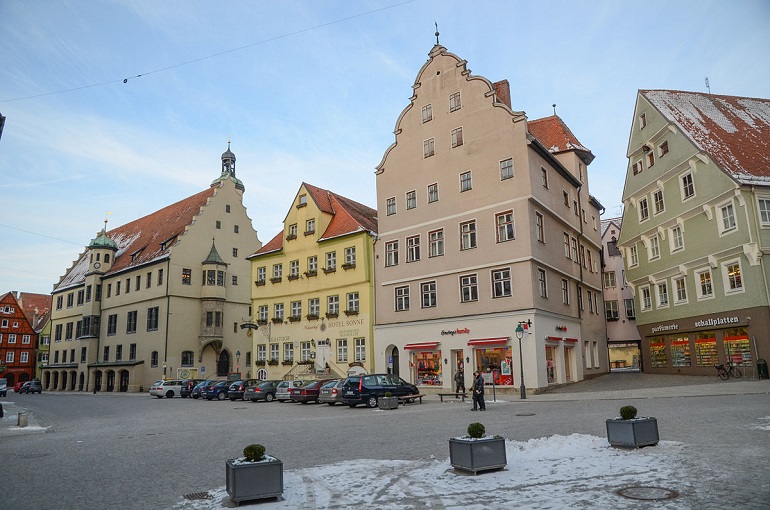
At the heart of Nördlingen lies the Market Square, surrounded by historical buildings, including the 14th-century Gothic Town Hall. Serving as the seat of local government since 1832, the Town Hall features a Renaissance staircase constructed from local suevite stone. The square itself is the site of regular markets and local events, contributing to the character of the town centre.
Tanner Quarter (Gerberviertel)
Close to the river Eger, the Tanner Quarter consists of streets lined with former tanners’ houses, many of which have been restored. The buildings are notable for their high gables and timber frames, reflecting the trade that dominated this part of Nördlingen for centuries. The quarter provides insight into the town’s economic history and retains many original architectural features, including wooden drying galleries formerly used for processing hides.
Löpsinger Gate Tower (Löpsinger Tor)
The Löpsinger Gate Tower is one of five surviving gates in the city wall and dates back to the 14th century. The tower was an important part of the town’s defence infrastructure. Today, it offers views over the town and surrounding area, and is a notable point needed to complete a full circuit of the wall.
Ofnet Caves (Ofnethöhlen)
Located a few kilometres south of Nördlingen, the Ofnet Caves are a significant prehistoric site on the slopes near the town. The caves are accessible to the public and are known for archaeological finds, including ancient human remains and artefacts that provide insight into early settlement in the Ries region.
Top Museums
Stadtmuseum Nördlingen
Housed in the former Heilig-Geist-Spital, the Stadtmuseum traces the settlement history of the Ries region from the Palaeolithic era through Roman times and into the Middle Ages. Exhibits include prehistoric skull finds, metal-age and Roman artefacts, plus displays on medieval trade, guilds and legal customs. A highlight is a tin-figure diorama depicting the Thirty Years’ War and the pivotal Battle of Nördlingen (1634), vividly conveying the conflict’s impact on the populace. Religious life is illustrated through 15th- and 16th-century panel paintings by Friedrich Herlin, Hans Schäufelin and Sebastian Taig, set within the Spital’s 1518-renovated hall. The museum also explores post-war migration, recounting the arrival of displaced persons from the Tetschen-Bodenbach district.
Stadtmauermuseum (City-Wall Museum)
Occupying one of Nördlingen’s original city-wall towers, this museum delves into the history of the town’s 2.7 km circuit of defensive walls, complete with five gates and twelve towers. Spread over six floors, exhibits feature interpretive panels on fortification construction, 17th-century uniforms and weaponry, and a replica cannon. A focal point is a tin-figure model of the 1634 battle, set against the backdrop of the battlements, offering panoramic views of Nördlingen’s red-brick rooftops and the surrounding Ries crater.
RiesKraterMuseum
Situated in a painstakingly restored 1503 timber-framed barn, the RiesKraterMuseum is dedicated to the meteorite impact that formed the Nördlinger Ries some 15 million years ago. The six-room itinerary begins with an aerial photograph and relief-model of the crater, then explains cosmic collision mechanics and the formation of impact rocks, including suevite and Buntsandstein breccias. On display are meteorite fragments—among them the Neuschwanstein meteorite first found in 2002—and even a sample of genuine lunar rock. Upstairs, interactive demonstrations and microscopy detail shock-pressure effects that create microscopic diamonds, while multimedia stations contextualise the event within solar-system evolution.
Bayerisches Eisenbahnmuseum (Bavarian Railway Museum)
Set on the former Nördlingen locomotive depot, this private museum spans 3.5 hectares of historic engine sheds, turntable and workshops. Over 200 original vehicles, including around 25 steam locomotives, sit in situ amidst tracks, servicing facilities and restored depots. The emphasis is on authentic railway operation: many exhibits remain in working order and are presented “to touch and experience,” from diesel multiple units to elegant express engines. Annual “Steam Days” see operational demonstrations, while special events allow visitors to ride heritage trains through the Ries countryside.
Museum “augenblick” für Optische und Akustische Attraktionen
Tucked down Pfarrgasse, “augenblick” traces the origins of visual and sound media. The collection showcases panorama paintings, magic-lantern projectors, early film equipment, viewing boxes and mechanical musical instruments—barrel organs, player pianos, gramophones and more. Demonstrations evoke nineteenth-century spectacle, from ghostly lantern shows to the marvel of the camera obscura, offering a hands-on encounter with pre-electronic entertainment.
Local Cuisine
Visitors to Nördlingen should try distinctive local specialties such as Stabenwurst—a freshly grilled sausage unique to the town and a must at the weekly markets, and Maultaschen, hearty pasta parcels filled with meat or vegetables. Other time-honoured favourites include Krautwickel (stuffed cabbage rolls), Zwiebelrostbraten (roast beef with onions), and the refined Rieser Culatello Riserva, a delicately aged ham maturing in local cellars. Indulge in sweet treats like the local Gamoer cake—named after a beloved local footballer—or sample the Nördlinger Mandle, an almond-filled dark chocolate confection. With its vibrant farmers’ markets and traditional inns, Nördlingen’s food scene fuses rustic charm with gourmet flair, all celebrated with a glass of locally-brewed “champagne beer.”
Getting There & Around
By train, Nördlingen is well-connected with direct regional rail services from major Bavarian cities such as Munich, Nuremberg, and Stuttgart. The journey from Munich to Nördlingen typically takes around 1 hour and 24 minutes on the fastest trains. The railway station is a short walk from the town centre, making arrival by rail a convenient and scenic option for travellers.
By coach or bus, services to Nördlingen depend on your departure point and travel date; there are routes from various German cities, but direct connections may be limited. Most long-distance coaches stop at central bus stations in nearby towns, requiring a transfer to a regional bus or train for the final stretch into Nördlingen. Facilities and amenities may vary by provider, so checking your route in advance is advised.
By car, reaching Nördlingen is straightforward via Germany's excellent motorway network, with well-maintained roads leading you through picturesque countryside. Several parking garages are available within and just outside the old-town’s walls, so finding a secure parking spot close to the historic centre is rarely an issue.


