


 Belgium Guide
 Luxembourg Guide
| Contents |
|---|
Introduction
Maastricht, the capital of the Dutch province of Limburg, is the southernmost city in the Netherlands, situated on both sides of the Meuse River near the Belgian and German borders. With approximately 120,000 inhabitants, this historic city attracts over 3 million tourists annually, drawn to its rich architectural heritage dating back to Roman times, vibrant cultural scene, and renowned culinary offerings. The city centre features 1,677 national heritage buildings, making it second only to Amsterdam in historical architecture, and is particularly known for its impressive religious structures, including the Romanesque St Servatius Basilica and the Basilica of Our Lady. As the birthplace of the euro and the location where the Maastricht Treaty was signed, the city holds significant importance in European history, while its university contributes to a lively international atmosphere.
Interesting Facts about Maastricht
- Maastricht is considered the oldest city in the Netherlands, founded by the Romans in the 1st century BCE.
- The Maastricht Treaty, signed in 1992 at the Limburg provincial government buildings, laid the foundation for the European Union and the introduction of the euro.
- It was the first Dutch city to be liberated by Allied forces during World War II, in September 1944.
- The city’s medieval streets were intentionally designed with curves to hinder enemy attacks, a strategic feature of its historic fortifications.
- Maastricht is home to the Sint Servaas Basilica, the oldest church in the Netherlands, dating back to the 6th century.
- It boasts 1,677 national heritage buildings, the second-highest number in the country after Amsterdam.
- Maastricht’s Sphinxkwartier district features repurposed 19th-century industrial sites, including the iconic Eiffel building, now a cultural hub with rooftop dining.
- The city’s underground network of casemates—tunnels used for defence during sieges—spans over 14 kilometres and is open for guided tours.
- Fictional musketeer d’Artagnan, from Alexandre Dumas’ novels, died during the 1673 French siege of Maastricht.
- Maastricht Carnival, celebrated before Lent, is one of the Netherlands’ largest and most vibrant festivals.
History
Starting as a Celtic settlement from at least 500 B.C.E., Maastricht evolved as the Roman city of Trajectum Ad Mosam ("Meuse-crossing"). It was the second city located in the present-day Netherlands to gain civil rights under the Romans (after Nijmegen), and the first with Medieval city rights (in 1204).
Saint Servatius of Tongeren died in Maastricht and is buried in the crypt of the basilica that bears his name (see below). In the Middle Ages, the Prince-Bishopric of Liège and the Duchy of Brabant held joint sovereignty over the city.
The celebrated Comte d'Artagnan, Captain-Lieutenant of the musketeers of the king of France (the one from the 3 musketeers by Alexandre Dumas), was killed in Maastricht while attempting to take the city.
After the Napoleonic era, Maastricht became a part of the United Kingdom of the Netherlands in 1815. When the southern provinces sought independence from the North to form Belgium in 1830, Maastricht and the whole province of Limburg was at first almost entirely under Belgian rule. In 1839, the Treaty of London was imposed on the Belgians and the city and the eastern part of Limburg, despite being geographically and culturally closer to Belgium, were permanently added to the Netherlands.
Main Attractions
Maastricht's charm resides in its homogeneity and atmosphere, rather than in impressive buildings. Its architecture contrasts with the cities of Holland, and resembles cities upstream the Meuse, like Liège and especially Namur.
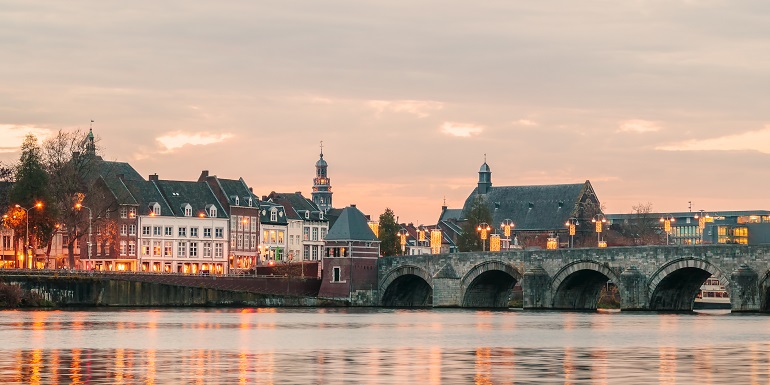
The Meuse splits the center in a western and an eastern half. The station and business area are on the eastern side, while the historical centre and greater part of the shopping streets are on the other side. The modern pedestrian John F. Kennedy Bridge links the two.
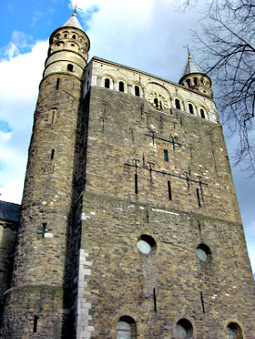
Maastricht boasts not just one, but two 1000-year old basilicas. Both edifices were built in a similarly sober Romanesque style. Onze Lieve Vrouwebasiliek (Basilica of Our Lady) stands opposite the pedestrian bridge over the Meuse, near the visible section of the ramparts. Sint Servaasbasiliek (Basilica of Saint Servatius) dominates the Vrijthof Square at the other end of the shopping streets, a few hundreds metres inland.
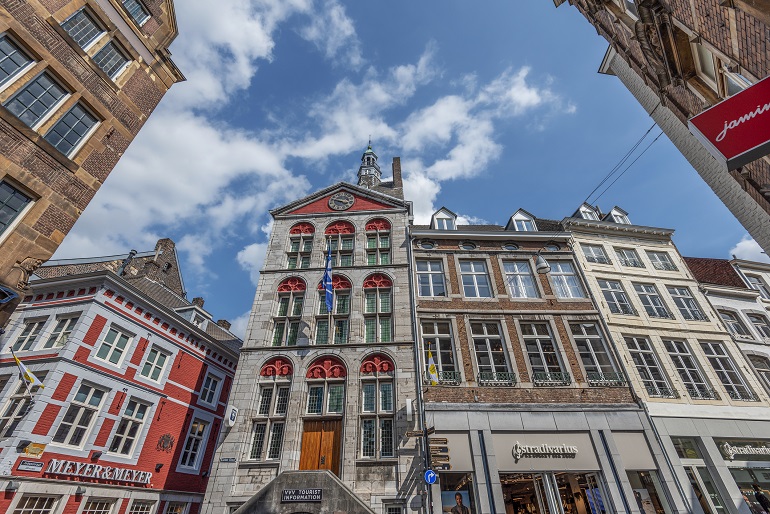
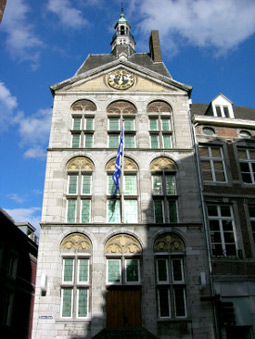
The delightful traditional Mosan-style (i.e. from the Meuse region) is at its best in the old Maastricht, within the ramparts. Note the Dinghuis, built in 1470 in the Mosan Renaissance style. It was originally used as a courthouse by the Principality of Liège and the Duchy of Brabant, which ruled conjointly over the city. It was converted into a theatre in 1713, and now houses the Tourist Information Centre.
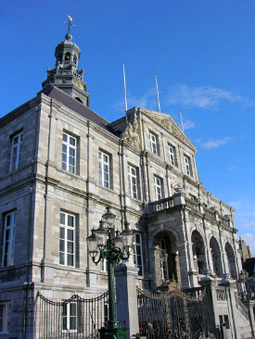
The handsome bluestone Stadhuis (townhall) occupies the Markt, the second largest town square in the country. There are two modern shopping centres, one west of the square, and the other one east.
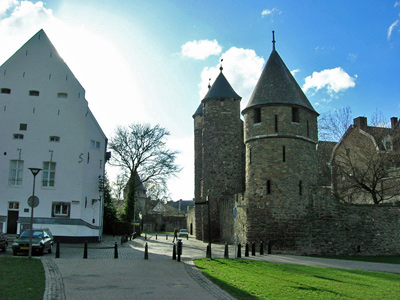
Facing JFK Bridge, the Helpoort is a section of the medieval rampart (with towers) that survived almost intact. It dates from 1229, making it the oldest such fortification in the country. The delightful Nolenspark, Stadpark (city park) and Aldenhofpark surround the southern section of the city wall, along the Jeker canal and two large ponds. The area southwest of the historic centre is endowed with cute orange-roofed white houses reminding of Bruges' Beguinages.
Every year in February, Maastricht stages one of Europe's biggest and most lively carnivals. It may not have the beauty of Binche's carnival in Belgium, but the festive spirit is there.
Top Museums
Bonnefanten Museum
The Bonnefanten Museum is Maastricht's premier art institution, housed in a striking building designed by Italian architect Aldo Rossi. This museum offers an impressive collection of fine and contemporary art, featuring works by Dutch and Flemish masters alongside modern and contemporary pieces. The iconic rocket-shaped tower on the Maas River makes it a modern landmark in the city.
Natural History Museum of Maastricht
Located in the heart of the city, the Natural History Museum of Maastricht is a treasure trove for nature enthusiasts. The museum showcases the region's natural history through its extensive collection of over 550,000 objects. Visitors can explore exhibits on geology, palaeontology, and the flora and fauna of South Limburg. A highlight is the famous mosasaurus fossil, affectionately known as 'Bèr'.
Fotomuseum aan het Vrijthof
Situated in the former Spanish Government building, a 16th-century structure, the Fotomuseum aan het Vrijthof is dedicated to photography. The museum presents exhibitions featuring renowned photographers, with a focus on socially relevant themes. Its unique location and commitment to the art of photography make it a must-visit for art lovers.
Maastricht Museum
Housed within Centre Céramique, the Maastricht Museum offers a deep dive into the city's rich history. The museum tells the hidden stories of Maastricht through its permanent collection and temporary exhibitions. Interestingly, the exhibits are presented not only in Dutch and English but also in the local Maastricht dialect, offering a truly authentic experience.
Museum aan het Vrijthof
Located on Maastricht's most famous square, the Museum aan het Vrijthof focuses on history, art, and antiques. The museum is housed in one of the oldest non-religious buildings in the city, known as the Spanish Government Building, which dates back to the 16th century.
Bureau Europa
For those interested in architecture and urban planning, Bureau Europa is a must-visit. This institute explores contemporary architecture and design through exhibitions, lectures, and debates. It aims to stimulate discussion about the built environment and its impact on society.
Museum of Illusions Maastricht
For a unique and interactive experience, the Museum of Illusions offers visitors a chance to explore the world of optical illusions, holograms, and mind-bending exhibits. It's an engaging attraction suitable for visitors of all ages, challenging perceptions and providing entertainment through science.
Local Cuisine
Maastricht's culinary scene brilliantly reflects its unique position at the crossroads of Dutch, Belgian, French and German influences. The city's local specialities include zuurvlees, a delightfully tangy meat stew served with chips and apple sauce, whilst the famous Limburg vlaai, a fruit-filled tart, stands as the region's signature sweet treat. The dining landscape ranges from cosy brown cafés serving traditional fare like bloedworst (blood sausage) and konijn (rabbit cooked in beer) to Michelin-starred establishments. During Carnival season, one must try the nonnevotte, bow-shaped doughnuts with a fascinating historical connection to local nuns. The city's vibrant food culture particularly shines through its blend of casual eatcafés and upscale restaurants, making it a true gastronomic capital of the Netherlands.
Shopping
Maastricht offers diverse shopping experiences across several distinct districts. The main shopping area in the Binnenstad (city centre) centres around Grote Staat, with two major shopping centres: Entre Deux and Mosae Forum. The elegant Stokstraatkwartier houses high-end boutiques and designer shops, while the Wyck district features trendy and vintage retailers. Most shops operate Monday through Saturday, with typical hours from 10:00 to 18:00, except Mondays when shops open at 12:00. Thursday evenings offer late-night shopping until 21:00, and most shops open on Sundays from 12:00 to 18:00. For outlet shopping, visitors can travel to nearby Maasmechelen Village (20 minutes away) or Designer Outlet Roermond (45 minutes away), both offering extensive collections of premium and luxury brands.
Nature in and around Maastricht
Maastricht and its surrounding areas offer a wealth of natural attractions, with the Sint Pietersberg being a prominent feature. This limestone hill, standing at about 171 metres, provides breathtaking views of the Limburg countryside, the Meuse river, and the historic city. The area boasts rare limestone slopes and a unique microclimate, creating a haven for diverse flora and fauna, including rare orchids, butterflies, and the eagle owl. Visitors can explore well-maintained hiking trails, cycle routes, and mountain biking paths throughout the Sint Pietersberg. The ENCI quarry, with its clear blue water, offers an impressive sight and can be accessed via a 215-step staircase. Additionally, the Jeker valley near Chateau Neercanne presents a picturesque landscape dotted with old farmhouses and trickling streams, whilst the nearby Gronsveld valley features forested hills and natural fountains, providing ample opportunities for nature enthusiasts and hikers alike.
Getting There & Around
Maastricht, situated in the southernmost tip of the Netherlands, is easily accessible by various modes of transport. The most convenient way to reach the city from major Dutch airports like Amsterdam Schiphol or Brussels Airport is by train, with regular services running to Maastricht Central Station. Once in the city, visitors can utilise the efficient Stadsbus network operated by Arriva, which covers most areas with comprehensive routes. For budget-conscious travellers, the P+R Maastricht Nord offers free parking for up to 48 hours with affordable bus connections to the city centre at just 2 euro per person. Cycling is particularly popular due to the city's flat terrain and well-maintained bike lanes, whilst walking is ideal for exploring the compact city centre. Those arriving by car should note that city centre parking can be costly at 2.60 euro per hour, though cheaper alternatives exist in peripheral areas like the Stadtpark parking facility at 1.40 euro per hour. For international connections, Flixbus offers services to various European cities including Brussels, Amsterdam, and Prague.
Best Time to Visit
The best time to visit Maastricht is from mid-May to mid-September when the weather is most pleasant and conducive to outdoor activities. During this period, temperatures are generally mild and comfortable, with daytime highs ranging from 18°C to 23°C. Spring (April to June) offers the charm of blooming tulips and flowering trees, whilst autumn (September to October) boasts stunning foliage along the River Meuse. Summer months (July and August) are popular for events like the Maastricht Summer Concerts, though they can be crowded and pricier. For those seeking a festive atmosphere, winter brings the enchanting Maastricht Christmas Market. However, be prepared for cooler temperatures and potential rainfall throughout the year, as Maastricht's climate can be unpredictable.