



| Contents |
|---|

Passau and the Danube.
Introduction
Built at the confluence of the Danube with the Inn and Ilz, close to the Austrian border, Passau is an alluring city of pastel painted façades. With a population of 50,000—approximately 12,000 of whom are students at the University of Passau—the city combines a compact urban centre with a lively academic community. Passau’s historic core features well-preserved Gothic and Baroque architecture, most notably the Veste Oberhaus fortress overlooking the town and St Stephen’s Cathedral, which houses one of the world’s largest cathedral organs. Often referred to as the “Three Rivers City,” Passau serves as a popular stop for Danube river cruises and offers a range of cultural attractions, museums and riverside promenades.
Interesting Facts about Passau
- Passau is known as the "City of Three Rivers" because the Danube, Inn, and Ilz rivers converge there.
- The city was originally settled by the Celts over 2,000 years ago and later became a Roman colony known as Castra Batava.
- St. Stephen's Cathedral in Passau is home to one of the largest church pipe organs in the world, boasting more than 17,000 pipes.
- Much of Passau was destroyed by fire in 1662 and was rebuilt over the following decades, resulting in its distinctive Baroque architecture.
- The historic old town features the impressive Veste Oberhaus fortress, which was built in 1219 and now houses the largest city museum in Lower Bavaria.
- Passau’s medieval fame included manufacturing swords stamped with a red wolf emblem, believed to bring invulnerability in battle.
- The city’s Town Hall clock tower plays melodic carillon bells throughout the day and displays flood marks from past centuries.
- About a fifth of Passau’s 50,000 residents are students, giving it a lively and youthful atmosphere.
- The city served briefly as the home of Adolf Hitler as a child, and its waterfront marks the event where he was reportedly rescued from the river.
- Passau is the starting point for many Danube river cruises and the cycling path that runs all the way to Vienna.

History
Passau's remarkable history stretches back over two millennia, beginning with the Celtic settlement of Bojodurum established around the 2nd century BCE. The Romans recognised the strategic importance of this location at the confluence of three rivers and established two settlements: Batavis (in present-day Passau-Altstadt) as a Roman castrum in the province of Raetia, and Boiotro (Passau-Innstadt) in the province of Noricum. During the 5th century, St Severinus established a monastery here, and the site gained particular significance in 739 when the English archbishop Boniface founded the diocese of Passau. This diocese became the largest in the German Kingdom and Holy Roman Empire, covering territory in southern Bavaria and most of present-day Upper and Lower Austria. From 1217, when Bishop Ulrich II received imperial prince dignity, the bishops exercised both spiritual and secular authority as Prince-Bishops, ruling the three-river city for nearly 600 years despite repeated citizen revolts for municipal freedom.
The Renaissance and early modern periods brought both prosperity and transformation to Passau. The city flourished as a major trade centre, particularly benefiting from the lucrative salt trade along the Inn River. During the Renaissance, Passau became one of Germany's most prolific centres for sword and bladed weapon manufacture after Solingen. Local smiths stamped their blades with the distinctive Passau wolf symbol, and superstitious warriors believed these weapons conferred invulnerability upon their bearers, leading to the practice being known as "Passau art". However, catastrophe struck in 1662 when a devastating fire consumed most of the city. The subsequent reconstruction, overseen by the wealthy Prince-Bishop and executed primarily by Italian architects, transformed Passau into the baroque masterpiece visible today. This Italian baroque influence earned the city its nickname as the "Venice of Bavaria".
The modern era brought significant political and social changes to Passau. The city was secularised and divided between the Electorate of Bavaria and the Electorate of Salzburg in 1803, with the Salzburg portion becoming part of Bavaria in 1805. Notably, Adolf Hitler and his family lived in Passau from 1892 to 1894, and during the Nazi period, the city became something of a pilgrimage site. During World War II, Passau housed three sub-camps of the notorious Mauthausen-Gusen concentration camp. The city surrendered unconditionally to American forces on 3 May 1945 and subsequently served as a displaced persons camp. In recent decades, Passau has developed into the economic, cultural, and communications centre of southeastern Bavaria, whilst maintaining its historical character. The city's vulnerability to flooding, due to its position at the river confluence, was dramatically demonstrated in June 2013 when severe flooding caused extensive damage to the old town.
Main Attractions
Veste Oberhaus
Situated on St. George's mountain, high above Passau, the Veste Oberhaus is a formidable fortress that dates back to 1219. It was constructed for the prince-bishops of Passau and served as a stronghold and symbol of their power for centuries. Today, the fortress offers visitors some of the most commanding panoramic views of the city and the unique confluence of the Danube, Inn, and Ilz rivers. Visitors can reach the fortress via a scenic footpath or take a shuttle bus from the city centre, making it an accessible vantage point to appreciate the city's layout.
St Stephen’s Cathedral (Dom St. Stephan)
Dominating the skyline of the Old Town, St. Stephen’s Cathedral is a magnificent example of Italian Baroque architecture, completed in 1688 after a fire destroyed its predecessor. Its interior is renowned for its lavish stucco work and frescoes, but its most famous feature is the colossal organ. With 17,774 pipes and 233 registers, it is the largest cathedral organ in the world. Between May and October, visitors can experience its powerful sound during daily midday concerts, which are a major draw for tourists and music lovers alike (excluding Sundays and public holidays).
Altstadt (Old Town)
Passau’s Altstadt, or Old Town, is a charming and historically rich quarter nestled on the peninsula between the Danube and Inn rivers. Its character is defined by narrow, winding cobbled streets, grand squares, and impressive Baroque buildings with Italianate flair. Key areas include the main square, Residenzplatz, which features the ornate Wittelsbacherbrunnen fountain, and Theresienstraße, a bustling street lined with independent shops and cafés. The entire district is easily explored on foot, offering picturesque riverside views and a tangible sense of history at every turn.
Rathaus (Town Hall)
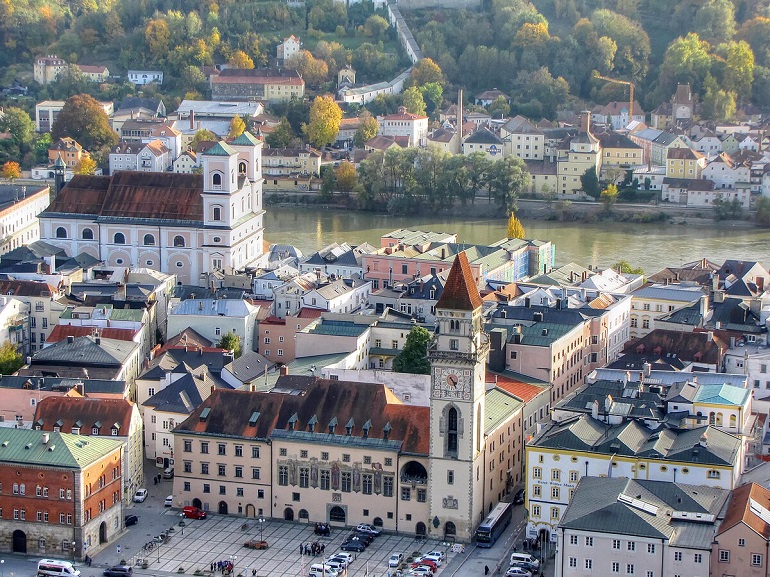
The Rathaus, or Town Hall, located on the Danube riverbank, is a historic building whose origins trace back to the 14th century when a patrician house was acquired by the city. Its most striking features are the neo-Gothic tower, which houses a carillon that plays melodies at different times of the day, and its grand façade. The building serves as a historical record of the city's frequent floods, with marks on its exterior wall indicating the high-water levels of various inundations over the centuries, including the record flood of 2013.
Riverbank Promenades
The banks of the Inn river are flanked by two popular promenades that offer scenic walks and impressive views. The Innkai is a riverside walk notable for the Schaiblingsturm (Schaibling Tower), a white, round defensive tower from the 13th century that once formed part of the city's medieval fortifications. Further along, the Innpromenade provides a tranquil path for walking and cycling, with excellent views across the water towards the Old Town and the point where the Inn flows into the Danube.
Dreiflüsseeck (Three Rivers Corner)
The Dreiflüsseeck is the geographical point at the very tip of Passau's Old Town peninsula where three rivers—the Danube, the Inn, and the Ilz—converge. This natural spectacle is particularly remarkable because of the distinct colours of the water from each river. The Inn's milky green glacial water flows alongside the darker water of the Danube and the black water of the Ilz, creating a visible, multi-toned current for some distance downstream. A small park at the confluence provides the best vantage point to observe this unique phenomenon.
Höllgasse (Artist’s Alley)
Höllgasse is a narrow, picturesque alley in the Old Town known for its vibrant atmosphere and artistic community. Its most distinctive feature is the multicoloured cobblestones that pave the street, creating a cheerful, rainbow-like path for visitors. The lane is lined with a variety of artisan workshops, small galleries, and independent boutiques, making it an ideal place to find unique local crafts, artworks, and souvenirs. The alley's creative spirit and charming appearance make it a memorable part of any walk through Passau.
Pilgrimage Church and Pauline Fathers' Monastery
Perched on a hill above the Innstadt district, across the river from the Old Town, is the Pilgrimage Church of Mariahilf and the adjoining Pauline Fathers' Monastery. This sacred site has been a destination for pilgrims since the 17th century. The main approach to the church is via a long, covered staircase known as the "heavenly ladder," which is adorned with votive offerings from worshippers. From its elevated position, the church grounds offer splendid panoramic views over the rooftops and towers of Passau, providing a different perspective of the city's scenic setting.
Top Museums
Veste Oberhaus (Oberhausmuseum)
Perched atop the fortress of Veste Oberhaus, the Oberhausmuseum occupies one of Europe’s largest medieval castle complexes. Within its historic walls, eight thematic sections trace Passau’s evolution: from the daily realities and spiritual beliefs of the Middle Ages to the rise of guilds, the city’s mythic narratives, and its role as a trading hub on the three rivers. Highlights include a Fire Museum in the former cannon vault, showcasing firefighting equipment from the 17th to 20th centuries, and multimedia installations in the Observation Tower offering panoramic vistas and immersive glimpses into past eras. The castle’s storied past—as princely residence, military fortress and “Bastille of Bavaria”—frames the museum experience, inviting visitors to explore over 4,000 m² of exhibitions that blend artefacts, multimedia and architectural splendour.
Passau Glass Museum (Glasmuseum Passau)
Dubbed “the most beautiful glasshouse in the world” by Friedrich Dürrenmatt, the Passau Glass Museum claims the largest European glass collection globally. Nearly 15,000 items illustrate the diversity of Bavarian, Bohemian, Austrian and Silesian glassmaking from 1650 to 1950. The displays emphasise the Golden Age of Art Nouveau and 19th-century glass exhibited at world fairs, alongside pieces once owned by European royalty. Housed in a historic patrician building, the collection underscores Passau’s central role in the continent’s glass trade and artistic research centre.
Roman Museum “Kastell Boiotro”
Located in Innstadt’s medieval street, the Roman Museum occupies a late-medieval house built atop the remains of the late-Roman fort Boiotro. Its basement reveals original foundations, while over 600 archaeological objects—accompanied by models and ancient textual references—chart 400 years of Roman occupation on the Empire’s northern frontier. The museum’s integration of in situ remains with interpretive displays offers a vivid reconstruction of urban life in the province of Raetia.
Museum at the Cathedral (Diocesan Museum & Cathedral Treasury)
Housed in the Baroque “Saalbau” linking the Cathedral to the Residenz, the Museum at the Cathedral presents around 100 treasures spanning eight centuries of ecclesiastical art. Liturgical vessels, monstrances, vestments, sculptures and paintings illustrate faith and piety in the Passau diocese. The former prince-bishop’s library, with its 18th-century furnishings and illusionistic ceiling frescoes, provides an atmospheric setting for the Cathedral treasury, blending Rococo stucco work with masterpieces by Johann Carlone and Johann Georg Unruhe.
Museum Moderner Kunst Wörlen
Set within a Romanesque town-house in the Altstadt, the Museum Moderner Kunst Wörlen was founded in 1990 by architect and patron Hanns Egon Wörlen. Its core collection comprises over 1,500 works by Georg Philipp Wörlen and his artist contemporaries, emphasising Expressionism, New Objectivity and post-war movements. A rolling programme of c. 15 temporary exhibitions annually features international modern and contemporary artists—ranging from Lyonel Feininger and Max Beckmann to Yoko Ono—positioning the museum as a vibrant forum for East–West artistic dialogue at Germany’s eastern gateway.
Fresco Museum Niedernburg
The Fresco Museum preserves the 12th-century secco paintings of St Mary’s Church vestibule, the sole surviving remnant of the medieval Niedernburg Abbey destroyed by 17th-century fires. More than 800 years old, these Romanesque murals depict biblical narratives with vivid medieval iconography. Presented behind protective glass and explained through bilingual digital displays, the delicate wall paintings rank among southern Germany’s most valuable Romanesque cultural assets.
Medieval Torture Museum at Anger
Set in historic vaulted chambers near Angerplatz, the Medieval Torture Museum explores the grim realities of Inquisition and witch persecutions. Original instruments and artefacts document ecclesiastical courts’ methods, with contextual narratives tracing dissenters’ trials across Europe. The exhibition’s immersive layout—leveraging the authentic ambience of medieval cellars—reveals the darker facets of spiritual and judicial history in the Middle Ages.
Local Cuisine
Local menus are anchored by robust classics, such as Schweinebraten (roast pork with dumplings and rich dark beer gravy), the iconic Weißwürste (white sausage) served with sweet mustard and freshly baked pretzels, and the savoury Bratwurst, often enjoyed with tangy sauerkraut. Thanks to its scenic riverside location, the city also offers delicious freshwater fish like fried Inn char and smoked trout. For a sweet finish, don’t miss Lebkuchen (spiced gingerbread) or a generous portion of apple strudel with vanilla sauce. Whether you choose to dine in a traditional beer garden or a cosy inn, the vibrant mix of regional produce and time-honoured recipes makes Passau’s cuisine warmly inviting for every visitor.
Shopping
Passau’s main shopping area centres on the pedestrianised streets of Bahnhofstrasse and Ludwigsplatz, where more than 500 lie within easy walking distance of one another. The Stadtgalerie Passau, located at Bahnhofstrasse 1, houses around 90 outlets over three floors, including mid-range fashion brands, cafés and a children’s play area. In the old town, Höllgasse—also known as Art Alley—features artisan workshops, galleries and specialist boutiques, while Rathausplatz hosts seasonal markets and occasional late-night shopping events. Beyond high-street names, visitors can explore traditional crafts such as leather goods from MarJo and root-carved artworks by local makers.
Nature in and around Passau
Passau is encircled by diverse natural landscapes, from the lush riverine forests of the Ilztalwanderweg along the Ilz, where the socalled “Black Pearl” weaves through steep banks and floodplain meadows, to the ancient woodlands of the Bavarian Forest National Park, a 240 km² protected area beginning just 50 km north of the city. On the Danube downstream lies the Schlögener Donauschlinge, a dramatic oxbow bend offering panoramic views from its elevated viewing platform, while directly above Passau the Oberhauser Leite reserve features towering gneiss and granite escarpments reclaimed by mixed forest and criss-crossed by the historic Ludwigsteig trail. Together these sites showcase the geological variety and well-preserved ecosystems that frame Passau’s cultural heritage.
Getting There & Around
By train Passau is well connected by rail, with frequent Intercity and regional trains linking the city to major hubs such as Munich, Vienna, and Linz. Direct trains run regularly from Munich and Vienna, while convenient connections are available from many German cities and neighbouring countries, making train travel a reliable and comfortable option.
By coach or bus Several long-distance bus operators serve Passau, connecting it to numerous cities across Germany and Europe. Coaches typically arrive at the central bus station, with convenient services from operators like FlixBus ensuring travel from cities such as Munich, Düsseldorf, and Budapest, as well as further afield.
By car Passau is easily accessible by car via the A3 motorway from direction of Regensburg and Vienna, and from Munich using the A92 in combination with connecting routes. The city offers several parking options, including long-term facilities and shuttle services, and is well signposted for those driving from neighbouring regions.
Best Time to Visit
The best time to visit Passau is during late spring (May and June) and early autumn (September and October), when the weather is pleasantly mild and the city is less crowded with tourists. During these months, visitors can enjoy comfortable temperatures, ideal for sightseeing along the picturesque rivers and exploring historical landmarks without the peak-season rush. Summer (July and August) is also popular for travellers who prefer warmer weather and bustling city life, though this period sees more rainfall and higher accommodation prices. For those seeking a serene experience and vibrant scenery, late spring and early autumn perfectly balance ideal climate and fewer crowds.


