


 Ireland Guide
 Scotland Guide
 Wales Guide
| Contents |
|---|

Introduction
Durham (pop. 45,000) is the principal tourist city of North-East England. It is famous for its Norman Cathedral and 11th-century castle, both listed as UNESCO World Heritage sites.
Durham University, established in 1832, claims to be England's third oldest after Oxford and Cambridge. The Chancellor of the University is writer Bill Bryson, appointed by the University's Convocation on 4 April 2005. Tony Blair and Rowan Atkinson ("Mr Bean") both attended Chorister School in Durham (adjacent to the cathedral).
Interesting Facts about Durham
- Durham Cathedral and Castle form a UNESCO World Heritage Site, designated in 1987 alongside the Taj Mahal and Palace of Versailles.
- The city's name comes from the Old English "Dun" (hill) and Norse "holme" (island), reflecting its location on a hill surrounded by the River Wear.
- Durham University, founded in 1832, is one of England's oldest universities and a significant employer in the region.
- The legend of the Dun Cow, involving a milkmaid searching for her lost cow, is said to have led to the founding of Durham in 995 CE.
- Durham was historically known for the manufacture of hosiery, carpets, and mustard, with Mrs Clements inventing modern English mustard in the city.
- The Durham Miners' Gala, an annual event celebrating the region's coal mining heritage, continues despite the closure of local collieries.
- Durham Cathedral's main door features a Sanctuary Knocker, which historically granted fugitives 37 days of sanctuary if they grasped it.
- The city was part of the County Palatine of Durham from the 1070s until 1836, ruled by prince bishops with semi-independent powers.
- Durham Regatta, known as "the Henley of the North", predates its southern counterpart by five years, having been founded in 1834.
- Parts of the Harry Potter films were shot at Durham Cathedral, with the cloisters featuring as Hogwarts corridors.
History
Durham was founded in 995, when a group of monks from Lindisfarne chose the strategic high peninsula as a place to lay the body of Saint Cuthbert of Lindisfarne (634-687), an Anglo-Saxon monk and bishop in the Kingdom of Northumbria. The city's name comes from the Old English "dun" (hill) and the Old Norse "holme"(island).
The city has played an important part in the defence of the north and Durham Castle is the only Norman castle keep never to have suffered a breach. The Battle of Neville's Cross which took place just west of the city on 17 October 1346 between the English and Scots is the most famous battle of the age.
From 1071 until the Great Reform Act of 1832, the bishopric held the powers of a Bishop Palatine (known in continental Europe as "Prince-Bishop"), which is to say that the bishop had both military leadership and religious authority - a privilege unique to Durham in England.The bishops of Durham enjoyed extraordinary powers such as the ability to hold their own parliament, raise their own armies, appoint their own sheriffs and Justices, administer their own laws, levy taxes and customs duties, create fairs and markets, issue charters, salvage shipwrecks, collect revenue from mines, administer the forests and mint their own coins.
The Lord Bishop of Durham was considered the second most powerful person in England after the King himself. Henry VIII curtailed some of the Prince-Bishop's powers and, in 1538, ordered the destruction of the shrine of Saint Cuthbert.
The traditional trade in Durham included carpet making and weaving, as well as mustard manufacturing. The Industrial Revolution placed the city at the heart of the coal fields. Practically every village around the city boasted a coal mine and, although these have since disappeared with the decline in heavy industry.
The first Durham Miners' Gala ("The Big Meeting") was held in 1871 and remains the largest socialist trades union event in the world.
Main Attractions
Durham has a compact historic centre best explored on foot. The pretty market square has a Guildhall dating from 1356. There are numerous interesting churches and old bridges, but two attractions really just stand out of the lot, the castle and the cathedral. The third most important sight is the Penshaw Monument, on Penshaw Hill.
If you have time to spare, you could enjoy a boat ride on the River Wear, visit the small medieval hall pompously known as Crook Hall & Gardens, or stroll around Durham University's Botanic Garden.

Durham Castle
The magnificent castle was built shortly after the Norman Conquest of 1066 as one of the strongholds protecting England's northern border against the Scots. It is a good example of motte-and-bailey castle - that is, built on raised earthwork and surrounded by a protective wall. This is the type of castle favoured by the Normans in the 11th and 12th centuries.
The Bishop of Durham was appointed by the King to exercise royal authority on his behalf, explaining why the castle and the cathedral were built next to each others, only separated by Palace Green. Because of this close association between temporal and religious power, locals have witfully dubbed County Durham "Land of the Prince Bishops" (a double title normally found in Germany).
The Great Hall, created by Bishop Antony Bek in the early 14th century, used to be Britain' largest, until it was shortened at the end of the 15th century.
Nowadays the castle is occupied by the University College of Durham University. In 1832, Bishop Edward Maltby donated the castle to the newly-formed university as accommodation for students, and still houses over 100 students at present (mostly in the keep). The bishop subsequently moved to the sumptuous Auckland Castle, about 10 miles south of Durham.
The castle can be visited all afternoons during term time, and on mornings during academic holdidays. Visits are by guided tours only.

Durham Cathedral
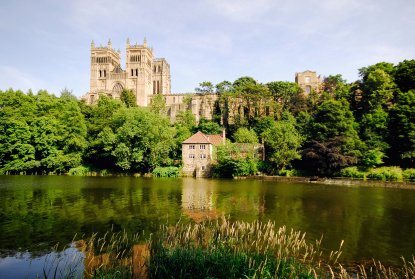
Regarded as one of the finest examples of Romanesque architecture in Europe, Durham Cathedral has managed to preserve the unity and integrity of its original design. Construction began in 1093 and was completed for the most part within 40 years. The UNESCO reported it to be "the largest and most perfect monument of 'Norman' style architecture in England".
The treasures of Durham Cathedral include relics of St Cuthbert, the head of St Oswald of Northumbria and the remains of the Venerable Bede.
Durham Cathedral has been featured in the Harry Potter films as Hogwarts School of Witchcraft and Wizardry, where it had a spire digitally added onto the top of the famous towers.
Top Museums
Cathedral Museums
Durham Cathedral Museum
Nestled within the awe-inspiring Durham Cathedral, a UNESCO World Heritage site, this museum is a treasure trove of North East England's history, culture, and faith spanning 2,000 years. The museum's centrepiece is the octagonal Great Kitchen, where visitors can marvel at priceless artefacts associated with St Cuthbert, including his exquisitely hand-carved 7th-century wooden coffin and the iconic Pectoral Cross.
The Monks' Dormitory, with its impressive 15th-century oak timber roof, offers an immersive experience of monastic life. Here, visitors can explore interactive exhibits that bring to life the daily routines and spiritual practices of the cathedral's medieval inhabitants. The Open Treasure exhibition showcases a rotating display of rare manuscripts and precious objects from the cathedral's collection.
Art Museums
The Bowes Museum
Set in the market town of Barnard Castle, The Bowes Museum is housed in a magnificent French-style chateau that seems almost out of place in the Durham countryside. This cultural gem is the legacy of John and Joséphine Bowes, whose vision was to create a world-class museum in the North East of England.
The museum's diverse collection spans centuries and continents, featuring an impressive array of fine and decorative arts. Visitors can admire exquisite examples of silver and metalwork, fashion and textiles, furniture, ceramics, and sculptures. The painting collection includes works by renowned artists such as Canaletto, El Greco, and Goya.
The museum's crowning glory is the Silver Swan, an enchanting 18th-century automaton that showcases the pinnacle of mechanical engineering and artistry of its time. This life-size silver bird, when wound up, preens itself, looks around, and appears to catch and swallow a fish from a stream of glass rods.
Open-Air Museums
Beamish Museum
Known as "The Living Museum of the North," Beamish is England's largest open-air museum and offers an unparalleled immersive journey into the region's past. Spread across 300 acres, the museum focuses on life in urbanised North East England during two pivotal periods: 1825 and 1913.
Visitors can explore authentic reconstructions of period buildings, including a colliery village, a 1900s town, a 1940s farm, and a Georgian landscape. The museum's attention to detail is remarkable, with costumed interpreters bringing history to life through demonstrations of traditional crafts and daily routines.
Ride on a tram or vintage bus, descend into a coal mine, or visit the dentist's surgery for a glimpse of early 20th-century medical practices. The 1900s town features shops stocked with period-appropriate goods, a bank, and even a pub where visitors can enjoy a pint. Beamish continues to evolve, with plans for a 1950s town and other expansions in the works.
Historical Museums
Durham Castle Museum
Part of the Durham World Heritage Site alongside the cathedral, Durham Castle offers guided tours that unveil over 1,000 years of history. Originally built as a Norman fortress in the 11th century, the castle's story is intertwined with that of the powerful Prince-Bishops of Durham, who wielded both religious and secular authority in the region.
Today, while serving as home to University College, Durham University's founding college, the castle retains its historical significance. Visitors can explore the Great Hall, adorned with coats of arms and portraits, and climb the Norman Chapel, one of the finest examples of Romanesque architecture in Britain. The Black Staircase, with its intricate wooden carvings, and the Tunstall Gallery, showcasing portraits of past bishops, are other highlights of the tour.
Oriental Museum
Operated by Durham University, the Oriental Museum houses an extensive collection of over 35,000 artefacts from East and Far East Asia, making it one of the finest collections of its kind in the UK. The museum's galleries are organised geographically, allowing visitors to explore the art and archaeology of China, Japan, Korea, India, Egypt, and other parts of the Near and Middle East.
Highlights include an impressive collection of Chinese ceramics spanning 5,000 years, a full-sized reconstruction of an ancient Egyptian tomb, and a comprehensive display of Japanese art, including samurai armour and exquisite netsuke carvings. The museum also features a tranquil Japanese garden, providing a serene space for reflection.
Durham Museum and Heritage Centre
Situated in a historic Grade I listed building that was once the parish church of St Mary-le-Bow, this museum offers a window into Durham's rich past. The exhibits feature fascinating objects that illustrate the city's origins, growth, lost trades, and the lives of its people throughout the centuries.
Highlights include a detailed model of medieval Durham, offering visitors a bird's-eye view of the city as it appeared in the 15th century. The Crime and Punishment section, complete with a Victorian prison cell, provides insight into historical law enforcement practices. The museum's beautiful stained glass windows, some dating back to the 17th century, add to the atmospheric experience.
Industrial Heritage Museums
Durham Mining Museum
Located in Spennymoor Town Hall, this museum pays tribute to the region's rich mining heritage. It features three distinct display areas, including a simulated underground coalface and tunnel, allowing visitors to experience the working conditions of miners firsthand.
The museum houses an extensive collection of mining memorabilia, including tools, safety equipment, and personal effects of miners. Photographs and documents tell the stories of individual miners and their families, offering a poignant look at the human side of this dangerous profession. The museum is dedicated to the memory of over 24,000 individuals who lost their lives in mining-related accidents in Northern England since 1293, serving as a powerful reminder of the industry's human cost.
Archaeological Museums
Museum of Archaeology
Situated next to Durham Cathedral, this compact museum explores 250,000 years of history through archaeological artefacts discovered in the North East. The collection spans from Prehistory to the Roman era, featuring everyday items alongside rare and beautiful objects that offer insights into the lives of our ancestors.
Highlights include spectacular Bronze Age metalwork, such as swords and axes, and Roman treasures retrieved from riverbeds. The museum also showcases medieval stonework from the cathedral and castle, providing a tangible link to Durham's architectural heritage. Interactive displays and hands-on activities make this museum particularly engaging for visitors of all ages.
Transport Museums
Locomotion
While technically located in Shildon, just outside Durham, Locomotion is a significant museum that celebrates the region's railway heritage. As part of the National Railway Museum, it houses an impressive collection of over 70 rail vehicles, including the famous Locomotion No. 1, which hauled the world's first passenger train on the Stockton and Darlington Railway in 1825.
Visitors can explore the history of rail transport through interactive exhibits, climb aboard historic carriages, and even experience a simulator of driving a high-speed train. The museum also features outdoor play areas and a miniature railway, making it an excellent destination for families.
Killhope Lead Mining Museum
Set in the North Pennines Area of Outstanding Natural Beauty, Killhope offers visitors a chance to experience the life and work of lead mining families in the 19th century. The museum features a fully restored water wheel, the Park Level Mine where visitors can don hard hats and explore underground, and a washing floor where they can try their hand at traditional ore processing techniques.
The site also includes nature trails, allowing visitors to explore the beautiful surrounding landscape and learn about the area's geology and wildlife. The museum's Visitor Centre houses exhibits on the social history of lead mining communities, including a recreation of a "mine shop" where miners would have gathered before and after their shifts.
Local Cuisine
Durham's local cuisine features hearty meals like panaculty, a comforting dish made with leftover roast beef and vegetables, or tuck into a classic ham and pease pudding stotty, a regional sandwich featuring a soft flatbread. For a taste of Durham's fishing heritage, try the fresh fish and chips from local chippies. The city is also known for its Lammas bread, a flavoursome loaf traditionally baked to celebrate the harvest season. Those with a sweet tooth will enjoy indulging in Durham Pudding, a rich dessert made with dried fruit and spices. Don't miss the opportunity to sample some of Durham's artisanal cheeses, locally brewed ales, and seasonal produce from the many farmers' markets and food festivals held throughout the year.
Shopping
The city centre features the Prince Bishops Shopping Centre, home to high street favourites and independent boutiques. For those seeking unique finds, Durham Market Hall, a Victorian covered market dating back to 1851, houses over 50 independent traders selling everything from fresh local produce to handmade crafts. Dalton Park Outlet Shopping Centre, located just outside the city, offers discounted designer brands across more than 65 shops. The historic streets of Durham are dotted with quirky craft shops, antique dealers, and speciality stores, whilst the surrounding market towns like Bishop Auckland and Chester-le-Street provide additional retail therapy options with their own distinct charm. Farm shops and farmers' markets throughout the county offer locally sourced goods and artisanal products, allowing visitors to take home a taste of Durham.
Nature in and around Durham
The North Pennines Area of Outstanding Natural Beauty, designated as Britain's first European Geopark and now a UNESCO Global Geopark, showcases spectacular geology and diverse flora and fauna. Along the coast, the Durham Heritage Coast features dramatic limestone cliffs and rare plant species. Inland, Hamsterley Forest provides extensive trails for walking and cycling, as well as adventure play areas for families. Nature enthusiasts can visit High Force Waterfall, one of England's largest waterfalls, located in Upper Teesdale. The region also boasts vast stretches of heather moorland, particularly in the Durham Dales, which is home to a significant portion of the world's remaining heather moorlands. For wildlife watching, spots such as Noses Point Nature Reserve, Blackhall Beach, and Cross Gill Nature Reserve offer opportunities to observe marine life and various bird species throughout the year.
Getting There & Around
By train, Durham is well-served by rail with frequent direct services from London King's Cross taking around three hours, whilst fast through-trains also operate from most other parts of Britain including Edinburgh in under two hours.
By coach, there are several daily coach services to Durham from London and other major centres, with National Express and other operators providing regular connections that arrive at Durham's centrally-located bus station.
By car, Durham benefits from excellent road links, with the A1/A1(M) motorway providing fast, easy access from the South, whilst those travelling from the North can choose between the A1 coastal route or the scenic A68 cross-country route through Northumberland. From the West, the A66 offers a picturesque cross-Pennine route connecting the Lake District and M6 motorway to Durham.
Best Time to Visit
The best time to visit Durham is during the summer months of July and August. These months offer the warmest temperatures, with daytime highs reaching up to 19°C, and the longest days for sightseeing. However, spring (March to May) is also an excellent choice, as the weather is mild and pleasant, with temperatures ranging from 8°C to 16°C. Spring offers the added bonus of fewer crowds and the chance to see Durham's beautiful countryside come to life. Autumn (September to November) can be charming with its colourful foliage, but expect cooler temperatures and more rainfall. Winter (December to February) is cold and can be wet, but the city's festive atmosphere and Christmas markets make it an appealing time for some visitors. Regardless of when you choose to visit, be prepared for changeable weather, as Durham, like much of the UK, can experience multiple seasons in a single day.