


 Ireland Guide
 Scotland Guide
 Wales Guide
Introduction
The Strand is London’s grand riverside thoroughfare, a lively link between Trafalgar Square and the legal quarter by the Royal Courts of Justice. Lined with theatres and storied institutions, it blends West End sparkle with centuries of history: pause at Somerset House for galleries and courtyard cafés, browse the tiny Twinings shop and museum, and admire the Art Deco glamour of the Savoy. Step down to Victoria Embankment Gardens for a green breather, or detour into Covent Garden’s markets a street away. Churches in the central islands—St Mary le Strand and St Clement Danes—anchor the vista, while the Adelphi and Vaudeville keep the curtain up after dark. With Charing Cross, Embankment and Temple stations close by, the Strand is an easy, atmospheric stroll that rewards both first-time visitors and Londoners who like their culture, architecture and theatre within arm’s reach.
Historical Background
The name "Strand" derives from the Anglo-Saxon word strond, meaning beach or shore, reflecting its origins as a waterside settlement before 19th-century embankments pushed the Thames further south. During the Middle Ages, The Strand served as the crucial artery between two great cities: the City of London, England's trade and banking hub, and the City of Westminster, the seat of political power and royal authority.
From the medieval period through the 17th century, The Strand was London's most prestigious address, lined with magnificent mansions and palaces belonging to aristocrats, bishops, and abbots. These grand residences occupied the space between The Strand and the River Thames, with many accessed via private water gates for visitors arriving by barge along London's "silver watery highway". Notable properties included John of Gaunt's Savoy Palace (destroyed in the Peasants' Revolt of 1381), Edward Seymour's Somerset Place, York House, Durham House, Arundel House, and Essex House.
As the aristocracy gradually moved westward in later centuries, these palaces were demolished or rebuilt, replaced by commercial developments and the institutional buildings that characterise The Strand today. The area became famous for its coffee houses, taverns, and as the centre of the British book trade, attracting literary and political figures including Charles Dickens and Virginia Woolf.
Architecture and Notable Buildings
Somerset House
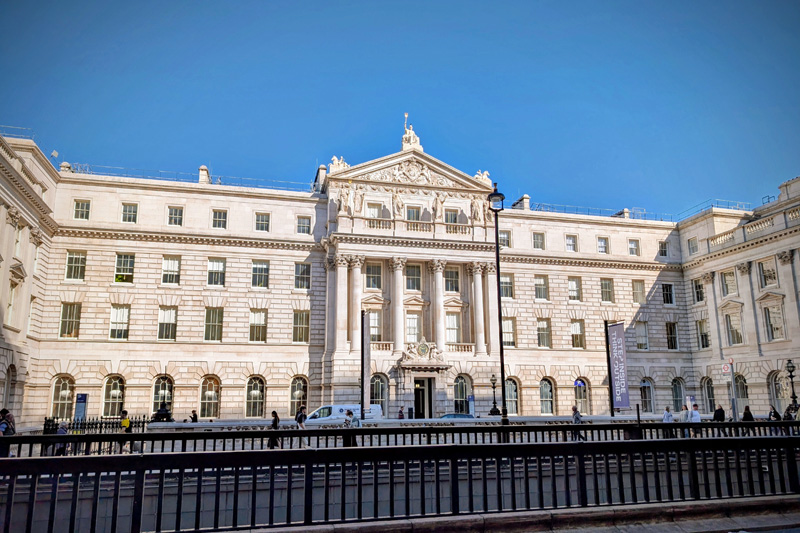
Somerset House stands as one of The Strand's most impressive landmarks, occupying the site where Edward Seymour's Tudor palace once stood. The current building, a grand Palladian structure rebuilt in the Georgian era, now functions as a major arts centre overlooking the River Thames. Throughout the year, Somerset House hosts an eclectic range of exhibitions, installations, and events, including the Sony World Photography Exhibition and London Fashion Week, many of which are free to attend. The building also features seasonal attractions, most famously its winter ice rink in the central courtyard.
Royal Courts of Justice
The Royal Courts of Justice represent one of the finest examples of neo-Gothic architecture in London. Designed by architect George E. Street and constructed between 1873 and 1882, this imposing legal complex took eleven years to build and houses over sixty departments of legal procedure, including the Superior Courts of Law and Equity, the High Court of Admiralty, and ecclesiastical courts. The building's stunning architectural features and historical significance make it a must-see landmark, and guided tours offer visitors the opportunity to wander its corridors whilst learning about the British legal system's history.
The Island Churches
St Mary le Strand
St Mary le Strand is a celebrated baroque gem designed by James Gibbs and consecrated in 1724. It was the first of the "Queen Anne Churches" built as part of a Parliamentary scheme to construct fifty new churches for London's rapidly growing population. The original medieval St Mary le Strand had been demolished in 1549 to make way for the first Somerset House, and parishioners successfully petitioned for its reinstatement in 1711. The church's grand and dignified baroque design showcases Gibbs's sophisticated knowledge of ancient, Renaissance, and contemporary European architecture. Its prominent location on the processional route between Westminster, Buckingham Palace, and the City of London adds to its significance beyond the purely local. St Mary le Strand serves as the London church of the Women's Royal Naval Service (WRENS), and was where Charles Dickens's parents were married in 1809.
St Clement Danes
St Clement Danes stands just east of St Mary le Strand, outside the Royal Courts of Justice. Originally rebuilt by Sir Christopher Wren in 1682, the church was burnt out during the Second World War and subsequently reconsecrated in 1958 as the Central Church of the Royal Air Force. Today it houses antique and modern silver, RAF Books of Remembrance, Squadron Standards, and military badges, serving as a memorial to Britain's air forces.
Recent pedestrianisation projects have freed St Mary le Strand from its former position as a traffic island, making it more accessible to visitors and allowing its architectural beauty to be better appreciated.
York Watergate
Hidden in the Embankment Gardens stands the York Watergate, a solitary remnant of the grand York House that once occupied this area. This 17th-century gateway marks where the River Thames once met the shore, serving as the entrance for aristocratic visitors arriving by private barge. The watergate provides a fascinating glimpse into London's topographical history, demonstrating how far the river's edge has receded since the Victorian embankments were constructed.
The Savoy
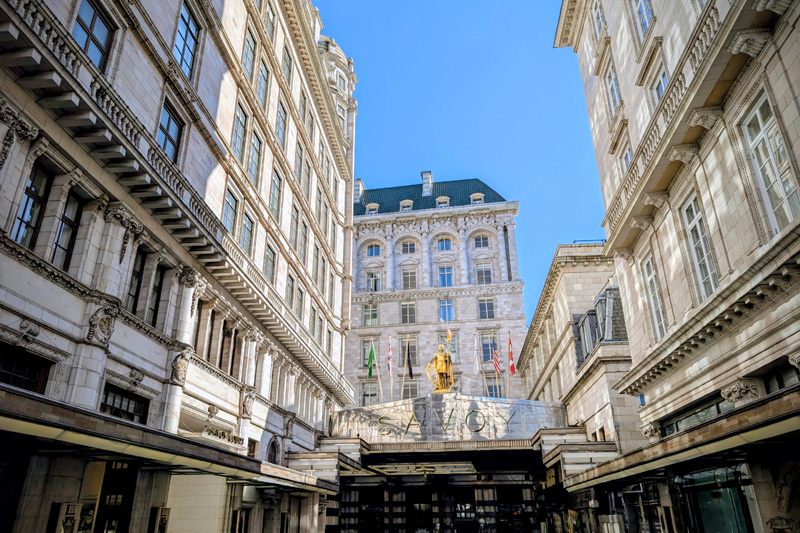
Where John of Gaunt's magnificent Savoy Palace once stood, destroyed in the Peasants' Revolt of 1381, the name has endured through the centuries. The Savoy Hotel now occupies this historic site, maintaining the area's association with prestige and luxury. Nearby, tucked just off The Strand, visitors can find the Savoy Chapel (the King's Chapel of the Savoy), a historic place of worship with its own distinctive heritage.
Cultural Attractions and Museums
Dr Johnson's House
Literature enthusiasts will appreciate Dr Samuel Johnson's House, dedicated to the father of the modern English dictionary. Located near The Strand, this historic house welcomes visitors on Fridays and Saturdays, displaying a stunning collection relating to the writer's life and times. The house offers insight into 18th-century literary London and Johnson's monumental contribution to English lexicography.
Temple Bar
Temple Bar stands as the only surviving gateway to the City of London, marking the historic boundary between Westminster and the City. This memorial is steeped in centuries of ceremonial significance and serves as a tangible link to London's medieval past.
Aldwych Underground Station
Hidden beneath The Strand lies the disused Aldwych Station (also known as Strand Underground Station), which served Londoners from 1907 until its closure in 1994. The London Transport Museum organises special tours allowing visitors to explore this atmospheric time capsule, where Londoners sheltered during the Blitz and where numerous films have been shot, including The Darkest Hour and V for Vendetta. The station's beautiful platform tiling features unique patterns and colours originally designed to help illiterate Londoners and foreign visitors navigate the Underground network.
The India Club
Near Somerset House, up a winding staircase, sits The India Club, a beautifully atmospheric 1940s colonial-era establishment with significant historical connections. This venue was a favourite meeting spot of the India League, whose members campaigned for Indian independence, eventually achieved in 1947. The no-nonsense décor and classic offerings preserve a palpable sense of mid-20th-century history.
Theatre and Entertainment
The Strand forms an integral part of London's West End theatre district, hosting several major venues presenting world-class productions. The Novello Theatre has been home to the long-running musical Mamma Mia!, whilst the Lyceum Theatre famously presents The Lion King, one of the world's most successful stage shows. The Adelphi Theatre, established in 1806 and located directly on The Strand, ranks amongst London's oldest theatres, maintaining the area's theatrical heritage that stretches back over two centuries.
Theatre-goers benefit from the concentration of venues, making The Strand an ideal base for catching multiple performances during a London visit. The area buzzes with pre-theatre and post-show activity, with audiences filling nearby establishments throughout the evening.
Shopping and Retail
The Strand offers extensive shopping opportunities, both along the street itself and in the adjacent Covent Garden area. Covent Garden, just minutes away, features the renowned "Beauty Corner" with flagship stores from Charlotte Tilbury, Nars, Deciem, Jo Malone, and Aesop. Fashion enthusiasts can browse collections from Tom Ford, Mulberry, Ted Baker, and Paul Smith amongst numerous other brands.
The shopping experience extends from major chains to independent boutiques, with the bustling Covent Garden Piazza providing a vibrant atmosphere enhanced by street performers and market stalls. Borough Market, London's famous food market, lies within easy reach at 1.6 kilometres from The Strand.
Dining Scene
The Strand and surrounding areas offer an exceptional range of dining options suitable for every occasion and budget. From traditional British establishments to international cuisine, the diversity reflects London's cosmopolitan character.
Covent Garden, adjacent to The Strand, provides countless cafés and eateries, making it an ideal location for breakfast, lunch, or dinner. The area caters to all tastes, from casual brunch spots to fine dining establishments. The Covent Garden Piazza offers particular appeal for alfresco dining, with many venues providing outdoor seating overlooking the historic market building.
Various cuisines are represented throughout the area, including Italian, Japanese, and contemporary European fare, alongside traditional British cooking. The concentration of quality establishments means visitors can explore different culinary experiences within a compact area.
Drinking and Nightlife
The Strand benefits from numerous distinguished bars and pubs, each offering distinct atmospheres and specialities. Historic establishments sit alongside contemporary cocktail bars, providing options for every preference.
The American Bar at The Savoy claims to be London's longest-surviving cocktail bar and has served countless famous patrons, including Winston Churchill. Its reputation for classic cocktails and impeccable service makes it a destination for those seeking a sophisticated drinking experience.
Other notable venues include speakeasy-style establishments offering extensive cocktail menus, late-night bars with atmospheric interiors, and rooftop bars providing spectacular views across London's skyline. From these elevated positions, drinkers can admire landmarks including the Houses of Parliament, The Shard, and Tower Bridge.
The Old Bank of England, now a stunning pub, offers another historically significant venue where visitors can enjoy refreshments in grand surroundings reminiscent of its former banking purpose.
Practical Information
Location and Geography
The Strand runs for just over three-quarters of a mile, extending from Trafalgar Square in the west to Temple Bar in the east, where it meets Fleet Street. The street sits entirely within Central London's Zone 1, placing it at the heart of the capital's transport network and tourist attractions.
The area benefits from its position between major districts: Westminster lies to the west, the City of London to the east, Covent Garden to the north, and the River Thames and South Bank to the south. This central location makes The Strand an excellent base for exploring multiple areas of London.
Transport Connections
The Strand enjoys exceptional transport links, with multiple Underground stations providing access to six different Tube lines:
- Charing Cross: Bakerloo and Northern lines (1 minute walk)
- Embankment: Bakerloo, Northern, District, and Circle lines (3 minutes walk)
- Temple: District and Circle lines
- Covent Garden: Piccadilly line
- Leicester Square: Northern and Piccadilly lines (7 minutes walk)
Mainline railway services operate from Charing Cross Station, connecting The Strand to destinations across Southeast England. Numerous bus routes serve The Strand, whilst river services from Embankment Pier provide an alternative transport option along the Thames.
This concentration of transport options ensures visitors can easily reach The Strand from any part of London and use it as a hub for exploring the wider capital.
Visiting Tips
The Strand's compact nature and excellent pedestrian infrastructure make walking the ideal way to experience the area. A stroll along the full length allows visitors to appreciate the architectural variety, from grand institutional buildings to historic churches and modern commercial developments.
Many attractions, including Somerset House's exhibitions and certain church visits, are free, making The Strand accessible regardless of budget. However, popular venues such as theatres and guided tours should be booked in advance, particularly during peak tourist seasons and for weekend performances.
The area remains lively throughout the day and evening, with different atmospheres at various times. Daytime brings shoppers and tourists, whilst evenings see theatre audiences and diners filling the streets.
Combining visits to multiple attractions makes efficient use of time, as major sites sit within minutes of each other. A typical visit might include touring the Royal Courts of Justice, exploring Somerset House, visiting one or both island churches, and catching a West End show, all easily accomplished on foot.
Accommodation
The Strand and its immediate surroundings offer numerous accommodation options ranging from historic luxury hotels to modern boutique establishments and budget-friendly chains. The area's central location and transport links make it particularly convenient for visitors wishing to explore multiple London attractions without lengthy journeys.
Hotels along The Strand provide easy access to major tourist sites, with Trafalgar Square, Covent Garden, the South Bank, and the British Museum all within comfortable walking distance. The concentration of theatres, restaurants, and cultural venues means guests can enjoy evening entertainment without travelling far from their accommodation.
The Strand Today
Contemporary Strand has evolved from its role as a route "between two centres" to become a centre in its own right. The street successfully balances its rich historical heritage with modern commercial vitality, creating a dynamic urban environment that appeals to residents, workers, and visitors alike.
The architectural landscape tells the story of London's development, with Georgian, Victorian, and modern buildings standing side by side. Recent improvements, including pedestrianisation schemes, have enhanced the area's walkability and public spaces, making historic landmarks more accessible and creating a more pleasant environment for exploring.
As both a major thoroughfare and a destination, The Strand embodies London's ability to preserve its past whilst embracing the present. Whether visitors seek cultural enrichment, theatrical entertainment, historical exploration, or simply wish to experience a quintessentially London street, The Strand delivers on every count.