


 Ireland Guide
 Scotland Guide
 Wales Guide
| Contents |
|---|
Introduction
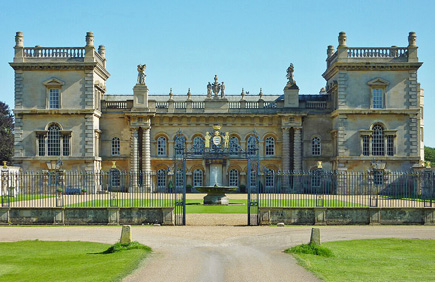
Grimsthorpe Castle is a country house that has been the home of the de Eresby family for over 500 years. The property was granted to the 10th Baron Willoughby de Eresby by King Henry VIII in 1516. The building itself presents a mix of architectural styles, featuring a Tudor courtyard and a grand Baroque north front, which was a final major work by the architect Sir John Vanbrugh. Visitors to the estate can explore the castle's staterooms, which house collections of paintings, furniture, and tapestries. The surrounding grounds include formal gardens, a kitchen garden, an extensive park landscaped by Lancelot 'Capability' Brown, ancient woodlands, and a 50-acre lake.
Interesting Facts about Grimsthorpe Castle Park & Gardens
- Grimsthorpe Castle has been the ancestral home of the de Eresby family since 1516, when it was granted by Henry VIII.
- The castle was originally built around 1140 by Gilbert de Gant, Earl of Lincoln, during the period known as the Anarchy.
- King John's Tower, which survives from the original 13th-century fortification, stands at the south-east corner of the present building.
- The magnificent baroque south front was designed by Sir John Vanbrugh in 1703, the same architect who created Blenheim Palace and Castle Howard.
- Henry VIII and his court visited the castle in 1541, with the house being specially built to accommodate the royal party and their hunting expeditions for red deer.
- The castle boasts a unique architectural blend of medieval, Tudor, baroque, and Palladian styles, creating what has been described as having "castle-like playfulness".
- The Great Hall is considered one of Sir John Vanbrugh's masterpieces, featuring a vast theatrical space with monumental stone screens.
- The castle's 3,000-acre park was landscaped by Lancelot 'Capability' Brown in 1771, featuring rolling pastures, lakes, and woodland.
- During the First World War, Grimsthorpe Park served as an emergency landing ground for the Royal Flying Corps and Royal Air Force.
- The state dining room contains the actual throne used by George IV for his coronation banquet, as well as Queen Victoria's footstool from the House of Lords.
- In 1944, the castle housed a company of the Parachute Regiment whilst they recovered from operations in Italy before training for Operation Market Garden.
- The current owner is Jane Heathcote-Drummond-Willoughby, 28th Baroness Willoughby de Eresby, who is the granddaughter of Nancy Astor.
- The castle sits on the site of the ancient Vaudey Abbey, which was suppressed during the Dissolution of the Monasteries and demolished to build the Tudor stronghold.
- Some oak trees in the park were recorded in the Domesday Book of 1068 and survived into the 20th century.
- The 1st Earl of Ancaster built a private railway in the 19th century, the Edenham and Little Bytham railway, with stations at Grimsthorpe village and the castle.

History
The history of Grimsthorpe Castle begins in the medieval period, with its origins tracing back to a small castle built on a ridge overlooking the Lincolnshire fens. While often said to have been started by Gilbert de Gant, Earl of Lincoln, in the early 13th century, it is plausible it was constructed even earlier, around 1140, during the turbulent era known as the Anarchy. The oldest surviving section, a stout tower at the south-east corner, is known as King John’s Tower, though this name may be a misattribution. During the Wars of the Roses, the castle belonged to Lord Lovell, a staunch supporter of Richard III. When Henry VII claimed the throne, Lovell joined a failed rebellion, leading to the confiscation of his properties, including Grimsthorpe.
In 1516, the castle entered a new, defining chapter when King Henry VIII granted it to William, the 11th Baron Willoughby de Eresby, and his Spanish bride, Maria de Salinas, who had been a lady-in-waiting to Catherine of Aragon. This marked the beginning of the family's continuous, 500-year ownership of the estate. After the Baron's death, his seven-year-old daughter Katherine inherited the property in 1526. She later married Charles Brandon, 1st Duke of Suffolk and a close friend of Henry VIII, who embarked on a major rebuilding project to enlarge the house. Using stone from the recently suppressed Vaudey Abbey, the Duke rapidly transformed the castle in just 18 months to accommodate a visit from King Henry VIII and his court in 1541. Later, during the reign of Mary I, Katherine and her second husband were forced into exile for their Protestant views, but they returned to Grimsthorpe under Queen Elizabeth I.
The castle underwent another significant transformation in the 18th century. In 1715, Robert Bertie, newly created the 1st Duke of Ancaster and Kesteven, commissioned Sir John Vanbrugh, the celebrated architect of Blenheim Palace and Castle Howard, to create a grand Baroque masterpiece. Vanbrugh designed an imposing north front with dramatic arcades and columns, intending a complete overhaul of the building. However, this was to be Vanbrugh’s final project; both he and the Duke died before the ambitious scheme could be completed, leaving only the magnificent north range finished. This resulted in the house's unique blend of architectural styles. The celebrated landscape architect Lancelot ‘Capability’ Brown was later employed to design the parkland in 1771. During the 20th century, the estate served the nation during both World Wars, first as an airfield and later as a training ground for the Parachute Regiment ahead of Operation Market Garden. Today, Grimsthorpe Castle remains the cherished home of the de Eresby family.
Description
Overview
Grimsthorpe Castle is a large country house in the Lincolnshire countryside, notable for its quadrangle layout and the distinct architectural styles of its four façades. The grand north front is a masterpiece of English Baroque design, the final major work of its architect, Sir John Vanbrugh. This imposing façade, built from honey-coloured local limestone, contrasts with the three other sides of the building which retain their earlier, more modest Tudor character. The castle is built around a large central courtyard, a feature that reflects its development over several centuries.
Architecture and Design
The castle presents a fascinating study in architectural evolution, with each of its four sides displaying different appearances that reflect the various building periods since the 13th century. The north front stands as the final masterpiece of Sir John Vanbrugh, the renowned architect responsible for Blenheim Palace and Castle Howard. This Baroque façade creates a striking contrast with the Tudor elements elsewhere in the building, particularly the quaint south façade with its distinctive character.
The building's massive and martial character recalls the bastions of a great fortress dressed in classical style, with towers and outlying pavilions contributing to its fortress-like appearance. At the south-east corner stands King John's Tower, believed to be part of the original medieval castle structure. The castle's design incorporates a central courtyard, creating an enclosed quadrangle that enhances its fortress-like qualities.
Interior Spaces
The Vanbrugh Hall serves as the castle's centrepiece, featuring monumental stone arcades arranged on two levels around the perimeter. Arcaded screens at each end separate the hall from the staircases, creating a dramatic architectural statement reminiscent of Audley End House and Castle Howard. The staircase leads from behind the hall screen to the state rooms on the first floor.
The State Dining Room occupies Vanbrugh's north-east tower, distinguished by its painted ceiling illuminated through a Venetian window. The King James and State Drawing Rooms have undergone redecoration over the centuries and house portraits by Reynolds and Van Dyck, alongside European furniture and yellow Soho Tapestries woven by Joshua Morris around 1730.
The Chinese Drawing Room features a splendidly rich ceiling and an 18th-century fan-vaulted oriel window. The walls display Chinese wallpaper depicting birds amidst bamboo, creating an exotic atmosphere within the English castle setting. The chapel impresses visitors with its superb 17th-century plasterwork.
Collections and Furnishings
The castle houses remarkable collections that reflect its long association with the Willoughby family. As one of three families in England who fulfil the hereditary office of Lord Great Chamberlain, the Willoughbys have accumulated one of the largest collections of royal thrones and furnishings outside the Royal Palaces. The collection includes sculpture, paintings, tapestries, ceramics, and furniture displayed throughout the lavishly furnished rooms.
Notable pieces include the throne used by George IV at his Coronation Banquet and a Regency giltwood throne and footstool used by Queen Victoria in the old House of Lords. The collection also features a walnut and parcel gilt chair and footstool made for George III's use at Westminster. The South Corridor contains thrones used by Prince Albert and Edward VII, as well as the desk on which Queen Victoria signed her coronation oath.
Gardens and Grounds
The formal gardens at Grimsthorpe are arranged to the south and east of the castle. A key feature is the series of intricate parterres, laid out in the 19th century by the Countess of Ancaster with design input from William Andrews Nesfield. These geometric patterns are delineated with low box hedges and filled with seasonal planting. A long, dramatic herbaceous border runs along a terrace wall, providing vibrant colour throughout the summer and offering fine views across the estate’s lake. The formal gardens are also punctuated with sculpted topiary and expansive lawns, alongside mature fruit trees, including quince and medlar.
Leading away from the formal areas is a semi-wild woodland garden, which provides a more naturalistic and tranquil atmosphere. This area is threaded with paths and contains plantings of rhododendrons, azaleas, and magnolias. In spring, the woodland floor is carpeted with narcissi, primulas, and bluebells. Further from the castle lies the ornamental vegetable garden and orchard, which was established in the 1960s. Laid out with geometric beds, it produces fruit and vegetables for the castle while also being a decorative feature in its own right, with trained fruit trees and a mix of flowers and produce.
Parkland
The castle is set within approximately 3,000 acres of parkland, a landscape designed in the 1760s by Lancelot 'Capability' Brown. The park incorporates remnants of the ancient royal Forest of Kesteven, which accounts for the high number of veteran and ancient oak trees found across the estate. Brown’s design enhanced the natural features, creating a rolling, naturalistic landscape with strategic clumps of trees to frame views of the castle. A key component of his design is the 50-acre man-made lake, which sits serenely within the landscape. A notable historic feature is the V-shaped avenue of trees, which provides a formal approach through the park.
The park functions as a historic deer park and supports a large, free-roaming population of three deer species: red, fallow, and muntjac. The diverse habitats of woodland, pasture, and wetlands also support a wide variety of other wildlife, including birds of prey. The park is accessible to visitors via a network of waymarked trails suitable for walking and cycling. For a more comprehensive overview of Brown's landscape and areas not easily reached on foot, the estate offers guided minibus tours of the park.
Visitor Facilities
The estate provides a range of facilities for visitors. For families, there is a large adventure playground with high towers, a zip wire, climbing frames, and slides catering to a wide range of ages. Refreshments are available from the main Tea Room, which serves light lunches, sandwiches, and homemade cakes, or from a separate food trailer often positioned near the playground for drinks and ice cream. A gift shop located in the courtyard stocks a selection of souvenirs, books, local Lincolnshire produce, and plants propagated from the castle's gardens.
The grounds have been made accessible, with most routes consisting of level or gently sloping tarmac, brick, and gravel paths. Seating is provided at regular intervals throughout the gardens and park. For visitors with limited mobility, mobility scooter hire is available. Cycle hire is also offered on-site for those wishing to explore the designated parkland trails. Well-behaved dogs are welcome on leads throughout the gardens and parkland, though they are not permitted inside the castle, playground, or food service areas. Ample car parking is situated close to the main entrance.
Getting There
Grimsthorpe Castle is reached most easily by car. From the A1, take the Colsterworth exit and follow the A151 towards Bourne, passing through Corby Glen; the castle will be visible on your right as you approach Grimsthorpe village, with the entrance found halfway down the hill. Those travelling by public transport can take a train to Grantham, then complete the journey by taxi, or alternatively, take a train to Peterborough, continue by bus to Bourne, and then catch a local bus or taxi onwards. The nearest bus stops are at The Black Horse Inn and the Demand Responsive Area in Grimsthorpe, each just a short walk to the main entrance. Ample parking is available on-site, as well as dedicated facilities for disabled visitors and a smooth, accessible approach to the estate for those with limited mobility.
Best Time to Visit
The best time to visit Grimsthorpe Castle is between May and September, when the castle, gardens and parkland are open to the public. During these months, visitors can enjoy the estate in its full splendour, with the gardens in vibrant bloom and the parkland teeming with wildlife. The castle is open from Sunday to Thursday, offering ample opportunity to explore its fascinating interiors, stroll through the meticulously kept formal gardens, and wander the expansive grounds. Late spring and throughout the summer provide the perfect conditions for picnics, woodland walks, and family days out, making this period ideal for experiencing the beauty and history of Grimsthorpe Castle.