


 Ireland Guide
 Scotland Guide
 Wales Guide
| Contents |
|---|

Introduction
Built in 1456 by Thomas Bouchier, Archbishop of Canterbury, Knole House is one of the great treasure houses of England, as well as one of the most visited site owned by the National Trust.
The history of the estate goes back to the 12th century. It was the residence of five archbishop of Canterbury in total, before being confiscated by Henry VIII.
In 1566, Knole House was given by Elizabeth I to her cousin and favourite, Thomas Sackville, 1st Earl of Dorset, whose descendants still own it today. Sackville enlarged and embellished the house, which remains little altered since then.
Nowadays, Knole's prime attraction is the wonderful 17th-century royal Stuart furniture collection, unrivalled in England by its rarity and quality. The house has a stupendous amount of Renaissance, Tudor and Stuart artworks, including first-class plasterwork ceilings, grand tapestries, carved marble, silver furniture, painted walls, as well as portraits by Van Dyck, Gainsborough and Reynolds.
Knole House is so extensive that is resembles a village of terraced Renaissance houses separated by a central Gatehouse, rather than a single habitation. There are no less than 365 rooms, 52 stairs and 7 courtyards. You can also watch deer grazing in the surrounding park.
The manor and Sackville family appear in some literary works, such as V. Sackville-West's work 'Knole and the Sackvilles', and Virginia Woolf's 'Orlando'.
Interesting Facts about Knole House
- Knole House occupies a total of four acres and ranks amongst the top five largest houses in England.
- The house is famously rumoured to be a "calendar house" featuring 365 rooms, 52 staircases, 12 entrances, and 7 courtyards, though in reality it contains around 400 rooms.
- Built by Thomas Bourchier, Archbishop of Canterbury, between 1456 and 1486, Knole was transformed from a small manor house into a magnificent archbishop's palace.
- Henry VIII seized the house from Archbishop Thomas Cranmer in 1538 and used it as a hunting lodge, even housing his daughter Mary I there during his divorce from Catherine of Aragon.
- The Sackville family has called Knole home since 1603, when Thomas Sackville purchased the lease for £4,000.
- Knole houses one of the world's rarest collections of Stuart-era furniture and textiles, many pieces stamped with "WP" for Whitehall Palace and dating back to the reigns of James I and Charles I.
- The house sits within Kent's last remaining medieval deer park, where wild sika and fallow deer roam freely amongst ancient oaks and beeches across 1,000 acres.
- Vita Sackville-West, the renowned author and gardener, was born at Knole and wrote the definitive history "Knole and the Sackvilles" in 1922.
- Virginia Woolf used Knole as the inspiration and setting for her novel "Orlando," having visited frequently as Vita Sackville-West's lover.
- One of the towers is called "Shelley's Tower," named after Giannetta Baccelli, an Italian dancer and mistress of the 3rd Duke of Dorset, whose name the household staff couldn't pronounce properly.
- The Great Staircase at Knole is considered one of the most magnificent examples of Jacobean woodwork in any English house, decorated with heraldic devices and classical grisaille wall paintings.
- Knole has welcomed visitors for over 400 years, making it one of England's longest-running tourist attractions.
- The house's attics contain hidden historical treasures, including 17th-century letters discovered under floorboards and graffiti carved into ancient beams.
- Edward Sackville-West, known as "Eddy," lived in the Gatehouse Tower between 1926 and 1940 and regularly hosted members of the Bloomsbury Group.
- The Gatehouse Tower offers panoramic views from its summit, reached by climbing 77 steps to the top.
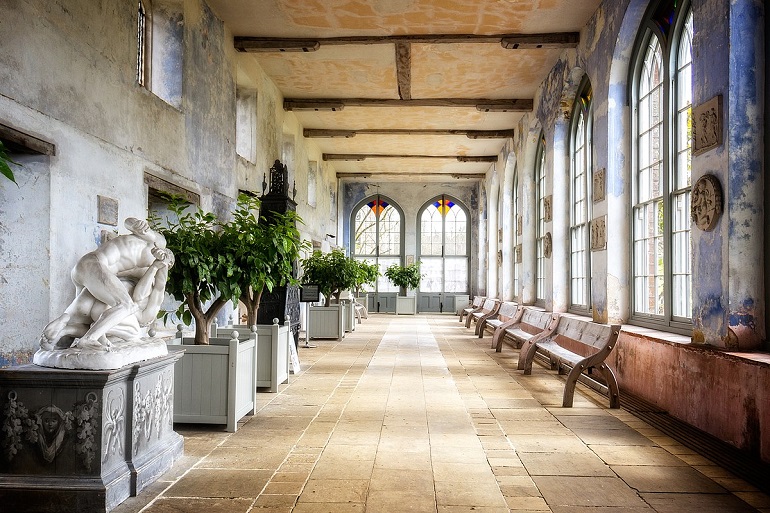
History
Knole House's origins stretch back to the late 13th century when Robert de Knole was the earliest recorded owner of the estate in the 1290s. The site may have even earlier significance, with Bronze Age field remnants visible in the surrounding parkland and Echo Mount possibly topped by a Bronze Age burial mound that could be the original "knoll" from which the house takes its name. The current magnificent structure began taking shape between 1456 and 1486 when Thomas Bourchier, Archbishop of Canterbury and Lord Chancellor, acquired the estate from James Fiennes, 1st Baron Saye and Sele, and commenced construction of a substantial residence using local Kentish ragstone. Bourchier expanded the property considerably, adding a large courtyard and an impressive castellated entrance tower, transforming what had been a modest manor into an archiepiscopal palace befitting his elevated ecclesiastical position.
The house's fortunes changed dramatically during the Tudor period when it passed into royal hands in 1538 after King Henry VIII seized it from Archbishop Thomas Cranmer. Henry VIII found Knole particularly useful as a hunting lodge and notably housed his daughter Mary I there whilst he pursued his divorce from Catherine of Aragon. Following Henry's death, the property passed through various hands during the reigns of Edward VI and Mary I before Elizabeth I initially granted it to Robert Dudley, 1st Earl of Leicester, in the early 1560s, though he returned it in 1566. The estate then became the subject of considerable competition, with a complex web of leases involving Thomas Rolf and the wealthy lawyer John Lennard, whose family held various rights until Thomas Sackville, Elizabeth's cousin and later 1st Earl of Dorset, secured definitive ownership by purchasing the remaining 51 years of Lennard's lease for £4,000 in 1603.
Thomas Sackville immediately embarked upon an ambitious transformation of Knole, employing some 200 workmen in a building programme that was supposed to take two years but continued with vast expenditure even into 1608-1609. This early 17th-century remodelling created the Jacobean façade that visitors see today, though substantial elements of the earlier medieval structure remain, including the northern range of Stone Court with its high-status apartments and late-15th-century wall paintings. The Sackville family have been the primary inhabitants ever since, with the house becoming famous for its connection to the writer Vita Sackville-West, who penned "Knole and the Sackvilles" in 1922 but was unable to inherit due to male primogeniture laws. The property was gifted to the National Trust in 1946 along with 43 acres of parkland, though the Sackville-West family continue to maintain private apartments within the house. Knole is famously reputed to be a "calendar house" with 365 rooms, 52 staircases, 12 entrances, and 7 courtyards, though in reality it contains around 400 rooms with 15 currently open to visitors.
Description
The Architectural Marvel
Setting and Grounds
The house sits majestically within a thousand-acre deer park, where herds of fallow and sika deer roam freely amongst ancient oak trees, some dating back over 500 years. The approach to Knole reveals the house gradually, emerging from wooded valleys and rolling parkland that has remained largely unchanged for centuries. Stone boundary walls snake across the landscape, punctuated by elaborate gate lodges that herald the grandeur within.
Exterior and Courtyards
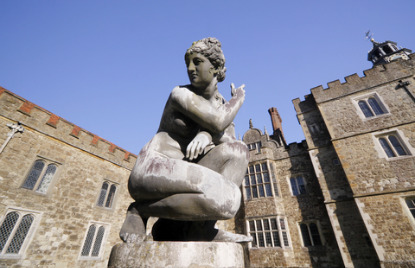
Approached through a pair of imposing Tudor gatehouses crowned with battlements and heraldic beasts, the house unfolds into successive courtyards named Green, Stone, Water, Pheasant, Squirrel, Sackville and Cat—each framed by tall stone façades and mullioned windows that catch the shifting Kent light. The façades combine late-medieval structures with Jacobean additions, including an ornate loggia adorned with classical pilasters and a grand central front punctuated by paired Doric columns supporting elaborate pediments.
Seven interlocking courtyards create a sense of perpetual discovery, revealing glimpses of carved doorways topped with heraldic shields, rusticated arches bearing the Sackville arms, and hood-moulded windows beneath steeply pitched roofs of Kentish ragstone tiles. Lead rainwater heads bear dates and initials, whilst ornate chimneys twist skyward in clustered arrays. The interplay of light and shadow across these stone surfaces creates an ever-changing tableau of architectural drama.
Interior Grandeur
The Great Hall and Screen
Stepping through the heavy oak doors into the vast Great Hall is to enter a realm of medieval splendour touched by Renaissance refinement. Dark oak panelling rises to meet an elaborately carved Jacobean screen spanning from floor to the hammer-beam ceiling, its intricate tracery incorporating vine leaves, grotesque masks, and heraldic devices. Portraits of past inhabitants peer down from high walls, their gilded frames catching what little light filters through the tall gothic windows, while the low illumination accentuates the warm amber hues of the ancient timber and the carved heraldic motifs that celebrate generations of the Sackville lineage.
The hall's stone-flagged floor, worn smooth by centuries of footfall, extends beneath a magnificent minstrels' gallery supported by carved corbels depicting mythical beasts. Tapestries depicting hunting scenes and biblical narratives hang from the walls, their rich colours muted by age but still conveying the wealth and taste of their original owners.
The Great Staircase
Ascending the famed Great Staircase is an encounter with Renaissance exuberance at its most theatrical. Greek-style marble columns, shipped from Italian quarries, support a richly frescoed barrel vault depicting the Four Ages of Man, the Five Senses, and the Social Virtues in swirling compositions of mythological figures and allegorical scenes. The staircase's soaring stone balustrade, carved with intertwining foliage and heraldic beasts, guides visitors past painted wall panels that imbue the approach to the upper state rooms with operatic grandeur.
Each landing reveals new vistas through tall casement windows, framing views of the deer park and distant Kent countryside. The painted ceiling above depicts zodiacal signs and planetary deities, reinforcing the house's cosmic symbolism whilst demonstrating the sophisticated classical learning of its Jacobean creators.
State Showrooms and Galleries
Beyond the staircase lies a magnificent procession of state rooms, largely unchanged since the early eighteenth century, each telling its own story of power, patronage, and artistic achievement:
Brown Gallery
This long, narrow portrait gallery stretches for nearly 100 feet, its dark oak panelling providing a dramatic backdrop for rare seventeenth-century chairs of state upholstered in their original crimson velvet and gold thread. Portraits of Tudor and Stuart dignitaries gaze down from ornate gilded frames—including works attributed to Kneller, Lely, and Van Dyck—whilst carved stone fireplaces topped with heraldic overmantels and tapestry-hung walls create an atmosphere both intimate and powerfully dignified.
The gallery's floorboards, of ancient English oak, creak softly underfoot, whilst tall windows punctuate the eastern wall, their diamond-leaded panes casting geometric shadows across Persian carpets and polished furniture. Display cases contain rare manuscripts, including letters from Elizabeth I and James I, their vellum pages testament to the family's proximity to royal power.
Cartoon Gallery
Originally designed to display large cartoons for tapestry production, this ethereal chamber now houses an outstanding collection of classical sculptures and marble busts set against pale lime-washed plaster walls. The cool north light filtering through tall sash windows—a Georgian addition—perfectly illuminates the carved marble forms, including works attributed to classical masters and contemporary sculptors.
Ancient Roman fragments stand alongside seventeenth-century portrait busts, creating a dialogue between antiquity and more recent artistic achievement. The room's understated elegance, with its simple cornicing and geometric floor pattern, provides the perfect foil for the sculptural collection whilst offering respite from the richer decorative schemes elsewhere in the house.
Leicester Gallery (Billiard Room)
Known also as the Billiard Room, this chamber displays a jewel-like array of furniture that represents the pinnacle of English craftsmanship. The room's crowning glory is the original Knole sofa—a magnificent crimson velvet state couch with movable "wings" secured by ranks of gilt studs, renowned worldwide as the prototype for the distinctive Knole style that graced countless country houses and continues to be reproduced today.
Surrounding this masterpiece stand equally impressive pieces: gilt wood pier glasses reflecting candlelight, marquetry cabinets inlaid with exotic woods and mother-of-pearl, and delicate porcelain figures arranged on marble-topped console tables. The walls display a carefully curated selection of family portraits, their subjects seemingly engaged in eternal conversation across the centuries.
State Beds and Royal Furniture
Knole's collection of royal Stuart furniture ranks among the finest surviving examples in Britain, much of it acquired directly from royal palaces during the Commonwealth period. Three magnificent state beds—the Spangled, Venetian, and King's beds—stand as centrepieces of their respective chambers, their towering canopies of silver-gilt thread and silk hangings once gracing the bedchambers of monarchs at Whitehall and Hampton Court.
The King's Bed
The most spectacular of these is the King's Bed, traditionally associated with James II, its crimson and gold hangings embroidered with the royal arms and topped by ostrich plumes. The bed's carved and gilded frame incorporates cherubs, crowns, and acanthus leaves in a riot of Baroque decoration that speaks to the divine right of kings and the earthly magnificence expected of royal surroundings.
Seating and Cabinet Furniture
X-framed armchairs, their crimson velvet seats supported by carved dolphin legs, line the showrooms alongside stools and chairs of state bearing the original Whitehall Palace inventory numbers. Many pieces retain their original upholstery—a remarkable survival testifying to the house's careful stewardship over the centuries. Cabinet furniture includes spectacular examples of marquetry work, lacquered Oriental pieces, and English interpretations of Continental designs.
Tapestries and Textiles
The rooms throughout Knole are adorned with an exceptional collection of tapestries spanning three centuries of European textile production. Flemish and Brussels tapestries depicting biblical scenes, mythological episodes, and verdant landscapes create immersive environments that transport visitors to different worlds and eras.
The Venetian Bedroom Tapestries
In the Venetian Bedroom, late sixteenth-century Delft tapestries shimmer with muted chiaroscuro effects, their silk and gold threads catching the light to reveal subtle variations in tone and texture. These masterpieces depict scenes from Ovid's Metamorphoses with a sophistication that rivals contemporary painting.
The King's Room Suite
The King's Room displays a magnificent suite of late seventeenth-century London-woven panels illustrating episodes from the life of Nebuchadnezzar, their rich blues and golds creating a backdrop of oriental splendour. These tapestries, woven in the Mortlake workshops, represent the height of English textile production and demonstrate the cosmopolitan tastes of the Restoration court.
Decorative Arts and Craftsmanship
Carved Details and Metalwork
Throughout Knole, carved doorcases reveal the evolution of decorative taste from Tudor linenfold panelling through Jacobean strapwork to Georgian neoclassical motifs. Wrought-iron fittings—door handles, window catches, and fireplace accessories—demonstrate the skills of generations of craftsmen, many pieces bearing the maker's marks of renowned smiths.
Painted Ceilings and Wall Decoration
Painted ceilings throughout the state rooms reveal layers of artistic intervention, from simple heraldic devices to elaborate mythological scenes executed by Continental artists in the employ of the Sackville family. Recent conservation work has revealed hidden details and original colour schemes, demonstrating the house's original brilliance before centuries of candlelight dimmed the decorative schemes.
Witchmarks and Historical Curiosities
Tudor witchmarks—ritual marks carved into wooden beams and stone surrounds—can be found inscribed above doors and fireplaces throughout the older parts of the house, hinting at the superstitions and beliefs of earlier inhabitants. These apotropaic symbols, designed to ward off evil spirits, provide fascinating glimpses into the mindset of Tudor and Jacobean society.
Getting There
Knole House, situated in the heart of Kent's medieval deer park, is easily accessible by various modes of transport.
By train, visitors can take direct services to Sevenoaks station from London and numerous other destinations. From Sevenoaks station, it's approximately a 30-minute uphill walk through the town centre to reach the house entrance.
By coach, local bus services operate to Sevenoaks, with the nearest bus station located three-quarters of a mile from Knole Park. Several bus routes including the 1, 3, 8, 402, and 308 services provide connections to the area.
By car, drivers should use postcode TN13 1HX for satellite navigation and exit the M25 at Junction 5 onto the A21, following signs for Sevenoaks. The park entrance is conveniently located in Sevenoaks town centre, just off the A225 High Street opposite St Nicholas Church, making it straightforward for those travelling from north, south, east, or west.
Best Time to Visit
The ideal time to visit Knole House is during the spring and summer months, from April to September. During this period, the extensive gardens are at their most splendid, with vibrant rhododendrons and azaleas blooming in late spring, creating a spectacular display of colour. The warmer weather is perfect for exploring the vast 1,000-acre medieval deer park that surrounds the house, offering picturesque walks and opportunities to spot the resident wild deer herd. While these months can be popular, visiting on a weekday will help you avoid the largest crowds. Autumn also offers a unique charm, as the parkland foliage turns to rich shades of orange and brown, providing a stunning, atmospheric backdrop for a visit.