


 Ireland Guide
 Scotland Guide
 Wales Guide
| Contents |
|---|

Introduction
Stowe House and Landscape Gardens, located in Buckinghamshire, represent one of the finest examples of Georgian landscape design in Britain. The estate features over 250 acres of meticulously crafted gardens comprising valleys, vistas, narrow lakes and rivers, complemented by more than 30 temples and monuments designed by leading 18th-century architects including Charles Bridgeman, James Gibbs, William Kent and Lancelot 'Capability' Brown. Originally developed by Viscount Cobham from 1717, the gardens are historically significant as the first English garden for which a guidebook was produced. The grade I listed country house, now home to Stowe School, is owned by the Stowe House Preservation Trust and regularly opens to visitors, while the gardens and parkland have been under National Trust stewardship since 1989. The landscape includes distinct areas such as the Elysian Fields, Hawkwell Field, Grecian Valley, and features notable structures like the Temple of Ancient Virtue, Gothic Temple, and Palladian Bridge.
Interesting Facts about Stowe House
- Stowe House is a Grade I listed country house in Buckinghamshire, England, and serves as the home of the private Stowe School.
- The surrounding Stowe Gardens, also Grade I listed, are considered one of the finest examples of English landscape gardening.
- The gardens were designed by notable figures like Charles Bridgeman, William Kent, and Capability Brown during the 18th century.
- Stowe Gardens feature over 40 monuments, including the Temple of Venus, the Palladian Bridge, and the Gothic Temple.
- The estate was originally purchased by John Temple in 1589 and developed extensively by his descendants.
- Richard Temple, 1st Viscount Cobham, transformed the gardens into a masterpiece of Georgian landscape design starting in 1717.
- The National Trust acquired the gardens in 1989 and undertook a £10 million restoration programme to preserve their historical significance.
- Stowe House opened as a public school in 1923 with just ninety-nine boys and only one bathroom available at the time.
- The estate's original village was absorbed into the grounds, leaving Stowe Church as one of its few remaining features.
- Visitors have been exploring Stowe Gardens for over 300 years, making it one of Britain’s oldest tourist attractions.

History
The estate's origins date back to 1589 when John Temple purchased the manor. It was under Sir Richard Temple in the late 17th century that the estate began its transformation, with the construction of a new mansion and the development of formal gardens. The 18th century saw the gardens evolve into a masterpiece of naturalistic landscaping under the guidance of Charles Bridgeman, William Kent, and Capability Brown. These designers transitioned the gardens from their baroque beginnings to the celebrated English landscape style, incorporating sweeping vistas, ornamental temples, and monuments that reflected the wealth and status of the Temple-Grenville family.
The gardens have been a tourist attraction for over 300 years, boasting iconic features such as the Corinthian Arch, the Palladian Bridge, and the Temple of British Worthies. By the 19th century, additions like the Lamport Gardens further enhanced their appeal. However, financial difficulties led to significant sales of estate assets in the late 19th and early 20th centuries. In 1923, Stowe House became home to Stowe School, saving it from potential ruin. The National Trust took ownership of the gardens in 1989, initiating extensive restoration efforts to preserve this historic landscape. Today, visitors can explore these meticulously restored grounds, which remain a testament to Britain's cultural heritage.
Stowe House itself is a Grade I listed building managed by the Stowe House Preservation Trust. Its interiors were completed during the tenure of successive owners who left their mark on its architectural splendour. While Stowe School occupies much of the house today, public access allows visitors to appreciate its grandeur alongside the surrounding gardens. The estate continues to be a collaborative effort between Stowe School and the National Trust, ensuring its legacy as one of Britain's most significant cultural landmarks.
Description
Stowe House
As you approach Stowe House along the grand driveway, the imposing façade gradually reveals itself—a breathtaking example of Neoclassical architecture that commands immediate admiration. The house, now home to Stowe School, represents the pinnacle of 18th-century design ambition.
The North Front, with its majestic Corinthian portico, creates an unforgettable first impression. This magnificent façade stretches over 916 feet and features a central block flanked by colonnades and pavilions, creating one of the longest façades of any country house in England.
The Magnificent Interiors
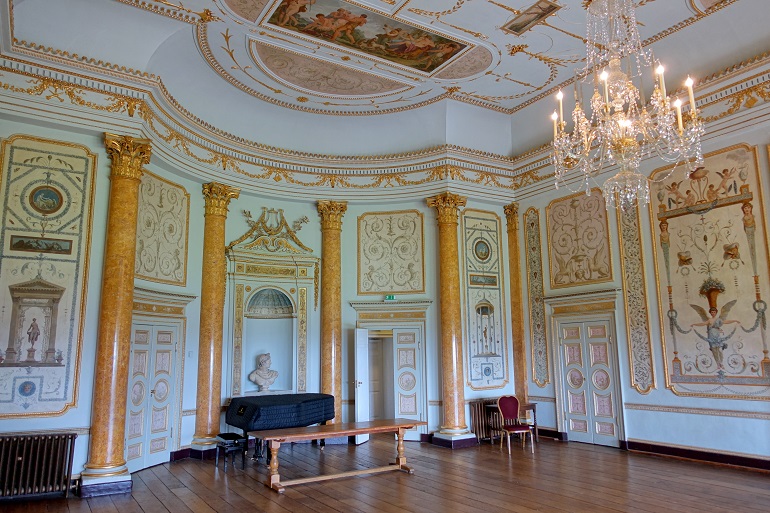
Step inside to discover a series of opulent state rooms that reflect the flamboyant tastes of the Temple-Grenville family. The Marble Saloon, often described as one of the most beautiful rooms in England, features a coffered dome inspired by the Pantheon in Rome. Its walls are adorned with Derbyshire alabaster and sixteen Ionic columns of scagliola (imitation marble).
The State Dining Room dazzles with its gilded ceiling and intricate plasterwork, whilst the Library showcases exquisite woodcarving and literary heritage. The Music Room, with its outstanding acoustics and decorative ceiling, offers a glimpse into the cultural life of the estate's former inhabitants.
The Egyptian Hall presents a fascinating example of early 19th-century Egyptomania, with hieroglyphic-inspired decorations and sphinx motifs. Meanwhile, the Blue Room charms visitors with its delicate colour scheme and elegant proportions.
The Landscape Gardens: A Living Work of Art
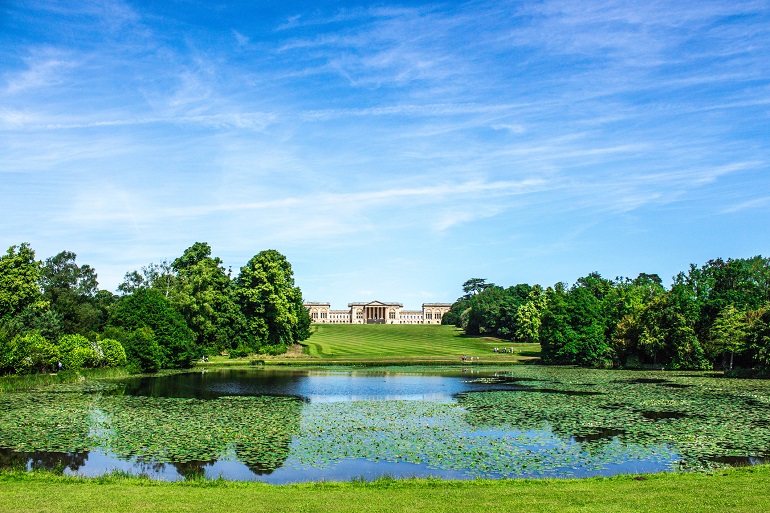
Stowe's true magnificence lies in its expansive landscape gardens, widely regarded as one of the most significant examples of the English garden style. Covering 250 acres, these gardens represent the collaborative genius of the greatest landscape designers of the 18th century, including Charles Bridgeman, William Kent, and Capability Brown.
The Elysian Fields: A Philosophical Landscape
One of the garden's most innovative areas, the Elysian Fields was designed by William Kent as a physical manifestation of philosophical ideals. This verdant valley follows natural contours and is punctuated by classical structures that invite contemplation.
The Temple of Ancient Virtue, a circular structure modelled after the Temple of Vesta at Tivoli, houses statues of Greek luminaries including Homer, Lycurgus, Socrates, and Epaminondas. Across the stream stands the Temple of British Worthies, featuring busts of sixteen notable Britons including Shakespeare, Newton, and Queen Elizabeth I, creating a thought-provoking juxtaposition of classical and British ideals.
The Shell Bridge spans the stream dividing these temples, its rusticated arches adorned with shells and rough stonework, exemplifying the picturesque aesthetic that Kent pioneered.
The Grecian Valley: Capability Brown's Masterpiece
Designed by Lancelot 'Capability' Brown, the Grecian Valley represents a revolutionary approach to landscape design. This sweeping valley is an abstract composition of landform and woodland, showcasing Brown's talent for creating seemingly natural landscapes that appear untouched by human hands.
The valley's gentle slopes are punctuated by carefully placed clumps of trees, creating a rhythm of open space and woodland that draws the eye across the landscape. The Temple of Concord and Victory stands proudly at one end, its classical proportions harmonising perfectly with the naturalistic setting.
The Hawkwell Field: Gothic Splendour
This area is home to one of Stowe's most striking features, the Gothic Temple. This octagonal folly, designed by James Gibbs, represents the medieval English tradition in contrast to the classical elements found elsewhere in the garden. With its stunning circular rooms, stained glass windows, and spiral staircase, it offers panoramic views of the surrounding landscape from its battlemented roof.
Nearby, Lady's Temple provides a more intimate space for reflection, its delicate proportions and elegant dome creating a charming focal point within the landscape.
Lakes and Water Features: Reflective Beauty
Water plays a crucial role in the composition of Stowe's gardens. The Octagon Lake, with its geometric form, represents the earlier, more formal phase of garden design, whilst the sinuous 11-acre lake demonstrates the later naturalistic approach championed by Brown.
The Palladian Bridge, inspired by Palladio's design for the Rialto Bridge in Venice, creates a classical reflection in the still waters below. The cascade near the Eleven Acre Lake introduces movement and sound to the landscape, its gentle tumbling waters creating a soothing atmosphere.
The River Styx, a narrow winding stream, carries symbolic significance, representing the boundary between the living and the underworld in classical mythology. This waterway divides different areas of the garden, creating thresholds between contrasting landscape experiences.
Temples and Monuments: Architectural Jewels
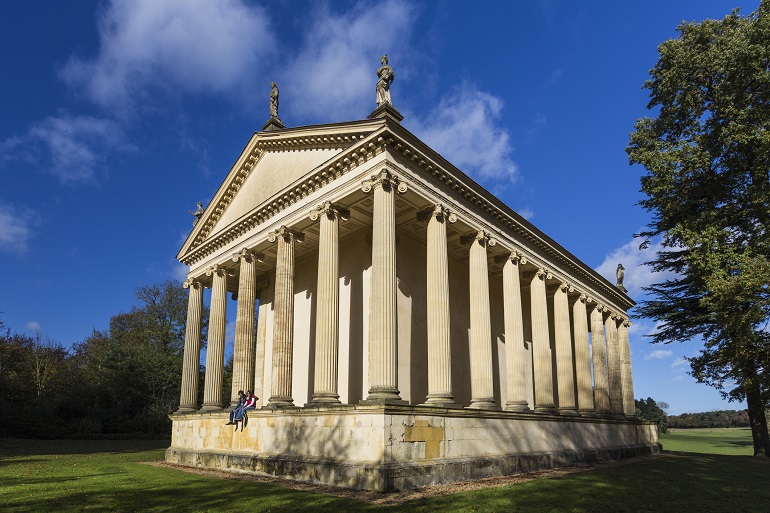
Stowe Gardens boast over 30 temples and monuments, each with its own charm and significance. These structures not only create focal points within the landscape but also convey political, philosophical, and moral messages intended by the garden's creators.
- The Temple of Venus: Set within its own garden, this delightful building celebrates love and beauty. Its interior features exquisite plasterwork depicting scenes from classical mythology.
- The Rotunda: This elegant circular temple offers panoramic views across the gardens, its classical proportions creating a harmonious silhouette against the sky.
- The Queen's Temple: Originally built as the Temple of Friendship, this Neoclassical building features intricate interior decorations including medallions depicting British queens.
- The Corinthian Arch: This grand entrance to the estate, designed by Thomas Pitt, frames stunning views of the house when approached from Buckingham.
- The Bourbon Tower: This gothic tower provides a vertical accent in the landscape and offers views across the estate for those who climb its winding stairs.
- The Temple of Friendship: A charming pavilion that once housed busts of the Temple family's political allies.
- The Pebble Alcove: A delightful folly decorated with intricate patterns formed from pebbles, creating a whimsical resting place.
The Formal Gardens: Geometric Precision
Near the house, more formal garden areas provide a transition between architecture and landscape. The Italian Garden features geometric beds filled with seasonal planting, whilst the Orangery Garden offers Mediterranean charm with citrus trees in decorative pots during summer months.
The Parterre, once a highly formal area with intricate patterns formed from low hedges and colourful planting, has been partially restored to give visitors a glimpse of earlier garden fashions that preceded the naturalistic landscape style.
Walks and Vistas: A Journey of Discovery
As you explore Stowe, you'll discover a network of paths that lead you through various landscapes, from formal gardens to more naturalistic areas. The Path of Vice and the Path of Virtue offer alternative routes through the Elysian Fields, each passing different monuments that reflect their respective themes.
The grand avenues, including the Grenville Column Walk and the Queen's Drive, offer long views across the estate, their straight lines contrasting with the curving paths found elsewhere. The ha-ha, an invisible boundary created by a sunken wall, allows uninterrupted views whilst keeping livestock away from the ornamental areas.
Each turn reveals new vistas, carefully designed to surprise and delight visitors. These 'pictures' in the landscape unfold sequentially, creating a narrative experience as one moves through the garden.
Flora and Fauna: Natural Splendour
Throughout the seasons, Stowe's gardens come alive with diverse plantings. Spring brings a carpet of daffodils and bluebells beneath the trees, whilst summer sees the meadows filled with wildflowers and butterflies. The ancient oak trees, some over 400 years old, provide a sense of permanence and continuity.
The arboretum contains specimen trees from around the world, including cedars of Lebanon, tulip trees, and giant sequoias. In autumn, the maples and sweet gum trees create a spectacular display of fiery colours, whilst winter reveals the elegant structure of the deciduous trees against the evergreen backdrop.
Wildlife enthusiasts will enjoy spotting various bird species, including kingfishers by the lakes and red kites soaring overhead. The parkland provides habitat for fallow deer, whilst the meadows support a rich diversity of insects and small mammals.
The Walled Garden: Productive Beauty
The restored walled garden offers a glimpse into the productive side of the estate. Here, heritage varieties of fruit trees line the walls, whilst vegetable beds demonstrate traditional growing techniques. The cutting garden provides seasonal blooms, and the glasshouses shelter tender plants during colder months.
The New Inn: Historic Welcome
The New Inn, a beautifully restored 18th-century coaching inn, serves as the visitor entrance to the gardens. Its courtyard and buildings provide a charming introduction to the estate, setting the scene for the wonders that lie beyond.
Getting There
To reach Stowe House, visitors have two main options. For those wishing to explore the gardens, the primary entrance is through the National Trust Stowe, where you'll find the New Inn visitor centre. Use the postcode MK18 5EQ for sat-nav directions. From there, enjoy a leisurely stroll through the picturesque gardens to reach the house. Alternatively, for a direct visit to the house, you must enter via the private Stowe School entrance. It's crucial to email in advance to arrange access through this entrance, using the postcode MK18 5EH. Ample visitor parking is available near the house at no charge. If travelling by public transport, the nearest railway stations are Bicester North (14.5 km away) or Milton Keynes Central (22.5 km away). Bus services, including the X5 and X60, operate in the area, with stops in nearby Buckingham town centre, from where Stowe is a short taxi ride away.
Best Time to Visit
The best time to visit Stowe House is during the summer months, from 1st March to 26th October, when it is open daily from 10:30 AM to 4:30 PM. This period allows for a more relaxed and comprehensive exploration of the house and its surroundings. During school holidays, the house is open daily, providing ample opportunities for visitors to enjoy guided tours and self-led explorations. However, if you prefer fewer crowds, consider visiting during the winter weekends when the house operates on reduced hours. It's advisable to check the house's website for specific opening times and to book tickets in advance, especially as the house is a working school and may have restricted access during term time. Additionally, combining your visit with a stroll through the adjacent Stowe Gardens, managed by the National Trust, can enhance your overall experience.