


 Ireland Guide
 Scotland Guide
 Wales Guide
| Contents |
|---|
Introduction
Salisbury (pop. 42,000, pronounced 'Sauls-bree') is a historic cathedral city in Wiltshire, England, situated approximately 90 miles southwest of London. The city is renowned for its magnificent 13th-century cathedral, which houses the tallest church spire in Britain at 123 metres and one of the four surviving original copies of Magna Carta. Built at the confluence of the rivers Avon and Bourne, Salisbury was established in the early 13th century when the settlement moved from nearby Old Sarum, and today retains its medieval street pattern centred around a spacious market square. The city serves as an excellent base for exploring the surrounding Salisbury Plain, including the world-famous prehistoric monument Stonehenge, located just eight miles to the north.
Interesting Facts about Salisbury
- Salisbury is over 800 years old, having moved from its original location at Old Sarum, an Iron Age hill fort, to its current position in the valley in 1220.
- The spire of Salisbury Cathedral has been the tallest in England since the late 16th century, standing at 404 feet (123 metres) high.
- Salisbury Cathedral houses the best-preserved of only four remaining original copies of the Magna Carta from 1215.
- The cathedral contains the world's oldest working mechanical clock, dating back to 1386, which has ticked more than 500 million times.
- Salisbury's Charter Market is one of the oldest in the UK, having operated continuously since 1227, just seven years after cathedral construction began.
- The Cathedral Close is the largest in Britain at 80 acres, offering plenty of space for picnics whilst admiring the towering spire.
- Stonehenge, one of the world's great wonders, is located just 9 miles from Salisbury and has stood in the Wiltshire countryside for 4,500 years.
- Despite its impressive height, Salisbury Cathedral was built on foundations of only 4 feet (1.2 metres) due to the high water table.
- The cathedral was constructed in a remarkably short period of just 38 years, from 1220 to 1258, using 70,000 tonnes of stone, 3,000 tonnes of timber, and 450 tonnes of lead.
- In 2015, the American rapper Jay-Z chose Salisbury Cathedral as the location for the global launch of his album artwork for "Magna Carta...Holy Grail".
- Salisbury is one of only three English cathedrals to lack a ring of bells, alongside Norwich Cathedral and Ely Cathedral.
- The city centre retains its medieval grid pattern layout with areas called "chequers," many named after historic inns like Blue Boar Row.
- Legend has it that the cathedral's location was chosen after a bishop asked for an arrow to be shot in the direction he would build it, and the arrow struck a deer that died on the spot where the cathedral now stands.
- The cathedral is home to peregrine falcons that have nested there since 2014 and are so popular they have their own live streaming channel.
- Sir Christopher Wren, who also designed St Paul's Cathedral in London, made improvements to Salisbury Cathedral's spire when it was found to be leaning slightly in the 17th century.
History
Salisbury has been inhabited since at least 300 BCE. It developed into the Roman fort of Sorbiodunum, later known as (Old) Sarum. Cynric, king of Wessex, took the place in 552 CE and became one of the most important town of the Saxon kingdom.
The Normans built a wooden castle in 1067 and replaced it by a stone keep in 1100. A first 53m-high cathedral was constructed by Bishop Osmund between 1075 and 1092, and was extended in 1120. Old Sarum was an uncomfortable, windswept and barren place, and in 1217 Bishop Richard Poore asked the Pope to move the cathedral to a more convenient place near the confluence of the Avon, Nadder, Ebble, Wylye (pronounced 'Why-lee') and Bourne Rivers, and New Sarum was founded.
The new cathedral was errected between 1220 and 1258, and this relatively fast construction allowed for a remarkably uniform style. The 123m spire was added between 1285 and 1315.
Old Sarum's cathedral was demolished in 1331. New Sarum became known as Salisbury from the name of the Earl who ruled over the city.
The first market was held at Salisbury's current Market square in 1219, and market has been held there twice a week (on Tuesdays and Saturdays) from 1361 to this day.
Main Attractions
Salisbury is a nice and airy market town, suitable for strolls and shopping. The oldest houses in town are Russel's (built in 1306) and John A'Port's (built in 1425). Fish Row, behind the Market Square, has some beautiful traditional houses as well.
Salisbury Cathedral and Cathedral Close
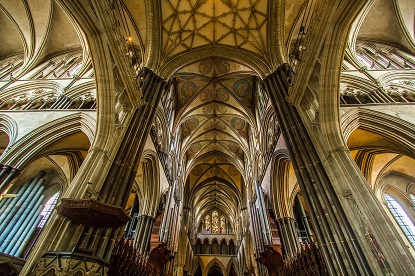
Salisbury Cathedral stands as one of Britain's finest examples of Early English Gothic architecture, founded in 1220 and completed in just 38 years. The cathedral boasts the tallest church spire in Britain at 123 metres and houses one of the four surviving original copies of the 1215 Magna Carta in its Chapter House. The building features the largest cloisters in Britain and contains the oldest working clock in the world, dating from 1386. Public guided tours are available, and visitors can climb the tower for panoramic views of the city and surrounding countryside.
The Cathedral Close, Britain's largest at 80 acres, surrounds the cathedral and provides a peaceful green space dotted with historic buildings. The Close contains several notable residences, including Arundells, the former home of Prime Minister Edward Heath, and various canonical houses dating from the medieval period. The area offers riverside walks and connects to the town centre through several historic gateways.

|

|

|
Market Place and Poultry Cross
Salisbury's Market Place forms the heart of the medieval city, established in the 13th century when the town was laid out in a grid pattern. The square hosts markets twice weekly on Tuesdays and Saturdays, selling local produce, crafts, and general goods. The Market Place is surrounded by historic buildings, including timber-framed houses, traditional pubs, and shops, creating an authentic medieval atmosphere.
The Poultry Cross stands at the centre of the Market Place, built around 1450 as one of several market crosses that once marked different trading areas. This hexagonal stone structure is the last surviving example of Salisbury's original market crosses, where poultry and dairy products were traditionally sold. The cross features Gothic Revival additions from the 19th century and serves as a focal point for the city's commercial heart.
St Thomas's Church
St Thomas's Church, officially known as St Thomas of Canterbury, predates Salisbury Cathedral and serves as the city's principal parish church. Built in the 12th century, the church is renowned for its medieval "doom" painting above the chancel arch, which depicts the Last Judgement. This rare survival was whitewashed during the Reformation and rediscovered in the 19th century. The church contains numerous historic features, including medieval glass, tomb monuments, and a carved rood screen, making it significant both architecturally and historically.
High Street Gate
The High Street Gate serves as the principal entrance to Cathedral Close from the city centre, built in the 14th century as part of the Close's defensive walls. This impressive stone gateway features a pointed arch and medieval stonework, providing a dramatic entrance to the cathedral precinct. The gate houses a small museum space above the archway and offers visitors their first glimpse of the cathedral's soaring spire upon entering the Close.


Town Path and Harnham Water Meadows
The Town Path provides one of Salisbury's most scenic walks, following the River Avon from the city centre through the Harnham Water Meadows to the south of the cathedral. This route offers the classic view of Salisbury Cathedral that John Constable famously painted in 1831, with the cathedral spire reflected in the river. The water meadows form part of an ancient flood management system and provide important habitats for wildlife, including kingfishers, herons, and various waterfowl. The path is suitable for walking year-round and connects to other riverside walks.
River Avon Walks
The River Avon flows through Salisbury, providing opportunities for riverside walking and wildlife observation. Several paths follow the river's course, including routes from Queen Street to the cathedral and walks through the surrounding water meadows. The river supports diverse wildlife and offers peaceful areas for recreation within the city. During summer months, visitors can arrange punt trips on certain sections of the river, providing a unique perspective of the city and its historic buildings.
Queen Elizabeth Gardens
Queen Elizabeth Gardens occupy a central location alongside the River Avon, providing landscaped green space within walking distance of the city centre. The gardens feature formal flower beds, mature trees, and riverside paths suitable for picnics and leisurely walks. The park includes children's play areas and connects to other riverside walks, making it a popular spot for both locals and visitors seeking respite from the city's busy streets.
Salisbury Racecourse
Salisbury Racecourse, situated on the edge of the city, has hosted horse racing since 1585, making it one of England's oldest racecourses. The flat racing venue operates primarily during the summer months, with meetings typically held from May to October. The racecourse occupies a scenic location with views across Salisbury Plain and provides a traditional English racing experience with its intimate atmosphere and picturesque setting.
Old Sarum
Old Sarum occupies a hill fort site 2 miles north of modern Salisbury, with evidence of continuous occupation from the Iron Age through to the medieval period. The site contains the foundations of the original Norman cathedral, built in 1092, and the remains of a Norman castle constructed by William the Conqueror. After the new cathedral was built in Salisbury in the 13th century, Old Sarum gradually declined and was abandoned by 1322. The site, managed by English Heritage, offers panoramic views over Salisbury and the surrounding countryside, with interpretation boards explaining the archaeological remains.
Top Museums
The Salisbury Museum

Situated within the King’s House in Salisbury’s Cathedral Close, The Salisbury Museum serves as the city’s principal museum of history and archaeology. The museum presents a fascinating journey through time, from the earliest days at Old Sarum to the modern day. Its standout feature is the internationally respected Wessex Gallery, which houses one of Europe’s most extensive collections of Stonehenge and prehistoric artefacts. These include the renowned Amesbury Archer—an early Bronze Age grave dating to approximately 2,300 BC—and remarkable hoards spanning the Roman to Iron Age.
The museum also holds diverse art collections, with works by famed artists such as J. M. W. Turner and Rex Whistler. Among the popular and distinctive exhibits are the Salisbury Giant—a 12-foot-tall figure from the medieval period—and “Hobnob”, who are particularly loved by younger visitors. Social history displays, folk objects, ceramics, costumes, and local archaeological finds all contribute to the museum’s in-depth portrayal of Salisbury’s heritage. The King's House, itself a Grade I listed medieval building, adds a sense of grandeur to any visit.
Throughout the year, The Salisbury Museum hosts an array of events, including temporary exhibitions, lectures, workshops, and hands-on family activities, making it a dynamic hub for history enthusiasts and families alike.
Boscombe Down Aviation Collection
Housed at Old Sarum Airfield, the Boscombe Down Aviation Collection is a must for aviation enthusiasts. The museum showcases a vast array of aircraft, cockpits, and memorabilia, with opportunities for visitors to sit inside many of the exhibits. The collection highlights South Wiltshire’s important role in aeronautical development and military aviation.

Mompesson House
Located in Cathedral Close, Mompesson House is an elegant 18th-century townhouse preserved by the National Trust. While primarily recognised as a historic house, it contains period furnishings and fine collections of porcelain and glass, offering a glimpse into the refined domestic life of Salisbury’s Georgian elite. Its walled garden provides a tranquil retreat just steps from the city centre.
Local Cuisine
When visiting Salisbury, you'll find the local cuisine is a delightful reflection of traditional English fare, with a focus on ingredients sourced from the surrounding Wiltshire countryside. A must-try is the Salisbury Faggot, a savoury dish made from minced off-cuts and offal, mixed with herbs and breadcrumbs. For a taste of something sweet, look for the historic Salisbury Simnel Cake, a light fruit cake with layers of marzipan, traditionally eaten at Easter but sometimes found at other times of the year. Beyond these, you'll discover pubs and restaurants serving classic ploughman's lunches, hearty Sunday roasts, and afternoon teas featuring locally made scones and clotted cream.
Getting There & Around
By train, direct services run regularly from London Waterloo, taking approximately 1 hour 20 minutes to 1 hour 30 minutes, with trains departing roughly every 30 minutes throughout the day. Additional direct rail connections are available from Cardiff, Bristol, Bath, Portsmouth, and Southampton.
By coach, National Express operates regular services from London Victoria Coach Station, Heathrow Airport, Gatwick Airport, and other major cities, providing a cost-effective alternative to rail travel.
By car, Salisbury is approximately 90 minutes' drive from London via the M3 motorway and A303, with clear signposting throughout the journey. The city is also conveniently located about 50 minutes from the ports of Portsmouth, Poole, and Southampton, and roughly one hour from Bath along the A36. For those driving, five Park & Ride sites operate around the city, providing convenient access to the centre whilst avoiding city traffic.