


 Ireland Guide
 Scotland Guide
 Wales Guide
| Contents |
|---|

Introduction
Alnwick Castle (pronounced "Anick") is the ancestral residence of the Percy family, Earls then Dukes of Northumberland since 1309, and is still inhabited by the present Duke. It is one of the largest medieval castles in the Britain and rightly deserves its nickname of "Windsor of the North". It is in fact the second largest inhabited castle in England after Windsor, and shares a similar opulence in its interior decoration.
First founded in 1096 by Norman nobleman Ivo de Vesci, throughout its rich history, Alnwick Castle has served as an important military outpost against Scottish intrusions, witnessed numerous sieges, and played a significant role during the Wars of the Roses. Today, visitors can explore its impressive architecture featuring medieval fortifications and luxurious Georgian interiors, wander through the stunning gardens including the famous Poison Garden, and participate in activities such as falconry displays and broomstick training.
Alnwick will look familiar to many visitors thanks to its appearance in several Hollywood blockbusters, such as Robin Hood: Prince of Thieves (1991), Elizabeth (1998), the first two Harry Potter films (2001, 2002) (e.g. at the scene of the Quidditch match outside Hogwarts School), and again in Ridley Scott's Robin Hood (2010). The BBC's historical sitocom Blackadder, which ran from 1983 to 2008, was shot in great part at Alnwick Castle as well.
Interesting Facts about Alnwick Castle
- Alnwick Castle is the second largest inhabited castle in England, surpassed only by Windsor Castle.
- The castle has been home to the Percy family for over 700 years and remains their residence to this day.
- Alnwick Castle has featured in 41 films and TV shows, including Harry Potter and Downton Abbey.
- The castle boasts an impressive library containing over 16,000 books, with the collection dating back more than 400 years.
- Alnwick Castle was first founded in 1096 by Norman nobleman Ivo de Vesci.
- The castle has formidable defences, including 2-metre thick walls and a 7-metre deep moat.
- Alnwick Castle was once captured by David I of Scotland in 1136.
- The famous medieval knight Harry 'Hotspur' Percy, immortalised in Shakespeare's play Henry IV, lived at Alnwick Castle.
- The castle grounds were landscaped by the renowned Lancelot 'Capability' Brown.
- Alnwick Castle is distinguished as one of the earliest castles in England to be built without a square keep.
- The castle receives over 600,000 visitors annually.
History
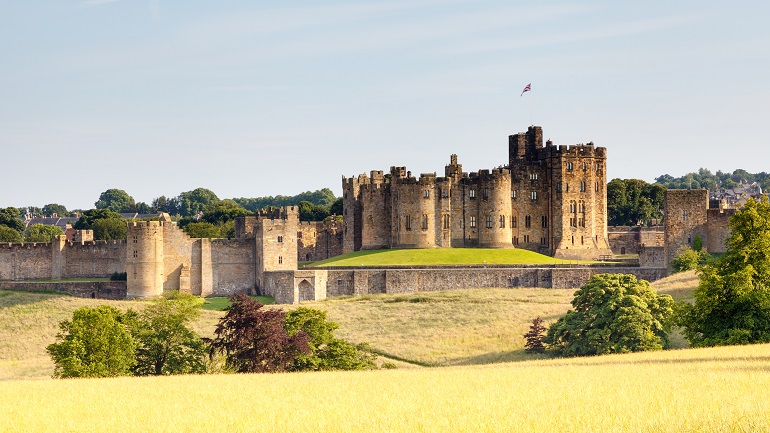
The castle predates the arrival of the Percys in Alnwick by at least 200 years. The earliest known castle dates from 1096, when Yves de Vescy, Baron of Alnwick, erected the first fortifications to defend England's border from Scottish invasions. It was besieged in 1172 and again in 1174 by William the Lion, King of Scotland and William was captured outside the walls during the Battle of Alnwick.
In 1309 it was bought from Antony Bek the Bishop of Durham by Henry de Percy, 1st Baron Percy and it has been owned by the Percy family ever since. The first Lord Percy of Alnwick restored the castle. The Abbot's Tower, the Middle Gateway and the Constable's Tower date from this period.
In 14045 the Percys rebelled against Henry IV, who besieged and then took the castle. The castle captured again three times in short succession during the Wars of the Roses (1455-1485), in 1461, 1462 and 1464.
The castle was renovated in the 16th century, and the interior was heavily altered by the renowned Scottish architect and designer Robert Adam in the second half of the 18th century. The ostentatious Neo-Gothic addition were partly removed by the 4th Duke, Algernon (1792-1865), who redecorated many rooms in Classical Italianate style.
Description
The Exterior
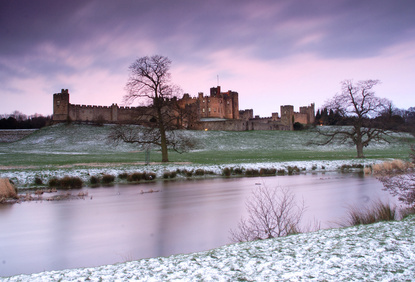
Alnwick is a motte-and-bailey castle surrounded by a colossal rampart adorned with towers at regular intervals. The Constable's Tower houses displays of military and historical interest. The Postern Tower exhibits an archaeological collection that includes frescoes from Pompeii, relics from Ancient Egypt and Romano-British objects. In the Abbot's Tower, you will find the Regimental Museum of the Royal Northumberland Fusiliers.
Various activities and events for children are organised on the castle grounds, such as medieval workshops, falconry displays, or magic shows inspired by Harry Potter.
The northern wall was lowered almost to the ground to open up the view on a small park, known as The Pastures. The park straddles the River Aln and was landscaped by Capability Brown and Thomas Call in the 18th century. Nearby is the much larger Hulne Park, which contains the remains of the 13th-century Hulne Priory.
The Interior
Only 6 of the 150+ rooms in the castle are open to the public, but these are the most sumptuous. The stern and drab character of the exterior doesn't prepare guests for the splendour of the lavishly decorated State Rooms. The two most impressive rooms are the Italian Renaissance style Drawing Room and the luxurious Dining Room. The walls are adorned with paintings by Italian and Flemish masters such as Van Dyck, Canaletto or Titian. As for the monumental Library, it was started 400 years ago and now holds over 16,000 books.
The Garden
Re-developped in 2001 by the the Duchess of Northumberland, Alnwick Garden has become a major attraction of its own, sporting for example a bamboo labyrith, a poison garden, and one of the largest treehouses in the world. But the garden's most marvelous element is the 80-metre-long stepped water Grand Cascade with its 120 water jets. It is noted as being one of the most children friendly garden in Britain.
Originally laid down in 1750 by Capability Brown under the patronage of the 1st Duke of Northumberland, Alnwick Garden experienced a first "golden age" under the 3rd and 4th Dukes in the 19th century, when it was used to grow exotic plant species from all over the world (including pineapples in greenhouses, among the first to be grown in Europe).
During the hardships of WWII, the garden was used to grow vegetables, then fell into disrepair. Jane Percy, the current and 12th Duchess, initiated the restoration project in 1997. She commissioned the celebarted Belgian landscape designers Jacques and Peter Wirtz to create the new garden, spreading on 4.8 hectares (12 acres). This came at a startling cost of £42 million. In 2005, Alnwick Garden had become the third most visited paid entry garden in the UK.
Getting There
To reach Alnwick Castle, you can use public transport from Newcastle-Upon-Tyne, which is approximately 33 miles south. Take the Arriva buses X15 or X18 from Newcastle Haymarket Bus Station to Alnwick via Morpeth. The journey takes about 1 hour and 20 minutes, depending on traffic. Once you arrive at Alnwick Bus Station, it's a short five-minute walk to the castle via Fenkle Street. Alternatively, you can use the train by getting off at Alnmouth Station, which is four miles east of Alnwick and connected by the X18 bus. If driving, Alnwick Castle is easily accessible from the A1. The castle's address is Alnwick, Northumberland, NE66 1NG.
Best Time to Visit
The best time to visit Alnwick Castle is from late March to early November, when the castle is fully open and offers a wide range of activities and tours. During these months, visitors can enjoy the stunning gardens, including the infamous Poison Garden, and partake in events such as falconry displays and broomstick training lessons inspired by the Harry Potter films. The castle's State Rooms and grounds are open daily, providing ample opportunities to explore its rich history and architectural splendour. It is advisable to plan your visit early in the day to avoid crowds and make the most of the various attractions available. Additionally, combining your visit with a stroll through Alnwick town or the adjacent gardens can make for a memorable day out.