


 Ireland Guide
 Scotland Guide
 Wales Guide
| Contents |
|---|

Introduction
Kirby Hall used to be one of the finest Elizabethan manor in the country. It was constructed in 1570 by Sir Christopher Hatton in the prospect of receiving Queen Elizabeth I.
Numerous additions were made in the 17th and 18th centuries, by Sir Christopher Hatton' son and great-grand-son.
Although the mansion was later abandoned and fell into disrepair, the Great Hall and State Rooms have recently been restored and redecorated to their original grandeur. Most of the house is neverthelless in a semi-ruined state.
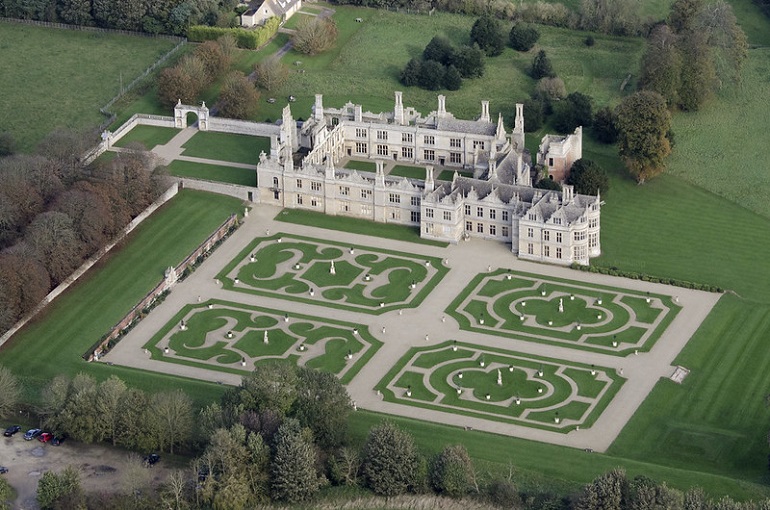
The late 17th-century gardens were lauded as the most exquisite of their time and are still pure delight.
Kirby Hall is the property of the Earl of Winchilsea, and is managed by the English Heritage.
Interesting Facts about Kirby Hall
- Begun in 1570 for Sir Humphrey Stafford, Kirby Hall is celebrated as one of the earliest and grandest Elizabethan ‘prodigy’ houses in England.
- Lord Chancellor Sir Christopher Hatton bought the estate in 1575 and transformed it into a lavish courtier’s palace fit for Queen Elizabeth I’s circle.
- Although Grade I listed, much of the mansion is now roofless, creating a striking semi-ruin around its central courtyard.
- The house boasts a long gallery stretching more than 100 feet, ranking among the largest of its era.
- King James I enjoyed the hospitality so much that he visited Kirby Hall on nine separate occasions.
- During the English Civil War the building was garrisoned by Parliamentarian troops, who inflicted considerable damage.
- A 1640s remodelling under architect Inigo Jones introduced pioneering Classical façades rarely seen before on English country houses.
- The recently restored formal gardens revive late-17th-century ‘cutwork’ parterres once hailed as the finest in the land.
- Free-roaming peacocks have become an enduring symbol of the estate, delighting visitors today.
- Film-makers used Kirby Hall as Mansfield Park in the 1999 adaptation of Jane Austen’s novel, showcasing its romantic ruins.
- From above, the mansion’s wings form a near-perfect symmetrical ‘H’, a hallmark of Renaissance pattern-book design.
- Earthworks beside the brook mark the vanished medieval village that occupied the site before the Elizabethan rebuild.
History
Kirby Hall, one of England’s great Elizabethan prodigy houses, was commenced in 1570 for Sir Humphrey Stafford of Blatherwick. Built from Barnack stone, the house reflects designs drawn from French architectural pattern books and early Classical influences. Although Stafford died before its completion, his son finalised the Elizabethan core, comprising a quadrangular courtyard and an imposing Great Hall. In 1575 the estate passed to Sir Christopher Hatton, Lord Chancellor to Queen Elizabeth I, who added lavish state rooms with double-height bow windows and enriched the gardens with formal parterres, statues and urns.
During the early 17th century Kirby Hall hosted royal visitors: Anne of Denmark stayed here in August 1605, and James I made nine visits between 1608 and 1624. Elizabethan grandeur evolved under Hatton’s descendants, with Sir Christopher Hatton III commissioning Inigo Jones to modernise the house in Jacobean Classical style. Later, the Finch-Hatton family inherited the estate in 1764 and in the 1780s George Finch-Hatton refurbished the interiors in fashionable 18th-century taste, removing Tudor panelling in favour of ornate wallpapers and pediments.
By the early 19th century the family had relocated to Eastwell Park, and Kirby Hall fell into neglect. Roofs were dismantled and much of the interior was stripped out, leaving a dramatic ruin. In 1927 the site was scheduled as a monument and, today, English Heritage cares for the semi-roofless shell, complete with restored gardens laid out in the 1690s style. Visitors can still explore the intact Great Hall and state rooms, wander the “cutwork” parterres and imagine the splendour of one of Northamptonshire’s finest Elizabethan houses.
Description
Architectural and Ambiential Description

Kirby Hall stands as a commanding example of Elizabethan design transformed by later Jacobean refinement. Approaching along the shaded avenue, the long east façade unfolds in mellow ashlar and coursed rubble limestone, punctuated by lofty mullioned windows and the ornate porch inscribed with carved motifs. The interplay of Renaissance symmetry and English manor-house grandeur is immediately apparent: balanced projecting wings flank a central archway, drawing the eye into the spacious cobbled forecourt.
Inner Courtyard and Classical Influences
Beyond the arch, the inner courtyard reveals classical influences never before seen in an English prodigy house. The façades here are dressed in fine Barnack stone and ashlar, with pilasters, entablatures and pediments that frame a sequence of state apartments. On the north side, double-height bow windows flood the rooms with light; on the south side, a run of oriel windows looks out over the parterre.
Interior Spaces and Atmospheric Ruin
Inside, much of the mansion is now a dramatic shell, yet the Great Hall retains its lofty ceiling and imposing chimney breast. The Long Gallery—stretching over 100 feet—is defined by its elegant panelling, richly carved niches and surviving fireplaces, offering atmospheric views through empty window frames to rolling Northamptonshire fields.
Restored Gardens and Formal Layout
The surrounding gardens have been meticulously restored to their late 17th-century layout. Gravel paths cut into the lawn trace the historic “cut-work” parterre, guiding the visitor past classical urns and leaden statues. The design was conceived to be viewed from above—its geometric tracery best appreciated from the upper windows of the main range. Scattered yew hedges and clipped box create formal lines, while the open lawns and borders create a sense of measured calm.
Romantic Ambience and Ruinous Charm
Today, the hall’s semi-roofless state adds to its romantic allure. Stone walls rise against the sky, their crenellated tops and carved string courses highlighted by shifting daylight. Inside the more intact chambers, traces of 17th- and 18th-century decoration remain: painted friezes, panelled alcoves and dramatic fireplaces. Everywhere there is a sense of lingering grandeur—fragments of carved stone and weathered masonry speak of an era of bold architectural ambition.
Grounds and Wildlife Flourish
Peacocks roam the grounds, their iridescent plumage a theatrical flourish amid the ruins. Light filters through crumbling arches, falling on moss-clad steps and the smooth surfaces of old stone benches. Whether viewed from the courtyard or the garden terraces, Kirby Hall offers a uniquely atmospheric encounter with Elizabethan and Jacobean artistry, where ruin and restoration create an evocative interplay of past splendour and present beauty.
Getting There
By train Take an East Midlands Railway service to Corby station, then hop in a taxi or catch the local bus to Gretton for a short walk along Kirby Lane to reach the estate.
By coach Long-distance coaches call at Corby town centre, where Stagecoach Midlands route X4 towards Weldon or Gretton links you with Kirby Lane for an easy stroll to the hall.
By car From the A43 north-east of Corby join the A6116, follow brown heritage signs towards Deene, and turn left onto Kirby Lane, where visitor parking is set just outside the entrance.
Best Time to Visit
The best time to visit Kirby Hall is during the spring and summer months, when the gardens are at their most vibrant and the weather is ideal for exploring the beautiful grounds and stately architecture. At this time of year, visitors can enjoy strolling through the lush parterre and taking in the grandeur of the Elizabethan mansion under clear skies. The hall is especially atmospheric in the warmer seasons, offering perfect opportunities for photography, picnics, and spotting the peacocks that roam the gardens. While the historic house is open at other times, spring and summer provide the most picturesque and enjoyable experience for travellers.