


 Ireland Guide
 Scotland Guide
 Wales Guide
| Contents |
|---|

Introduction
Petworth is one of the great stately homes of England. Built in 1688 for Charles Seymour, 6th Duke of Somerset (dubbed the "Proud Duke"), Petworth is an enormous classical-style edifice with no less than 63 windows on its main facade. It houses the most remarkable art collection managed by the National Trust, with numerous paintings by Turner (19 works in total), Van Dyck, Reynolds, Blake as well as sculpture, furniture and carvings by Gibbons.
Of the many rooms, the highlights are the Dining Rooms, the limewood carvings in the Carved Room, the Grand Staircase murals, and the kitchens in the Servants Quarters, which contain an astounding display of over 1000 copper cooking utensils.
The house is surrounded by a 12-hectare wooded Pleasure Ground, and a 280-hectare park, landscaped by Capability Brown, home to the largest herd of fallow deer in England. Several neo-classical structures enliven the premises, such as a Rotunda and a Doric Temple.
Interesting Facts about Petworth
- Petworth House has been a family home for over 900 years, with the land originally given as a royal gift from the widow of King Henry I to her brother Joscelin de Louvain in the 12th century.
- The current baroque mansion was built in 1688 by Charles Seymour, 6th Duke of Somerset, who was nicknamed the "Proud Duke" due to his haughty attitude towards servants and townspeople.
- The house contains intricate wood carvings by the renowned master craftsman Grinling Gibbons, who died in 1721.
- Petworth displays one of the finest art collections in the care of the National Trust, featuring masterpieces by Turner, Van Dyck, Reynolds, Gainsborough, Titian, and even a rare work by Hieronymus Bosch.
- The 700-acre deer park was transformed in the 1750s and early 1760s by the famous landscape architect Lancelot "Capability" Brown, and is considered one of the best surviving examples of his work.
- J.M.W. Turner was a frequent guest at Petworth during the 1830s and painted over 30 extraordinary oil paintings whilst staying there, many of which remain on display in the Turner Room.
- The house contains the oldest English terrestrial globe in existence, created by Emery Molyneux in 1592.
- Queen Elizabeth I banished the powerful Percy family to Petworth permanently due to her suspicions about their loyalty to Mary, Queen of Scots, transforming what was meant to be an occasional residence into their main home.
- The medieval chapel and undercroft from the original fortified manor house built in 1308-09 by Henry de Percy still survive as part of the current building.
- During the Second World War, a portion of the park housed up to 3,700 troops, and after the war it served as a Polish Resettlement Camp until 1959.
- The house was given to the National Trust in 1947 by the 3rd Lord Leconfield to avoid heavy death duties, whilst the current Lord and Lady Egremont still live privately in a section of the house today.
- Petworth's library contains 148 rare Jacobean play quartos bound into 18 volumes, including works by Shakespeare and Ben Jonson, still in their original contemporary bindings.
- The imposing Marble Hall features vast floor-to-ceiling windows overlooking the parkland and contains a mahogany organ purchased on Christmas Day in 1786.
- The house's art collection includes "A Vision of the Last Judgment" by William Blake, who lived nearby in the village of Felpham.
- Capability Brown's landscape transformation took 12 years and five separate contracts to complete, involving the creation of a serpentine lake and the moving of the original road from Petworth to Tillington three-quarters of a mile south.
History
Medieval Origins and the Percy Dynasty
Petworth House boasts an extraordinary 900-year history spanning just one family lineage, beginning when the land was granted as a royal gift from Adeliza of Louvain, widow of Henry I, to her brother Joscelin de Louvain in the 12th century. Joscelin subsequently married into the powerful Percy family and adopted their surname, establishing what would become the southern seat of the Earls of Northumberland. The medieval great house was fortified in 1308-9 by Henry de Percy, 1st Baron Percy, with the chapel and undercroft from this period still surviving as part of the current structure. Originally intended merely for occasional use whilst the family's primary stronghold remained at Alnwick Castle in Northumberland, Petworth's role transformed dramatically during the 16th century when Queen Elizabeth I, suspicious of the Percy family's Catholic allegiance to Mary, Queen of Scots, effectively placed them under house arrest at Petworth. This enforced residency following the failed 1569 Rising of the North led to significant expansion of the medieval building, with grand stables erected and pleasure gardens laid out as the Percys adapted to their permanent southern exile.
The Baroque Transformation
The most dramatic chapter in Petworth's architectural evolution began in 1682 when 16-year-old heiress Lady Elizabeth Percy, already twice widowed, married Charles Seymour, 6th Duke of Somerset, creating one of England's wealthiest couples. Between 1688 and 1702, the "Proud Duke" completely rebuilt Petworth in the fashionable Baroque style, directly inspired by the Palace of Versailles and designed to rival Europe's grandest palaces. The resulting mansion featured an imposing 320-foot-long stone façade and rooms furnished in the Louis XIV style. The Duke commissioned the renowned Dutch wood-carver Grinling Gibbons at the height of his career in the early 1690s to create intricate lime-wood carvings throughout the house, including four full-length portraits of the Duke and Duchess framed by carved family crests and armorials. The formal grounds were equally magnificent, featuring an avenue of lime trees, canal gardens, fishponds, parterres, and elaborate terraced walks carved into the hillside, complete with a great greenhouse and orangery.
The Golden Age and Artistic Legacy
Petworth entered what became known as its "Golden Age" in 1763 when George O'Brien Wyndham, 3rd Earl of Egremont, inherited the estate and transformed it into one of England's foremost centres of artistic patronage. As an avid collector of British art, the 3rd Earl welcomed numerous contemporary artists as frequent guests, most notably J.M.W. Turner, who created over 20 paintings inspired by his visits to Petworth and its surroundings. During the 1750s and early 1760s, the Earl commissioned Lancelot "Capability" Brown to completely redesign the parkland, a transformation that took 12 years and five separate contracts to complete. Brown swept away the formal gardens to create what is now considered one of the finest surviving examples of his "natural" landscape style, featuring a serpentine lake framed by rolling hills and carefully planned vistas. Today, Petworth houses one of the finest art collections in the National Trust, including works by Titian, Van Dyck, Reynolds, Bosch, and Blake, alongside the oldest English terrestrial globe in existence. The house passed to the National Trust in 1947 when the 3rd Lord Leconfield donated it to avoid heavy death duties, though descendants of the original family continue to reside privately in part of the house.
Description
The House
Baroque Magnificence

Petworth House presents one of the finest examples of late 17th-century baroque architecture in England. The magnificent west front, stretching an impressive 322 feet in length, was completed in 1702 and is believed to be the work of Daniel Marot, a Huguenot architect who worked for William III. Built of local green sandstone with Portland stone dressings, the facade features three storeys with elaborate volutes above the first floor and a panelled parapet that once supported sculptural decoration. The projecting three-bay pavilions at either end are constructed entirely of Portland stone, with windows featuring concave reveals that create dramatic recesses for busts and, in the central bay, a carved eagle.
State Rooms and Interiors
The house's interior represents a treasure trove of artistic achievement. The Marble Hall, completed in 1692, serves as the dramatic centrepiece of the main floor. This magnificent space, with its distinctive black and white marble flooring, was once the principal entrance to the house but later became a private study. The room exemplifies the baroque taste for grandeur with its high ceilings and ornate architectural details.
The Grand Staircase showcases some of the finest decorative painting in England. After a fire in 1714 destroyed the original staircase, Louis Laguerre was commissioned to create a magnificent series of allegorical murals depicting the story of Prometheus and Pandora. These elaborate ceiling and wall paintings represent one of Laguerre's finest achievements and demonstrate the sophisticated artistic patronage of the period.
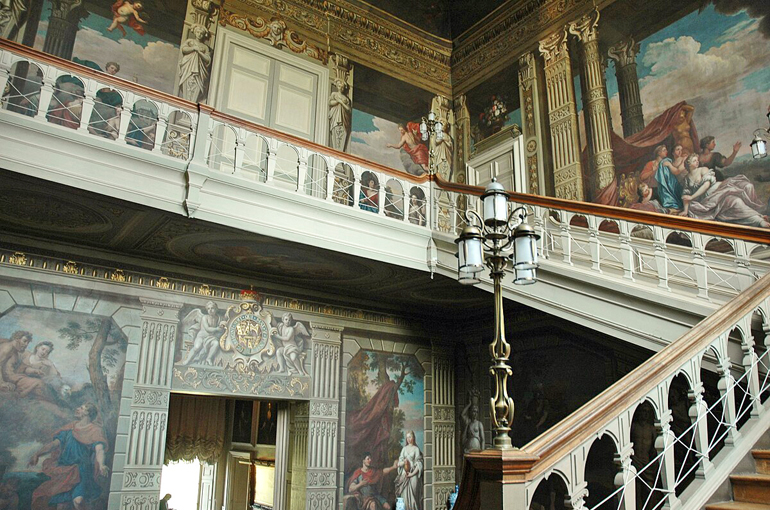
The most famous interior space is undoubtedly the Carved Room, which represents the crowning achievement of Grinling Gibbons, the master woodcarver of the 17th century. This extraordinary space comes alive with intricate swags, flowers, and surprising decorative details carved in limewood by Gibbons and other skilled craftsmen. The room was originally conceived to display Turner's specially commissioned landscape paintings, which still hang in their intended positions within the carved framework.
Medieval Heritage
Despite the baroque transformation, medieval elements survive within the house. The Chapel, dating from the 1300s, represents one of the oldest surviving parts of the building. This sacred space retains its medieval character whilst incorporating baroque decorative elements added during the 17th-century rebuilding. The bronze eagle lectern is believed to be the oldest item at Petworth, dating to approximately 1500. The stained-glass windows highlight the many alliances of the Percy family and date back to the 1600s.
Art Collections
Turner Collection
Petworth houses one of the most significant collections of Turner paintings outside London, with twenty oil paintings permanently displayed throughout the house. The artist was a frequent guest during the 1820s and 1830s, enjoying an unusually close relationship with George O'Brien Wyndham, 3rd Earl of Egremont. Turner's masterpiece "Petworth House from the Lake: Dewy Morning," painted around 1810, captures the house across the serpentine lake with remarkable atmospheric effects.
The Carved Room displays four specially commissioned Turner landscapes that were designed to complement Gibbons' intricate woodwork. Two depict scenes of Petworth Park that can be compared directly with the real landscape visible through the room's windows, whilst the others show Brighton's Chain Pier and the Portsmouth and Arundel Canal.
Old Master Paintings
The collection includes major works spanning several centuries of European art. Visitors can admire Titian's portrait of "An Unknown Cardinal," recently re-attributed after being displayed as "in the manner of Titian" for over a century. The Square Dining Room houses a significant group of Van Dyck portraits, including works depicting the Percy family. Hieronymus Bosch's "The Adoration of the Magi" represents one of the most famous paintings in the Petworth collection.
Sculpture Collection
The house contains an impressive array of classical and neoclassical sculptures. John Flaxman's monumental "Saint Michael overcoming Satan," inspired by Milton's "Paradise Lost," dominates the North Gallery. Ancient Roman statues include a rare 2,000-year-old sculpture of Emperor Nero as a boy, one of only three known to survive. The collection also features bronzes, including an early 19th-century copy of the Imperial Roman statue "Silenus nursing the infant Bacchus".
Decorative Arts
Beyond paintings and sculpture, Petworth showcases exceptional decorative arts. The house contains the earliest English terrestrial globe in existence, created by Emery Molyneux in 1592. Fine furniture includes Rococo gilt pier-glasses and pieces by renowned makers such as André-Charles Boulle. The ceramics collection represents some of the finest examples in the National Trust, assembled by the 2nd and 3rd Earls of Egremont.
Servants' Quarters and Below Stairs
Historic Kitchens
The Servants' Quarters, housed in a separate building connected to the main house by an underground tunnel, provide a fascinating glimpse into the operational heart of a great estate. The kitchens, dating from the mid-18th century and refitted in 1872 after a fire, operated with remarkable efficiency, producing up to 100 meals daily during the late 19th century.
The main kitchen, with its high ceiling and enormous windows, centres around a massive preparation table that served as the precursor to modern kitchen islands. The roasting hearth, equipped with a "hastener" to keep cooked food warm and shield cooks from the fierce heat, demonstrates the sophisticated systems developed for large-scale food preparation. Copper pots gleam on the kitchen ranges, whilst the dairy displays jellies and rolling pins as if the staff had merely stepped away for a moment.
Service Organisation
The kitchen operated like a precision production line, with strict hierarchies and carefully defined roles. Only kitchen staff entered the main kitchen, with footmen receiving prepared dishes through hatches. Food and supplies arrived at the north door of the Servants' Quarters, proceeding through various storage and processing rooms before final preparation in the kitchen. The head gardener would visit weekly to discuss available produce with the chef, ensuring the freshest ingredients for the house.
The Pleasure Garden
Capability Brown's Design
The Pleasure Garden surrounding Petworth House represents one of Capability Brown's earliest and most accomplished landscape designs, begun in 1753. Brown swept away the formal baroque gardens that had previously adorned the house, replacing geometric parterres and terraces with naturalistic planting and serpentine pathways.
The garden was designed in the theatrical style popular during the Georgian period, intended to evoke particular emotions as visitors walked through carefully orchestrated sequences of views. Brown planted climbers like honeysuckle and sweet briar alongside hellebores, lily of the valley, and butcher's broom. Estate records show he ordered 100 roses in March 1756, including Damask, Rosa Mundi, and Maidens Blush varieties.
Architectural Features
Two classical monuments provide focal points within the garden landscape. The Ionic Rotunda, constructed in 1766 at Brown's suggestion, resembles the Temple of Vesta in Tivoli, Italy. Positioned on a steep north slope, it symbolises the difficult path to fame and offers panoramic views across the surrounding countryside.
The Doric Temple, moved by Brown from the demolished rampart terraces, evokes the dignity and antiquity of ancient Greece. Today it houses a memorial to Henry Scawen Wyndham, who died in action at El Alamein during the Second World War.
Seasonal Displays
The garden provides year-round interest with carefully planned seasonal displays. Spring brings brilliant yellow daffodils leading up to the Ionic Rotunda, followed by carpets of violet bluebells and the white and pink blossoms of ornamental trees. The 3rd Earl of Egremont used the garden to showcase his collection of North American trees and shrubs, making it a living museum of botanical specimens brought to Georgian England from overseas.
Petworth Park
Capability Brown's Masterpiece
The 700-acre deer park represents one of the finest surviving examples of Capability Brown's landscape artistry. Working between 1753 and 1765 under five separate contracts totalling £5,500 (equivalent to over £9 million today), Brown transformed the formal landscape into a seemingly natural pastoral paradise.
Brown created two serpentine lakes to replace the earlier formal water features. The Upper Pond, constructed in 1753, stretches 2.1 kilometres and covers 6 hectares, whilst the Lower Pond borders London Road on the eastern side of the park. These artificial lakes, designed to appear like naturally meandering rivers, demonstrate Brown's mastery of water engineering and his ability to create convincing naturalistic effects.
The Living Landscape
The park supports between 700 and 800 fallow deer, continuing a tradition that spans over 500 years. These magnificent animals were reportedly hunted by Henry VIII during his visit to Petworth in the 1520s. Today they roam freely across the rolling grasslands, adding animation to Brown's carefully composed landscape.
Ancient and veteran trees provide another layer of historical depth. Three ancient oaks include one that was a sapling during the Norman Conquest of 1066, making it likely older than any building at Petworth. The "Beelzebub" oak, dating to 1779, marked the parish boundary and earned its name from the superstition that land beyond the parish was dangerous. Sweet chestnuts up to 600 years old, some gnarled and twisted by lightning strikes, punctuate the landscape alongside a hollow common lime tree that, despite being over 500 years old, continues to thrive.
Views and Vistas
Brown designed the landscape to provide a succession of carefully composed views. The stone carriageway from the north offers an impressive approach to the mansion, whilst various elevated positions throughout the park provide panoramic vistas extending to the South Downs. These views inspired Turner's numerous paintings of the estate and continue to enchant visitors today.
Wildlife and Conservation
The park operates under a Higher Level Stewardship agreement with Natural England, ensuring sustainable management for wildlife. Summer brings migrant birds including house martins, swifts, and swallows that travel from Africa to spend the warmer months at Petworth. The grounds support diverse wildlife whilst maintaining the aesthetic integrity of Brown's original design.
The Ha-Ha
Brown employed his signature ha-ha (a sunken wall and ditch) to separate the pleasure grounds from the parkland whilst maintaining uninterrupted views. At Petworth, this feature takes the unusual form of a stone retaining wall that rises above the level of the bank, planted along the top with a belt of evergreens. This invisible barrier keeps deer out of the formal gardens without spoiling the visual connection between house and landscape.
Practical Information
The house displays its collections across ground-floor state rooms with level access, though some upper areas including bedrooms require climbing steps. The Servants' Quarters feature the historic kitchens and now house the Audit Room Café, gift shop, and second-hand bookshop. The Pleasure Garden offers surfaced and gravel paths with some slopes and inclines, whilst the deer park provides more challenging terrain for longer walks.
Getting There
By train, the most convenient route to Petworth House & Park is to travel to Pulborough station, which is approximately 5¼ miles from the house. From London, take a train from Victoria to Pulborough (often requiring a change at Horsham), then catch the No. 1 Stagecoach bus service that runs between Worthing and Midhurst, which stops at Pulborough station and continues to Petworth town centre.
By coach, National Express operates services from London Victoria Coach Station to the area, whilst local bus services include the No. 1 Stagecoach route between Worthing and Midhurst and the No. 99 Compass service from Chichester to Petworth. Both services alight in Petworth town centre, from where it's a pleasant walk up Lombard Street towards St Mary's Church to reach the pedestrian entrance.
By car, Petworth House is easily accessible via the A283, with the main car park located just off this road (postcode GU28 9LR for sat nav). From the A272, simply drive north away from Petworth town centre and follow the brown tourist signs marked 'Petworth House', with the car park situated approximately 700 yards from the house itself.
Best Time to Visit
Petworth House & Park offers a delightful experience throughout the year, with each season revealing a different facet of its charm. Spring is perfect for enjoying the picturesque Shimmings Valley at its best, while summer is the ideal time to explore the Pleasure Grounds, when the flowers are in full bloom and you can wander through beautiful wildflower meadows. The summer months also host numerous family events and activities, including a traditional park fete. For a truly spectacular sight, an autumn visit is a must, as the 700-acre park is set ablaze with vivid colours. This season also brings the magic of the deer rutting season in October. Regardless of when you visit, arriving early, particularly on a weekend, is advisable to enjoy the house and grounds with fewer crowds.