


 Ireland Guide
 Scotland Guide
 Wales Guide
| Contents |
|---|

Introduction
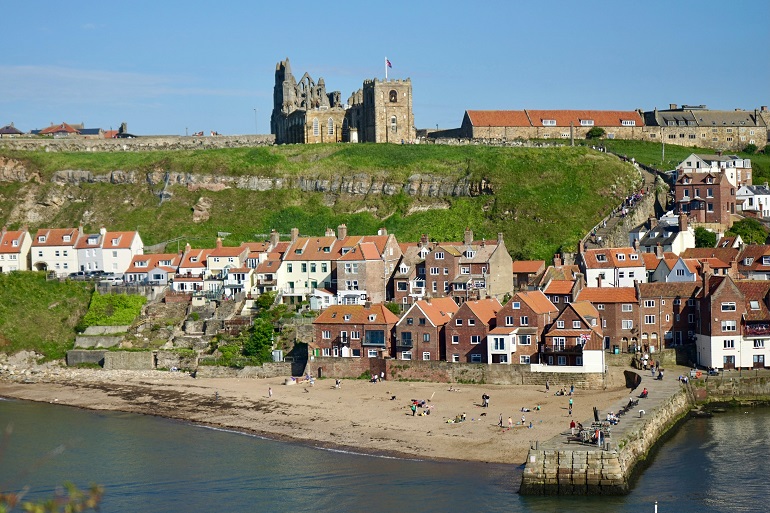
Whitby is a coastal town and civil parish in North Yorkshire, England, situated at the mouth of the River Esk where it meets the North Sea. The town is divided into East and West by the river, with the East Cliff crowned by the ruins of Whitby Abbey, founded in 657 CE and later inspiring Bram Stoker’s novel Dracula. Whitby’s maritime heritage includes its long-standing fishing industry, historic shipbuilding—most notably the construction of vessels used by Captain James Cook—and the import of alum and export of jet jewellery since the Bronze Age. With a population of around 13,000, the town combines narrow cobbled streets, a sheltered harbour, the Grade II-listed swing bridge and piers, and vibrant cultural events such as Whitby Goth Weekend and Whitby Folk Week, making it both a living port and a popular visitor destination.
Interesting Facts about Whitby
- Whitby Abbey was founded around 657 CE by St Hilda and became one of the most important religious centres in the Anglo-Saxon world.
- The historic Synod of Whitby took place at the abbey in 664 CE, where King Oswy decided that his kingdom would follow Roman rather than Celtic Christian practices, establishing the Roman method of calculating Easter still used today.
- Captain James Cook learnt seamanship in Whitby, and his famous ship HMS Endeavour was built in the town's shipyards.
- Between 1750 and 1840, Whitby was a major whaling port that made many local families wealthy, commemorated today by the whalebone arch on West Cliff.
- In 1790-91, Whitby built 11,754 tonnes of shipping, making it the third largest shipbuilder in England after London and Newcastle.
- The town has a rich smuggling history, with secret tunnels used to transport rum and brandy away from the watchful eye of tax collectors.
- Whitby was bombed during World War One in December 1914 by German naval forces, with the attack on coastal towns killing over 100 people and injuring nearly 600.
- Bram Stoker used Whitby Abbey as inspiration for his famous Gothic novel Dracula.
- Visitors must climb the famous 199 stone steps, known as the "Church Stairs," to reach St Mary's Church and Whitby Abbey from the town centre.
- The town is situated on England's "Dinosaur Coast," where fossils including dinosaur footprints can be found on the beach.
- Local legend claims that St Hilda of Whitby turned living snakes into stone and hurled them off the cliffs, explaining the abundance of ammonite fossils called "snake stones" found in the area.
- Whitby jet jewellery became highly fashionable during the 19th century, made from fossilised wood found in the local cliffs.
- The town's swing bridge, built between 1908 and 1909, still opens electrically to allow ships to pass between the upper and lower harbours.
- Whitby's coat of arms has included three snakestones since 1935, reflecting the local folklore about St Hilda's miraculous transformation of serpents.
- The early Saxon name for Whitby was Streonshal, meaning "Lighthouse Bay," and there are indications of an earlier Roman lighthouse and settlement on the headland.
History
The Ancient Foundations and Religious Significance
Whitby's remarkable history stretches back over 1,400 years, beginning with its Saxon origins as Streonshalh, meaning "lighthouse bay"—a name that hints at evidence of an earlier Roman lighthouse and settlement on the headland. The town's defining moment came in 656 CE when King Oswy of Northumbria founded a monastery here as thanksgiving for his victory over the pagan King Penda. This double monastery, accommodating both monks and nuns, was led by the remarkable Abbess Hild (later Saint Hilda), a member of the royal family whose wisdom attracted counsel-seekers from kings to peasants. The monastery became a centre of learning and culture, nurturing Caedmon, one of England's earliest poets, who transformed from a humble cowherd into a celebrated Anglo-Saxon versifier. Most significantly, Whitby hosted the pivotal Synod of Whitby in 664 CE, where it was decided that the English Church would adopt the Roman calendar rather than the Celtic tradition, marking a crucial turning point in English Christianity.
Medieval Destruction and Renaissance
The monastery's golden age ended abruptly when marauding Vikings destroyed it between 867 and 870 CE, leaving the headland desolate for over two centuries. Following the Norman Conquest, the site was granted to William de Percy, who re-established the monastery in 1078 as a Benedictine abbey dedicated to Saints Peter and Hilda. During this period, the settlement gained its current name "Whitby," derived from Old Norse meaning "white settlement". The medieval abbey flourished and was rebuilt in the 13th century, with its magnificent ruins still dominating the town today. However, this religious renaissance came to an end in December 1539 when Henry VIII's Dissolution of the Monasteries forced the abbey's surrender, reducing Whitby to a small fishing community of merely 20 to 30 houses and approximately 200 inhabitants by 1540.
Maritime Glory and Modern Development
Whitby's transformation from a modest fishing settlement into a major maritime centre began in the late 16th century with the discovery of alum, a valuable substance used in medicine, leather curing, and textile dyeing. The town's strategic position made it perfect for importing Durham coal to process the alum, whilst its abundant oak forests supported a thriving shipbuilding industry that by 1790-91 made Whitby the third-largest shipbuilder in England after London and Newcastle. From 1753, Whitby became a significant whaling port, reaching its peak in 1814 when eight ships captured 172 whales, producing 230 tons of oil and 42 tons of whalebone for the corsetry trade. The town's maritime heritage is forever linked with Captain James Cook, who learned his seamanship on Whitby colliers, and whose famous vessel HMS *Endeavour* was built here in 1764 as the coal carrier *Earl of Pembroke*. The arrival of the railway in 1839 marked Whitby's evolution into a popular tourist destination, capitalising on its Georgian reputation as a spa town with chalybeate springs renowned for their medicinal properties.
Main Attractions
Whitby Abbey
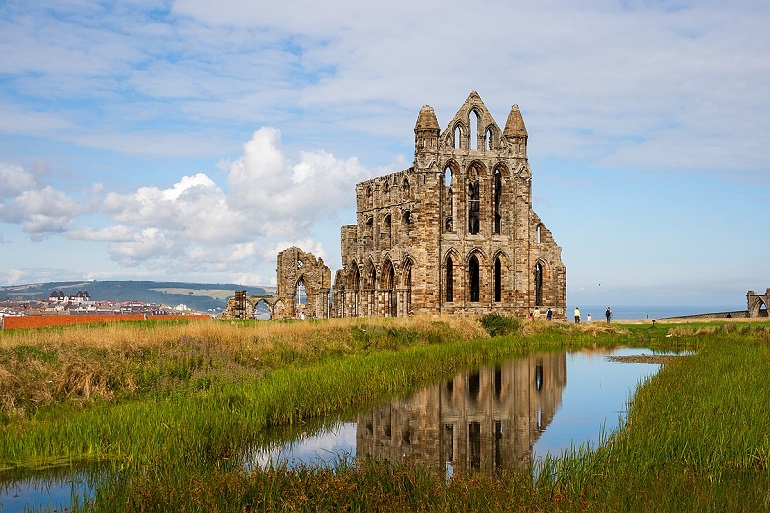
Positioned on the East Cliff overlooking the town, the ruins of Whitby Abbey are a prominent Gothic landmark. The site's history dates back to the 7th century when a monastery was founded by St. Hild, which hosted the Synod of Whitby in 664 CE. The current structure originates from a Benedictine monastery founded after the Norman Conquest, which later fell into ruin following the Dissolution of the Monasteries in the 16th century. The abbey's dramatic silhouette was a key inspiration for Bram Stoker’s novel Dracula, and the English Heritage site offers visitors panoramic views and historical interpretation.
The 199 Steps
The 199 Steps, also known as the Church Stairs, form a historic climb from the Old Town to St Mary’s Church and Whitby Abbey on the East Cliff. It is believed the steps were originally wooden and served as a test of Christian faith for those heading to worship at the church. Landings were placed at intervals along the ascent to provide resting places for pallbearers carrying coffins up to the graveyard. Today, the stone steps offer a challenging but rewarding walk with excellent views over the harbour and town.
St Mary’s Church
Adjacent to the abbey, St Mary’s Church is a Grade I listed building with Norman origins dating to around 1110. Its architecture is a mix of styles due to centuries of alterations. The church is notable for its unique and largely untouched 18th-century interior, which features a labyrinth of box pews, a three-decker pulpit, and galleries. The atmospheric graveyard surrounding the church contains weathered, sea-worn headstones and offers commanding views of the harbour, famously providing a setting for scenes in Bram Stoker's Dracula.
Whitby Harbour and Piers
The town is centred around its bustling, natural harbour, which is the estuary of the River Esk. It remains a working port with an active fishing fleet, and the harbourside is lined with shops, arcades, and eateries. Protecting the harbour mouth are two iconic stone piers, the East Pier and West Pier, which extend into the North Sea and are popular for walks, providing views of the coastline and the town's clifftop landmarks. Several boat trip operators are based in the harbour, offering short coastal tours and fishing excursions.
Whitby Beaches
Whitby has two main beaches located on either side of the River Esk. To the west is the large, sandy West Cliff Beach, a classic seaside destination with amenities including colourful beach huts available for hire, a seasonal cliff lift, and opportunities for surfing. Across the harbour, accessible from the old town, is the smaller and more sheltered Tate Hill Beach. This sand and shingle cove is protected by the harbour piers, making its waters calmer for paddling and swimming.
Captain Cook Memorial Statue & Whale Bone Arch
On the West Cliff stands a large bronze statue commemorating Captain James Cook, the renowned 18th-century explorer who lodged in Whitby as a young apprentice and learned his seamanship on local coal ships. Situated nearby is the iconic Whale Bone Arch, a monument made from the jawbones of a whale that symbolises the town's former prominence in the whaling industry. Together, these landmarks create a famous viewpoint for photographs, framing the East Cliff, the harbour, and Whitby Abbey.
Pannett Park
Pannett Park is a restored Victorian public park providing a tranquil green space close to the town centre. It features landscaped gardens, well-maintained paths, a lily pond, and a variety of themed floral displays. The park also contains a children's play area and a unique Jurassic garden that reflects the heritage of the local coastline, known for its fossils. It serves as a peaceful spot for relaxation and leisurely walks away from the busier parts of the town.
Falling Foss and Sneaton Forest
A short drive from Whitby, Falling Foss is a 30-foot waterfall located in the peaceful surroundings of Sneaton Forest. Visitors can follow a woodland trail through the forest and along May Beck to reach the waterfall, which is particularly impressive after heavy rainfall. At the top of the falls, a small, rustic tea garden operates seasonally from a cottage, offering refreshments in an idyllic woodland setting.
Whitby Coastal Cruises & Whale Watching
Various boat trips are available from Whitby's harbour, offering visitors the chance to see the town and the dramatic North Yorkshire coastline from the sea. These range from short 20-minute sightseeing tours around the bay to longer wildlife-watching excursions. In the late summer and early autumn, specialised whale watching boats take visitors out in search of marine life, with regular sightings of minke whales, dolphins, porpoises, and seals.
Walking Trails
Whitby is an excellent base for coastal and countryside walking. The Cleveland Way National Trail passes through the town, offering a spectacular cliff-top coastal path south towards Robin Hood's Bay and north to Sandsend, with dramatic sea views throughout. For a different experience, the Cinder Track is a 21-mile off-road route for walkers and cyclists that follows the path of a former railway line, connecting Whitby to Scarborough and offering a gentler, more sheltered inland journey.
Jet Shopping and Heritage
The town is the historic home of Whitby Jet, a black organic gemstone derived from fossilised wood found in the local cliffs. It became highly fashionable during the Victorian era after it was favoured for mourning jewellery by Queen Victoria. This heritage is still central to the town's character, and visitors can browse numerous specialist jewellers and workshops, particularly on Church Street and Sandgate, where the material is carved and sold.
The Dracula Experience
Located on Marine Parade near the harbour, The Dracula Experience is a small, independent tourist attraction that brings the story of Dracula to life. It functions as a theatrical walk-through that uses live actors, animated scenes, and special effects to retell the parts of Bram Stoker’s novel that are set in Whitby. The attraction offers a brief and entertaining horror-themed diversion based on the town's most famous literary connection.
Top Museums
Whitby Museum
Set in the picturesque Pannett Park, Whitby Museum is an independent Victorian-era institution renowned for its vast and quirky collections. The museum is a true treasure trove, revealing Whitby’s story from the Jurassic era to the modern day.
Highlights include:
- Fossils and Geology: Explore one of Britain’s finest collections of Jurassic fossils, including impressive ammonites, marine reptiles, and Ice Age remains. Children are often captivated by the large wall-mounted marine fossils.
- Whitby Jet: Admire an extensive display of locally-mined jet, crafted into intricate jewellery and artefacts.
- Maritime Heritage: Discover model ships, navigational instruments, and relics from Whitby’s seafaring past, including whaling and fishing.
- Local History: Exhibits delve into the lives of residents through costumes, toys, and social artefacts, including the famously gruesome ‘Hand of Glory’.
- Photography Collection: The museum holds works from notable local photographers, preserving Whitby’s visual history.
- Changing Exhibitions: There is always something new, with special exhibitions that frequently highlight aspects of the museum’s enormous collection.
Whitby Museum also houses a reference library and archives, serving as an invaluable research resource for local history and the wider North York Moors region.
Captain Cook Memorial Museum
Situated on Grape Lane in an immaculately restored 17th-century house overlooking the harbour, this museum stands at the very location where the young James Cook, one of the world’s greatest explorers, undertook his seaman’s apprenticeship.
Exhibition features:
- Historic Building: The house once belonged to Captain John Walker, Cook’s master. Authentic rooms recreate the mid-18th-century atmosphere, complete with original furnishings from the period.
- Cook’s Legacy: The museum chronicles Cook’s journey from Whitby apprentice to famed circumnavigator. Artefacts include original letters penned by Cook, rare maps, ship models, and collections from his global expeditions.
- Art and Documents: The museum boasts important artwork by voyage artists, as well as documents and books relating to Cook and his contemporaries.
- Annual Special Exhibitions: Each year, the museum curates a new exhibition; for instance, ‘Uncharted Dangers: Health at Sea and in Space’ explores medical challenges faced during Cook’s voyages and draws fascinating parallels to space exploration.
- Educational Facilities: The museum supports learning for schools, students, and researchers, making it engaging for all ages.
With its unique setting and remarkable collections, the Captain Cook Memorial Museum is a must-visit for those interested in maritime exploration and Whitby’s vital place in nautical history.
RNLI Whitby Museum
The RNLI Whitby Museum pays tribute to the town’s lifesaving heritage and the long-standing role of the Royal National Lifeboat Institution.
Key features:
- Exhibits: Discover historic lifeboats, rescuing equipment, and gripping stories of bravery at sea.
- Community Spirit: The displays highlight the courage and dedication of Whitby’s lifeboat crews, offering insight into a vital service that has saved countless lives along this rugged coastline.
Robin Hood’s Bay Museum
Located a short drive south in the picturesque fishing village of Robin Hood’s Bay, this museum explores local history, natural science, and maritime lore.
Exhibits include:
- Maritime artefacts relating to fishing and smuggling
- Natural history displays featuring local geology and coastal wildlife
- Social history collections chronicling village life through the ages
Whitby Abbey Museum
Perched above the town with dramatic views, the Whitby Abbey Museum offers visitors fascinating stories about the abbey, its people, and its enduring influence. The museum’s collection includes artefacts from excavations and information about the site’s role in shaping the region’s history and reputation.
Local Cuisine
The legendary fish and chips remain the quintessential Whitby experience, with establishments like Trenchers and the Magpie Café serving up perfectly battered cod and haddock straight from the North Sea. Beyond the classic chippy fare, visitors must sample Fortune's kippers—traditional smoked herring that has been produced at the family-run smokehouse since 1872. The town's maritime bounty extends to sweet Whitby crab, often served simply with lemon to showcase its delicate flavour. For those with a sweet tooth, Botham's lemon buns have been a local institution since 1865, earning such renown that celebrity chefs have attempted to recreate them. Other distinctive treats include Trillo's ice cream, particularly their jet-black Whitby Jet flavour, and the warming comfort of humble pie 'n' mash served with rich gravy. The town's culinary renaissance also features Whitby Gin, crafted with locally foraged sugar kelp and North York Moors heather, whilst traditional parkin—a sticky Yorkshire gingerbread made with oatmeal and treacle—provides the perfect accompaniment to afternoon tea.
Getting There & Around
By train, Northern Rail operates services to Whitby's centrally located railway station, though most journeys require at least one change, typically at Middlesbrough, with direct connections available from Newcastle and other northern cities. The scenic Esk Valley line offers particularly stunning countryside views as it winds through wooded valleys.
By coach, National Express and the award-winning Coastliner service provide regular connections from major cities across Britain, with the Coastliner route recognised as Britain's Most Scenic Bus Route, offering passengers spectacular views across the Yorkshire landscape.
By car, the A171 serves as the main route into Whitby, with drivers from the north following the coastal A171 from Guisborough, whilst those travelling from the south and west should take the A64 to Malton, then the A169 through Pickering before joining the A171. This route crosses the North York Moors, providing breathtaking moorland scenery along the way.