


 Ireland Guide
 Scotland Guide
 Wales Guide
| Contents |
|---|

Introduction
Kedleston Hall is an 18th-century neoclassical mansion located approximately four miles north-west of Derby. The house was designed by architects James Paine and Matthew Brettingham and was adapted by Robert Adam, who was responsible for the interiors. Built for Sir Nathaniel Curzon, 1st Baron Scarsdale, it served as the seat of the Curzon family. The property is now managed and maintained by the National Trust. The house is situated within a historic parkland that was landscaped by Robert Adam, and its interiors, including the notable Marble Hall, are designed in the grand Palladian style.
Interesting Facts about Kedleston Hall
- The Curzon family have resided at Kedleston since at least 1297, with their ancestors originally coming from Normandy at the time of William the Conqueror.
- The entire medieval village of Kedleston was demolished in 1759 by Nathaniel Curzon to make way for the manor house, with only the 12th-century All Saints Church remaining today.
- Kedleston Hall was designed by the relatively unknown architect Robert Adam, who was originally commissioned only to create garden temples but impressed Sir Nathaniel Curzon so much that he was put in charge of the entire mansion.
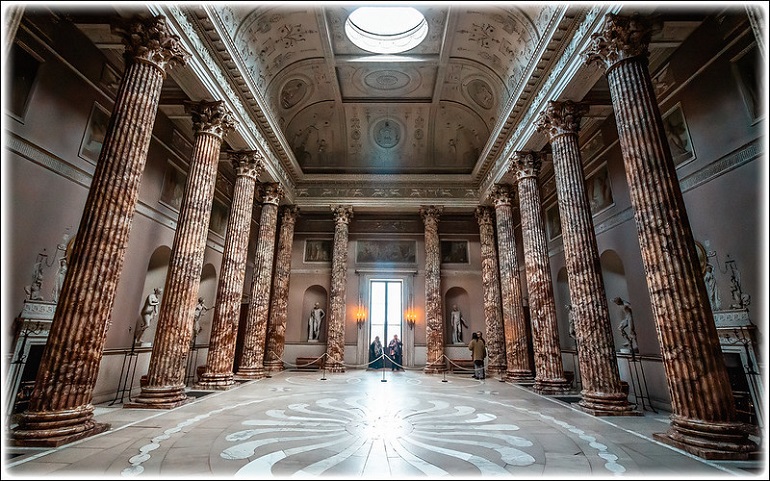
- The magnificent marble hall has been described by architectural historian Nikolaus Pevsner as "one of the most magnificent apartments of the 18th century in England".
- The hall was built as a showpiece rather than a comfortable family home, with the Curzon family actually living in a separate wing whilst the main house served primarily for entertaining.
- The south front of the building was based on Constantine's Arch in Rome, reflecting the neoclassical theme throughout the house.
- During the Second World War, Kedleston Hall served as a signals intelligence gathering station, forming one of the Y-stations that collected radio transmissions for Bletchley Park.
- The house contains one of the largest Asian collections in the Midlands, assembled by George, Lord Curzon of Kedleston, who served as Viceroy of India from 1899 to 1905.
- Lady Curzon's famous Delhi Durbar Coronation dress of 1903, known as the "peacock dress," is displayed in the house, though the original precious stones have been replaced with imitations.
- The marble hall features twenty fluted pink Nottingham alabaster columns with Corinthian capitals and is lit by an innovative glass skylight rather than conventional windows.
- The State Floor took over 30 years to restore to reflect Robert Adam's original vision, with original painting schemes being reintroduced.
- The house stands on over 800 acres of Italian-style classical landscape, complete with a ha-ha (sunken wall) to provide uninterrupted views whilst keeping animals away from the house.

History
Kedleston Hall is a spectacular "temple of the arts" created to showcase wealth, taste, and power. The Curzon family, who arrived in Britain from Normandy with William the Conqueror, have held the estate since at least the 12th century. In 1759, Sir Nathaniel Curzon, the 1st Baron Scarsdale, decided to replace the family's medieval manor house with a grand new building to rival the nearby Chatsworth House. To achieve his vision, Curzon controversially had the entire village of Kedleston moved, leaving only the original 12th-century All Saints Church standing. The project, built between 1759 and 1765, was initially designed by architects James Paine and Matthew Brettingham, but Curzon was so impressed with the garden follies created by the then-unknown Robert Adam that he put him in charge of the entire build.
Intended as a showpiece for entertaining and displaying fine art rather than a comfortable family home, the hall's design is a masterclass in Palladian architecture. The south front is a direct interpretation of the Arch of Constantine in Rome. Inside, Adam created some of England's most complete and unaltered 18th-century interiors. The centrepiece is the breathtaking Marble Hall, which rises 62 feet to a glass oculus, and the circular Saloon, intended as a sculpture gallery. Adam's vision extended to the contents; he commissioned bespoke furniture, including bookcases by local craftsman James Gravenor, to perfectly complement the rooms. The Curzon family has always lived in a separate family wing, leaving the lavish state rooms of the central block for impressing guests. The building that now houses the restaurant was once the Great Kitchen, which catered for the family's elaborate dinner parties.
The hall's more recent history is just as notable. George Curzon, who served as Viceroy of India from 1899 to 1905, inherited the house in 1916. He established a museum on the ground floor to house his vast collection of Asian artefacts, which is now one of the most significant in the care of the National Trust. The museum also displays the stunning "peacock dress" worn by his wife, Lady Curzon, for the 1903 Delhi Durbar. During the Second World War, the hall was used by the War Office as a training camp and a secret 'Y-station', intercepting radio signals for decryption at Bletchley Park. By the 1970s, the cost of upkeep became too much for the family, and the estate was transferred to the National Trust in lieu of death duties. The Curzon family still resides in the private wing today, and the Trust has undertaken extensive restoration to preserve Adam's original vision.
Description
Kedleston Hall is a pre-eminent example of 18th-century neo-classical architecture. The initial design was by James Paine, but the project was comprehensively taken over and executed by Robert Adam from 1760. The hall is constructed on a Palladian plan, consisting of a central main block flanked by four smaller wings. Two of these wings, the east and west, are connected to the central block by curved corridors. The central block contains the state rooms, which were conceived purely for formal entertaining and display, emphasising the house's grand and ceremonial character. The east wing originally contained the Curzon family’s private apartments, while the west wing was designed to be a self-contained domestic unit, housing kitchens, laundries, and staff accommodation.
The approach to the main entrance reveals a sweeping north façade, executed in the Palladian style and featuring a grand, six-columned Corinthian portico accessed by a wide, shallow flight of steps. In contrast, the south façade is a more direct interpretation of classical Roman architecture, modelled on the Arch of Constantine. This façade features a central triumphal arch motif, with access provided by a curved double staircase that leads to the Saloon. Statues of classical deities are positioned in niches and along the roofline. The exterior is constructed from local Hollington stone, with a contrast between the rusticated ground floor and the smooth-dressed stone of the principal floors above, all featuring extensive and precise classical detailing.
Upon entering through the main portico on the north front, visitors are received into the Marble Hall. This monumental space was designed by Adam to evoke the open-air atrium of a Roman villa. The room is lined with twenty fluted pink Nottingham alabaster columns with Corinthian capitals, which support a heavily decorated cornice. Set into niches along the walls are classical statues, above which are grisaille panels painted by Joseph Biagio Rebecca, depicting scenes from Homer’s Iliad. The hall measures approximately 20 metres by 11 metres and rises to a height of 12 metres. The floor is laid with a geometric pattern of Italian marble. Natural light enters exclusively from a central skylight in the ceiling, a design choice that eliminates the need for windows, thereby preserving the room's internal symmetry and classical form.
Directly beyond the Marble Hall lies the Saloon, a circular chamber that forms the heart of the state apartment circuit. Based on the design of the Pantheon in Rome, this full-height room is covered by a coffered dome and lit from above by a central oculus. The Saloon was intended to function as a sculpture gallery and a formal reception room. Its decorative scheme includes intricate plasterwork rosettes within the dome's coffering, wall panels featuring classical subjects, and columns of scagliola imitating marble. The room contains four large apse-like recesses; these not only serve as powerful design features but also cleverly conceal heating stoves within their pedestals.
The main sequence of state rooms was designed as a 'parade route' for distinguished visitors. The principal apartment, or state bedroom suite, is a prominent feature of this route. It showcases fine period furniture and paintings, dominated by the State Bed. This bed is an elaborate creation with a frame intricately carved and gilded to resemble palm trees, from which hang original silk damask hangings. The adjacent State Dressing Room continues the opulent theme with its own decorated ceiling and furnishings. The Drawing Room is lit by a large Venetian window and contains an elaborate chimneypiece with alabaster surrounds and caryatids (sculpted female figures). The original colour scheme was green and white, and the walls are hung with notable paintings. Adam also designed large pier glasses for this room, positioned between the windows to reflect the parkland outside.
The State Dining Room features a large apse with a coffered semi-dome, based on a design from the Palace of Augustus in Rome. The apse houses an Adam-designed sideboard, and the room is furnished with original curved tables also designed by Adam. The walls are decorated with paintings of game and still life by artists including Frans Snyders. Other significant rooms on the state floor include the Music Room, which has Ionic doorcases and a delicate plaster ceiling. Its notable features are a marble chimneypiece intricately inlaid with local Blue John stone and a historic pipe organ housed within a case also designed by Adam. The Library served a dual purpose as a repository for books and a less formal family sitting room. It features bookcases, a desk, and a side table all to Adam's designs, and a compartmented ceiling with a pattern of octagons and squares.
Kedleston Hall is also noted for its extensive collections. The house contains significant displays of European Old Master paintings, classical sculpture, and original 18th-century furnishings designed specifically for their locations within the hall. Housed in the east wing is the Eastern Museum, which holds a large and diverse array of artefacts from South Asia and the Middle East. This collection was assembled by George Nathaniel Curzon during his service as Viceroy of India from 1899 to 1905. Notable exhibits include Indian and Burmese arms and armour, religious and ceremonial objects, textiles, silverware, and artworks from Japan and China. The museum’s most celebrated exhibit is Lady Curzon’s Peacock Dress, created by the House of Worth in Paris for the 1903 Delhi Durbar. The gown is made from cloth of gold, intricately embroidered with gold and silver thread, and decorated with iridescent green beetle wing-cases sewn into the fabric to simulate peacock feathers.
The surrounding grounds at Kedleston Hall were landscaped in the 18th century by William Emes, a follower of Lancelot 'Capability' Brown. Emes transformed the earlier formal landscape into a more fashionable naturalistic style, with sweeping lawns, carefully managed woodlands, and a series of three interconnected lakes. Robert Adam also contributed to the landscape, designing the elegant three-arched bridge that spans the middle lake, as well as various gate lodges and other park structures. Within the Pleasure Grounds, which are situated near the hall, there are more formal garden areas providing seasonal floral displays. A notable feature is the Fishing Pavilion, a circular domed building designed by Adam, located on an island in the lake. The extensive parkland supports a wide variety of wildlife, and both long and short walking routes allow visitors to explore the estate and appreciate the carefully constructed vistas.
Getting There
Kedleston Hall, located in Derbyshire near Derby, is easily accessible by both car and public transport. If driving, follow the A38 northward and take the first exit for Derby University, then follow Kedleston Road and turn left at the sign for Hulland and Kedleston, continuing for one more mile—use postcode DE22 5JD for your satnav to reach the main entrance. For those travelling by public transport, the 114 bus service operates from Derby Railway Station to Kedleston Hall, costing £6 and taking approximately 25-33 minutes. During summer Saturdays, the bus stops directly at the hall, whilst on other days it stops at The Smithy, requiring a pleasant one-mile walk to reach the attraction. Derby railway station offers direct connections from major cities including Birmingham New Street (35 minutes), Nottingham (20 minutes), Sheffield (30 minutes), and Leicester (30 minutes). As an added incentive for sustainable travel, visitors arriving by train, bus, or bicycle receive a complimentary hot drink from the restaurant upon showing their valid ticket or bike helmet. Car parking is available but requires pre-booking, with the entrance gate opening at 9am and closing at 5pm.
Best Time to Visit
The best time to visit Kedleston Hall truly depends on what you wish to experience. For those with a passion for gardens, the period from spring through to autumn is ideal, as the formal gardens are at their most vibrant and colourful, offering a beautiful interpretation of their 18th-century design. Summer is particularly special for wildlife enthusiasts, providing the best chance to spot the full array of fauna across the parkland, including swans with their cygnets on the lakes. If you enjoy walking, the grounds are spectacular in autumn, when the landscape is painted with rich, colourful tints. For a more festive atmosphere, a visit in December is a must, as the hall is beautifully decorated for Christmas. While the estate offers something unique in every season, the drier months from April onwards are generally best for fully exploring both the magnificent hall and the expansive parkland walks.