


 Ireland Guide
 Scotland Guide
 Wales Guide
| Contents |
|---|

Introduction
Hardwick Hall is a magnificent Elizabethan country house located in Doe Lea, Derbyshire, built between 1590 and 1597 for Elizabeth Talbot, better known as Bess of Hardwick, one of the most powerful women of the Tudor era. The hall is renowned for its revolutionary architectural design featuring an unprecedented amount of glass windows, earning it the contemporary rhyme "Hardwick Hall, more glass than wall." Designed by architect Robert Smythson, the three-storey limestone building showcases the wealth and ambition of its creator through its symmetrical façade, ornate towers, and grand state rooms filled with original tapestries, furniture, and portraits. Today, the property is managed by the National Trust and remains one of England's finest examples of Elizabethan architecture, set within extensive gardens and parkland that offer visitors a glimpse into 16th-century aristocratic life. The hall's exceptional preservation, including many original features and furnishings, makes it an essential destination for those interested in Tudor history, architecture, and the story of one of England's most remarkable women.
Interesting Facts about Hardwick Hall
- Hardwick Hall was built between 1590 and 1597 by Elizabeth Talbot, Countess of Shrewsbury, famously known as "Bess of Hardwick," who became the second richest person in England after Queen Elizabeth I.
- The hall earned the local rhyme "Hardwick Hall, more glass than wall" due to its revolutionary use of enormous multi-paned windows at a time when glass was considered an expensive luxury.
- Designed by renowned architect Robert Smythson, Hardwick Hall represents one of the finest examples of an Elizabethan "prodigy house" - ostentatious palatial-style homes built by wealthy courtiers.
- The building features Bess of Hardwick's initials "ES" (Elizabeth Shrewsbury) prominently displayed on stone crowns atop each of the six turreted towers.
- Each of the three main floors has progressively higher ceilings than the one below, creating a dramatic ascending effect throughout the house.
- The chimneys were ingeniously built into the internal walls rather than external ones to maximise space for the spectacular window displays.
- Hardwick Hall houses one of Europe's finest collections of Elizabethan tapestries and embroideries, reflecting Bess's passion for needlework and textile collecting.
- The hall was one of the first buildings in England to be professionally "designed" by an architect, with Robert Smythson creating detailed plans and drawings before construction began.
- The High Great Chamber on the top floor is illuminated by eight enormous windows and served as the main entertainment space for important guests.
- Bess built the "New" Hardwick Hall immediately beside the existing "Old" Hardwick Hall, intending the two structures to complement each other like wings of a single grand building.
- The hall remained in the possession of Bess's descendants, the Dukes of Devonshire, for 450 years until it was transferred to the National Trust in 1959.
- Hardwick Hall represents one of the earliest English interpretations of Italian Renaissance architecture, incorporating innovative symmetrical design principles.
History
Hardwick Hall stands as a testament to the ambition and power of its creator, Elizabeth Talbot, Countess of Shrewsbury, better known as 'Bess of Hardwick'. Born into a minor gentry family, Bess rose through four advantageous marriages to become the wealthiest woman in England, second only to Queen Elizabeth I herself. After the collapse of her fourth marriage in 1584, Bess returned to her family estate at Hardwick. Finding the original medieval manor house inadequate for a countess, she began transforming it into a grand mansion, now known as Hardwick Old Hall, between 1587 and 1596. However, before this project was even finished, her husband died in 1590, leaving her extraordinarily rich. Almost immediately, Bess commissioned the architect Robert Smythson to design an even grander house just metres away—the building we now know as Hardwick Hall, constructed between 1590 and 1597.
The new Hall is a spectacular example of an Elizabethan prodigy house, designed as a conspicuous statement of Bess's immense wealth and status. Its most famous feature is the sheer quantity of glass, a great luxury at the time, which gave rise to the local saying, 'Hardwick Hall, more glass than wall'. To accommodate the exceptionally large windows, the chimneys were cleverly built into the internal walls. The building's design was innovative, with the great hall built on an axis through the centre of the house rather than at a right angle to the entrance. The three main floors feature progressively higher ceilings, indicating the increasing importance of the rooms and their occupants. Lest anyone doubt who was responsible for this marvel, Bess had her initials, 'ES' for Elizabeth Shrewsbury, topped with a coronet, emblazoned on the six high towers. Bess moved in during 1597, and a 1601 inventory reveals a treasure trove of fine tapestries, furniture, and portraits, many of which can still be seen today.
After Bess died at Hardwick in 1608, the estate passed to her descendants, the Cavendish family, who became the Dukes of Devonshire. The family eventually came to favour their other great house at Chatsworth, and the Old Hall was partially dismantled in the 1750s for its stone, gradually falling into ruin. The 'New' Hall remained in the family for centuries and played a role in the Second World War, when the British Army's 1st Parachute Brigade was formed on the estate in 1941. In 1956, the house was transferred to the Treasury in lieu of death duties and was subsequently passed to the National Trust in 1959, which undertook a major programme of restoration. Today, Hardwick Hall is open to the public, while the magnificent, roofless Old Hall is cared for by English Heritage and reopened in 2023 after extensive conservation work.
Description
Setting
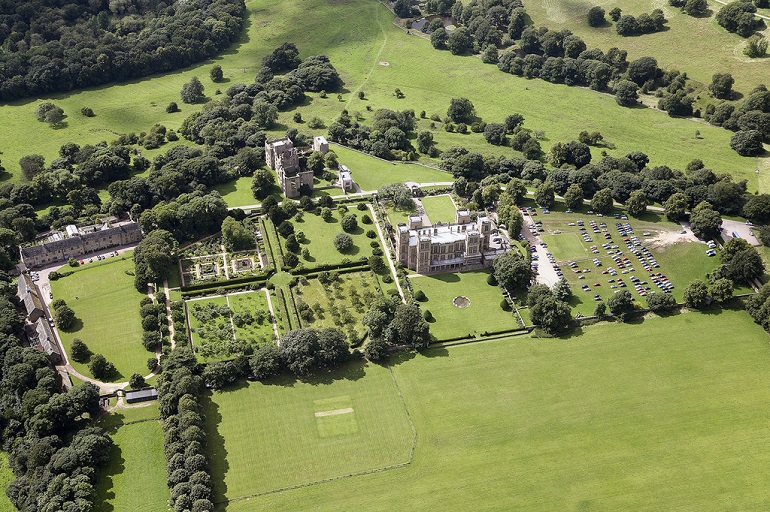
Hardwick Hall occupies an elevated plateau in north‐east Derbyshire, overlooking the valley of the River Doe Lea. The Hall sits within a 2,500-acre estate of ancient woodland pasture, lakes and farmed parkland that lie between the villages of Heath and Rowthorne.
Exterior and Plan
The house follows a compact rectangular plan with projecting corner towers. Each of the three principal storeys has progressively higher ceilings, a design decision that leaves the roof‐line crenellations of the central block stepping down from the taller corner towers. Continuous bands of tall, mullioned windows cover all façades, creating the frequently quoted impression of “more glass than wall”. The initials “ES” are carved in open stonework on every tower parapet.
Principal Approach
Visitors enter through a walled forecourt on the east side, passing a pair of 17th-century gatepiers topped with stone globes. From here a straight gravel path leads to the main door in the central bay of the east front.
Ground Floor Rooms
- Entrance Hall – a through-hall paved with dark limestone flags and lit by double-height glazing to both the east and west façades.
- Chapel – a two-storey space occupying the south-east corner tower, notable for original oak fittings and a late-16th-century plaster frieze of foliage scrolls.
- Kitchens and Service Rooms – aligned along the west range, linked by a broad passage that allowed easy delivery of food to the Great Hall above.
First Floor State Apartments
- Great Hall – 20 m long, lined with oak panelling to dado height and hung with the ten-piece Gideon embroidery set covering the upper walls. A strap-work plaster frieze runs beneath a hammer-beam style open timber roof.
- High Great Chamber – occupying the entire south range. The room is illuminated by eight windows; its plaster frieze depicts hunting scenes, while the plaster ceiling shows interlaced ribs picked out in ochre.
- Presence Chamber – a smaller audience room separated from the High Great Chamber by an oak screen, furnished with the inlaid Eglantine Table and a pair of embroidered wall cushions.

Long Gallery
Running the full 51 m length of the north range on the second floor, the Long Gallery is one of the longest surviving Elizabethan galleries in England. Portraits of Tudor nobility line the walls; the Sea-Dog Table of carved walnut and gilded sea monsters stands midway along the western side. The ceiling height here exceeds 7 m, giving the space an unusually light atmosphere.
Furnishings and Decorative Arts
Hardwick retains one of the largest groups of 16th- century textiles in situ. Among them are:
- Gideon Tapestries – woven in Brussels c. 1578, covering the Great Hall walls floor-to-ceiling.
- Virtues and Vices hangings – a set of smaller tapestries displayed in the Withdrawing Chamber.
- Needlework Cushions – more than 50 examples of late-Elizabethan canvas work, many initialled “BS” and dated 1601.
Furniture highlights include carved oak joint stools, Florentine pietra-dura cabinet panels mounted in English cases, and a group of upholstered chairs with imported Genoese velvet.
Staircases
A broad stone stair rises from the west end of the Entrance Hall to a half-landing lit by a triple-light window. From there a dog-leg flight leads to the state rooms; a separate timber service stair links the kitchens to the upper floors.
Gardens
- East Court – a retained 17th-century enclosure with clipped yew cylinders framing the axial path.
- South Borders – double herbaceous borders laid out along the retaining wall beneath the house.
- Orchard – positioned west of the hall, still planted with Derbyshire varieties of apple and damson.
- Herb and Kitchen Garden – rectangular beds edged with box, supplying the estate restaurant with seasonal produce.
Old Hall
South-west of the present house stand the roofless remains of Hardwick Old Hall. Surviving plasterwork in its High Great Chamber shows life-size figures of classical deities within strap-work frames. A stair tower provides elevated views across the estate and to Bolsover Castle on clear days.
Estate Walks and Features
Way-marked trails of 1 km, 3 km and 5 km loop through oak woodland rich in ancient pollards and support populations of red deer and lesser spotted woodpecker. Stainsby Mill, a water-powered corn mill dating from the early 19th century, lies 1.5 km north-west of the Hall and demonstrates working mill machinery on set days.
Getting There
Hardwick Hall is most easily reached by car, situated 8 miles south-east of Chesterfield via the A6175 (leave the M1 at Junction 29 and follow the brown tourist signs). For those travelling by public transport, the nearest railway station is Chesterfield, from which you can take a taxi (costing approximately £15-25) or catch the Pronto bus service from Chesterfield coach station, though bus services are limited and may require a walk of up to 2 miles from the nearest stop. Train fares vary considerably depending on your starting point, with journeys from London costing £55-200 and from Manchester approximately £45-65. The postcode for sat-nav users is S44 5RW, though Google Maps users should search for "Hardwick Hall, Doe Lea, S44 5QJ" to reach the visitor car park. An on-demand bus service is also available through Travel Derbyshire, offering door-to-door transport to the Hardwick car park for those in the local area.
Best Time to Visit
The best time to visit Hardwick Hall is during the late spring to early autumn months, from May to September, when the gardens are in full bloom and the weather is comfortably mild for exploring the estate. During this period, visitors can make the most of longer daylight hours, enjoy vibrant floral displays in the landscaped grounds, and attend various seasonal events often held at the Hall. Spring brings fresh greenery and blossoming flowers, while summer showcases the Hall at its most picturesque, making it ideal for leisurely walks and picnics. Early autumn offers a quieter experience with beautiful autumnal colours in the surrounding woodland. This timing ensures a delightful visit, both visually and atmospherically, as the historic house and its spectacular gardens truly come alive.