


 Ireland Guide
 Scotland Guide
 Wales Guide
| Contents |
|---|

Introduction
Famous for its association with three of the most prominent 16th-century Englishmen, Sir John Hawkins (1532-1595), Sir Francis Drake (1540-1596) and Sir Walter Raleigh (1554-1618), Plymouth (pop. 278,000) played a major role in Britain's naval history. It was also the departure point of the Mayflower in 1620, carrying the Pilgrims to the New World. With one of the finest natural harbours in the world, the city's Devonport Dockyard remains Western Europe's largest naval base (but second in importance in Britain after Portsmouth).
Modern Plymouth is the largest city in Devon. It is a unitary authority which incorporates the neighbouring towns of Devonport and East Stonehouse. Due to its naval importance, the town was heavily bombed by the Luftwaffe during WWII, and its centre is now an amalgam of non descript concrete reconstructions - although a few interesting buildings have survived. Notable attractions including the National Marine Aquarium, the historic Barbican area with its cobbled streets and Tudor buildings, the Royal Naval College, and the modern waterfront development at Coxside.
People born in Plymouth are known as Plymothians or less formally as Janner. In the Royal Navy, "Guz" is a nickname for Devonport.
Interesting Facts about Plymouth
- Plymouth's extensive history dates back to the Bronze Age, evolving from a trading post at Mount Batten into the thriving market town of Sutton before being formally renamed Plymouth in 1439.
- The city served as the departure point for the Mayflower Pilgrims in 1620, who sailed from near the Mayflower Steps to the New World in search of religious freedom.
- Plymouth was home to the world's first offshore lighthouse, the original Eddystone Lighthouse, which was constructed of wood and operated from 1698 to 1703.
- Sir Francis Drake made Plymouth the first town in Britain to receive a fresh water supply from outside its boundaries by constructing a 14-mile leat from the River Meavy on Dartmoor in 1591.
- Plymouth became the first city in England to elect a female MP when Nancy Astor was elected in 1919, representing Sutton.
- The city is home to the UK's largest aquarium, the National Marine Aquarium, which houses more than 4,000 aquatic creatures and captivates audiences with BBC documentaries.
- Plymouth's entire retail city centre was destroyed during the Second World War and subsequently rebuilt, creating one of the finest examples of 1950s British architecture.
- The Port of Plymouth serves the largest naval base in Western Europe, HMNB Devonport, which houses nuclear submarines and large warships.
- Plymouth Gin Distillery, which first opened its doors in 1793, is home to England's oldest distillery.
- Olympic diver Tom Daley was born in Plymouth and became one of Britain's youngest Olympians, competing in three Olympic Games before turning 23.
- There are 52 places called Plymouth across the world, making it one of the most widely replicated place names globally.
- The Plymouth Barbican boasts the largest concentration of cobbled streets in Britain, with over 100 listed buildings in the historic port area.
- Drake's Island, visible from Plymouth Hoe, is actually the tip of an ancient volcano.
- Captain Cook first set sail from the Port of Plymouth in 1768, beginning his famous voyages of exploration.
- The word "dinosaur" was first used in public during a talk in Plymouth, when Sir Richard Owen coined the term "Dinosauria".
History
Plymouth was founded at the estuary of the rivers Plym, Tavy and Tamar. It developed into a town in the 15th century and saw its heyday in the next century, when it served as Francis Drake's base for his voyage around the globe (1577-1580) and to defeat the Spanish Armada (1588).
It is said that when alerted of the approach of the Armada, Drake insisted on finishing his game of bowls on Plymouth Hoe before setting sail to defeat the Spaniards. Drake's fleet chased the Armada up to Calais, and aided by a storm, managed to sink 51 Spanish vessels without losing any.
In 1620, the Pilgrim Fathers, a group of 102 puritans who had broken away from the Church of England, embarked aboard the Mayflower in Plymouth, with destination the newly founded colony of Virginia. Forced off course by the weather, they finally landed near present-day Provincetown (Massachusetts), and settled at what they named the "Plymouth Colony".
It was also from Plymouth that Captain James Cook set sail on his three voyages to the Southern Hemisphere that led him to Tahiti, New Zealand, Australia, New Guinea, Antarctica and Hawaii. Charles Darwin's HMS Beagle also set off from Plymouth, and so did the ships who took convicts and colonists to Australia in the 19th century.
Main Attractions
The Hoe
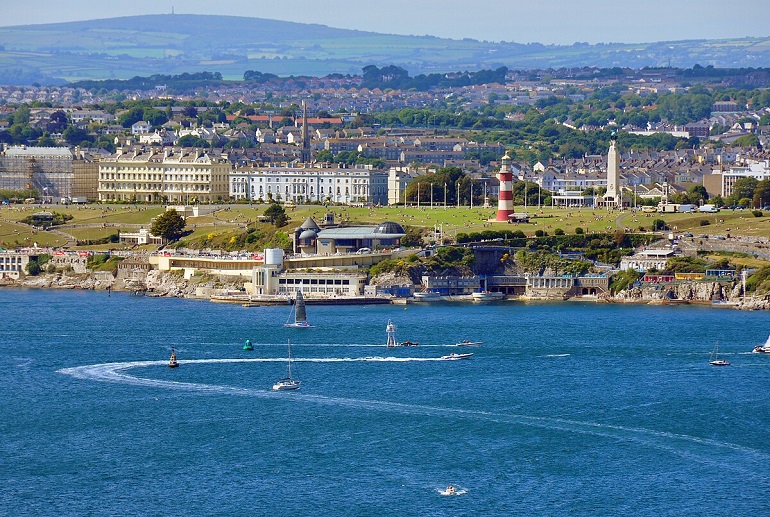
The park and seafront promenade known as the Plymouth Hoe, which commands great views on the Plymouth Sound (i.e. the Bay of Plymouth), is the first place to visit in town. It is here that Francis Drake supposedly played bowls before routing the Armada, and a statue now commemorates the man.
Still on the Hoe, Smeaton's Tower was built in 1759 by John Smeaton on the Eddystone Rocks, and was the world's first lighthouse built using 'hydraulic lime' (a form of concrete). When it was discovered that the rocks upon which the lighthouse stood were becoming eroded, it was dismantled and moved to the Hoe in 1877 as a memorial, and replaced by a new one in 1882.
Beside the lighthouse, the Plymouth Dome has a very instructive overview of the city's history from the great explorer to the WWII blitz. There is a recreation of an Elizabethan street with dummies complemented by sound and even smell. The Smeaton's Gallery concentrates on the lighthouse's history.
During the Civil War, Plymouth was the only city of the South-West to support the Parliamentarians. That prompted Charles II to built the Royal Citadel (built 1665-1670), between the Hoe and Barbican, to keep control over this strategic port. There are guided tours on Tuesdays at 2:30pm (1h15min) between May and September.
Barbican and Old Town
Locked between the Citadel and Sutton Harbour, the Barbican district is the heart of old Plymouth and now mostly houses shops and restaurants. Most of the buildings on New Street have survived WWII or were reconstructed in their respective Tudor or Jacobean style. The Elizabethan House is the only one that can be visited (open Wed-Sun 10am to 5pm from April to October; entry £1).
The Plymouth Dry Gin Distillery has been operating since 1793 and is the oldest distillery in England.
Right across the Barbican is the National Marine Aquarium, Britain's largest aquarium, with Europe's deepest tank. It was also the first aquarium in the UK built solely for the purpose of education. It has a stunning collection of seahorses, sharks and coral fauna and flora, among others.
More toward the centre of town, the Merchant's House Museum, at 33 St Andrews Street, has more historical exhibits housed in a Jacobean building.
The Docks
The Devonport Dockyard were built in 1690 and cover an area of 2.6 km². It has 15 dry docks, 6km of waterfront, 25 tidal berths and 5 basins, and is the main refitting base for Royal Navy nuclear submarines.
Royal William Yard
This former Royal Navy victualling yard has been transformed into a contemporary destination whilst preserving its impressive Grade I listed buildings. The complex, designed by Sir John Rennie in the 1820s, now houses restaurants, bars, galleries, and residential spaces within its historic stone structures. Visitors can explore the yard on foot or arrive by water taxi, enjoying views across the River Tamar towards Cornwall whilst experiencing the grandeur of Georgian military architecture.
National Marine Aquarium
Located on Sutton Harbour, the National Marine Aquarium holds the distinction of being the UK's largest aquarium, focusing on both British and international marine ecosystems. The facility features numerous large tanks, including Britain's deepest aquarium tank, alongside interactive exhibits and educational programmes. The aquarium's location provides additional appeal, situated within walking distance of the Barbican and offering views across the harbour.
Tinside Lido
This distinctive art deco swimming pool, built into the rocky shoreline below Plymouth Hoe, operates as a seasonal outdoor facility using filtered seawater. The semi-circular pool, dating from 1935, offers a unique swimming experience with views directly out to sea, making it popular with both locals and visitors during the summer months. The lido's geometric design and coastal setting create a striking visual landmark visible from the Hoe above.
Royal Citadel
Constructed in the 1660s on the orders of King Charles II, the Royal Citadel remains an active military installation whilst offering guided tours during summer months. The fortress occupies a strategic position on the eastern edge of Plymouth Hoe, with its star-shaped fortifications providing excellent examples of 17th-century military architecture. The site includes the Royal Chapel of St Katherine, still used for regular services, and offers insights into Plymouth's military history spanning over 350 years.
Central Park
As Plymouth's largest public park, Central Park provides extensive recreational facilities across its 30 hectares. The park includes a golf centre, tennis courts, bowling greens, children's playground, skate park, and numerous walking paths through both formal gardens and natural areas. The park's elevated position offers views across the city and serves as a venue for various events and festivals throughout the year.
Devonport Park
This Victorian park exemplifies 19th-century public park design, featuring formal flower beds, tree-lined avenues, and a central ornamental lake. The park includes modern amenities such as children's play areas, sports facilities, and a café, whilst maintaining its original character through mature trees and traditional landscaping. Wildflower meadows within the park support local wildlife and provide seasonal colour displays.
South West Coast Path
Plymouth's section of the South West Coast Path follows the city's extensive waterfront, connecting many of the major attractions whilst providing access to coastal scenery. The path offers various walking options, from short strolls around the Barbican to longer walks extending towards the Tamar bridges or eastward along the coast. The route passes through different landscapes, including urban waterfront, historic dockyards, and natural coastal areas.
Mount Edgcumbe Country Park
Accessible by foot ferry from the Barbican, Mount Edgcumbe Country Park occupies the Cornish side of Plymouth Sound, offering formal gardens, parkland, and coastal walks. The park features several themed gardens, including French, Italian, and English styles, alongside the restored Mount Edgcumbe House. The ferry journey itself provides excellent views of Plymouth's waterfront, whilst the park offers a contrasting rural experience within easy reach of the city centre.
Top Museums
The Box
The Box is Plymouth’s contemporary museum, art gallery, and archive—a vibrant cultural hub that combines cutting-edge exhibitions with historic collections. Here, you can marvel at thousands of natural history specimens, a striking replica woolly mammoth, significant archaeological artefacts, and rotating displays of fine and decorative arts. The Box also delves into local and global history, featuring work by both historical and contemporary artists, and houses a large archive for research and learning. The award-winning venue often hosts contemporary exhibitions, immersive family-friendly activities, and community events, ensuring plenty of reasons to return throughout the year.
Mayflower Museum

Located on the Barbican, the Mayflower Museum offers a compelling journey through four centuries of Plymouth’s maritime heritage. Its engaging displays focus on the story of the Mayflower voyage in 1620, exploring the lives of the Pilgrims and their encounter with the Native American Wampanoag people. Recent exhibitions present new narratives, questioning colonial legacies and offering Indigenous perspectives alongside interactive period objects, maps, and multimedia features. The museum connects Plymouth’s global history with the city’s modern identity as a port.
Elizabethan House
This beautifully restored property on the Barbican takes visitors back to 17th-century Plymouth. Through immersive storytelling and original features, Elizabethan House captures what life would have been like during one of the city’s most historic periods. The house vividly portrays the social and domestic lives of its former residents, making it a treat for those interested in local heritage and everyday history.
Merchant’s House
The Merchant’s House is a preserved 16th-century townhouse showcasing Plymouth’s social history. Filled with period rooms and exhibits, it brings to life the story of Plymouth’s merchant class and urban development. The museum displays a range of domestic, commercial, and civic artefacts, offering a window into life in the city over several centuries.
Devonport Naval Heritage Centre
Focusing on the city’s important role as a naval base, this museum offers a fascinating look at maritime and military history. Exhibits range from ship models and naval artefacts to personal stories of the people who served locally, highlighting Plymouth’s contribution to the Royal Navy and national defence over the years.
Local Cuisine
The local speciality fish and chips reigns supreme, particularly when enjoyed with stunning harbour views, featuring locally caught haddock and Plymouth sole. Maritime delicacies extend to crab sandwiches made with fresh local catch, lobster, and tiger prawns. The historic pasty, with the earliest recorded recipe dating back to Plymouth in 1510, remains a beloved local tradition, traditionally filled with meat and diced vegetables or cheese and onion. No visit is complete without experiencing a proper Devonshire cream tea, served the Devon way with clotted cream first, alongside freshly baked scones and local jam. The city also boasts Plymouth Gin, produced at England's oldest working gin distillery since 1793, where the Mayflower Fathers allegedly spent their last night before departing for the New World. For those seeking hearty traditional fare, hog's pudding (white pudding) offers a taste of regional history, whilst the waterfront markets and street food scene provide everything from authentic Cornish pasties to international flavours.
Getting There & Around
Plymouth has connections to most places in Devon and Cornwall. It is located at the end of the M5 motorways from Birmingham, Bristol and Exeter, which continues as the A38 to Bodmin.
By train, Great Western Railway operates direct services from London Paddington to Plymouth, with up to 24 trains daily taking around 3 hours 15 minutes, whilst services from Bristol Temple Meads take approximately 2 hours 30 minutes and trains from Exeter arrive in about an hour.
By coach, National Express runs direct services from London Victoria Coach Station up to 7 times daily, with the journey taking around 5 hours 30 minutes, and coaches also operate from various other cities across the country via well-connected networks.
By car, most driving routes will bring you onto the M5 motorway, which merges to become the A38 and leads directly into Plymouth, with typical driving times of around 4 hours from London, 4.5 hours from Manchester, and 2.5 hours from Cardiff, making it easily accessible from most locations within the UK.