


 Ireland Guide
 Scotland Guide
 Wales Guide
| Contents |
|---|

Introduction
Fountains Abbey & Studley Royal Park is a UNESCO World Heritage Site located in North Yorkshire, England, combining the atmospheric ruins of a 12th-century Cistercian monastery with one of Britain's finest 18th-century water gardens. The site encompasses the substantial remains of Fountains Abbey, founded in 1132 and once amongst the wealthiest monasteries in England until its dissolution in 1539, alongside the elegant landscaped gardens of Studley Royal, created by John Aislabie and his son William between 1718 and 1781. Managed by the National Trust, the 800-acre estate features medieval monastic buildings including the abbey church, cellarium, and mill, integrated seamlessly with ornamental lakes, cascades, temples, and carefully planned vistas that exemplify the English landscape garden movement. The park also encompasses St Mary's Church, a Victorian Gothic Revival masterpiece designed by William Burges, and Fountains Hall, a Jacobean mansion built partly from stone taken from the abbey ruins.
Interesting Facts about Fountains Abbey & Studley Royal Park
- Fountains Abbey was founded on 27th December 1132 by thirteen Benedictine monks from St Mary's Abbey in York who had grown tired of the extravagant and rowdy lifestyle of the York monastery.
- The abbey is Britain's largest monastic ruin and one of the largest and best-preserved ruined Cistercian monasteries in England.
- Fountains Abbey became one of the wealthiest monasteries in England through its thriving wool trade, as English wool was highly prized even by the Italians during the medieval period.
- The abbey's magnificent vaulted cellarium stretches over 300 feet long and is home to several species of bats that emerge after dusk.
- King Henry VIII ordered the dissolution of Fountains Abbey in 1539, ending over 400 years of monastic life, and the property was subsequently sold to Sir Richard Gresham, a London merchant.
- The Georgian water garden at Studley Royal is one of the finest surviving examples in England, created by John Aislabie in the 18th century after he was expelled from Parliament following the South Sea Bubble financial scandal.
- The entire estate spans 800 acres and was designated a UNESCO World Heritage Site in 1986, combining medieval monastic ruins with 18th-century landscaped gardens.
- Studley Royal's deer park is home to over 300 red, sika, and fallow deer roaming amongst ancient tree avenues.
- St Mary's Church within the park, designed by William Burges, is considered one of the finest examples of High Victorian Gothic Revival architecture in England.
- Fountains Hall, a Jacobean mansion built between 1597-1604, was constructed partly using stone salvaged from the abbey ruins.
- The two separate estates of Fountains Abbey and Studley Royal were combined in 1767 when William Aislabie purchased the Fountains estate, creating the unified landscape we see today.
- Huby's Tower, which dominates the abbey site today, was built in the 1500s only to be destroyed a few years later during the dissolution of the monasteries.
- The abbey featured two distinct orders of monks: lay brothers who wore simple brown tunics and managed daily operations, and choir monks in white tunics who prayed seven times daily.
- The River Skell runs through the property, and all the land along the river was originally owned by the Archbishop of York.
- The National Trust acquired the estate in 1983 and it now welcomes approximately 420,000 visitors annually, making it one of the Trust's most popular properties.
History
Fountains Abbey stands as Britain's largest and most impressive monastic ruin, with a rich history stretching back nearly nine centuries. Founded in 1132 by thirteen Benedictine monks from St Mary's Abbey in York, the abbey emerged from religious reform and discord. These monks, led by Saint Robert of Newminster, had grown weary of the extravagant and rowdy lifestyle at their York monastery and sought a more devout, simple existence. They were granted sanctuary by Thurstan, Archbishop of York, who provided them with land in the sheltered valley of the River Skell, approximately three miles southwest of Ripon. The site proved ideal for monastic life, offering natural springs (which inspired the name "Fountains"), stone and timber for building, and protection from harsh weather. Within just three years, by 1135, the community had been admitted to the austere Cistercian Order, becoming the second Cistercian house in northern England after Rievaulx Abbey.
The abbey flourished remarkably over the following centuries, accumulating vast wealth that made it one of England's richest monasteries. The introduction of the Cistercian system of lay brothers proved transformative, as these labourers relieved the monks from routine farming and maintenance tasks, allowing them to dedicate more time to prayer and worship. Through the industrious work of these lay brothers, Fountains Abbey built its fortune on wool production, lead mining, cattle rearing, horse breeding, and stone quarrying—capitalising on the Yorkshire Dales' abundant natural resources. The monastery owned extensive lands across western Yorkshire and operated successfully for 407 years. However, this prosperous era came to an abrupt end in 1539 when King Henry VIII ordered the Dissolution of the Monasteries. The abbey was subsequently sold to Sir Richard Gresham, a merchant, and parts of its stone were later used to construct the nearby Elizabethan mansion, Fountains Hall, in 1611.
Studley Royal Park represents a separate but equally fascinating chapter in the site's history, created through the vision and ambition of the Aislabie family during the Georgian era. John Aislabie inherited the Studley Royal estate in 1693 and initially pursued a successful political career, becoming Chancellor of the Exchequer in 1718. However, his involvement in the notorious South Sea Bubble financial scandal led to his expulsion from Parliament in 1720. Undeterred by this career disaster, Aislabie returned to Yorkshire and devoted the remainder of his life, from 1721 until his death in 1742, to creating one of England's most spectacular Georgian water gardens. Inspired by French landscape design, he transformed the wild, wooded valley into formal geometric gardens featuring cascades, canals, ornamental ponds, and extraordinary vistas, including architectural follies such as the Temple of Piety. His son William continued this ambitious project and, in 1767, purchased the neighbouring Fountains Abbey ruins, cleverly incorporating them into the landscaped pleasure grounds and uniting the two estates into a single magnificent property. This combined heritage site was recognised by UNESCO as a World Heritage Site in 1986 and is now maintained by the National Trust, representing over 900 years of British history from medieval monasticism to Georgian landscape artistry.
Description
The Abbey and Surroundings
Fountains Abbey Ruins
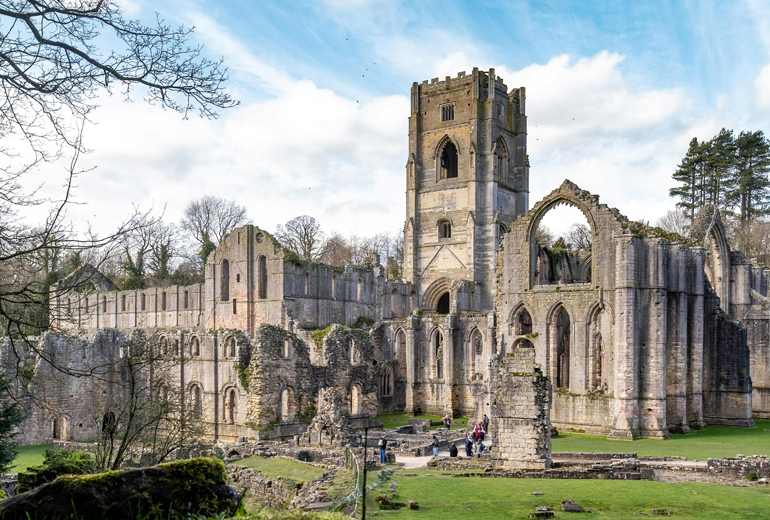
At the heart of the estate stand the monumental remains of Fountains Abbey, one of the largest and most evocative monastic ruins in England. The abbey's skeletal framework tells the story of Cistercian monasticism through its soaring arches, imposing tower, and expansive stone foundations that stretch across the valley floor.
The nave remains particularly striking, with its series of pointed arches creating a cathedral-like atmosphere even without a roof. Visitors can walk through what was once the monks' processional route, experiencing the scale and grandeur that would have greeted medieval pilgrims. The choir area, though roofless, retains much of its structural integrity, allowing guests to imagine the daily liturgical life that once filled these spaces with Gregorian chant.
The tower, reaching skyward at 165 feet, serves as a dramatic focal point visible from throughout the estate. Its sturdy Norman construction contrasts beautifully with the more delicate Gothic elements found elsewhere in the ruins. The cellarium, or lay brothers' quarters, showcases impressive vaulted ceilings that have survived the centuries, creating cool, contemplative spaces perfect for quiet reflection. This remarkable 300-foot structure with its large, vaulted ceilings remains one of the internationally renowned features of the abbey.
Stone pathways wind between the various chambers, including the chapter house where monastic community meetings once took place, and the refectory where hundreds of monks once dined in silence. Information panels throughout the ruins help visitors understand the daily rhythm of monastic life without overwhelming the contemplative atmosphere.
Fountains Hall
Adjacent to the abbey stands the distinguished Fountains Hall, a magnificent Jacobean manor house built from honey-coloured stone reclaimed from the abbey itself. This architectural gem demonstrates the transition from medieval to Renaissance sensibilities, with its symmetrical façade, mullioned windows, and elaborate chimneys creating a striking contrast to the abbey's Gothic austerity. Completed in the early 17th century, the hall showcases how post-Dissolution landowners repurposed monastic materials.
The hall's formal gardens feature carefully maintained box hedging, seasonal flower displays, and specimen trees that frame views of both the building and the abbey beyond. These gardens serve as an elegant transition between the more formal landscape design and the wilder parkland areas. Access to the interior is limited to a few rooms, though the building's mysterious, almost casket-like quality creates an intriguing exterior presence.
Monastic Mill and Water Features
The mill, another fascinating remnant of the abbey's industrial past, sits alongside the River Skell where it once ground grain for the monastic community. At 800 years old, Fountains Mill is the only surviving Cistercian cornmill in Britain and represents the oldest building within the estate. The restored mill wheel and accompanying water channels demonstrate the ingenious hydraulic engineering that the Cistercian monks employed to harness the river's power. The gentle sound of flowing water adds to the peaceful ambiance whilst illustrating the practical aspects of medieval monastic life. The mill operated continuously until 1927, testament to the enduring quality of monastic engineering.
Studley Royal Water Garden
The Formal Water Features
The exquisite Studley Royal Water Garden represents the pinnacle of Georgian landscape design, created as a series of interconnected water features that flow naturally down the River Skell valley. This masterpiece of 18th-century garden art demonstrates the period's fascination with the interplay between formal design and natural topography, developed by John Aislabie beginning around 1716.
The Moon Pond and Crescent Pond form the garden's centrepiece, their geometric shapes creating perfect reflections of the sky and surrounding trees. The Moon Pond is circular with a submerged causeway, flanked by the crescent-shaped ponds that create striking visual compositions. These formal pools are connected by a series of cascades that create gentle water music as they tumble over carefully constructed stone steps. The mathematical precision of these water features contrasts beautifully with the organic curves of the surrounding landscape.
Canal-like waterways lined with clipped hedges guide visitors along prescribed routes whilst offering constantly changing perspectives of the garden's composition. The grade I-listed canal stretches approximately 500 metres long and 10 metres wide, featuring gritstone walls and a puddled clay base. These channels, bordered by laurel banks and punctuated by ornamental bridges, create a sense of journey and discovery that unfolds gradually as one moves through the space.

Classical Architecture and Follies
Throughout the water garden, carefully positioned temples and follies serve as focal points and rest stops. The Temple of Piety, with its classical columns and elegant proportions, provides shelter whilst framing views across the water to the abbey ruins. The Temple of Fame, a small rotunda built around 1770, is perched on higher ground along the High Ride path, offering panoramic vistas across the entire estate.
The Banqueting House stands as a testament to Georgian entertaining, its Palladian-style architecture and riverside location making it an ideal spot for outdoor dining with prospects over the formal gardens. The Octagon Tower, constructed around 1735, represents another architectural highlight positioned high on the west side of the valley. These structures aren't merely decorative; they serve as viewing platforms that transform the landscape into a series of living paintings.
The Surprise View and Woodland Walks
The celebrated Surprise View represents one of landscape design's greatest theatrical moments. Also known as Anne Boleyn's Seat, this neo-classical garden seat is approached through a dark Serpentine Tunnel that heightens anticipation, with visitors emerging to a breathtaking panorama of Fountains Abbey framed by the valley's natural contours. This carefully orchestrated revelation demonstrates the Georgian understanding of emotional manipulation through landscape architecture.
Serpentine paths wind through carefully managed woodland areas, past hidden grottos and hermitages that add elements of mystery and contemplation to the garden experience. Ancient yew tunnels create natural corridors that focus attention on specific views whilst providing shelter and shade. The High Ride path offers elevated perspectives across the entire landscape, connecting various follies and viewpoints.
Seasonal Plantings and Horticultural Features
The water garden showcases year-round interest through carefully planned seasonal displays. Spring brings carpets of snowdrops and early bulbs that naturalise throughout the woodland areas, creating spectacular drifts of colour beneath ancient trees. Summer reveals the full glory of the herbaceous plantings, with colourful wildflowers and carefully maintained formal bedding providing vibrant contrasts to the green lawns and water features.
Autumn transforms the landscape into a tapestry of golden and russet tones, with the mature tree collection displaying spectacular seasonal colour that reflects beautifully in the still waters of the ponds. The ancient lime tree avenue that leads through the deer park to the original entrance gate becomes particularly striking during this season. Winter brings its own atmospheric beauty, with frost highlighting the architectural details of the follies and the stark silhouettes of the abbey ruins creating dramatic compositions against grey Yorkshire skies.
Wildlife and Natural Features
The Deer Park
Beyond the formal gardens, the estate's medieval deer park is home to approximately 300 to 500 wild deer representing three distinct species. Red deer, the largest inhabitants of Studley Royal Park, are indigenous to the UK and typically display dark reddish-brown colouring. The males, called stags, bear impressive antlers shaped like tree branches, whilst females (hinds) and their young (calves) create family groups throughout the parkland.
Fallow deer, introduced during the Norman Conquest and brought to Studley Royal in the late 1600s, display characteristic pale brown colouring with white spots, though occasionally all-white or dark variations appear. The males (bucks) sport distinctive 'palmate' antlers that are broad and flat, whilst the females (does) tend to their young (fawns) during the summer months.
Sika deer represent the smallest and most timid population within the park. Originally native to China, Korea, and Eastern Russia, these Asian deer are distinguished by their white, heart-shaped marking on their hindquarters. The deer give birth throughout June and July, creating opportunities for visitors to observe the calves, though mothers often leave their young resting in shady spots as natural behaviour.
The rutting season during autumn provides spectacular wildlife viewing opportunities, with dominant stags establishing territories and guarding harems whilst younger males engage in sparring sessions to establish hierarchy within the herds.
Flora and Ancient Trees
The parkland boasts an extraordinary collection of ancient trees, with numerous specimens over 300 years old contributing to the landscape's timeless character. The Cherry Tree in the deer park holds particular significance as one of the oldest cherry trees in the UK, estimated to be at least 325 years old. Despite storm damage in 2008 that reduced it to a single remaining stem, conservation efforts continue, with 30 cuttings taken in 2022 for propagation at the National Trust's Plant Conservation Centre.
The estate supports diverse woodland habitats that change dramatically with the seasons, from spring carpets of bluebells and wood anemones to summer displays of meadow flowers and autumn fungi. Ancient yew groves create cathedral-like spaces beneath their spreading canopies, whilst oak, ash, and beech specimens provide nesting sites and food sources for countless wildlife species.
Avian Life and Smaller Wildlife
The estate at Fountains Abbey and Studley Royal is rich with birdlife, including goldfinches, blue tits, song thrushes, various woodpecker species, geese, and swans. The conservation team monitors bird populations using the traffic light system of red, amber, and green conservation bands. Marsh tits, currently in the red conservation band, have been recorded nesting on the estate in recent years, with fledglings occasionally spotted around the grounds in May.
The varied habitats support numerous other wildlife species, from butterflies that frequent the wildflower meadows to hedgehogs that, despite declining numbers nationally, still inhabit the estate grounds. The combination of formal gardens, ancient woodland, open parkland, and water features creates an exceptionally diverse ecosystem that supports both common and rare species throughout the year.
St Mary's Church
Set within the parkland stands St Mary's Church, an exquisite masterpiece of High Victorian Gothic architecture designed by William Burges in 1871. Considered one of Burges's finest works, this striking church provides a dramatic counterpoint to the medieval abbey ruins with its elaborate spires, richly decorated stonework, and jewel-like stained glass windows. The church's position within the deer park creates spectacular approaches from multiple directions, with ancient trees framing views of its distinctive silhouette.
The interior showcases Burges's characteristic attention to detail, with intricate carved stonework, magnificent stained glass, and elaborate decorative schemes that reflect the Victorian Gothic Revival movement at its peak. The church remains an active place of worship whilst also serving as an architectural highlight for visitors exploring the wider estate.
Facilities and Experiences
Visitor Infrastructure
Fountains Abbey & Studley Royal Park is exceptionally well-equipped for visitors of all ages and interests, with comprehensive facilities designed to enhance every aspect of the experience. A network of pathways suitable for leisurely strolls or extended walks connects all major attractions, with options ranging from short accessible routes to challenging longer circuits that explore the furthest reaches of the deer park.
Engaging family trails and a dedicated children's play area ensure younger visitors remain entertained throughout their visit. The play area features a charming miniature wooden abbey that allows children to explore monastic architecture in a hands-on way, along with climbing structures and imaginative play equipment set within sight of the real abbey ruins.
Dining and Shopping
Refreshments are available at multiple locations across the estate, including the main restaurant at the Visitor Centre and the Studley Royal tea-room positioned to offer scenic views over the lakes and formal gardens. Both establishments serve seasonal menus featuring local ingredients, from full hot meals and sandwiches to sweet treats and traditional afternoon tea options.
The National Trust shop and plant centre provides an extensive selection of gifts, books, and souvenirs, with particular emphasis on seasonal stock inspired by National Trust properties. Visitors can find everything from silk scarves in unique prints to homeware pieces, garden tools and accessories, seasonal blooms, and locally-produced food and drink items.
Accessibility and Special Provisions
The estate works to ensure accessibility for all visitors, though the site's historic nature and extensive grounds present some challenges. Wheelchair access is available to most major attractions, with particular attention paid to providing level routes to the abbey ruins via the Westgate car park. A regular shuttle service operates between the Visitor Centre, Westgate, Studley, and St Mary's Church, with wheelchair-friendly vehicles available upon request.
Assistance dogs are welcome throughout the estate, and well-behaved dogs on leads can explore almost all areas of the grounds. Special provisions include 'dog parking' areas at the playground and dog-friendly dining options at the restaurant.
Seasonal Events and Activities
Throughout the year, the estate hosts a diverse programme of events that celebrate both the natural and cultural heritage of the site. Wildlife walks led by knowledgeable volunteers provide insights into the deer populations and other fauna, whilst seasonal nature trails highlight different aspects of the changing landscape.
Outdoor theatre performances take advantage of the dramatic abbey ruins as a backdrop, creating magical evening experiences that blend culture with heritage. Re-enactment weekends bring history to life, whilst photography workshops help visitors capture the beauty of the changing seasons and architectural details.
Winter illuminations occasionally transform the ruins into a spectacular light display, whilst spring flower festivals celebrate the estate's horticultural heritage. Summer concerts and autumn harvest celebrations provide year-round reasons to return and experience the estate's ever-changing character.
Getting There
By train, the nearest mainline railway station is Harrogate, located 12 miles from the abbey, from where you'll need to take a connecting bus or taxi to complete your journey. Alternatively, you can travel to Ripon and catch the connecting bus service.
By coach, regular bus services operate to the area, with Transdev service 36 running daily connections to Ripon from Leeds and Harrogate, whilst DalesBus service 139 provides direct transport from Ripon to Fountains Abbey on Mondays, Thursdays, and Saturdays throughout the year. During summer months, additional DalesBus services 822 and 825 operate from York to Fountains Abbey on Sundays and bank holidays.
By car, the abbey is easily accessible via the B6265 to Pateley Bridge from Ripon, approximately 4 miles west of the town centre, with clear brown tourist signs directing you from both the A1 and A61. The site is situated 12 miles north of Harrogate, and free parking is available at the visitor centre.
Best Time to Visit
Fountains Abbey & Studley Royal Park can be experienced throughout the year, with each season presenting its own unique charm. Spring brings delightful wildflowers and emerging daffodils and crocuses after the winter frosts, whilst summer provides the perfect conditions for picnics on the lush green grass with lovely warm weather. Autumn is particularly spectacular, as the parkland transforms with brilliant reds and golds adorning the trees, creating a stunning natural display. Winter visitors can enjoy a magical atmosphere when frost and snow turn the landscape into a winter wonderland, and the abbey hosts special Christmas services, choirs, and colourful lighting displays. October holds special appeal with the "Fountains by Floodlight" events, where the abbey ruins are dramatically illuminated with golden floodlights, creating an enchanting evening experience. Late spring (May to June) and early autumn (September to October) are considered optimal periods for those seeking the most comfortable walking conditions and the best of both mild weather and seasonal beauty.