


 Ireland Guide
 Scotland Guide
 Wales Guide
| Contents |
|---|

Introduction
Burton Constable Hall is a Grade I-listed Elizabethan country house set amid 300 acres of Capability Brown-designed parkland in the East Riding of Yorkshire, three miles south-east of Skirlaugh and nine miles north-east of Hull. Built around a 12th-century pele tower and remodelled in the 1560s by Sir John Constable, the house retains 18th- and 19th-century interiors—including one of the finest surviving cabinets of curiosities—and has remained the Constable family’s home for over four centuries. Today the Hall, Stables Kitchen and gift shop are open to visitors, offering guided tours of more than thirty rooms, landscaped gardens, walks and family activities.
Interesting Facts about Burton Constable Hall
- Burton Constable Hall has been the ancestral home of the Constable family for over 400 years, making it one of England's longest continuously family-owned estates.
- The oldest surviving part of the hall is a 12th-century limestone tower, known as Stephen's Tower, which originally served as a medieval pele tower to protect the village during the reign of King Stephen.
- The hall houses one of the most significant 18th-century Cabinets of Curiosities surviving in its original country house setting, created by William Constable who believed it was possible to cross-breed rabbits and chickens.
- The 300-acre parkland surrounding the hall was designed by the famous landscape architect Lancelot 'Capability' Brown, representing one of the best-documented examples of his work.
- A 59-foot-long sperm whale skeleton, which became stranded at nearby Tunstall in 1825, is displayed in the Great Barn and famously inspired Herman Melville's reference to it in his masterpiece Moby-Dick.
- The Chinese Room features extraordinary gilded dragons climbing either side of the window bay and was designed in the 1820s by Marianne, Lady Clifford Constable, who was inspired by the Prince Regent's Brighton Pavilion.
- Sir John Constable, who built the current Elizabethan mansion in the 1560s, was a remarkable character who successfully navigated the treacherous religious and political conflicts of 16th-century England despite supporting both Catholic and Protestant sides.
- The hall contains over 30 lavishly decorated rooms filled with original furnishings, including pieces by renowned craftsmen Thomas Chippendale and architect James Wyatt.
- The estate includes a unique French orange tree automaton from 1815 that creates the illusion of birds singing to accompanying music.
- Burton Constable incorporates a fascinating building history, with the current Elizabethan 'prodigy house' built around and incorporating remains of earlier medieval and 15th-century structures.
- As Lord Paramount of the Seigniory of Holderness, Sir Clifford Constable was legally entitled to anything of interest that washed up on the foreshore, which is how the estate came to possess the famous whale skeleton.
- The hall's Great Hall was originally an Elizabethan room that rose to the full height of the building and was top-lit by a lantern before being remodelled with wonderful plasterwork ceilings.
History
Burton Constable Hall boasts a remarkably complex architectural history spanning nearly nine centuries, with its earliest foundations dating to the 12th century. The oldest surviving structure is the lower portion of the north tower, known as Stephen's Tower, which served as a medieval pele tower to protect the village of Burton Constable during the reign of King Stephen. The site's name itself reflects its fortified origins, with "Burton" meaning a settlement at a fortified dwelling, whilst the Constable family added their name to the manor in the 13th century when Erneburga of Burton married Ulbert Constable for the Count of Aumale in 1190. By the 12th century, a bustling village of approximately 40 families occupied the site, complete with long strips of farmland, wooded common land for rabbit catching, and a small mill. However, the Black Death plague of 1349 and declining crops led to the village's eventual disappearance by the 1500s, when the Constable family enclosed the land for their grand manor.
The magnificent Elizabethan mansion visitors see today was largely created by Sir John Constable (1526-1579) during the 1560s, who proved remarkably adept at navigating Tudor political complexities despite supporting both Catholic and Protestant sides of religious struggles. Sir John purchased the Seigneury of Holderness from the Earl of Westmorland for £4,000 and embarked on building what became known as an Elizabethan prodigy house. His transformation incorporated remains of the late 15th-century brick manor house, including the north lodgings wing and north tower, which were modernised with new stone mullioned windows and mock quoins to harmonise with the new building. The new construction featured a Great Hall rising the full height of the building with top-lighting from a lantern, alongside a parlour, great chamber, and south wing containing kitchens, additional lodgings, and a chapel. A turreted gatehouse, courtyards, and stable block completed the complex, as depicted in the earliest known painting of the house that hangs in the Great Hall.
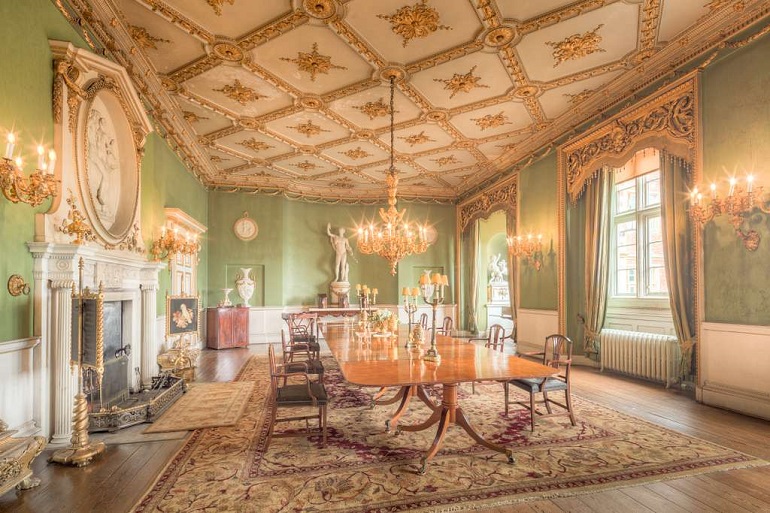
The 18th century brought extensive Georgian remodelling when William Constable commissioned leading architects including John Carr, Timothy Lightoler, and Lancelot "Capability" Brown for both interior redesigns and landscape improvements during the 1760s. The dining room received particular attention with designs from Robert Adam, Thomas Atkinson, and Timothy Lightoler, featuring plasterwork by Giuseppe Cortese and ceiling decorations inspired by contemporary excavations at Pompeii and Herculaneum. Between 1772 and 1782, Capability Brown transformed the parkland into one of his best-documented projects, joining existing ponds to create two lakes separated by a dam-cum-bridge, whilst installing clumps of trees, sunk fences, and the characteristic ha-ha. William Constable also assembled one of England's most significant Cabinets of Curiosities, purchasing scientific instruments including an 18th-century telescope from York clockmaker Henry Hindley in 1760 for 100 guineas—believed to be the world's first equatorially-mounted telescope. The estate gained further notoriety when a 59-foot sperm whale stranded at nearby Tunstall in 1825 was erected as a skeleton in the park, later immortalised in Herman Melville's *Moby-Dick*, where he described Sir Clifford Constable's articulated whale specimen.
Description
Architectural Grandeur
Exterior Magnificence
The Hall presents a striking symmetrical façade of warm terracotta brick, its H-plan design embodying the finest principles of Elizabethan prodigy house architecture. The central block, flanked by elegant wings, rises to a distinctive lantern-crowned Great Hall that dominates the skyline. Mullioned windows march across the façades in perfect rhythm, their stone surrounds contrasting beautifully with the rich brickwork.
The builders achieved a remarkable architectural harmony by incorporating medieval remnants—most notably visible in the weathered limestone foundations of the north tower—with the grand ambitions of Tudor magnificence. Ornate brick diapering enriches the upper storeys, while sculptural stone dressings frame doorways and windows. The roofline bristles with elaborate chimneystacks, their twisted forms silhouetted against Yorkshire skies, whilst corner towers anchor the composition with fortress-like authority.
Classical pediments crown the main entrance, supported by columns that hint at the Renaissance influences permeating English architecture of the period. The south façade, facing the gardens, presents a particularly theatrical composition where projecting bays create dramatic plays of light and shadow throughout the day.
Structural Innovation
The Hall demonstrates sophisticated engineering for its era, with load-bearing walls that support expansive window openings whilst maintaining structural integrity. The integration of medieval foundations with Elizabethan superstructure required ingenious solutions, evident in the subtle changes of building material and the careful alignment of new work with ancient walls.
Interior Splendour
The house unfolds through more than thirty interconnected rooms, each space telling its own story whilst contributing to a cohesive narrative of evolving taste and changing fashions across five centuries.
Grand Reception Rooms
The Entrance Hall immediately establishes the house's nobility with its soaring proportions and monumental stone fireplace bearing the Constable family arms. Classical marble busts of Roman emperors line niches, their stern gazes surveying visitors as they have for generations. The space breathes with natural light streaming through tall windows, whilst polished oak floors reflect the glow of crystal chandeliers suspended from an elaborately moulded ceiling.
The Great Hall represents the ceremonial heart of the house, its full-height volume creating an atmosphere of medieval grandeur softened by Georgian refinement. Though the original lantern remains concealed above James Henderson's 18th-century plasterwork ceiling, the space retains its Elizabethan proportions and sense of occasion. Heraldic shields punctuate the walls, whilst a magnificent minstrels' gallery overlooks the space from the western end.
The hall's oak-panelled walls rise to meet an intricate frieze depicting mythological scenes, their carved reliefs catching and reflecting light throughout the day. A vast refectory table, capable of seating twenty, dominates the centre, whilst Cromwellian chairs and Jacobean settles provide intimate seating areas beneath towering windows.
Intimate Living Spaces
The Chinese Room showcases the 18th-century fascination with Oriental aesthetics, transformed into a whimsical sanctuary of Chinoiserie delights. Hand-printed wallpaper, supplied by the renowned Chippendale workshop, depicts pagodas, exotic birds, and flowering trees in delicate blues and golds. Lacquered furniture gleams beneath gilt dragons that spiral around window frames, whilst porcelain vases and jade ornaments complete the exotic tableau.
The room's bamboo-effect furnishings include an extraordinary desk whose legs terminate in carved elephant feet, and chairs upholstered in silk depicting chrysanthemums and peonies. A corner cabinet displays blue and white porcelain accumulated during the family's Grand Tour ventures, whilst silk curtains filter light through their painted landscapes of distant mountains and pavilioned gardens.
The Staircase Hall provides a vivid theatrical ascent painted in authentic period green that immediately transports visitors to the Georgian era. The colour, mixed according to 18th-century recipes, creates an atmosphere of refined drama enhanced by curving mahogany balustrades that flow like frozen music toward the upper floors.
Elaborately moulded 17th-century plasterwork crowns the space, its swirling acanthus leaves and fruit garlands picked out in gold leaf. Ornate brass lanterns illuminate each landing, their flickering light (now electric but retaining original fittings) playing across painted wall panels and reflected in gilded mirrors. The ascent provides glimpses through doorways into successive chambers, each tantalising view drawing visitors deeper into the house's mysteries.
Specialist Collections
The Cabinet of Curiosities represents one of England's finest surviving examples of Enlightenment collecting, housed within William Constable's purpose-built Wunderkammer. Cabinets of polished ebony and Italian marble display an extraordinary assemblage: narwhal tusks alongside ancient Egyptian canopic jars, mineralogical specimens beside medieval manuscripts, scientific instruments sharing space with exotic shells and coral formations.
The room's glass-fronted cases protect delicate artefacts whilst allowing detailed examination of their craftsmanship. Visitors can study Roman coins, examine fossilised ammonites, and marvel at intricate clockwork automata that still function after centuries. The collection reflects the intellectual curiosity of the Georgian gentleman-scholar, when natural philosophy and artistic appreciation were considered essential accomplishments.
Additional State Rooms
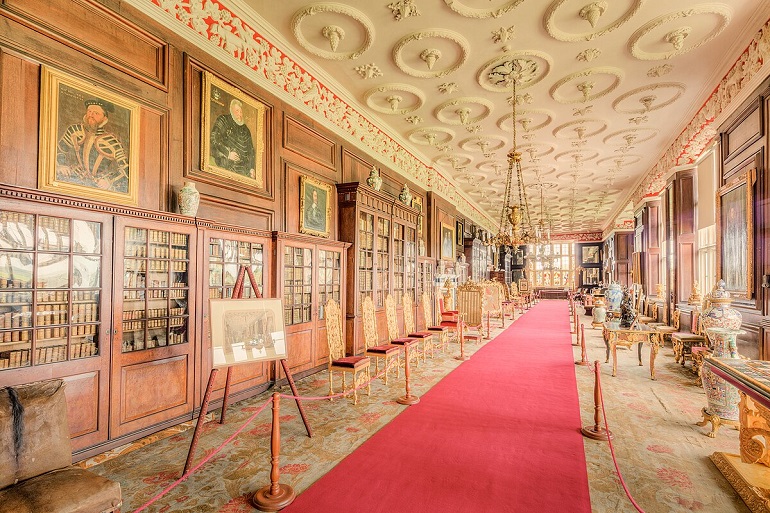
The Long Gallery stretches the entire length of the house's upper floor, its 110-foot expanse originally designed for indoor exercise during inclement weather. Family portraits line the walls in gilded frames, creating a visual genealogy spanning four centuries. The gallery's proportions—deliberately narrow to encourage promenading—offer constantly changing perspectives through tall windows overlooking the gardens.
The Blue Drawing Room epitomises Regency elegance with its sumptuous silk wall coverings and furniture arranged in intimate conversational groups. Gilt-bronze mounts ornament satinwood furniture, whilst a marble chimneypiece supports Sèvres porcelain and ormolu clocks. The room's acoustic properties, enhanced by its proportions and soft furnishings, made it ideal for musical entertainments.
The Dining Room seats twenty-four around a mahogany table set with Constable family silver and Crown Derby porcelain. Portraits of family patriarchs oversee meals, whilst sideboards display racing trophies and ceremonial plate. The room's deep red damask walls provide a rich backdrop for evening entertainments lit by matching crystal chandeliers.
Gardens and Landscape
Capability Brown's Parkland
The Hall sits within 330 acres of landscaped parkland designed by Lancelot 'Capability' Brown, England's most celebrated landscape architect. His naturalistic vision transformed formal baroque gardens into flowing compositions of lawn, water, and carefully placed tree clumps that appear effortlessly natural whilst being entirely artificial.
Serpentine lakes reflect the house's façades, their irregular shorelines planted with weeping willows and ornamental bridges spanning narrow channels. The ha-ha—a concealed ditch preventing livestock from approaching the house whilst maintaining uninterrupted views—demonstrates Brown's genius for invisible boundaries that preserve landscape unity.
Ancient parkland oaks, some predating the house itself, punctuate rolling grassland grazed by rare-breed cattle whose presence maintains the medieval landscape character. Avenue plantings of lime and beech create formal approaches, their seasonal changes marking the passage of time across generations of Constable occupancy.
The Walled Garden
The 18th-century walled garden represents one of Yorkshire's finest examples of productive landscape design, its four-acre enclosure originally heated by an innovative "stove house" system that enabled cultivation of exotic fruits and vegetables throughout harsh northern winters.
Pedimented pavilions anchor each corner, their classical proportions providing focal points for geometric plantings that blend utility with beauty. Central grass paths divide the space into quarters, each section devoted to different horticultural purposes: kitchen vegetables, cutting flowers, soft fruit, and ornamental shrubs.
The restored glasshouses shelter tender plants whilst providing year-round garden interest. Victorian peach houses, their south-facing walls warmed by afternoon sun, still produce fruit using traditional cultivation methods. Heritage apple varieties trained against warming walls include local Yorkshire cultivars alongside rarities from the Constable family's European travels.
Contemporary plantings respect historical precedent whilst accommodating modern maintenance requirements. Herbaceous borders peak in midsummer abundance, their cottage-garden profusion softening the geometric formality of box-edged beds and gravel pathways.
Pleasure Gardens and Woodland
Beyond the walled garden, informal pleasure grounds invite leisurely exploration along winding paths that reveal carefully composed vistas. The rose garden, enclosed by yew hedging, displays varieties spanning three centuries of breeding, from ancient gallicas to modern English roses.
Specimen trees include rare conifers planted by Victorian Constables during their botanical enthusiasms. A dawn redwood, among the first planted in England following the species' rediscovery in China, towers above rhododendron plantings that provide spring colour beneath its spreading canopy.
The woodland garden follows natural contours through mixed plantings of native and exotic species. Spring brings drifts of naturalised bulbs—snowdrops, crocuses, and daffodils—followed by bluebells carpeting the woodland floor. Meandering streams feed the main lake, their banks planted with moisture-loving perennials and ferns.
Garden buildings punctuate the landscape: a Georgian orangery houses citrus trees during winter months, whilst Gothic follies provide romantic focal points for garden vistas. The Bothy cottage, originally accommodation for head gardeners, nestles within a sea of white roses that bloom in succession throughout summer.
Collections and Treasures
Fine Art Collection
The house contains one of Yorkshire's most significant private art collections, accumulated through centuries of patronage and collecting. Family portraits by leading artists chronicle changing fashions in both dress and artistic style, whilst landscape paintings document the estate's evolution.
Old Master paintings include works attributed to Continental masters acquired during Grand Tour expeditions. Religious subjects hang alongside mythological scenes, their rich colours enhanced by careful conservation and sympathetic lighting.
The portrait collection spans four centuries, from Tudor panel paintings to Victorian photography. Formal state portraits in gilded frames share walls with intimate family groups, creating a visual narrative of domestic life across generations.
Decorative Arts
Furniture collections represent the finest English craftsmanship from the 16th to 19th centuries. Elizabethan oak gives way to Georgian mahogany, whilst Regency rosewood and satinwood demonstrate changing tastes and improving trade connections.
The china collection includes services commissioned for specific occasions: wedding breakfast sets, coronation commemoratives, and everyday family porcelain that survived daily use across centuries. Crown Derby, Spode, and Chinese export porcelain reflect both English and international sources.
Textile collections preserve rare examples of historical furnishing fabrics. Bed hangings, upholstery, and window treatments demonstrate contemporary colour schemes whilst highlighting the skills of historical embroiderers and weavers.
Natural History Specimens
William Constable's scientific interests resulted in extensive natural history collections that remain largely intact. Geological specimens from Yorkshire and beyond demonstrate contemporary understanding of Earth's history, whilst botanical specimens preserve examples of plants no longer cultivated.
The mineralogy collection includes both local finds and exotic specimens acquired through scholarly correspondence. Fossils from Yorkshire's coast sit alongside tropical shells and coral formations that amazed Georgian visitors unfamiliar with such exotic forms.
Getting There
Burton Constable Hall, situated in Holderness, East Yorkshire, is readily accessible by various transport methods, being just 10 miles northeast of Hull and 15 miles east of Beverley. By train, visitors should travel to Hull Paragon Interchange, the nearest railway station, from where Burton Constable is approximately a 25-minute taxi journey.
By coach, take the East Yorkshire Motor Service 277 from Hull Paragon Interchange (stand 34) to the nearest bus stop on Balk Lane, Sproatley, then enjoy a pleasant 2-mile walk to the Hall via the clearly signposted Burton Constable Holiday Park and across Capability Brown's Bridge.
By car, the route is well-marked with Historic House signs: from Hull, follow the A1033 towards Hedon, turn left at Saltend roundabout and follow signs to Preston and Sproatley; alternatively, from Beverley, take the A1035 Bridlington road, turn right at White Cross roundabout, then follow the A165 towards Hull and the Historic House signs from Skirlaugh.
Best Time to Visit
The best time to visit Burton Constable Hall truly depends on what you wish to experience, as this grand estate offers a changing programme of delights throughout the year. For those keen to explore the 330 acres of 'Capability' Brown parkland, the summer months are ideal, with warm weather and a vibrant calendar of outdoor events including open-air theatre, classic car shows, and craft fairs. The Hall itself is generally open from April to early November, and visiting during this period allows you to see its magnificent rooms. However, the estate also holds special seasonal events; autumn brings Halloween fun and ghost tours, whilst the festive period sees the Hall beautifully decorated for Christmas, hosting fairs and musical performances. The grounds, stables, and gift shop remain open daily for most of the year, but as the Hall's opening times are more restricted, it is always wise to check the official website for the latest event schedules and opening details before you travel.