


 Ireland Guide
 Scotland Guide
 Wales Guide
| Contents |
|---|

Introduction
Bowood House is a Grade I listed Georgian country house near Calne in Wiltshire, set within some 4,000 acres of parkland laid out by Lancelot “Capability” Brown. Built in the 1720s on the site of an earlier hunting lodge and remodelled in part by architects Henry Keene and Robert Adam, the estate has been the seat of the Fitzmaurice family—later Marquesses of Lansdowne—since 1754. The surviving “Little House” contains period interiors, including Adam’s orangery and a laboratory where Joseph Priestley discovered oxygen in 1774, while the grounds feature formal terraces, an arboretum, an Italianate garden and a recently opened walled garden. Open daily to visitors from April to November, Bowood also offers family facilities such as an adventure playground, cafés and guided tours of both house and gardens.
Interesting Facts about Bowood House
- Bowood House is where oxygen was first discovered by Joseph Priestley on 1st August 1774, earning it designation as an ACS National Historic Chemical Landmark in 2000.
- The house has been owned by the Fitzmaurice family (Earls of Shelburne and Marquesses of Lansdowne) for more than 250 years.
- In the 18th century, Robert Adam designed a menagerie at Bowood where exotic animals including a leopard and an orangutan were kept.
- William Petty, 2nd Earl of Shelburne, who lived at Bowood, served as Prime Minister from 1782 to 1783 and was created Marquess of Lansdowne for negotiating peace with America after the War of Independence.
- The picturesque lake at Bowood was created by flooding the village of Manning's Hill, whose submerged cottages and stone walls were rediscovered by divers in 2007.
- Among the family treasures displayed at Bowood are Napoleon's death mask and Queen Victoria's wedding chair.
- The famous "Big House" at Bowood was demolished in 1955 due to its deteriorated condition after standing empty since the Second World War.
- During the First World War, part of Bowood was converted into a military hospital overseen by the 5th Marchioness of Lansdowne.
- The estate features one of the most exciting adventure playgrounds in the South West, complete with a life-size pirate ship built from wood sourced from Bowood's own estate.
- Bowood's walled garden was opened to the public for the first time in its 270-year history in 2025.
- The grounds contain an outstanding collection of rare trees and shrubs planted by Capability Brown in the 1760s, including nine champion specimens.
- The estate's Rhododendron Walks cover 60 acres and contain almost thirty original hardy hybrid rhododendrons that were thought to be extinct.
- Robert Adam's magnificent Orangery, originally designed as a conservatory, now serves as an art gallery displaying the Lansdowne collection.
- The estate features classical picturesque elements including a Doric Temple, cascades, a hermit's cave, and grottoes added in the 1780s.
- Bowood House and its grounds hold the prestigious Grade I listing status, recognising their exceptional architectural and historic importance.
History
The Origins and Early Development of Bowood House
The first house at Bowood was constructed around 1725 on the site of a former royal hunting lodge by Sir Orlando Bridgeman, 2nd Baronet, who had purchased the property from the Crown. His grandfather, Sir Orlando Bridgeman, Lord Chief Justice of the Common Pleas, had originally been granted the lease by Charles II. However, Bridgeman's financial difficulties led to a dramatic turn of events—in 1737, he faked his own suicide by leaving farewell letters and his clothes by the Thames before hiding at an inn in Slough, eventually dying in Gloucester gaol in 1746. The unfinished house and park were acquired in 1739 through a Chancery decree by his principal creditor, Richard Long. In 1754, the estate was purchased by John Petty, 1st Earl of Shelburne, who immediately employed architect Henry Keene to complete and extend the house, adding an impressive portico on the south front and service suites.
The Golden Age Under the Marquesses of Lansdowne
The estate's most illustrious period began under William Petty, 2nd Earl of Shelburne, who served as Prime Minister from 1782 to 1783 and was created 1st Marquess of Lansdowne in 1784 for negotiating peace with America after the War of Independence. He commissioned the renowned architect Robert Adam to decorate the grander rooms and create the magnificent Diocletian Wing (Orangery), which still dominates the house entrance today. Adam also designed a mausoleum for the 1st Earl in the park and employed Benjamin Carter to sculpt chimney-pieces for the house. Bowood became a centre of intellectual activity, with notable guests including Benjamin Franklin and Mirabeau, an early leader of the French Revolution. Most significantly, on 1st August 1774, Joseph Priestley, the house librarian and tutor to the Earl's sons, discovered oxygen in his laboratory at Bowood, earning the estate a place in scientific history. The estate's grounds were transformed in the 1760s by Lancelot "Capability" Brown, who created the sinuous lake almost one kilometre long and laid out the landscape over 2,000 acres. In the 1780s, Charles Hamilton added a cascade, grottoes, and a hermit's cave to complement Brown's design.
War, Demolition, and Modern Revival
The 20th century brought dramatic changes to Bowood House. During the First World War, part of the Diocletian Wing was converted into a military hospital, opened and overseen by the 5th Marchioness. The Second World War saw the Big House used first by Westonbirt Girls School and then by the RAF. Tragedy struck in 1944 when both the 7th Marquess and his brother were killed in action, causing the title to pass to their cousin. The 8th Marquess found the Big House so dilapidated after the war that he made the difficult decision in 1955 to demolish it entirely. Architect Frederick Sortain Samuels was employed to convert the surviving Little House into a more comfortable residence, which forms the current house that visitors see today. Before demolition, Adam's dining room was carefully removed and eventually installed in Lloyd's of London building. The remaining house and its Grade I listed gardens, designed by Brown and Hamilton, continue to be owned by the Petty-Fitzmaurice family, with the 9th Marquess Charles Petty-Fitzmaurice serving as the current custodian of this remarkable 300-year-old estate.
Description
The House and Interiors
Robert Adam's Architectural Legacy
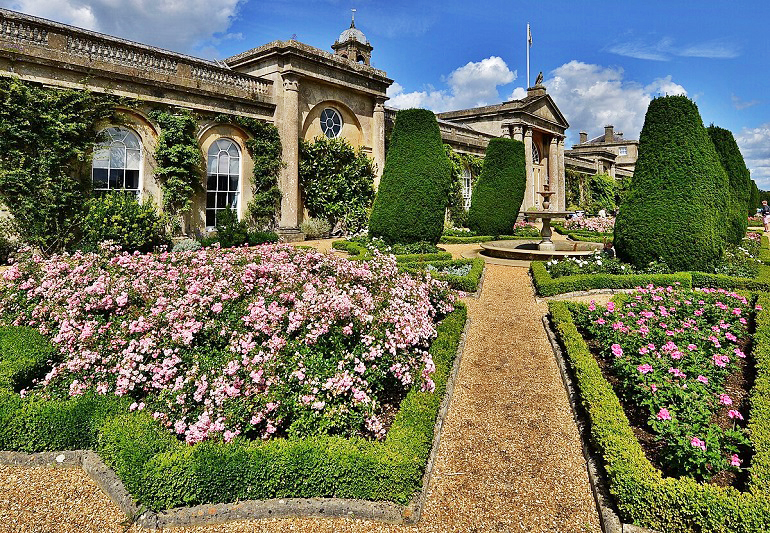
The house itself represents the pinnacle of 18th-century domestic architecture. Robert Adam's signature style permeates every room, from the delicate ceiling plasterwork to the carefully calibrated proportions that create an atmosphere of both grandeur and intimacy. The pale ashlar stone exterior, quarried from local Bath stone, weathers beautifully to create subtle variations in tone that shift throughout the day as light plays across the balanced façades.
Principal Rooms
The Orangery serves as the estate's most spectacular interior space. This soaring gallery, with its series of perfectly arched windows, floods the room with natural light that dances across polished Purbeck stone floors. The subtle neoclassical detailing includes delicate ionic pilasters and an intricate coffered ceiling adorned with Adam's characteristic palmette and anthemion motifs. Originally designed to house exotic citrus trees during winter months, the space now functions as an exhibition gallery where the architecture itself provides the primary attraction.
Adjacent to the Orangery, the Family Chapel offers an intimate contrast to the grandeur elsewhere. Rich oak panelling, installed in the early 19th century, creates a warm, contemplative atmosphere enhanced by soft light filtering through small-paned windows. The chapel remains consecrated and occasionally hosts private family services, maintaining its original spiritual purpose within the domestic setting.
The Library exemplifies the Georgian ideal of scholarly refinement. Floor-to-ceiling bookcases, crafted from beautifully grained mahogany, house an impressive collection of leather-bound volumes spanning centuries. Between the shelves, niches display fine neoclassical busts and marble sculptures, while the intricate parquet flooring—laid in a geometric pattern of English oak and walnut—reflects the room's intellectual gravitas. A carefully positioned reading alcove beneath tall windows provides the perfect spot for quiet contemplation.
Within the Sculpture Gallery, classical marbles and family portraits create a museum-quality display beneath Adam's expertly designed vaulted ceiling. Discreet skylights, ingeniously integrated into the architectural scheme, provide optimal lighting that enhances each sculpture's form while protecting delicate artworks from harsh direct sunlight. The gallery houses several important pieces, including works attributed to leading 18th-century sculptors.
The Gardens and Parkland
Capability Brown's Masterpiece
The surrounding parkland represents Capability Brown at his most accomplished. His signature serpentine lake winds through the valley bottom, its carefully calculated curves creating ever-changing vistas as visitors move through the landscape. The water feature, fed by natural springs, supports abundant wildlife including great crested grebes, kingfishers, and occasional visiting herons.
From the house's upper terrace, broad Portland stone steps descend through formal terraced gardens where clipped yew hedging provides year-round structure. The herbaceous borders, replanted according to Gertrude Jekyll's principles in the early 20th century, offer seasonal displays of carefully coordinated colour schemes—from delicate spring pastels through summer's bold jewel tones to autumn's warm bronzes and russets.
The Arboretum
The 100-acre Arboretum functions as both botanical collection and designed landscape. Gravelled avenues, wide enough for carriages, wind between specimen trees many of which are champions of their species. The collection includes rare cedars of Lebanon planted in the 1760s, their massive trunks now requiring several people to encircle them. Mature lime avenues create cathedral-like spaces beneath their interlocking branches, while specimen copper-leaf magnolias provide spectacular spring displays of waxy pink and white blooms.
Careful labelling throughout the arboretum provides botanical information without detracting from the landscape's aesthetic appeal. The collection represents not merely horticultural curiosity but a living library of tree species from across the globe, many introduced during the great age of plant hunting in the 18th and 19th centuries.
Water Features and Garden Buildings
The cascade represents one of Brown's more theatrical interventions in the landscape. Here, water tumbles over carefully arranged moss-covered limestone ledges into a series of reflective pools before joining the main lake. The sound of falling water creates a natural symphony that changes with the seasons—from winter's crystalline tinkle to summer's gentle murmur.
Positioned strategically beside the lake, the Doric Temple provides both focal point and contemplative retreat. Its white Portland stone columns, following classical proportions precisely, create perfect reflections in the still water. The temple's positioning was calculated to be visible from multiple viewpoints throughout the parkland, creating what landscape designers term "borrowed scenery"—views that appear natural but are actually carefully orchestrated.
The Woodland Garden
Located two miles from the main house, the 30-acre Woodland Garden offers an entirely different horticultural experience. This naturalised landscape, developed during the Victorian era's passion for exotic plant collecting, contains one of England's finest collections of rhododendrons and azaleas.
Winding bark-chip pathways meander beneath towering specimens some reaching over 20 feet in height. Many of these represent original Victorian hybrids, carefully preserved examples of 19th-century horticultural achievement. Some varieties, once thought extinct, have been rediscovered here growing in their original locations.
The woodland's seasonal progression provides year-round interest. Spring arrives with carpets of native bluebells interspersed with exotic species—Himalayan blue poppies, rare trilliums, and delicate wood anemones. Summer brings the rhododendron display to its peak, with blooms ranging from pristine whites through delicate pinks to deep crimsons and purples.
Secluded woodland ponds, fed by natural springs, create perfect habitats for amphibians and water-loving plants. These quiet waters reflect the dappled light filtering through the canopy above, where ancient oaks mingle with more recent plantings of beech, birch, and ornamental maples.
Family Attractions and Activities
The Adventure Playground
Bowood's adventure playground demonstrates how contemporary family facilities can integrate sensitively with historic landscapes. The centrepiece life-size pirate ship, constructed from sustainable timber, nestles among existing mature trees whose branches provide natural camouflage.
The ship's multiple levels connect through rope walks suspended between trees, creating aerial pathways that offer thrilling perspectives over the surrounding parkland. Giant slides spiral down from the ship's deck, while climbing walls and rope challenges provide varied physical activities suitable for different ages and abilities.
The Den and Activity Barn
Purpose-built for younger visitors, the Den and Activity Barn provides weatherproof play facilities designed to stimulate creativity and imagination. Soft play areas, craft activities, and educational displays about the estate's wildlife ensure that even the smallest visitors can engage meaningfully with the Bowood experience.
The building's architectural design, while clearly contemporary, uses traditional materials and proportions that complement rather than compete with the historic structures nearby.
Hidden Treasures and Seasonal Delights
Throughout the estate, countless smaller discoveries await the observant visitor. Hermits' caves, hewn into hillsides during the 18th-century fashion for romantic ruins, provide mysterious glimpses into past centuries' more theatrical approach to landscape design.
The walled gardens, originally utilitarian spaces for growing produce for the house, now showcase seasonal planting schemes that demonstrate both historical accuracy and contemporary horticultural excellence. Spring bulb displays give way to summer's cottage garden profusion, followed by autumn's harvest displays and winter's architectural plant structures.
Water features throughout the estate create constantly changing reflections and soundscapes. From the main lake's broad expanses that mirror the sky's every mood, to intimate streamside paths where water trickles over ancient stones, these aquatic elements provide both visual interest and wildlife habitat.
Specimen trees dot the landscape, many planted by previous generations and now reaching magnificent maturity. Ancient oaks, some predating the current house by centuries, provide links to the landscape's deeper history. More recent additions include exotic species introduced during Victorian plant-hunting expeditions—Wellingtonias from California, monkey puzzle trees from Chile, and rare conifers from the Himalayas.
The estate's wildlife adds another dimension to the visitor experience. Red kites circle overhead, their distinctive calls echoing across the valley. Deer graze openly in the parkland, seemingly oblivious to human observers. The lake supports diverse waterfowl, while the woodlands provide habitat for everything from tiny wrens to magnificent great spotted woodpeckers.
Getting There
By train, visitors should travel to Chippenham station, the nearest mainline railway station, from where taxis are readily available or you can take the number 55 bus to Studley crossroads.
By coach, regular bus services including routes 33 and X33 (running between Chippenham and Devizes) pass directly through Derry Hill village, whilst route 55 stops conveniently on the A4 near the village turning, though visitors should note it's approximately a 1½ mile walk from the bus stop to the house entrance.
By car, the estate is conveniently positioned just off junction 17 of the M4 motorway and is clearly signposted from both the A4 and A342; simply follow the brown tourist signs to the white entrance gates at the eastern end of Derry Hill village, using postcode SN11 9NF for satellite navigation, where ample free parking is available.
Best Time to Visit
The best time to visit Bowood House is largely dependent on what you wish to see. For horticultural enthusiasts, the undisputed highlight is the flowering season of the separate Woodland Gardens, which are typically open for just six weeks from late April to early June. This is when the extensive collection of rhododendrons and azaleas bursts into a spectacular display of colour. However, for a broader family day out incorporating the main House, the glorious formal gardens, and the renowned Adventure Playground, the warmer summer months from June to early September are ideal. During this period, the weather is generally more favourable for enjoying the expansive grounds and outdoor activities. It is always advisable to check the official Bowood website for the precise opening dates and times for the year of your visit, particularly for the limited season of the Woodland Gardens.