Italy Guide  |
|---|
|
| | Top Italian Cities |
|---|
|
| | Italian Regions |
|---|
|
| | Europe Guide |
|---|
|
| | Travel Tools |
|---|
|
|
|
|
Trentino-South Tyrol Travel Guide
 Rosengarten (Catinaccio) group in the Dolomites, Trentino-South Tyrol. Rosengarten (Catinaccio) group in the Dolomites, Trentino-South Tyrol.
Introduction

Trentino-South Tyrol (known as Trentino-Alto Adige in Italian and Trentino-Südtirol in German) is one of the five autonomous regions of Italy. The region was part of the Holy Roman Empire from the 8th century, then the Austrian Empire and the Austro-Hungarian Empire, until its annexation by Italy in 1919.
One third of the population speaks German as their first language, mostly in the northern province of South Tyrol, where the proportion rises to two thirds of German speakers. A small minority (4%) in the Dolomite Mountains also speaks Ladin, a Rhaeto-Romance language that is not spoken anywhere else. Two minor dialects of Southern Bavarian have survived in the remoteness of Trentino: Mòcheno (aka Fersentalerisch), spoken in three towns of the Mocheni Valley, and Cimbrian (aka Zimbrisch), spoken in a few villages in the south of Trentino.
The region offers some of the best skiing and hiking areas in Italy.
Cuisine
Trentino-South Tyrol's cuisine is a delightful fusion of Italian and Germanic influences, showcasing hearty alpine flavours. Key dishes include canederli (bread dumplings) and spätzle (spinach pasta), both often served with speck, the region's distinctive smoked ham. Polenta is a staple, frequently accompanying game meats or local fish like trout. The area is renowned for its cheeses, with Vezzena and Algunder being notable varieties. For dessert, apple strudel reigns supreme, reflecting the region's abundant orchards. These dishes, along with specialties like carne salada (cured beef) and smacafam (a savoury cake), embody the unique culinary heritage of this mountainous region, blending rustic traditions with high-quality local ingredients.
Attractions
|
South Tyrol (Alto Adige)
| Bolzano (Bozen) |
|---|
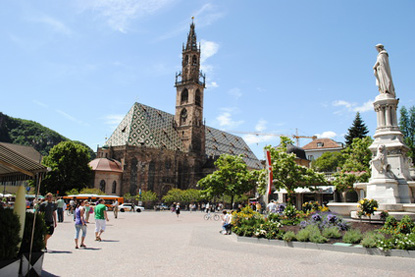
 Bolzano, nestled in the stunning Dolomites, is a fascinating blend of Mediterranean and Central European cultures where Italian and German influences harmoniously coexist. The city boasts the remarkable distinction of being home to Ötzi, Europe's oldest known natural mummy, who is over 5,300 years old and can be viewed at the South Tyrol Museum of Archaeology. The medieval centre features the magnificent Piazza Walther, dominated by a Gothic cathedral with its distinctive green and gold roof and 65-metre bell tower housing 25 bells. Visitors can explore the charming Via dei Portici, a street lined with Gothic-style arcades, pastel-coloured buildings and taverns, whilst the vibrant Piazza delle Erbe hosts a 500-year-old daily market overlooked by an elegant 18th-century Neptune Fountain. The city's rich artistic heritage is exemplified in the Dominican Church, which houses some of the finest Giotto School frescoes in South Tyrol. |
| Merano (Meran) |
|---|
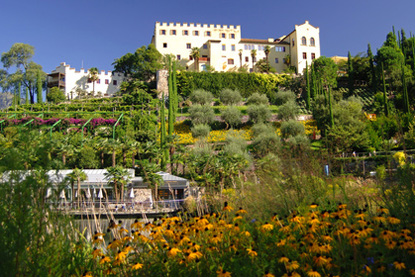
 Merano, a charming medieval town in South Tyrol, boasts an impressive array of historical and natural attractions, including Europe's oldest spa promenade, the Tappeiner Promenade, which has been delighting visitors for 150 years. The town's medieval heritage is beautifully preserved in its 13th-century Portici shopping district and the imposing Powder Tower, which offers panoramic views over the Burgraviato valley. The architectural jewel of the town is the Church of St. Nicholas, whose construction spanned more than 160 years and features one of South Tyrol's oldest star-vaulted ceilings from 1440. Nature enthusiasts will be captivated by the award-winning botanical gardens at Trauttmansdorff Castle, home to 80 different garden worlds and a Caribbean palm beach. Local culinary specialities include speck (a type of cured ham) and regional wines, which can be savoured in the numerous restaurants along the historic Laubengasse. |
| Brixen (Bressanone) |
|---|
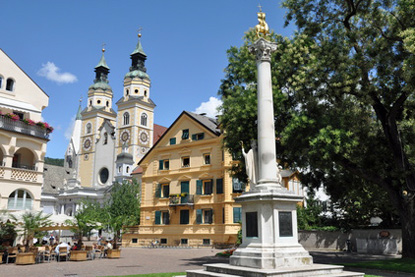
Brixen, the oldest town in Tyrol, boasts over a millennium of rich history since its first mention as 'Prihsna' in 901. This charming South Tyrolean town features a magnificent cathedral with 3,335 pipes in its organ, alongside the remarkable White Tower, which stands 72 metres tall and houses a complex carillon of 43 bells that can play over 100 different melodies. The town's medieval centre is adorned with colourful frescoed houses, elegant arcades, and the fascinating Hofburg, a Renaissance bishop's palace that now houses one of Europe's most significant nativity scene collections. A peculiar artistic detail can be found in the Romanesque cloister, where visitors can spot a curious fresco of an elephant-horse hybrid, painted by an artist who had never seen a real elephant. The picturesque Adler bridge, first documented in 1233, offers splendid views of the historic centre with its colourful buildings and bustling narrow streets. |
| Novacella Convent |
|---|
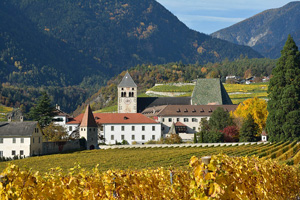
Nestled in South Tyrol's northernmost wine-growing region, the Novacella Abbey (Abbazia di Novacella in Italian; Kloster Neustift in German) has been a beacon of culture since its founding in 1142 by Bishop Hartmann. This magnificent Augustinian monastery boasts a stunning Baroque collegiate church, a Rococo library housing medieval masterpieces by Michael and Friedrich Pacher, and a Gothic cloister adorned with valuable frescoes. The monastery's unique circular building, Castello dell'Angelo, once served as both hostel and defence facility, whilst the courtyard features a remarkable fountain depicting the wonders of the world—with Novacella itself celebrated as the eighth wonder. Today, visitors can explore the historic gardens, marvel at the Turkish wall, and sample renowned white wines like Sylvaner, Müller-Thurgau and Kerner produced by the monastery's own winery. |
| Dolomites |
|---|

 The Dolomites, a UNESCO World Heritage site in northern Italy, stand as one of Europe's most spectacular mountain ranges. These dramatic limestone peaks, with their distinctive pale grey hue and jagged spires, create an otherworldly landscape that has captivated travellers for centuries. Spanning across three regions of northern Italy—Trentino, Alto Adige, and Veneto—the Dolomites offer year-round adventures, from world-class skiing in winter to remarkable hiking and climbing in summer. The area is also steeped in fascinating cultural heritage, where Italian, German, and ancient Ladin influences merge to create a unique blend of traditions, cuisine, and architecture. Picture-perfect alpine meadows, crystalline lakes, and charming mountain villages dot the landscape, making the Dolomites an unmissable destination for both outdoor enthusiasts and those seeking the authentic charm of the Italian Alps. |
Trentino
|
Stelvio National Park |
|---|
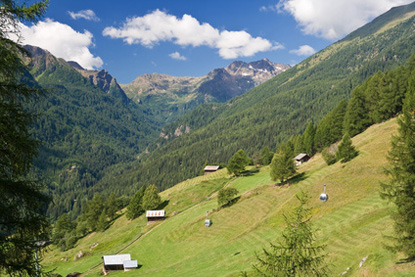
 Stelvio National Park, established in 1935, stands as the largest protected area in the entire Alpine region, spanning an impressive 134,620 hectares (505 sq mi) across four Italian provinces. This remarkable park showcases diverse landscapes ranging from glaciers and alpine pastures to dense forests and waterfalls, stretching from 650 metres to a staggering 3,905 metres above sea level at the mighty King Ortles peak. Visitors can spot abundant wildlife including golden eagles, rock partridges, ibexes, chamois, badgers, mountain hares, marmots, stoats, and rare flora such as the glacier buttercup that thrives above 3,500 metres. The park offers year-round activities, from family-friendly hikes along ancient water irrigation channels called "waalwege" to challenging mountain tours, whilst history enthusiasts can explore old Venetian sawmills, traditional cheese dairies, and WWI military ruins. The park's extensive network of marked hiking trails, spanning approximately 250 kilometres, provides access to breathtaking vistas and is frequently featured in the prestigious Giro d'Italia cycling race. |
|
Adamello Brenta Nature Park |
|---|

The Adamello Brenta Nature Park, established in 1967 as Italy's first park of its kind, is the largest protected area in Trentino, spanning an impressive 620 square kilometres. This UNESCO Geopark showcases a remarkable contrast between the Brenta Dolomites and the Adamello-Presanella massif, featuring 41 glaciers and 48 lakes across elevations from 477 to 3,558 metres above sea level. The park is a wildlife haven, home to a successfully reintroduced brown bear population that grew from near extinction to over ninety specimens, alongside 8,000 chamois, golden eagles, and 1,300 plant species. Visitors can explore more than 700 kilometres of hiking trails, including challenging via ferratas, and discover seven visitor centres themed around different aspects of the park's natural heritage. The park's diverse landscape encompasses everything from fir, beech and larch forests to alpine meadows, with spectacular geological formations that took shape when the Southern Alps emerged from the sea 20 million years ago. |
| Trento |
|---|
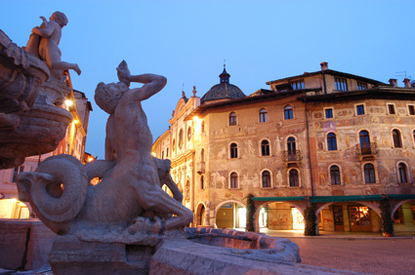
Trento beautifully blends Italian and Austrian influences whilst maintaining a distinctly Italian character. The city's centrepiece is the magnificent Piazza del Duomo, featuring the 13th-century Cathedral of San Vigilio and the striking Neptune Fountain from 1768. The city's crown jewel, Castello del Buonconsiglio, served as the residence of prince-bishops for five centuries and houses the remarkable Torre Aquila, featuring the exceptional 15th-century Cycle of the Months frescoes. Nature enthusiasts can explore the nearby Orrido di Ponte Alto canyon, whilst science buffs shouldn't miss MUSE, the city's modern science museum. The city's buildings are adorned with colourful Renaissance frescoes, particularly visible on the facades of Casa Cazuffi and Palazzo Rella, creating an enchanting atmosphere, especially when snow blankets the city in winter. |
| Rovereto |
|---|
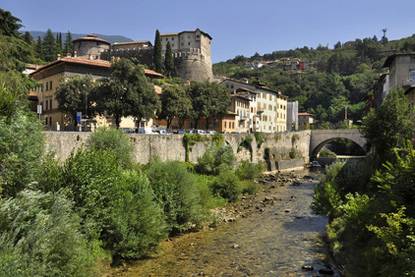
Nestled in the Vallagarina valley between Trento and Verona, Rovereto is a charming cultural hub that blends history, art and peace advocacy. The city boasts one of the world's largest bells, the Maria Dolens, crafted from melted WWI cannons, which rings daily as a poignant reminder of peace. Visitors can explore the impressive 14th-century castle housing the Italian War Museum, wander through Venetian-influenced streets, and marvel at dinosaur tracks from 200 million years ago at Monte Zugna. The city's artistic heritage shines through its museums, including MART and the unique Casa d'Arte Futurista Depero, Italy's only Futurist museum. Mozart himself performed his first Italian concert in Rovereto's San Marco church, adding to the city's rich cultural tapestry. |
|
Paneveggio-Pale di San Martino Natural Park |
|---|
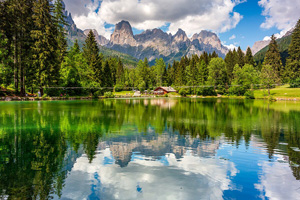
The Paneveggio-Pale di San Martino Natural Park, established in 1967, is a stunning UNESCO World Heritage Site spanning nearly 200 square kilometres in the Italian Dolomites. The park is renowned for its 'Forest of Violins', where the legendary luthier Stradivari discovered exceptional resonant spruce trees that are still prized by violin makers worldwide for crafting premium instruments. Visitors can observe majestic deer in their natural habitat, explore ancient Mesolithic hunting grounds near the Colbricon lakes, and hike to the unique Cristo Pensante (Meditating Christ) statue atop the Castellazzo peak. The park's dramatic landscape features the towering Pale di San Martino massif, reaching heights of 3,192 metres, alongside pristine alpine lakes, rushing streams, and traditional mountain cottages where visitors can sample local butter and cheese. The park's main visitor centre is located at Villa Welsperg in Tonadico, offering an excellent starting point for exploring this remarkable protected area that perfectly balances conservation with traditional rural activities. |
|


 : Local interest
 : Moderately interesting
 : Outstanding place
 : Must-see in the country
 : Top cities in Europe