


| Contents |
|---|
Introduction
Lucca is a charming city located in Tuscany, Central Italy, situated on the Serchio River near the Ligurian Sea. With a population of approximately 89,000, this ancient city is renowned for its remarkably intact Renaissance-era city walls that stretch 4 kilometres around the historic centre. These 16th-century walls, among the best-preserved in Europe, now serve as a popular public promenade and cycling path. Within the walls, visitors will discover a well-preserved historic centre featuring numerous monuments, including the iconic Torre Guinigi—a 44-metre-high medieval tower crowned with oak trees, the Torre delle Ore (Clock Tower), and the Cathedral of San Martino. The city's history dates back to Etruscan times in the 8th century BCE, later becoming a Roman colony in 177 BCE. Lucca is also notable as the birthplace of several world-class composers, including Giacomo Puccini, who composed "La Boheme" and "Madama Butterfly".
Interesting Facts about Lucca
- The historic centre of Lucca is encircled by intact 16th-century walls stretching 4.2 kilometres, now a popular pedestrian promenade.
- Lucca’s Torre Guinigi, a 14th-century tower, features an ancient rooftop garden with holm oak trees.
- Known as the "City of 100 Churches," Lucca boasts numerous well-preserved medieval and Renaissance religious buildings.
- The city maintained its independence as a republic until 1847, retaining a distinct regional dialect.
- Lucca is the birthplace of opera composer Giacomo Puccini, creator of Madama Butterfly and La Bohème.
- Every October, Lucca hosts Europe’s largest comic and gaming festival, Lucca Comics & Games.
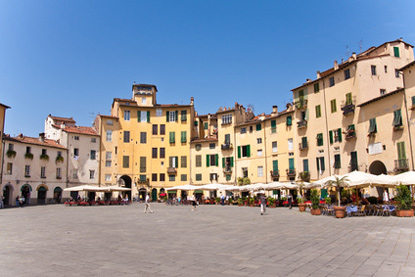
- The elliptical Piazza dell’Anfiteatro sits on the site of a Roman amphitheatre, visible in its unique architecture.
- Traditional Buccellato, a sweet bread with raisins and aniseed, is a culinary specialty dating back centuries.
- Lucca’s 16th-century walls are among the best-preserved in Europe, transformed into a green recreational space.
- The city’s Summer Festival attracts international music stars to performances in historic squares like Piazza Napoleone.
History
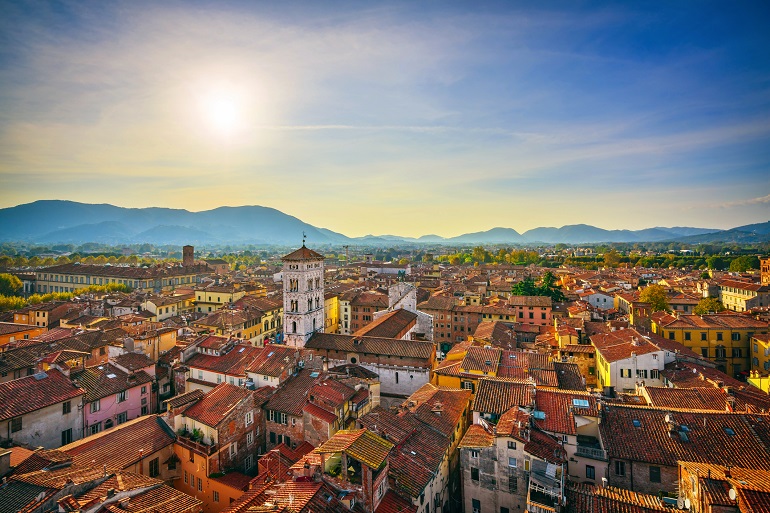
Originally called Luk, meaning "marshy place", the city was founded by the Etruscans, though evidence suggests human habitation since the Paleolithic era. It became a Roman colony in 180 BCE, and the rectangular grid of its historical centre still preserves the Roman street plan, with Piazza San Michele occupying the site of the ancient forum. Under Roman rule, Lucca prospered as an important junction of roads to Parma, Florence, Rome, Pisa, and Luni.
After the fall of the Roman Empire, Lucca was ruled successively by the Goths, Byzantines, and Lombards, becoming the residence of one of the three Lombard dukes in Tuscany. The city began to constitute itself as an independent commune with a charter in 1160, and for almost 500 years, Lucca remained an independent republic. During this period, Lucca enjoyed great prosperity through the silk trade that began in the 11th century, rivalling the silks of Byzantium. Under the rule of Castruccio Castracani in the early 14th century, Lucca became a leading state in central Italy, even rivalling Florence until his death in 1328.
Lucca's independence came to an end when it was conquered by Napoleon Bonaparte in 1805, who installed his sister Elisa Bonaparte Baciocchi as "Princess of Lucca". From 1815 to 1847, it became a Bourbon-Parma duchy before being incorporated into the Grand Duchy of Tuscany. As part of Tuscany, it became part of the Kingdom of Sardinia in 1860 and finally part of the Italian State in 1861. The city recovered quickly from the impacts of World War II and developed a strong culture of entrepreneurship that not only helped it recuperate economically but also played a catalyst in establishing a thriving tourism industry. Today, visitors can explore Lucca's fascinating history through its well-preserved architecture, including its famous city walls, which underwent their final transformation in the 16th century to create the impressive structure we see today.
Main Attractions
The City Walls (Le Mura di Lucca)
The walls of Lucca represent one of the most impressive defensive structures in Europe, second in size only to the walls of Nicosia in Cyprus. Stretching precisely 4 kilometres and 223 metres in circumference, these magnificent fortifications were built between 1504 and the second half of the 17th century to protect the Republic of Lucca from the expansionist ambitions of Florence and the Grand Duchy of Modena.
Interestingly, despite their imposing presence, the walls never actually served their intended defensive purpose. Over time, their function transformed dramatically when Marie Louise of Bourbon converted them into a large public park, with outdoor spaces transformed into expansive lawns and promenades.
The complete circuit features 11 defensive bastions, 12 curtains and 6 monumental gates. The oldest gate, Porta San Pietro, dates from 1566, followed by Porta Santa Maria (or Borgo Giannotti) completed in 1593 and Porta San Donato in 1629. The remaining three gates are more modern, with Porta Elisa built in 1811 in honour of Elisa Baciocchi, Porta S.Anna (Porta Vittorio Emanuele) constructed a century later, and the most recent, Porta San Jacopo, dating from 1931.
Today, the walls serve as a beloved recreational space where locals engage in various physical activities from cycling to jogging. The wide, tree-lined paths atop the walls offer splendid views of both the historic centre and the surrounding countryside, making them the principal attraction for visitors to Lucca.
Piazza dell'Anfiteatro
This extraordinary oval-shaped plaza stands as the very symbol of Lucca and the centre of town life. What makes it unique is that it was built on the site of an ancient Roman amphitheatre, preserving the original elliptical form in its layout.
The amphitheatre's construction began in the 1st century CE under Emperor Claudius and was completed during the Flavian period. In its heyday, it was an imposing structure with fifty-four arches and a cavea capable of accommodating up to ten thousand spectators.
During the Middle Ages, when this area became a plaza, it was called "Parlascio," believed to derive from "parlare" (to talk) as it hosted popular assemblies. In reality, the name was a corruption of "paralisium," the Latin for "amphitheatre." Like many Roman structures during the medieval period, Lucca's amphitheatre was transformed into a fortification during the Gothic Wars.
In the 19th century, architect Lorenzo Nottolini restored the value of this ancient space by demolishing the buildings that had crowded the arena over the centuries and creating the new Via dell'Anfiteatro, which follows the same perimeter and volumes of the ancient building. The city thus gained a new oval space dedicated to the town market (hence its alternative name "Piazza del Mercato").
Some of the Roman remains are still visible along Via dell'Anfiteatro, in the buildings surrounding the plaza, and in the lowest of the four arches leading into it—the only one remaining from the ancient structure.

Guinigi Tower (Torre Guinigi)
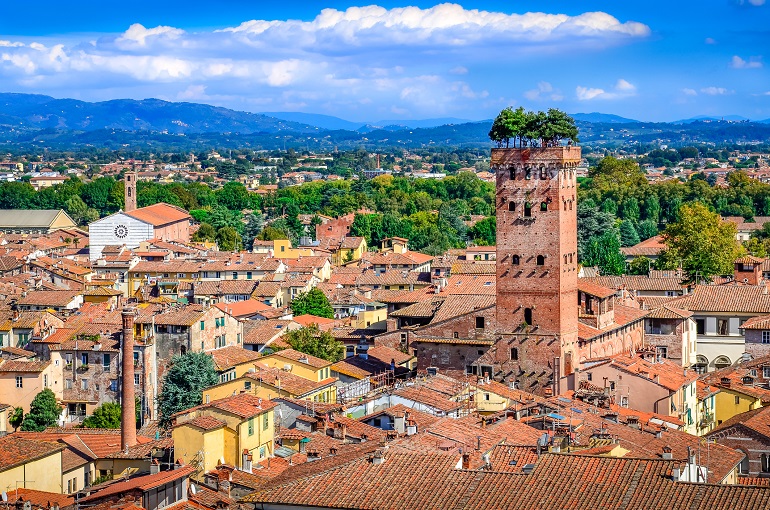
The Guinigi Tower stands as one of the most distinctive landmarks in Lucca, a medieval "skyscraper" built in the mid-14th century by a powerful family of merchants and bankers.
Rising to a height of 44.19 metres, this remarkable structure is constructed of stone and red bricks in the Tuscan Romanesque-Gothic style. It forms part of a larger complex that once belonged to the Guinigi "consorteria" or family association.
What truly sets this tower apart is its hanging garden at the summit, an unusual feature among medieval towers. The garden, with its distinctive canopy of holm oak trees, is visible from afar and adds a unique element of beauty to the tower's silhouette. These trees were not merely decorative but symbolised rebirth and renewal.
The tower remained in the Guinigi family's possession until relatively recently—only in 1968 was it donated to the city by the family's heirs, becoming part of Lucca's public heritage. It's worth noting that originally there were approximately 200 towers and tower houses within Lucca's walls, but the Guinigi Tower is the only privately-owned tower to have survived intact through the 16th century.
From its summit, visitors can enjoy a spectacular panoramic view of Lucca and the surrounding hills, making it one of the most popular attractions in the city.
Torre delle Ore (Clock Tower)
At 50 metres, the Torre delle Ore (Tower of the Hours) stands as the tallest of the 130 towers built in Lucca since Medieval times. Located centrally on Via Fillungo at the corner with Via dell'Arancio, it is one of only two towers that have remained standing, the other being Torre Guinigi.
Built in the 13th century, the tower belonged to several prominent families of Lucca including the Quartigiani, Diversi, Cristofani, Sesmondi and Ceci. In 1390, the General Council of Lucca commissioned the most important goldsmith of the time, Labruccio Cerlotti, to create a clock for the tower. A century later, in 1490, an external dial was positioned to make the time visible as well as audible by the chimes.
The tower underwent significant modifications in the 18th century when Louis Simon from Geneva designed a new mechanism with the help of Sigismondo Caturegli from Lucca. At the same time, three new bells were installed, crafted by Stefano Filippi. The iron weathervane bearing the motto "Libertas" and the year 1754 on the roof commemorate this renovation.
The Torre delle Ore is also associated with the legend of Lucida Mansi, a noblewoman from Lucca who allegedly sold her soul to the Devil in exchange for beauty and youth. According to the tale, on the night of 14th August 1623—the last of her "diabolic" youth—Lucida attempted to climb the tower's steps to stop the bell that would strike the hour of her death. Failing to make it in time, she supposedly threw herself into the lake of the Botanical Garden, from where it is said she still emerges on nights of full moon.
Palazzo Pfanner
Palazzo Pfanner stands as an elegant testament to Lucca's aristocratic past, situated just a few minutes from the sixteenth-century town walls and the austere medieval palazzi of the city centre.
Construction of this magnificent residence began in 1660, commissioned by the Moriconi family—silk merchants and members of Lucca's nobility. However, following a sudden financial crisis, they were forced to sell the building in 1680. The palazzo was subsequently acquired by the Controni family who, having recently obtained noble status, wished to celebrate their social advancement by renovating and expanding the structure.
The Controni family likely entrusted the architectural work to Domenico Martinelli (1650-1718), a native of Lucca, who designed the monumental main staircase completed around 1686. The garden design is attributed to the renowned architect Filippo Juvarra (1678-1736) from Messina.
The grand staircase, crafted in sandstone, is embellished with vaults decorated with early eighteenth-century paintings attributed to Bartolomeo De Santi (1687-1764) and Lorenzo Castellotti (active 1730-1750). This impressive feature leads to the large main hall of the palazzo, where visitors can admire valuable frescoes painted around 1720 by Pietro Paolo Scorsini (1658-1731).
These frescoes were executed according to the principles of the quadraturist school, a style very much in vogue in Lucca from the late seventeenth century onwards. Quadraturism was characterised by the creation of illusory spatial expansion through architectonic elements painted in perspective, adding a sense of grandeur and depth to the already impressive interiors.
Piazza Napoleone
Piazza Napoleone, also known as Piazza Grande, is Lucca's largest square and serves as the city's main gathering place. The square was created in 1806 during the Napoleonic era when Elisa Bonaparte Baciocchi, Napoleon's sister and Princess of Lucca, ordered the demolition of medieval buildings to create this grand space.
The square is dominated by the Palazzo Ducale (Ducal Palace), which dates back to the 14th century but was extensively remodelled during the 16th and 17th centuries. Today, it houses the offices of the Provincial Administration. The square is lined with plane trees and features a central statue of Maria Luisa di Borbone, who ruled Lucca after the fall of Napoleon.
During summer, Piazza Napoleone becomes the venue for the Lucca Summer Festival, which has hosted international music stars since 1998. In winter, the square transforms into a Christmas market and ice-skating rink, making it a year-round focal point for both locals and visitors.
San Michele in Foro
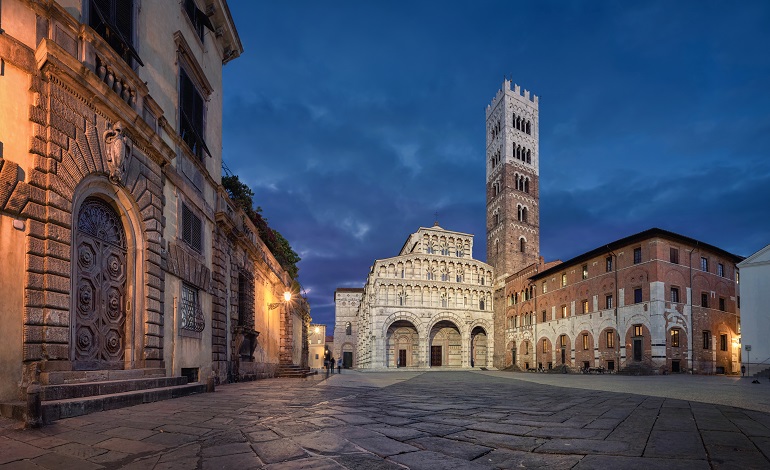
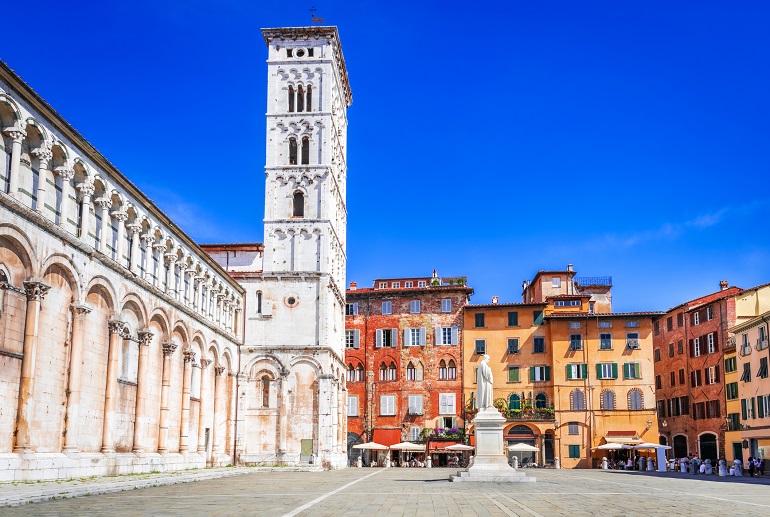
The Church of San Michele in Foro stands on the site of the ancient Roman forum, as indicated by its name. Its striking façade, rising high above the rooftops of the surrounding buildings, is one of Lucca's most recognisable landmarks.
Built between the 11th and 14th centuries, the church exemplifies the Pisan Romanesque style with its distinctive white marble façade featuring multiple tiers of colonnades. The façade is crowned by a large statue of the Archangel Michael slaying a dragon. Local legend claims that a diamond is embedded in the angel's ring, though this is merely folklore.
The interior, in contrast to the ornate exterior, is relatively simple with a Latin cross plan and a nave flanked by two aisles. Notable artworks inside include a glazed terracotta Madonna and Child by Andrea della Robbia and a panel painting of the Four Saints by Filippino Lippi.
The church's bell tower, with its distinctive octagonal top section, provides another element to Lucca's skyline and complements the nearby Guinigi Tower.
Basilica of San Frediano
The Basilica of San Frediano is one of Lucca's oldest and most important churches, easily recognisable by its spectacular golden mosaic adorning the upper façade. This 13th-century mosaic depicts the Ascension of Christ, with the apostles below and angels above.
Founded in the 6th century by Saint Fridianus (San Frediano), an Irish bishop of Lucca, the church was rebuilt in the 12th century in the Romanesque style. The unusual feature of having its apse at the west end rather than the east is due to it being built over an earlier church.
Inside, the basilica houses several notable artworks, including a 12th-century baptismal font with reliefs depicting the life of Moses, a 15th-century terracotta Madonna by Matteo Civitali, and the mummified body of Saint Zita, a 13th-century servant girl who became the patron saint of domestic workers and lost keys.
The basilica's bell tower, dating from the 13th-14th centuries, completes the impressive exterior of this important religious monument.
Porta San Gervasio
While Lucca is famous for its Renaissance walls and gates, the older medieval gate of Porta San Gervasio offers visitors a glimpse into the city's earlier defensive system. Dating from 1255, this gate is one of the few remaining structures from Lucca's medieval walls.
Located just a few metres from the later Porta Elisa, Porta San Gervasio illustrates how much smaller the city used to be before its expansion. The gate features well-preserved frescoes on its inner side and exemplifies medieval military architecture with its pointed arch and defensive features.
Unlike the more monumental Renaissance gates, Porta San Gervasio has a more intimate, authentic character that transports visitors back to medieval Lucca. Its proximity to the later walls makes it easy to compare the different architectural styles and defensive strategies employed over the centuries.
Aqueduct of Nottolini
The Aqueduct of Nottolini represents a monumental engineering achievement located primarily in the territory of Capannori, just outside Lucca. This impressive structure was designed by Lorenzo Nottolini, an architect born in Segromigno in Monte who gained fame for his work in service to the royal duchy of Lucca between 1818 and 1848.
The aqueduct was constructed to address serious public health issues related to Lucca's water supply. While wealthy families received water directly from the surrounding hills, poorer residents relied on impure well water that often caused epidemics.
Although preliminary studies for improving water supply dated back to 1732, construction didn't begin until 1823 when Maria Luisa of Bourbon firmly expressed her wish to provide Lucca with high-quality water. The project experienced multiple interruptions before its final completion in 1851.
Stretching 4 kilometres in length, the aqueduct features a straight line of 459 stone arches, each standing 12 metres high. Its design combines elegant classicism with simple, severe architecture. Unfortunately, some arches were demolished in the 20th century to accommodate highway construction.
Nottolini's ingenious system drew water from 18 different springs in Guamo, at the foot of Monte Pisano. The water was first conveyed to a circular temple-cistern built between 1823-25, where it was filtered through stones and grates designed to remove impurities. The architect created two separate water channels: one for spring water destined for public and private fountains in Lucca, and another for the city's monumental fountains, prioritising the purest drinking water.
The aqueduct terminates at the little temple of San Concordio, a circular neoclassical building in the Doric style, where water was collected in a marble pool. From there, it was conveyed to the city, supplying a complex system of fountains. Notably, Nottolini modified his original plan, which would have led the water directly within the city walls, choosing instead to preserve the integrity of Lucca's historic ramparts.
Top Museums
Art and History Museums
National Museum of Villa Guinigi
The National Museum of Villa Guinigi, set within one of Lucca's most historically significant and beautiful buildings, provides an expansive journey through the city's vibrant past. Commissioned by Paolo Guinigi, the influential lord of Lucca from 1400 to 1430, the villa itself is a testament to the city's rich architectural heritage. Today, it serves as the perfect backdrop for an impressive collection of artefacts, spanning from prehistoric times right through to the 18th century.
Visitors can explore a carefully curated chronological path, beginning with archaeological finds that unearth Lucca's earliest settlements and inhabitants. As you progress, you'll encounter a diverse array of paintings and sculptures, each piece carefully selected to illustrate Lucca's artistic and historical evolution. The collection includes Romanesque sculptures, Renaissance paintings, and Baroque artwork, providing a comprehensive overview of the city's artistic development. Key exhibits include works by local Lucchese artists, as well as pieces from renowned Tuscan masters. The museum also delves into the social and political history of Lucca, showcasing objects that shed light on the lives of its citizens throughout the centuries. From ancient tools and pottery to exquisite Renaissance artworks, the National Museum of Villa Guinigi offers a captivating glimpse into Lucca's fascinating story.
Palazzo Mansi Museum
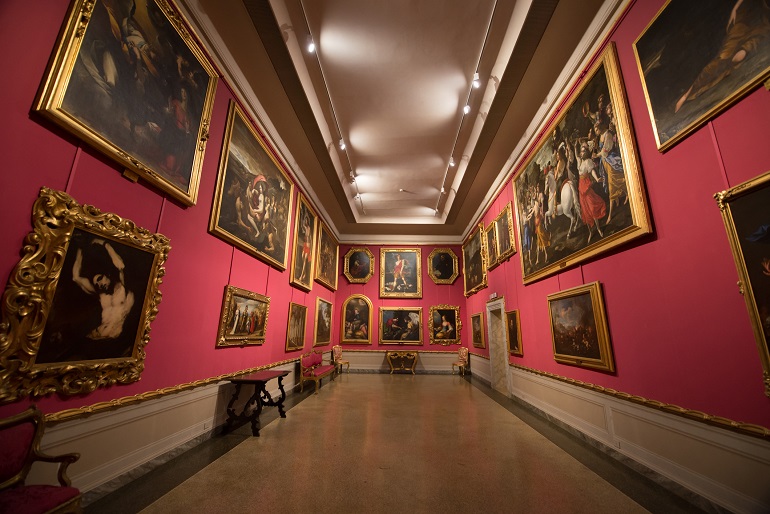
The Museo di Palazzo Mansi, nestled in the heart of Lucca, stands as a testament to the city's wealth and artistic patronage. This museum-residence provides a unique insight into the opulent lifestyles of Lucca's powerful merchant families. The palazzo, originally constructed in the 16th century, was later acquired by the Mansi family, who transformed it into a lavish Baroque palace. The meticulously preserved interiors offer a glimpse into the world of the Lucchese aristocracy, complete with richly decorated rooms, intricate frescoes, and period furnishings.
Inside, visitors can admire a significant national art gallery, showcasing a diverse collection of paintings from the 16th to 19th centuries. The collection includes works from the 19th century, as well as pieces from the Flemish, Roman, and Tuscan schools. Notable artists represented include Titian, Tintoretto, and Veronese, among others. The gallery provides a comprehensive overview of Italian and European art from the Renaissance to the Romantic period. In addition to the art collection, the Palazzo Mansi Museum offers a fascinating glimpse into the lives of the Mansi family, with displays of their personal belongings, family portraits, and historical documents. Walking through the opulent rooms of the palazzo, visitors can imagine the lives of the wealthy merchants who once called this magnificent building home.
Cathedral Museum and Archaeological Complex
This multifaceted museum complex offers a comprehensive exploration of Lucca's rich history, art, and religious heritage. It houses an excellent collection of artworks and ancient artefacts that narrate the millennial history of Lucca Cathedral, from its origins in the early Middle Ages to the present day. The museum's collection includes sculptures, paintings, liturgical objects, and precious textiles, showcasing the artistic and cultural significance of the cathedral throughout the centuries.
Highlights include the diptych of Areobindo, a remarkable ivory carving sculpted in Constantinople in the 6th century, a Flemish casket adorned with intricate details, and precious fabrics and goldsmith works crafted by skilled artisans. The archaeological area beneath the church of San Giovanni and the Baptistery dome offers a glimpse into Lucca's ancient past, revealing finds dating from the Roman age to the Middle Ages. Visitors can explore the remains of Roman buildings, early Christian structures, and medieval fortifications, gaining insight into the city's urban development over time. The Cathedral Museum and Archaeological Complex provides a fascinating journey through Lucca's religious, artistic, and archaeological heritage, offering a deeper understanding of the city's cultural identity.
Specialised Museums
Puccini Museum - Casa Natale
The birthplace of the globally celebrated composer Giacomo Puccini has been lovingly transformed into a captivating museum dedicated to his life and work. Reopened to the public in 2011 after extensive renovations, the museum provides an intimate and insightful tour through the life of the musical genius, from his birth on 22 December 1858 to his creation of his final, unfinished masterpiece, Turandot. The museum offers a personal perspective on Puccini's early life in Lucca, his musical development, and his rise to international fame.
Visitors can explore the rooms where Puccini spent his childhood, furnished with original pieces and historical artefacts. Family photographs, portraits, and letters provide a glimpse into the composer's personal life and relationships. One of the museum's most prized possessions is the famous Steinway piano on which Puccini composed Turandot, his last opera. The museum also features exhibits on Puccini's operas, including La Bohème, Tosca, and Madame Butterfly, with costumes, set designs, and musical scores. Through interactive displays and multimedia presentations, the Puccini Museum brings the composer's life and music to life, offering visitors a deeper appreciation for his extraordinary talent and enduring legacy.
Lucca Center of Contemporary Art
For those seeking a more modern artistic experience, the Lucca Center of Contemporary Art (Luccam) provides a refreshing contrast to the city's predominantly historical offerings. Located in the beautifully restored 16th-century Palazzo Boccella, the museum features a dynamic and ever-changing programme of contemporary artworks spread across five floors. The museum's mission is to promote contemporary art in all its forms, from painting and sculpture to photography and video installations.
Luccam showcases the work of both established and emerging artists from Italy and around the world, offering visitors a unique perspective on current artistic trends and movements. The exhibitions often explore themes of social and political relevance, engaging with contemporary issues and provoking thought-provoking discussions. The museum also hosts a variety of events, including artist talks, workshops, and educational programmes, making it a vibrant hub for contemporary art in Lucca. Whether you're a seasoned art enthusiast or simply curious about contemporary art, the Lucca Center of Contemporary Art provides a stimulating and engaging experience.
Museum of Torture
The Museo della Tortura offers a unique, albeit unsettling, glimpse into the darker aspects of human history. This museum houses a comprehensive collection of torture tools and devices used for capital punishment, interrogation, and coercion throughout history. The exhibits showcase the ingenuity and cruelty of the human mind, revealing the methods used to inflict pain and suffering on individuals throughout different cultures and eras.
While not for the faint-hearted, the Museum of Torture provides a sobering and thought-provoking insight into the historical practices of punishment and interrogation. The displays are carefully curated to provide context and information about the historical and social circumstances in which these tools were used. The museum aims to raise awareness about the importance of human rights and the need to prevent torture and other forms of cruel and inhuman treatment. It serves as a reminder of the atrocities committed in the past and the ongoing need to protect human dignity and freedom.
Mint Museum
The Museo della Zecca, or Mint Museum, provides a fascinating insight into the history of coin production in Lucca. The museum traces its origins back to the 7th century when Lucca began minting its own coins, establishing its economic and political independence. Located in the San Donato Barracks within the city walls, the museum showcases the evolution of coin production techniques and the different types of coins produced in Lucca throughout the centuries.
The collection includes gold coins from the Lombard period, Carolingian money, and coins from the Republic of Lucca. Visitors can learn about the processes involved in minting coins, from the design and engraving of dies to the striking and distribution of the finished product. The museum also explores the role of coins in Lucca's economy and trade, as well as their symbolic and artistic significance. The Mint Museum offers a unique perspective on Lucca's history, shedding light on its economic power and cultural identity.
Local Cuisine
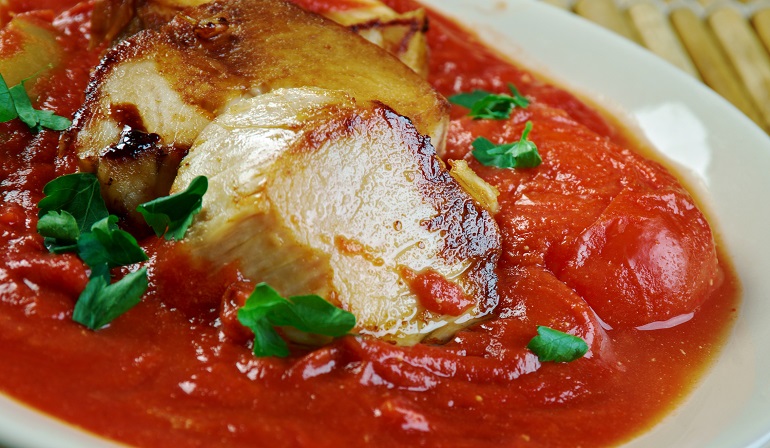
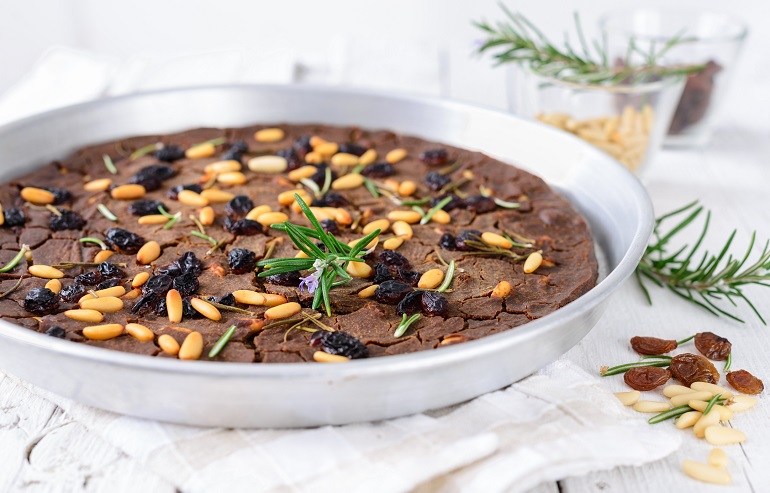
Lucca's cuisine is deeply rooted in Tuscan peasant traditions, featuring hearty, seasonal dishes that showcase the region's rich culinary heritage. Visitors should not miss tordelli (or tortelli lucchese), egg pasta parcels stuffed with seasoned beef and pork, typically served with a meat-laden ragù and flavoured with nutmeg. The city is renowned for its soups, including Zuppa di Farro, a wholesome combination of spelt, beans and seasonal vegetables, and Garmugia, a spring soup brimming with fresh vegetables like peas, asparagus and artichokes. Meat lovers will appreciate Rovelline, thinly sliced breaded veal fried and cooked in tomato sauce with capers, and Matuffi, layers of polenta alternated with meat sauce. Seafood enthusiasts should try Baccalà Fritters, deep-fried cod in batter. For those with a sweet tooth, Buccellato, a soft sweet bread flavoured with aniseed and sultanas, is a must-try local delicacy. During chestnut season, sample Necci, chestnut flour pancakes often filled with ricotta, and Castagnaccio, a cake made with chestnut flour, pine nuts, sultanas and walnuts. If visiting during Easter, look for Pasimata, a traditional sweet bread that takes two days to prepare.
Shopping
Lucca offers a diverse shopping experience centred around its main streets, Via Fillungo and Via Santa Lucia. Via Fillungo, stretching about 700 metres, features high-end boutiques, whilst Via Santa Lucia hosts more affordable shops. The city is known for quality clothing at stores like Tenucci, Vittorio Melecchi and De Simoni, which offer well-made, timeless garments. For food enthusiasts, Antica Bottega di Prospero sells local delicacies, whilst Enoteca Vanni is renowned for its excellent wine selection housed in underground crypt-like rooms. Lucca hosts several markets, including an important antiques market every third weekend of the month in Piazza Antelminelli and around the Duomo. Other notable markets include the handicraft market on the last weekend of each month, the weekly market on Wednesdays and Saturdays, and a farmers' market for seasonal produce. Most shops typically open from 10:00 to 19:30, with some closures on Sundays.
Nature in and around Lucca
Lucca and its surrounding areas offer a variety of natural attractions for outdoor enthusiasts. The Serchio River Park, located just outside the city, provides a perfect blend of natural beauty and urban accessibility. Spanning 250 hectares, it features clear waters, lush vegetation, and diverse flora and fauna. Visitors can enjoy activities such as walking, cycling, horseback riding, and canoeing. The park also includes the Fattoria degli Albogatti, an educational farm showcasing Lucca's silk production history. For those seeking more adventurous experiences, the nearby Apuan Alps Park in the Garfagnana and Versilia regions offers stunning mountain landscapes and opportunities for wildlife spotting. The Orrido di Botri Nature Reserve in Bagni di Lucca is home to a dramatic limestone gorge carved by the River Pelago, providing a unique and unspoilt natural environment. These attractions, combined with Lucca's well-preserved city walls that have been converted into a tree-lined park, make the area a haven for nature lovers and outdoor enthusiasts.
Botanical Garden (Orto Botanico)
The Botanical Garden of Lucca is an enchanting green space nestled between the city walls and the urban centre. Its origins date back to 1813 when the Department of Medicine and the Encouragement Committee of Lucca proposed the establishment of a garden dedicated to cultivating and preserving plant species native to the Lucca region, with a particular focus on medicinal varieties.
After several false starts and changes in location, the project was finally realised under the government of Marie Louise of Bourbon as a secondary structure of the Royal University of Lucca, opening on 5 November 1819. However, it was suppressed in 1847 when the Duchy unified with the Grand Duchy of Tuscany.
Today, the garden is subdivided into various sectors, including an arboretum containing mostly exotic trees and shrubs, a small lake that also hosts local fauna, a section dedicated to ericaceae with more than 200 species, a knoll featuring mountain species native to the areas around Lucca and Pisa, collections of native culinary plants and medicinal herbs, greenhouses housing numerous species from intertropical regions, and a seed house with a collection ready for exchange with other botanical gardens.
The garden's most celebrated resident is a magnificent cedar of Lebanon with a circumference exceeding 6 metres and a height of 22 metres. Its crown extends over an area of approximately 500 square metres. This impressive specimen was planted in 1822 by Paolo Volpi, the first director of the Lucca Garden, and serves as the unofficial mascot of this verdant sanctuary.
Getting There & Around
Lucca is easily reachable by both car and public transport, making it an accessible destination in Tuscany. If arriving by car, take the A11 Firenze-Mare motorway and exit at Lucca Est or Ovest, then park outside the city walls as the historic centre is largely pedestrianised. From Pisa Airport, take the PisaMover to Pisa Centrale station, then a direct train to Lucca (approximately 25 minutes, costing around €4). From Florence Airport, catch the T2 Vespucci tram to Santa Maria Novella station, then take a train to Lucca (about 1 hour 40 minutes, from €9). The Lucca train station is conveniently located at Piazza Ricasoli, just a five-minute walk from Porta San Pietro. For bus travel, companies like FlixBus and Itabus serve Lucca, with the main bus station situated at Piazzale Verdi inside the city walls. Once in Lucca, the compact historic centre is best explored on foot or by bicycle—the city is famously bike-friendly with many rental options available. The magnificent Renaissance walls that surround the city also serve as recreational pathways, offering splendid views and taking about 45 minutes to walk around completely.
Best Time to Visit
The best time to visit Lucca, Italy, largely depends on your preferences regarding weather and crowds. For warm, sunny days with minimal rain, July is often considered ideal, offering maximum daytime temperatures of around 27°C and plenty of sunshine. However, if you prefer milder temperatures without the peak summer heat, May, June, and September are excellent alternatives. These months provide pleasant temperatures ranging from 20°C to 26°C, making them perfect for exploring the city's historic sites and enjoying outdoor activities. Additionally, September offers a unique cultural experience with the Luminaria di Santa Croce, a magical event that illuminates the city with candles. Overall, these periods offer a great balance of weather and cultural experiences, making them ideal for a memorable trip to Lucca.