


| Contents |
|---|
Introduction
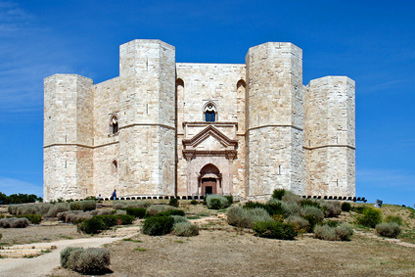
Built between 1240 and 1250 by Emperor Frederick II, Castel del Monte is UNESCO World Heritage Site is renowned for its unique octagonal design with eight octagonal towers at each corner. The castle features two floors, each containing eight rooms surrounding an eight-sided courtyard, reflecting Frederick's fascination with mathematics and geometry. Despite its name, Castel del Monte lacks traditional defensive features such as a moat or drawbridge, suggesting it may have served purposes beyond military defence—perhaps as a meeting place for scholars and intellectuals rather than a mere hunting lodge as once believed. Constructed using limestone, white marble and coral breccia, the castle blends various architectural influences including Romanesque, Gothic, classical and Islamic elements, showcasing Frederick II's cosmopolitan education and cultural interests. Located 540 metres above sea level in what is now the Alta Murgia National Park, the castle offers visitors spectacular views of the Apulian countryside.
Interesting Facts about Castel del Monte
- The castle features a perfect octagonal shape with eight octagonal towers at each corner, creating a structure that resembles an elegant stone crown when viewed from above.
- Despite its castle-like appearance, Castel del Monte lacks typical defensive features such as a moat, proper loopholes, and strategic positioning, suggesting it wasn't primarily built for military purposes.
- The castle's design is infused with mathematical precision, with the octagonal towers measuring exactly one-eighth of the castle's diameter, reflecting Frederick II's fascination with astronomy and natural sciences.
- Both floors of the castle contain exactly eight rooms arranged in an octagonal pattern around a central courtyard, creating an obsessive recurrence of the number eight throughout the structure.
- The spiral staircases in three of the castle's towers are arranged in a counter-clockwise direction, contrary to medieval defensive construction rules which would have forced defenders to hold weapons in their left hand.
- Frederick II was heavily influenced by multiple cultures, incorporating elements from classical antiquity, Islamic architecture, and north European Cistercian Gothic styles into the castle's design.
- The castle features sophisticated hydraulic systems in its bathrooms that were inspired by Oriental design, showcasing Frederick's connections to the Islamic world.
- After Frederick's death, the castle served various purposes, including as a hunting lodge under Manfred of Sicily and later as a state prison under Charles I of Anjou, where Manfred's sons were imprisoned.
- In the 18th century, the castle was stripped of its marble decorations and furnishings by the House of Bourbon, who repurposed the materials for their palace in Caserta.
- The Italian State purchased Castel del Monte from the Carafa family in 1876 for 25,000 lire to begin restoration efforts, with major work taking place in the 1930s.
- Castel del Monte was recognised as a UNESCO World Heritage Site in 1996 for its unique architectural significance and is featured on the Italian one-cent euro coin as the emblem of Puglia.
- Some scholars believe the castle's octagonal design symbolises the fusion of heaven and earth, with the octagon representing an intermediate symbol between a square (earth) and a circle (sky).
- Frederick II may have been inspired to build the octagonal shape after seeing either the Dome of the Rock in Jerusalem during the Sixth Crusade or the Palatine Chapel of Aachen Cathedral.
- The castle's design was highly influenced by the Fibonacci series and the Golden ratio, following Frederick II's meeting with mathematician Leonardo Fibonacci in Pisa in 1226.

History
Castel del Monte was commissioned by Holy Roman Emperor Frederick II of Hohenstaufen around 1240. Frederick II, known as "Stupor Mundi" (Wonder of the World), inherited the lands from his mother Constance of Sicily and fell in love with the rich region during his first visit to Puglia in March 1221. The construction was completed around 1250, showcasing Frederick's passion for mathematics, poetry, philosophy, and astronomy. This remarkable structure was part of a castle system designed to demonstrate the sovereign's royal power and magnificence throughout southern Italy.
The castle's most distinctive feature is its perfect octagonal design with eight octagonal towers positioned at each corner, creating a geometric masterpiece that combines Classical, Islamic, and Northern European architectural styles. Despite being called a castle, Castel del Monte lacks traditional defensive elements such as a moat or drawbridge, which has led to much debate about its original purpose. Some historians suggest it was intended as a hunting lodge, whilst others propose it was designed as an astronomical observatory or a symbolic structure representing the intermediate between earth (square) and sky (circle). Archaeological evidence has suggested that it originally had a curtain wall, potentially indicating some defensive function.
After Frederick II's death, the castle gradually lost its imperial significance. Under Manfred of Sicily, it occasionally served as a hunting lodge before becoming a state prison under Charles I of Anjou, where Manfred's sons were imprisoned after 1266. By the 16th century, it had become a refuge for shepherds and those fleeing the plague, and by the 18th century, its marble decorations and furnishings had been stripped away. The Italian State purchased the castle from the Carafa family in 1876 for 25,000 lire and initiated restoration efforts, with significant work carried out in the 1930s. In 1996, Castel del Monte was designated a UNESCO World Heritage Site, described as "a unique masterpiece of medieval military architecture," and today it stands as one of Puglia's most famous cultural sites, even appearing on the Italian one-cent euro coin.
Description
The Architectural Marvel on the Hill
Castel del Monte stands as a magnificent sentinel atop a 540-metre limestone hill in the Apulian countryside, approximately 17 kilometres from Andria. This extraordinary octagonal fortress, with its perfect mathematical proportions and enigmatic presence, cuts a striking silhouette against the azure Mediterranean sky. The castle's isolated position amidst the undulating terrain of the Alta Murgia National Park only enhances its mystical allure, making it appear almost like a geometric vision materialised from another realm.
The Exterior: A Study in Octagonal Perfection
The Façade and Structure
The castle's exterior is a masterclass in medieval architectural precision. Constructed entirely from local pale limestone and marble, the façade exhibits a subtle pink-hued glow at sunrise and a golden luminescence at sunset. The perfect octagonal shape is immediately apparent, with each of the eight walls measuring exactly 10.86 metres in length and standing at a uniform height of 25 metres. This mathematical exactitude extends to every aspect of the design.
At each of the eight corners rises an octagonal tower, creating a mesmerising visual rhythm. These towers, slightly taller than the main structure, feature narrow slits that served both defensive purposes and allowed for the careful regulation of light and air. The main entrance, positioned on the eastern façade to catch the first light of dawn, is framed by two towers and adorned with classical elements including a triangular pediment, Corinthian columns, and intricate carvings that blend Islamic, Gothic, and classical motifs.
Decorative Elements
The exterior stonework reveals a wealth of subtle details that reward close inspection. Delicate cornices run along the upper sections of the walls, while the towers feature elegant blind arcades and corbels. Particularly noteworthy are the zoomorphic gargoyles that project from various points around the structure, each uniquely carved to represent mythical creatures and beasts from medieval bestiaries.
The castle's windows, though relatively few in number, are architectural gems in themselves. The biforate (twin-arched) windows on the upper floor are separated by slender marble columns with intricately carved capitals. On the ground floor, narrow lancet windows allow minimal light to penetrate, creating a dramatic contrast with the more illuminated upper storey.
The Interior: Geometric Harmony and Medieval Innovation
The Central Courtyard
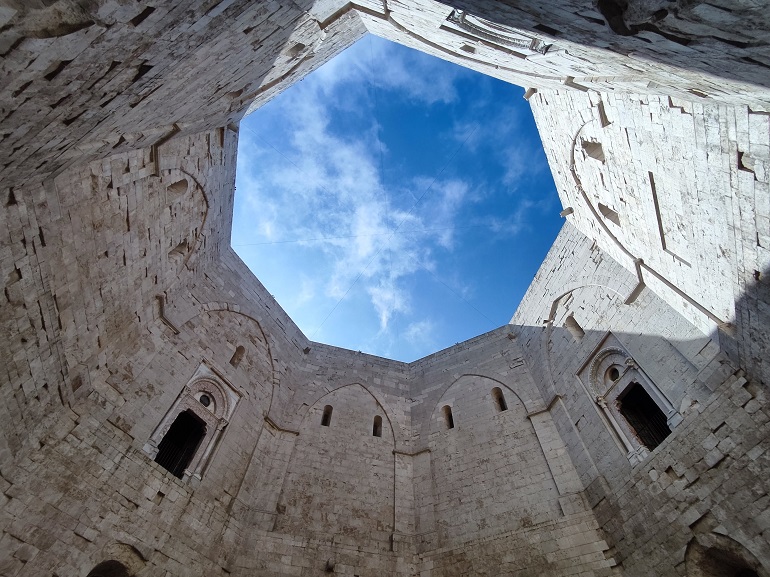
Stepping through the imposing main portal, visitors enter the heart of Castel del Monte—its central octagonal courtyard. This open space serves as the organisational hub around which all other elements revolve. The courtyard's walls rise in two distinct tiers, with the lower level featuring blind arches and the upper level displaying the elegant biforate windows that illuminate the castle's inner chambers.
The courtyard originally contained a marble-lined cistern or basin, part of the castle's sophisticated water collection system. Though this feature no longer remains intact, the drainage channels and water management infrastructure throughout the building testify to the advanced engineering knowledge of its creators.
The Ground Floor Rooms
The eight trapezoidal rooms on the ground floor encircle the courtyard in perfect symmetry. Each room features cross-vaulted ceilings supported by elegant ribs that converge at central keystones, some of which still bear traces of their original decorative elements. The walls, now largely bare, once displayed frescoes and tapestries, hints of which can occasionally be glimpsed in certain lighting conditions.
Particularly noteworthy is the third room (counting clockwise from the entrance), which contains remnants of a fireplace and what appears to have been a throne dais, suggesting its possible use as an audience chamber. The sixth room features the most complete surviving examples of the original floor tiling—polychrome marble pieces arranged in geometric patterns that echo the octagonal theme of the entire structure.
The Upper Floor and Its Refinements

Ascending via one of the three spiral staircases housed within corner towers, visitors reach the more refined upper floor. These eight chambers are distinguished by their ribbed cross-vaulted ceilings, which rise to a greater height than those below, creating a sense of increased spaciousness and grandeur.
The upper chambers feature more elaborate window treatments, with stone window seats set into the thick walls. These alcoves offer contemplative spaces with views across the Apulian countryside. The seventh chamber on this level contains the most impressive surviving architectural details, including fragments of marble inlay work and traces of blue pigment on the ceiling vaults, hinting at the celestial decoration that once adorned these spaces.
Each upper room also contains a fireplace and connects to a private latrine built into the thickness of the walls—an exceptional luxury for a 13th-century structure. These facilities were serviced by an innovative system of rainwater collection and drainage that permeates the entire building.
The Towers and Their Secrets
The eight octagonal towers contain some of the castle's most intriguing spaces. Three towers house elegant spiral staircases with steps carved from solid blocks of limestone, their central columns rising like twisted stone ropes. The remaining towers contain small chambers on multiple levels, connected by narrower staircases.
The north-eastern tower features a particularly well-preserved chamber with evidence of astronomical alignments in its window placements. During the summer solstice, sunlight enters through specific apertures to illuminate carved markers on the opposite wall—one of several features that have led scholars to speculate about the castle's possible function as an astronomical observatory or repository of esoteric knowledge.
The Surrounding Landscape: Nature's Embrace
The Immediate Environs
The castle stands in splendid isolation, surrounded by a roughly circular cleared area approximately 300 metres in diameter. This space, now covered with short grass and wildflowers, may once have served as a parade ground or ceremonial space. The approach to the castle follows a gently winding path that offers increasingly dramatic views of the structure, allowing visitors to appreciate its perfect proportions from multiple angles.
The Alta Murgia National Park Setting
Beyond this immediate clearing, Castel del Monte is embraced by the wild beauty of the Alta Murgia National Park. This protected landscape features characteristic Mediterranean vegetation, including fragrant wild thyme, rosemary, and oregano that perfume the air, particularly in the warmer months. Ancient olive groves, some with trees over 500 years old, dot the lower slopes, while the higher elevations support hardy grasses and seasonal wildflowers.
The park is home to numerous bird species, including the rare lesser kestrel, which can often be spotted soaring above the castle. Lucky visitors might glimpse wild boar, foxes, or European polecats in the surrounding countryside, particularly in the quieter early morning or evening hours.
Seasonal Variations
The landscape surrounding Castel del Monte undergoes dramatic seasonal transformations. In spring (April to June), the hillsides erupt in a riot of colour as poppies, asphodel, and wild orchids carpet the ground. Summer (July to September) brings the golden hues of sun-baked grasses and the intense blue of cornflowers. Autumn (October to November) sees the landscape take on more subdued amber and russet tones, while the sparse winter months (December to March) offer the most dramatic views of the castle's silhouette against clear, crisp skies or occasional dusting of snow.
Photographic Perspectives and Artistic Inspiration
Exterior Vantage Points
Photographers will find numerous compelling vantage points from which to capture Castel del Monte's enigmatic beauty. The approach road offers excellent distant views that emphasise the castle's commanding position in the landscape. For those willing to explore further afield, several unmarked paths lead to elevated positions on neighbouring hills, offering perspectives that frame the castle against the distant Adriatic Sea on clear days.
The most dramatic lighting conditions occur during the golden hours of early morning and late afternoon, when the low-angled sunlight brings the castle's geometric details into sharp relief and warms the limestone to a honeyed glow. After rainfall, the wet stones take on a deeper hue, creating striking contrasts with the surrounding landscape.
Artistic Legacy
The castle's perfect geometry and mysterious atmosphere have inspired countless artists over the centuries. Its image appears in medieval manuscripts, Renaissance paintings, and continues to influence contemporary artists drawn to its mathematical perfection and symbolic resonance. Many visitors bring sketchbooks to capture their own impressions of this architectural masterpiece, finding that the act of drawing reveals details and proportions that might otherwise go unnoticed.
Getting There
To reach Castel del Monte in Apulia, visitors have several transport options. From Bari (50 km away), drive via the A14 motorway, taking the Andria-Barletta exit onto SS170 and following signs for 18 km, or take a train to Andria station followed by bus number 6 (running April to October) for a 30-minute journey. From Andria town centre (about 15-20 km away), the direct SS170 road leads to the castle. Cars must park in the designated car park below the castle, with a shuttle bus service available for €1 per person; alternatively, adventurous travellers can opt for the 15-minute uphill walk through woodland. The castle itself is easily navigable on foot, with entrance costing €10 for adults, €2 for ages 18-24, and free for under-18s and on the first Sunday of each month. Allow approximately one to two hours to explore this magnificent octagonal fortress with its eight towers and unique architecture.
Best Time to Visit
The best time to visit Castel del Monte is during spring (April-May) or autumn (September-October) when temperatures are mild, crowds are moderate, and the surrounding landscape is at its most picturesque. These shoulder seasons offer pleasant daytime conditions without cloud cover, making them ideal for appreciating both the exterior and interior of this magnificent octagonal castle built by Emperor Frederick II in the 13th century. Summer months, particularly July and August, should be avoided as high temperatures combine with large groups of visitors, creating a less comfortable experience. For those wishing to avoid crowds entirely, early morning visits between 10:15 AM and 11:30 AM or after 4:00 PM are recommended, as these times typically see fewer fellow visitors. Winter visits can also be rewarding, offering illuminating views of white-winter scenery and a more tranquil atmosphere, though do note the castle operates on shorter hours during this season.