Italy Guide  |
|---|
|
| | Top Italian Cities |
|---|
|
| | Italian Regions |
|---|
|
| | Europe Guide |
|---|
|
| | Travel Tools |
|---|
|
|
|
|
 Polignano a Mare, Apulia. Polignano a Mare, Apulia.
Introduction

Apulia (Puglia in Italian) is the 'heel of Italy's boot'. The region spans over 19,345 km² (7,469 sq mi), and its population is about 4.1 million. It is the largest continental region of Southern Italy and the second most populous after Campania.
Apulia was known alternatively in ancient times as Messapia, Calabria, and Iapygia. Before the Roman conquest,its inhabitants spoke a language related to Illyrian languages. Nowadays various dialects are spoken, such as Tarantino and Salentino in the south (both related to Sicilian), the Bari dialect of Neapolitan language around Bari, and Faetar, a rare dialect of the Franco-Provençal language, in two isolated towns in the Province of Foggia.
Apulia boasts many first-rate attractions like the superbly located seaside towns of Polignano a Mare, Monopoli, Vieste and Peschici. The traditional trulli houses of Alberobello, dry stone huts with a conical limestone roofs, and Castel del Monte, the 13th-century castle of Holy Roman Emperor Frederick II, and the coastal town of Otranto, are all UNESCO World Heritage Sites.
Apulia is Italy's largest producer of oilve oil, accounting for 21% of the total production.
Attractions
North (Gargano Promontory)
| Gargano National Park
|
|---|

 The Gargano National Park, in northern Apulia, offers some of the most fantastic coastal views in Italy, a landscape of turquoise and deep-blue sea and white limestone rocks. Covering an area of approximately 121,118 hectares, the park is home to the Umbra Forest, one of the last remaining ancient forests in Italy and a UNESCO World Heritage Site. With over 2,000 plant species, including 87 varieties of spontaneous orchids, Gargano National Park boasts one-third of Italy's total plant species. Interestingly, Monte Sant'Angelo, located in the heart of the park, is the highest inhabited center in all of Apulia. |
| Vieste |
|---|

 Vieste, known as the "pearl of the Gargano," is a picturesque coastal town in Puglia, Italy, with a rich history dating back to ancient times. The town is home to the Defensola flint mine, one of the largest and oldest in Europe, dating back 7,000 years. Vieste's skyline is dominated by the imposing Castle, built in the 13th century by Emperor Frederick II of Swabia to defend against invaders. The town's symbol is the Pizzomunno, a 25-meter-high limestone monolith on Spiaggia del Castello, which is linked to a romantic local legend. Vieste's economy has transformed from primarily fishing and agriculture to a thriving tourist destination, with its pristine beaches and crystal-clear waters. |
Other attractions
 Foggia Foggia
 Monte Sant'Angelo
Rodi Garganico
| Peschici |
|---|
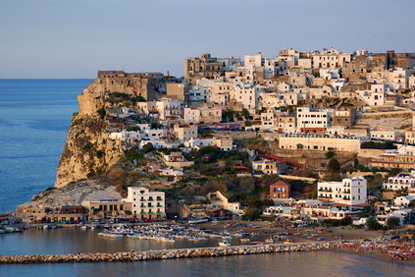
 Peschici is a picturesque village in the Gargano region. Perched atop a cliff overlooking the Adriatic Sea, Peschici offers visitors the unique opportunity to witness both sunrise and sunset over the water. Peschici's historic center is a maze of narrow, winding streets lined with whitewashed buildings, creating a charming Mediterranean atmosphere. The town is dominated by a Norman castle built around 1000 CE, which now houses a museum featuring a macabre "Torture Room". Peschici is also known for its traditional fishing structures called trabucchi, which have been transformed into unique dining locations where visitors can enjoy aperitifs or dinner with spectacular sea views. Peschici's coastline is dotted with impressive sea caves and hidden coves, best explored by boat tours that reveal natural wonders like the Grotta Sfondata and Grotta dei Contrabbandieri. The town is also famous for its local cuisine, including a traditional dish called "Panmbuss pu cefl," a mullet soup served on stale bread. |
| Castel del Monte ※ |
|---|

Castel del Monte is a 13th-century fortress with several intriguing features. It was built using a combination of limestone, white marble, and coral breccia, creating a striking appearance. Its unique octagonal design, with eight octagonal towers, reflects Emperor Frederick II's interest in mathematics and astronomy. The castle's design incorporates elements from various architectural styles, including Romanesque, Gothic, and Islamic influences. Castel del Monte features an advanced plumbing system that used rainwater for toilets and bathrooms, which was highly innovative for its time. The fortress was included in the UNESCO World Heritage list in 1996, recognized as a masterpiece of medieval military architecture. The castle's silhouette appears on the Italian 1-cent euro coin, showcasing its national significance. Unfortunately the castle was looted and stripped of its firnishings and marbles after being abandoned in the 17th century, so there is almost nothing left to see inside. |
Centre
| Trani |
|---|

 Trani's charming old town, with its maze of medieval streets and vibrant marina, makes it a popular destination for tourists and a perfect representation of Puglia's coastal beauty. Trani played a significant role in maritime history, issuing the "Ordinamenta et consuetudo maris" in 1063, considered the oldest surviving maritime law code in the Latin West. The city's most iconic landmark is the 12th-century Romanesque Cathedral of San Nicola Pellegrino, which stands majestically on the Adriatic seafront. The city has a fascinating Jewish heritage, with the Scolanova Synagogue being one of the few medieval synagogues in Italy still in use today. Trani was also a favorite residence of Emperor Frederick II, who built an impressive castle there in 1233. Trani is renowned for its excellent seafood cuisine and the beautiful "pietra di Trani," a cream-colored local stone used in many of its buildings. |
| Molfetta |
|---|

Molfetta's ancient port, dating back to Roman times, remains a bustling hub for local fishermen. The skyline is dominated by two impressive cathedrals: the Old Cathedral (Duomo di San Corrado), an 11th-century Romanesque masterpiece with two bell towers, and the newer Baroque Cathedral of the Most Holy Assumption. The town's historic center, located on the Sant'Andrea peninsula, features narrow streets, charming squares, and beautiful architecture. Molfetta played a significant role during the Crusades as a port of embarkation for pilgrims heading to the Holy Land. The town is also known for its picturesque harbor, scenic Lungomare Europa promenade, and the nearby Il Pulo Archaeological Area, one of southern Italy's most important Neolithic sites. |
| Giovinazzo |
|---|
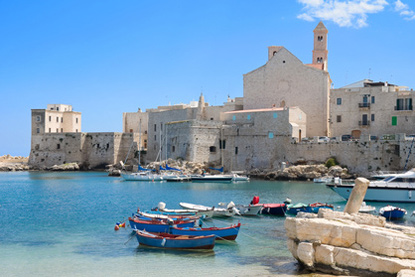
 Giovinazzo was originally founded by the Romans and called Natolium, possibly built on the ruins of an earlier Peucete settlement destroyed during the Punic Wars. The town's historic center, known as Borgo Antico, is a well-preserved gem featuring narrow streets, small arches, and tiny squares, all located beside an attractive fishing harbor. Giovinazzo is nicknamed the "City of Olive Oil" due to the extensive cultivation of olive trees in the surrounding agricultural areas. The town's main square, Piazza Vittorio Emanuele II, is considered one of the most beautiful in Puglia and is unique in Italy due to its trapezoidal shape. Giovinazzo hosts an annual Historical Parade (Corteo Storico) on the Saturday before August 19th, featuring over 150 people in costume and evoking important historical events. |
| Bisceglie |
|---|

Bisceglie offers visitors a rich blend of historical significance and coastal charm along the Adriatic. The town features impressive medieval architecture, including the Norman Tower and the Romanesque Cathedral of San Pietro with its beautiful rose window. History enthusiasts will appreciate the Dolmen of Chianca, an ancient megalithic structure dating back to Neolithic times, while the cobbled streets of the old town centre reveal centuries of cultural influences from Byzantine to Renaissance periods. The picturesque harbour lined with fishing boats provides a gateway to sandy beaches perfect for relaxation. Culinary experiences abound with excellent seafood restaurants serving fresh catches, local olive oil, and regional wines like Nero di Troia. The vibrant Wednesday market offers an authentic glimpse into local life, where visitors can sample artisanal cheeses and traditional Apulian products amidst the lively atmosphere that characterises this coastal gem. |
| Gravina in Puglia |
|---|
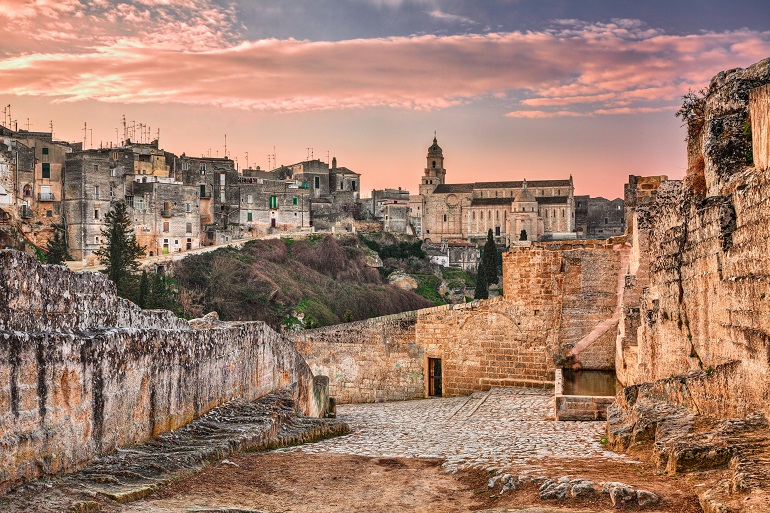
Gravina in Puglia, situated 60 kilometres west of Bari in southern Italy, is an ancient town with roots dating back to the Neolithic age. Set dramatically on the edge of a deep ravine, this historic settlement of 43,000 inhabitants features a remarkable underground network of tunnels, caves and ancient dwellings carved into the limestone. The town, which lies within the Alta Murgia National Park, is distinguished by its Romanesque Cathedral of Santa Maria Assunta perched along the ravine, offering panoramic views of the surrounding landscape. Originally established by the Greeks and later ruled by the Romans, Gravina was positioned strategically on the Via Appia route to Tarentum, and its rich history is evident in its blend of architectural styles, from ancient cave churches to Baroque buildings. |
| Altamura |
|---|
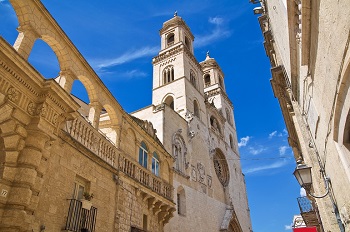
Altamura offers visitors a remarkable blend of prehistoric significance and medieval splendour. The city is home to the renowned Altamura Man, one of the oldest and most important Neanderthal skeletal discoveries, alongside dinosaur footprints dating back 85 million years at Cava Pontrelli. History enthusiasts will appreciate the impressive 13th-century Cathedral of Santa Maria Assunta, built under Emperor Frederick II, featuring intricate carved reliefs, a stunning rose window, and a notable stone pulpit from 1545. The city's rich past is evident in its partially preserved megalithic walls from the 6th-3rd century BCE and its historical connection to the Altamuran Revolution of 1799. Beyond monuments, visitors can explore the Pulo of Altamura, a massive karstic basin with ancient caves, or sample the local heritage at La Cantina Frrud, a 16th-century wine museum, while enjoying the vibrant atmosphere of Cathedral Square. |
| Bari |
|---|

Bari is among the ten largest cities in Italy and serves as a key port for trade and maritime transport in the Adriatic. Bari's old town, known as Bari Vecchia, dates back over 2,000 years and features a maze of narrow streets where you can watch local women making traditional orecchiette pasta by hand. Bari boasts Europe's longest seafront promenade, offering spectacular views of the Adriatic Sea. The city is home to the Basilica di San Nicola, which houses the relics of Saint Nicholas (Santa Claus), making it an important pilgrimage site. The city hosts the annual Fiera del Levante, an important Occidental-Oriental trade fair that has been held since 1930. |
| Polignano a Mare |
|---|

Perched dramatically atop a 20-meter-high limestone cliff overlooking the Adriatic Sea, Polignano a Mare boasts a rich history dating back to prehistoric times and is believed to be the site of the ancient Greek city of Neapolis of Apulia. Polignano is famous for three main attractions: its stunning crystal-clear waters perfect for cliff diving, its outstanding gelato, and as the birthplace of Domenico Modugno, who wrote and sang the international hit "Volare". The town's historic center, accessed through the 16th-century Arco Marchesale (also known as Porta Grande), features charming whitewashed streets, beautiful old churches, and panoramic terraces offering breathtaking sea views. A unique feature of Polignano a Mare is its "poetry trail," where verses in Italian and dialect decorate the walls of houses and streets, adding a touch of literary charm to the architectural beauty. Polignano a Mare is also renowned for its sea caves and caverns, many of which can only be explored by boat. The most famous of these is the Grotta Palazzese, which houses a renowned restaurant inside a natural cavity overlooking the sea. The town's iconic beach, Lama Monachile, is a small pebbled cove surrounded by towering cliffs and is the site of the annual Red Bull cliff diving competition. |
| Monopoli |
|---|

The city's origins date back to the Bronze Age, and it later became an important port during the Crusades. Monopoli's strategic location made it a target for various civilisations, including the Greeks, Romans, Byzantines, Normans, and Venetians, each leaving their mark on the city's culture and architecture. One of the most fascinating aspects of Monopoli is its successful resistance against a three-month siege by Spanish forces in 1529, which led to the city being granted free status. Monopoli's old town is a maze of narrow alleys and whitewashed buildings, creating a picturesque setting that attracts thousands of tourists annually. The city is home to several notable landmarks, including the imposing Castle of Charles V, which overlooks the sea, and the Baroque-style Cathedral of Maria Santissima della Madia. |
| Alberobello ※ |
|---|

Alberobello is a charming town renowned for its unique trulli houses. These distinctive dwellings, characterised by their conical roofs, date back to the mid-14th century and were built using a prehistoric dry-stone technique still in use today. The town's name originates from the Latin "silva arboris belli," meaning "forest of the tree of war," referring to an oak forest that once stood in the area. Alberobello boasts over 1,500 trulli structures, concentrated mainly in two districts: Rione Monti and Aia Piccola. These remarkable buildings earned Alberobello UNESCO World Heritage status in 1996, recognising their exceptional architectural and historical value. Interestingly, the trulli were originally constructed without mortar to avoid property taxes, as they could be easily dismantled during royal inspections. |
| Conversano |
|---|

Conversano offers visitors a genuine Italian experience away from mass tourism, combining notable historical landmarks with cultural traditions. The imposing Norman Castle stands alongside the 11th-century Romanesque Cathedral and 6th-century Benedictine Monastery, while the historic centre features charming cobbled lanes and quaint courtyards. Several museums house archaeological finds and artwork, with the town's cultural scene enhanced by initiatives like the 'Streets of Art' project. Famous for its cherries, Conversano boasts countryside filled with orchards, vineyards and olive groves, and a culinary tradition celebrating local produce. This combination of history, culture and gastronomy creates an authentic Puglian experience that rewards exploration. |
| Bitonto |
|---|
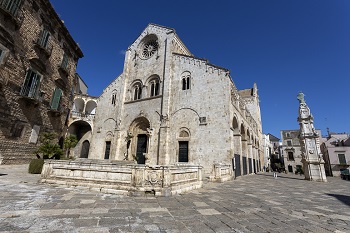
Bitonto offers a genuine Italian experience with its outstanding medieval architecture and remarkable Romanesque Cathedral, widely regarded as one of the finest in Italy. The historical centre features stone-paved streets lined with important churches, elegant palaces, and valuable archaeological sites revealing Roman foundations. Known as the 'City of Olives,' Bitonto produces exceptional olive oil celebrated at its annual festival. Visitors can explore the Diocesan Museum's religious artworks, enjoy performances at the Opera Festival, and savour authentic cuisine and traditional crafts that showcase the region's cultural heritage. |
Other attractions
 Castellana Caves
South (Salento Peninsula)
| Ostuni |
|---|
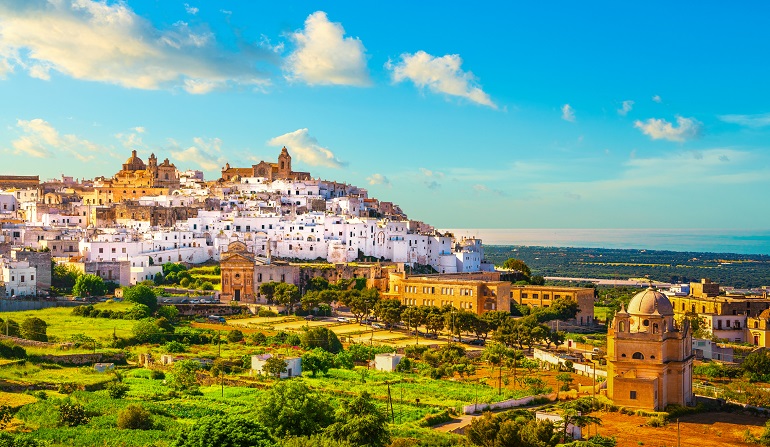
Ostuni, known as "La Città Bianca" (The White City), is a stunning hilltop town famous for its dazzling whitewashed buildings. The town's history stretches back to the Stone Age, with evidence of Neanderthal inhabitants over 40,000 years ago. Ostuni's population swells from about 32,000 in winter to around 200,000 during summer, making it a major tourist attraction in Apulia. The city's unique architecture reflects its diverse history, having been ruled by various civilisations including the Messapians, Greeks, Romans, and Normans. Ostuni boasts the second-largest rose window in Europe, second only to Notre Dame in Paris, which adorns its 15th-century cathedral. The practice of whitewashing buildings in Ostuni dates back to the Middle Ages and served both practical and health purposes, helping to keep buildings cool and slow the spread of disease. |
| Gallipoli |
|---|

Meaning "Beautiful City" in Greek, Gallipoli served as a crucial port throughout history, leading to its conquest by various civilisations, including the Romans, Byzantines, and Normans. Gallipoli's old town is situated on a small limestone island connected to the mainland by a 16th-century bridge, creating a unique geographical layout. In the 18th century, Gallipoli was the Mediterranean's largest olive oil market, with its oil used to light the streets of major European cities, including London. The town features impressive Baroque architecture, including the 17th-century Sant Agata Cathedral, which rivals the beauty of churches in Lecce. |
| Santa Maria di Leuca |
|---|
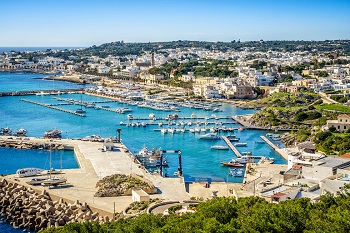
Known as "Finibus Terrae" (the end of the earth), Santa Maria di Leuca sits at the meeting point of two seas, providing crystal-clear waters and beautiful beaches, including the stunning Pescoluse beach, often called "the Maldives of Salento." History enthusiasts will appreciate the Basilica Santuario Santa Maria de Finibus Terrae, built on the site of an ancient Roman temple, along with numerous archaeological sites and elegant 19th-century Art Nouveau villas that line the coast. The impressive lighthouse, one of Europe's tallest, offers panoramic views of the surrounding landscape. Nature lovers can explore the numerous sea caves along the coastline, either by boat or through diving excursions, while the monumental waterfall and its 300-step staircase present a unique architectural marvel. |
| Taranto |
|---|
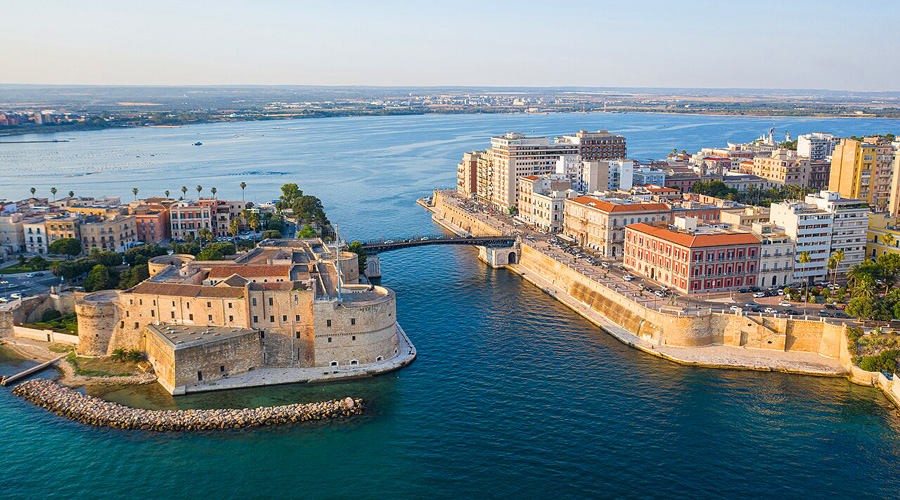
Founded by Spartan colonists in the 8th century BCE, it was once one of the largest and most powerful cities in Magna Graecia. Taranto is known as the "City of Two Seas" due to its position between the Mar Grande (Big Sea) and Mar Piccolo (Little Sea), which has made it an important naval and commercial port throughout history. The city is renowned for its archaeological treasures, particularly its collection of ancient Greek artifacts. The National Archaeological Museum of Taranto (MARTA) houses one of the largest collections of Greek pottery and goldsmithing in Southern Italy, showcasing the city's rich cultural heritage. Taranto is also famous for its delicious mussels, which have been celebrated since ancient times and continue to be a local delicacy. Taranto's skyline is dominated by the impressive Aragon Castle, built in the 15th century to defend against Turkish raids. The city's old town, with its winding Byzantine-era streets, offers a stark contrast to the more modern areas, creating a unique blend of ancient and contemporary urban landscapes. |
| Locorotondo |
|---|
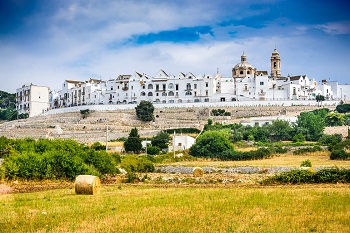
Locorotondo, a medieval village founded around 1000 CE, is distinguished by its circular structure that gave the town its name meaning "round place." The historic centre showcases white-washed houses with unique "cummerse" (pointed roofs) found only in this region, alongside architectural treasures such as the Baroque Palazzo Morelli and the 18th-century Mother Church of San Giorgio. Vibrant flowers adorn wrought-iron balconies throughout the white limestone buildings, creating picturesque streets. The town celebrates rich cultural traditions, including the August festival of San Rocco with its famous fireworks competition, and is recognised for its quality wines. From panoramic terraces, visitors can appreciate the beautiful countryside with olive groves, vineyards and the distinctive trulli dwellings that dot the landscape. |
| Brindisi |
|---|

Brindisi has been a busy port city since ancient times. It served as a crucial Roman port, marking the end of the Via Appia, one of ancient Rome's most important roads. Brindisi's strategic location made it a major departure point for pilgrims and crusaders heading to the Holy Land during the Middle Ages. Nowadays its port remains a significant hub for trade with the Balkan Peninsula, Greece, and the Middle East. The city's name, derived from the Messapic word "Brention," means "deer's head," reflecting the shape of its natural harbor. The city briefly became the capital of Italy from September 1943 to February 1944 during World War II. The city is home to the Tempio di San Giovanni al Sepolcro, one of Southern Italy's finest examples of Romanesque architecture, built in the 11th century. |
| Lecce |
|---|

Lecce, often called the "Florence of the South," is renowned for its stunning Baroque architecture, characterised by intricate ornamentation and the use of local "Lecce stone," a soft limestone that's easily workable for sculptures. Lecce's origins are steeped in legend, with some attributing its foundation to around 1200 BCE, immediately after the fall of Troy. The city flourished under Roman rule, becoming an important centre for trade and commerce, as evidenced by the well-preserved Roman Amphitheater in the city centre. Lecce experienced a golden age during the 17th century when many of its most iconic Baroque buildings were constructed, including the breathtaking Basilica of Santa Croce and the expansive Piazza del Duomo. Interestingly, Lecce is home to a hidden river called Idume, which flows for 7 km and traverses the city center. Beneath Palazzo Adorno, there's a water-bearing layer that was once used as a natural swimming pool for the palace's inhabitants. The city is also an important agricultural centre, known for its olive oil and wine production, as well as an industrial hub specialising in ceramics. |
| Otranto ※ |
|---|
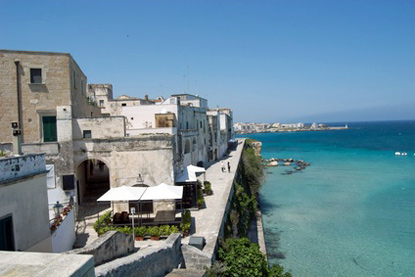
Otranto is the easternmost city in Italy, serving as a bridge between the East and West throughout its history. The city boasts an impressive 11th-century Cathedral, featuring an exquisite 12th-century mosaic floor that depicts the Tree of Life. Otranto's historic center is enclosed within defensive walls and is home to the imposing Aragonese Castle, built in the 15th century. The town witnessed a tragic event in 1480 when Turkish forces invaded, resulting in the martyrdom of 800 citizens who refused to convert to Islam. The nearby I Laghi Alimini, two interconnected saltwater lagoons, are home to diverse flora and fauna, including migratory birds like flamingos. |
|


 : Local interest
 : Moderately interesting
 : Outstanding place
 : Must-see in the country
 : Top cities in Europe