


| Contents |
|---|
Introduction
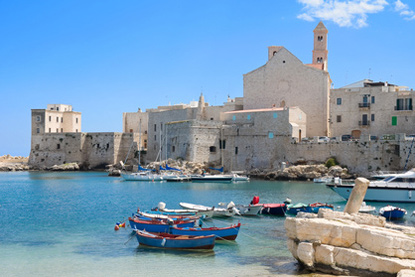
Giovinazzo is a small coastal town located approximately 18 km north of Bari. With a population of about 20,000 residents, this historic settlement traces its origins to Roman times when it was known as Natolium, later being fortified by Emperor Trajan in 102 CE. The town's compact historic centre (Borgo Antico) features narrow cobblestone streets, ancient city walls, and numerous arches connecting small squares. Notable landmarks include the 12th-century Co-cathedral of Santa Maria Assunta built in distinctive Apulian Romanesque style, the 17th-century Ducal Palace, and the picturesque fishing harbour. The large triangular Piazza Vittorio Emanuele II serves as the town's main gathering place, featuring the ornate Triton Fountain. Giovinazzo is easily accessible by rail, situated on the main line about 20 minutes from Bari, making it an ideal base for exploring the wider Puglia region whilst enjoying authentic Italian coastal life.
Interesting Facts about Giovinazzo
- Giovinazzo was originally a Roman fortified centre called Natolium, possibly built on the ruins of Peucete Netium which was destroyed during the Punic Wars.
- The town was fortified by Emperor Trajan in 102 CE and was among the first localities in Puglia to be converted to Christianity.
- Giovinazzo is known as the "City of the Olive Oil" due to the cultivation of olive trees that occupies most of its agricultural area.
- The town features traditional water mills called "palmento" that were used to crush olives for oil production.
- The impressive Romanesque Cathedral of Santa Maria Assunta, built in the 12th century, houses a Byzantine icon of the Madonna di Corsignano.
- Giovinazzo's historic centre can be accessed through the Arch of Trajan, built above a milestone of the ancient Via Traiana from the 2nd century CE.
- The town hosts an annual Historical Parade (Corteo Storico) before 19th August, featuring over 150 people in costume accompanied by trumpets and drums.
- Giovinazzo celebrates the Bonfires of Saint Anthony in January, where neighbours arrange bonfires and visitors can taste local dishes while enjoying music.
- The Giovinazzo Rock Festival is one of the biggest free rock festivals in Puglia, having hosted famous singers like Caparezza and Giuliano Palma.
- The splendid Fountain of the Tritons, constructed in 1933, dominates Piazza Vittorio Emanuele II, which was originally built in 1797 over an old sea inlet.
- The town features the Church of the Holy Spirit with its distinctive "trullo" shaped domes, built at the end of the 14th century in late Romanesque style.
- American actor John Turturro's father, Nicholas Turturro, emigrated to the United States from Giovinazzo in the first half of the 20th century.
History
Giovinazzo’s history stretches back to antiquity, with its origins shrouded in both legend and archaeological evidence. According to local lore, the town was founded by Perseus, son of Jupiter, though its documented roots trace to Roman times. Established as Natiolum, it likely emerged on the ruins of the Peucetian settlement Netium, destroyed during the Punic Wars. By 102 CE, Emperor Trajan fortified the site, cementing its strategic role in the Roman Empire’s coastal defences. This period also saw Giovinazzo become one of Puglia’s earliest Christian converts, with churches proliferating before the fall of the Western Roman Empire. The town’s Roman heritage endures in landmarks such as Trajan’s Arch, a 14th-century structure built using columns from the ancient Trajan Way.
The medieval era transformed Giovinazzo into a contested stronghold. From the 7th century, it served as a Lombard gastaldato (administrative district) until Byzantine reconquest in the 10th–11th centuries. Norman rule, beginning in the 11th century under Robert Guiscard, ushered in a golden age: the Cathedral of Santa Maria Assunta was constructed in Romanesque style, and the settlement evolved into a fortified castrum. Subsequent centuries saw shifting allegiances—Manfredi of Sicily granted the town to his relative Giordano Lancia in 1257, while Aragonese dominion in the 15th century spurred architectural renewal, including the addition of cylindrical rondelle towers to its walls. Despite economic decline under Angevin rule, the Aragonese revitalised Giovinazzo, embedding it within the Mediterranean’s trade networks.
By the early modern period, Giovinazzo had become a pawn in European power struggles. Charles V sold it to Ferdinando di Capua in the 16th century, and it later passed to the Gonzaga family before Nicolò Giudice Caracciolo, Prince of Cellamare, acquired it in 1651. The Giudice dynasty ruled until 1770, when the fiefdom reverted to the Bourbon Crown. Feudalism’s abolition in 1806 and Italian unification in 1861 marked Giovinazzo’s transition into a modern municipality. Today, its historic centre—a labyrinth of narrow alleys and sunlit squares—bears witness to this layered past, from Roman foundations to Baroque palazzos, offering travellers a tangible connection to millennia of Mediterranean history.
Main Attractions
Historic Centre
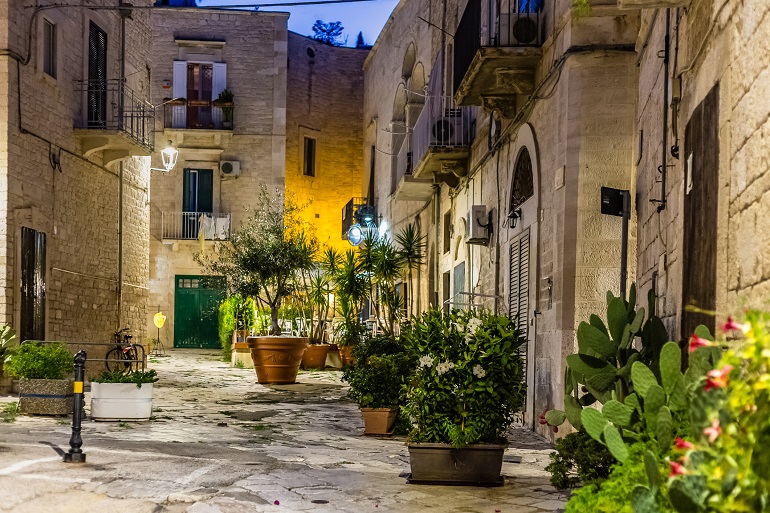
The medieval centro storico of Giovinazzo represents the historical soul of this Apulian town, with its labyrinthine network of narrow cobblestone streets, unexpected archways, and intimate squares that open suddenly between ancient limestone buildings. This atmospheric old quarter is primarily accessed through the Arco di Traiano, an impressive gate constructed above the milestones of the ancient Via Traiana, the Roman road that once connected Benevento to Brindisi. As you pass through this historic entrance, you step into a world where time seems to have slowed considerably.
The historic centre reveals its treasures gradually as you wander its alleyways. Weathered stone buildings display intricate balconies, decorative doorways, and family crests that speak to the town's noble past. Many structures date back to the 12th and 13th centuries, though some foundations are even older. The architectural styles blend Norman, Aragonese, and later Baroque influences, creating a visually rich tapestry that reflects the town's complex history under various rulers. The Palazzo Ducale stands as one of the most impressive buildings, constructed in the 16th century as a residence for local nobility. Its strategic position overlooking the sea offered both prestige and security to its original inhabitants, while today it provides visitors with a glimpse into aristocratic life of centuries past.
Piazza Vittorio Emanuele II
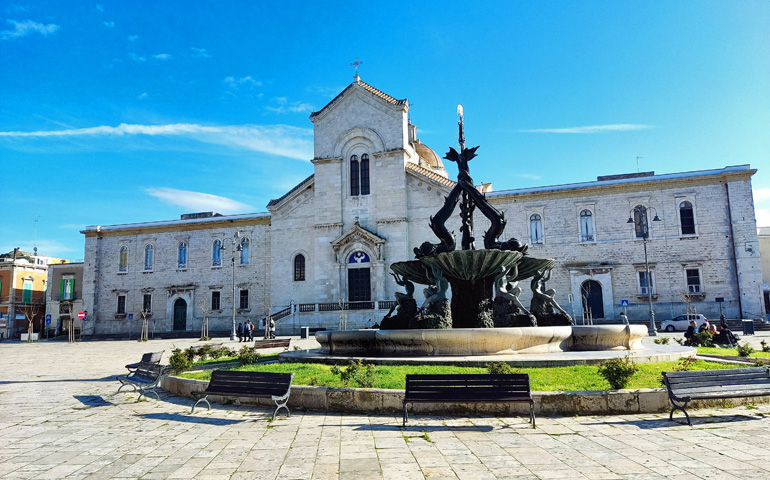
Piazza Vittorio Emanuele II serves as the cultural and social heart of Giovinazzo, a trapezoidal open space where locals and visitors alike gather throughout the day and evening. The square's distinctive shape evolved naturally over centuries rather than from deliberate urban planning, giving it an organic character that feels both intimate and expansive. At its centre stands the Fontana dei Tritoni, an ornate fountain constructed in 1933 by the sculptor Tommaso Piscitelli, featuring mythological sea creatures that pay homage to the town's maritime heritage.
The piazza is framed by buildings of various periods and styles, creating an architectural dialogue across centuries. The warm golden hues of local limestone glow particularly beautifully during the evening hours when the square fills with people participating in the traditional Italian passeggiata. Several historic palazzi line the square, their ground floors now housing cafés where patrons can sit at outdoor tables and observe daily life. During summer evenings, the piazza frequently hosts cultural events, from classical music performances to folk dancing demonstrations that showcase Puglia's rich cultural traditions. The atmosphere changes with the seasons and times of day, from the quiet morning hours when shopkeepers arrange their displays to the lively evening ambiance when families gather and conversations flow freely across the open space.
Giovinazzo Cathedral
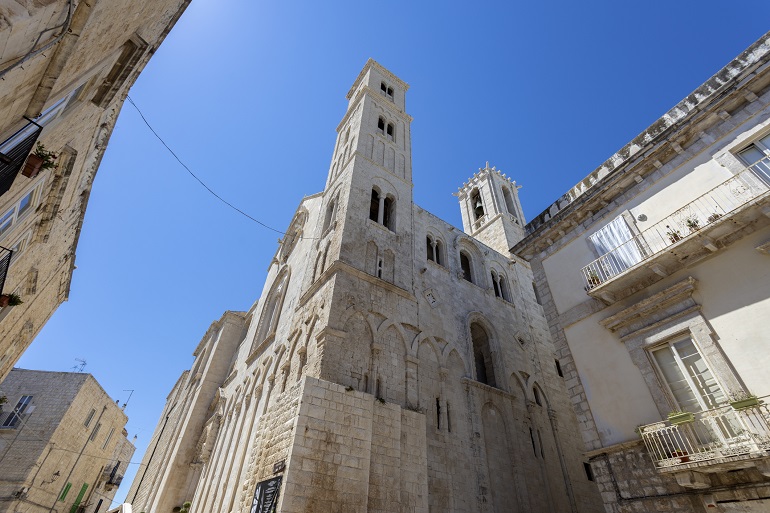
The Cattedrale di Santa Maria Assunta (Cathedral of Saint Mary of the Assumption) in Giovinazzo is a remarkable example of Apulian Romanesque architecture built during the Norman period (1150-1180) and consecrated in 1283. Sitting atop a gentle rise with views of the Adriatic Sea, this impressive limestone structure features a beautiful central Romanesque portal with fine decorations and a small portico supported by columns with griffins. While the apse retains its original Romanesque layout, much of the cathedral underwent Baroque modifications in the 18th century under Bishop Paolo De Mercurio (1731-1752), particularly after an earthquake. The interior presents a three-nave basilica design with arched ceilings and sturdy stone columns creating an atmosphere of calm and grandeur. The crypt has remained largely unchanged, supported by 10 columns with unusual Romanesque capitals and 12 pillars protruding from the perimeter walls. Visitors can access the cathedral during limited opening hours: Mondays, Wednesdays and Saturdays from 10:00 to 12:00.
Torrione Aragonese
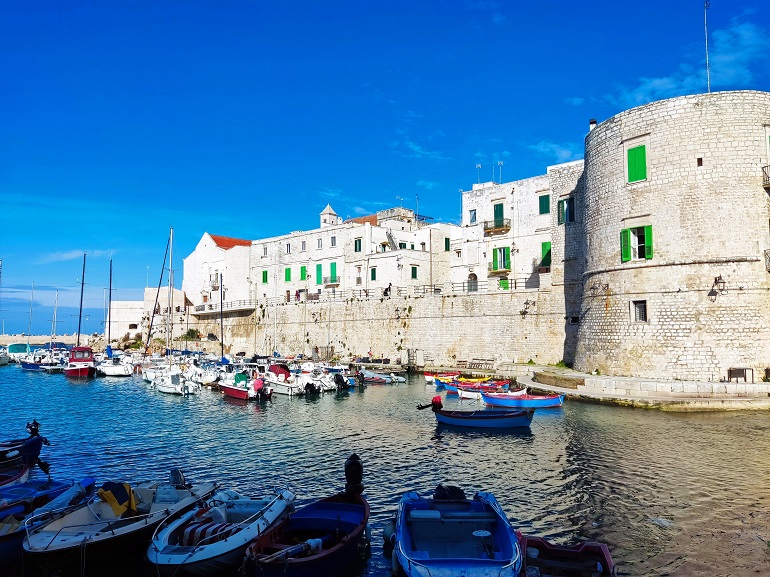
The Torrione Aragonese stands as a proud sentinel at the edge of Giovinazzo's harbour, its cylindrical form rising dramatically from the coastal rocks. Constructed in the 15th century during the Aragonese domination of southern Italy, this defensive tower formed part of a comprehensive coastal warning system designed to protect the region from Ottoman and Saracen raids. Built with the same golden-hued local limestone that characterises much of Giovinazzo's architecture, the tower's walls are impressively thick—nearly three metres in some sections—demonstrating the serious defensive purpose it once served.
The tower's strategic position allowed guards to spot approaching enemy vessels from considerable distances and signal to nearby towers using fire or smoke, creating a communication chain that could quickly alert inland settlements. Its circular design was intentional, offering no corners that could be easily targeted by cannon fire from ships. Today, visitors can appreciate the tower's impressive engineering and the panoramic views it offers of the Adriatic coastline. The structure features narrow slit windows that once served as positions for archers and early firearms, while the upper level provided an excellent vantage point for surveillance. The interior space, though relatively simple, conveys the austere functionality of military architecture from this period. Standing beside this historic structure as waves crash against the rocks below provides a tangible connection to the region's complex past, when coastal communities lived under constant threat of maritime raids.
City Walls
Giovinazzo's ancient city walls represent one of the most complete medieval defensive systems still visible in Puglia. These fortifications, which once completely encircled the old town, date primarily from the 12th century, though they were significantly reinforced and expanded during the Aragonese period in the 15th century when coastal defences became increasingly important throughout southern Italy. Constructed from local limestone that has weathered to a warm honey colour, these walls have withstood centuries of maritime storms and historical upheavals.
Walking along the remaining sections of the walls offers visitors a journey through Giovinazzo's defensive history. The eastern and northern sections remain particularly well-preserved, with impressive height and thickness that speak to their original purpose. Several watchtowers punctuate the walls at strategic intervals, creating a rhythm to the defensive perimeter. The relationship between the walls and the sea is particularly dramatic, with some sections rising directly from rocky outcrops above the water. This positioning made the town nearly impregnable from the seaward side. Small apertures and embrasures can still be seen in various sections, designed for archers and early firearms. The walls incorporate different building techniques that reveal their various construction periods—from the more regular Norman stonework to later Aragonese additions. As you walk along these ancient defences, the views alternate between glimpses of the labyrinthine old town on one side and the expansive azure of the Adriatic on the other, creating a vivid contrast between the enclosed medieval world and the open seascape that both threatened and sustained the community for centuries.
Lungomare di Giovinazzo
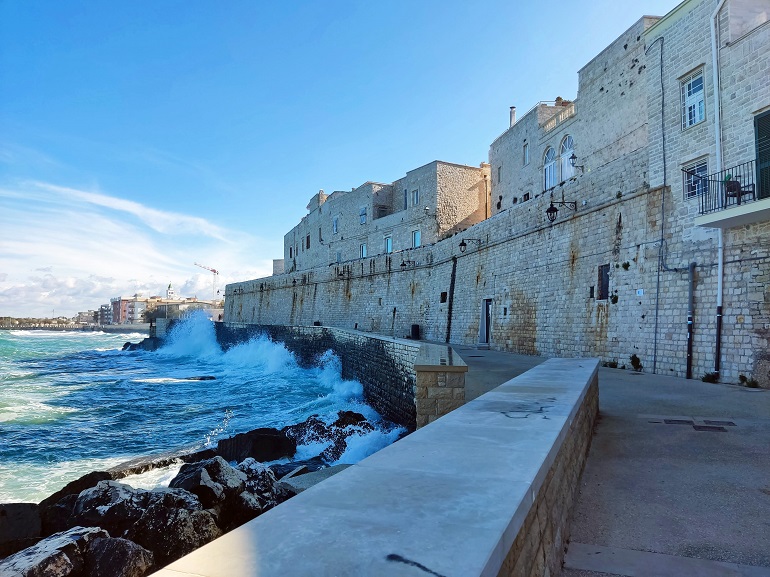
The Lungomare di Giovinazzo offers one of the most picturesque coastal promenades in the region, stretching along the Adriatic shoreline and providing constantly changing vistas of the sea. This carefully designed walkway follows the natural contours of the coastline, alternating between sections that run close to the water's edge and elevated portions that provide sweeping panoramic views. The promenade is paved with local stone that complements the natural rock formations along the shore, creating a harmonious transition between the built environment and the natural landscape.
The most scenic section begins near the Cathedral and runs outside the old city walls, where visitors can appreciate both the historic architecture of the town and the natural beauty of the coastline simultaneously. This portion of the lungomare features several belvedere points with stone benches positioned to take advantage of particularly striking views. The quality of light along this stretch is remarkable, especially in the early morning and late afternoon when the sun's rays illuminate the limestone buildings of the old town and cast a golden glow across the sea. The coastline itself alternates between small rocky coves with crystal-clear water and more rugged sections where waves crash dramatically against limestone formations. Native Mediterranean vegetation grows in protected pockets along the route, including prickly pear cacti, wild capers, and aromatic herbs that add sensory dimensions to the walking experience. The lungomare connects several of the town's beaches and fishing spots, making it not just a scenic route but a practical connection between different coastal attractions.
Harbour
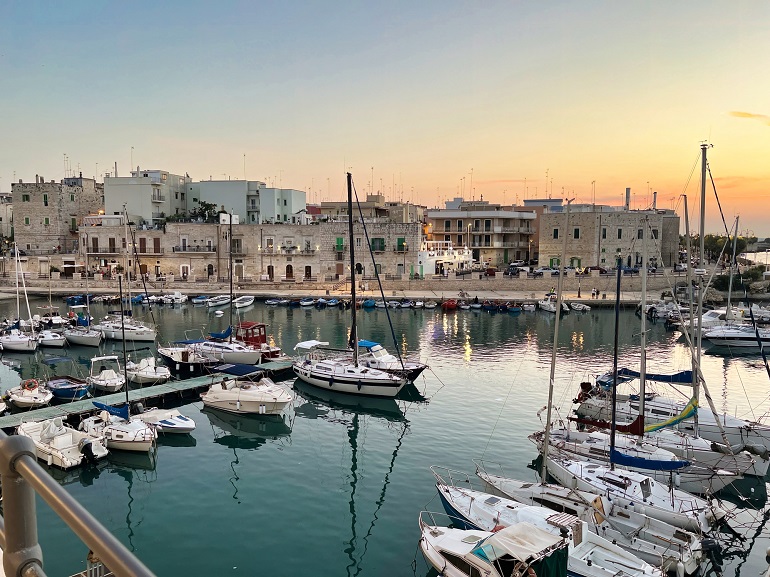
Giovinazzo's harbour represents the town's enduring connection to the sea, a sheltered haven that has served maritime purposes since ancient times. Unlike the large commercial ports of nearby cities, Giovinazzo's harbour maintains an authentic charm with its modest scale and working character. The port is divided into two distinct basins: the older, smaller inner harbour that dates back to Roman times, and the more recent outer harbour that accommodates larger vessels. Traditional wooden fishing boats painted in bright blues, reds, and yellows create a colourful display against the deep blue water, particularly in the early morning when fishermen return with their catches.
The harbour area serves as more than just a functional space for maritime activities; it forms a crucial part of the town's social landscape. The quayside comes alive particularly in the evening hours, when fishermen mend their nets in time-honoured fashion and sell portions of their daily catch directly from their boats. The eastern side of the harbour features an elevated walkway built atop ancient foundations, providing spectacular views across the water to the old town. This vantage point offers perhaps the most photogenic perspective of Giovinazzo, capturing the relationship between the medieval buildings, defensive walls, and the sea that has shaped the town's identity for millennia. The harbour's protective breakwater extends into the Adriatic like a stone finger, creating a popular spot for local anglers and those seeking contemplative moments watching the horizon. The quality of light here changes dramatically throughout the day, from the soft golden illumination of early morning that highlights the textures of the ancient stonework to the dramatic sunset hues that transform the harbour into a canvas of reflected colour.
Beaches
Giovinazzo offers several distinctive beaches that provide varied coastal experiences within close proximity to the historic centre. Lido Lafayette stands as one of the most popular stretches of coastline, characterised by a combination of sandy sections and smooth limestone platforms that create natural terraces leading into the crystalline Adriatic waters. The beach features remarkable water clarity that allows visitors to observe marine life even without snorkelling equipment. The seafloor gradually slopes away from shore, making it particularly suitable for families with children and less confident swimmers. The limestone formations that punctuate this beach create natural pools where seawater warms quickly in the summer sun, offering delightful bathing experiences.
Lido Cala Arena presents a different coastal environment with its distinctive cove formation that provides natural protection from stronger sea currents. This beach features finer sand mixed with small pebbles, creating a comfortable surface for sunbathing while offering the interesting tactile experience of walking on varied textures. The surrounding cliffs provide dramatic visual framing for the cove and offer some natural shade during certain hours of the day. The water here takes on a particularly intense turquoise hue due to the combination of white sand and the specific mineral content of the rocks. Beyond these main beaches, Giovinazzo's coastline reveals numerous smaller coves and rocky platforms that reward explorers willing to venture slightly further from the centre. These less-frequented spots offer increased privacy and the opportunity to experience the Mediterranean coastline in its more natural state, with native vegetation growing right to the water's edge and interesting rock formations shaped by centuries of wave action. The entire coastal area experiences the phenomenon of exceptionally clear water that characterises this stretch of the Adriatic, allowing for excellent visibility that enhances swimming and snorkelling experiences.
Top Museums
Museo Civico
The Museo Civico (Civic Museum) is one of Giovinazzo's notable cultural institutions. Housed in a historic building, it displays various artifacts related to local history. The museum features archaeological findings and historical items that tell the story of Giovinazzo's past, which dates back more than two thousand years. Some exhibits include original stone floors, walls, and architectural elements that have been preserved to showcase the town's heritage.
Pinacoteca Comunale
The Pinacoteca Comunale (Municipal Art Gallery) houses a collection of artwork significant to Giovinazzo and the surrounding region. Art enthusiasts will appreciate the diverse collection that reflects the artistic traditions of Puglia.
Palazzo Comunale
For those interested in modern art, the Palazzo Comunale (Town Hall) offers a collection of paintings by notable artists, including works by the Sicilian painter Renato Guttuso. This venue combines civic function with cultural significance, making it an interesting stop for visitors interested in contemporary Italian art.
Local Cuisine
Giovinazzo, known as the "City of the Olive Oil" due to its abundant olive groves, offers visitors a delightful gastronomic experience centred around fresh, local ingredients. The town's cuisine is heavily influenced by its coastal location, with fresh seafood featuring prominently on restaurant menus, including dishes like spaghetti alle vongole and grilled fish caught daily from the Adriatic Sea. Traditional Apulian specialties such as favetta e cicorie (mashed fava beans with boiled chicory) and orecchiette with broccoli rabe showcase the region's agricultural bounty. Locally-produced olive oil from traditional mills called "palmento" infuses virtually every dish, from simple bread, olive oil and tomato snacks to elaborate meals. Food enthusiasts might enjoy timing their visit to coincide with the annual "festival of grandmother's panini," where traditional sandwiches filled with sun-dried vegetables preserved in oil celebrate the region's culinary heritage and provide an authentic taste of local food traditions.

Getting There & Around
Reaching the picturesque town of Giovinazzo is straightforward via Bari Airport, located just 9 kilometres away, with flights from London taking around 2 hours 40 minutes. Trenitalia provides regular train services from major Italian cities, with connections from Rome taking 4 hours (€30) and from Bari only 22 minutes (€2-5). Several bus companies including FlixBus offer affordable routes to Giovinazzo, with journeys from Brindisi (€14) and Naples (€40). Alternatively, hire a car for the short 20-minute drive from Bari. Once in town, the centre is comfortably walkable with the train station just 500 metres from the heart of Giovinazzo. For exploring further afield, utilise the local bus network (lines 01, 33) and regional trains, with the Moovit app providing comprehensive journey planning using the local currency, Euro.