Italy Guide  |
|---|
|
| | Top Italian Cities |
|---|
|
| | Italian Regions |
|---|
|
| | Europe Guide |
|---|
|
| | Travel Tools |
|---|
|
|
|
|
Aosta Valley Travel Guide
 Arpy Lake, Aosta Valley. Arpy Lake, Aosta Valley.
Introduction

Aosta Valley (known as Valle d'Aosta or Val d'Aosta in Italian) is the smallest of Italy's 20 regions and one of the five semi-autonomous regions. It is also the only region that is not divided into provinces.
The Aosta Valley is only a bit larger than Luxembourg. With a population of only 130,000 and 39 inhabitants per km², it is the least populous and least densely populated region of Italy.
Most of the local population are native Italian speakers, but 70% of them can also speak French. There is a Walser German speaking minority in the Lys Valley, and a more widely distributed minority speaking Valdôtain, a form of Franco-Provençal (Arpitan).
Cuisine
Aostan cuisine is robust and simple, based essentially on potatoes, polenta, rye bread, and local cheeses, such as Fontina and Tomme de Gressoney.
Typical dishes include carbonade (beef stew marinated for 12 days with garlic and bacon, then seasoned with white wine, cinnamon, clover, nutmeg, etc.), fricandeau (veal cooked with onions, rosemary and white wine), crêpes à la valdôtaine (crêpes with ham and Fontina cheese), and seupetta à la valpelleunèntse (black bread with green cabbage and Fontina cheese). Savoyard dishes like tartiflette are also common.
Attractions
|
Courmayeur & Mont Blanc |
|---|

 Nestled at the foot of Mont Blanc, Europe's highest peak at 4,810 metres, Courmayeur evolved from an ancient Roman settlement where the name originated from 'Curia Maior' (seat of the parish). The Romans used the surrounding valleys for military purposes and trade routes 2,000 years ago, with parts of the modern Tour du Mont Blanc trail still following an ancient Roman road. The area gained prominence in 1786 when Jacques Balmat and Michel Paccard first conquered Mont Blanc, leading Courmayeur to become Italy's mountain climbing capital and establish the country's first guide company in 1850. Today, Courmayeur offers exceptional skiing, hiking, and climbing opportunities, with the stunning Skyway Monte Bianco cable car providing access to breathtaking alpine views. The mountain, though magnificent, demands respect, as it claims an average of 100 lives annually, making it one of the world's most challenging peaks. |
|
Mont Avic Natural Park |
|---|
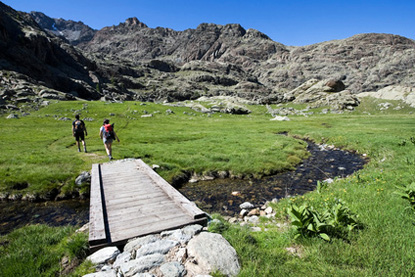
Established in 1989 as the first regional park in the Aosta Valley, Mont Avic Natural Park spans 5,747 hectares of pristine alpine landscape near the ancient Roman town of Aosta. The park boasts Italy's largest Mountain pine forest and an extraordinary collection of over 1,100 butterfly species, alongside numerous alpine lakes, peat bogs, and marshlands that are unrivalled in the region. The area's geological makeup includes fascinating ophiolites, which are remnants of an ancient seabed that emerged during the collision between African and European continents. Wildlife enthusiasts can spot ibexes, chamois, golden eagles, and marmots while exploring the park's network of trails, which range from gentle meadow walks to challenging high-altitude routes reaching up to 3,185 metres at Mont Glacier. The park's pristine condition owes much to its historically limited human interference, as the harsh terrain naturally restricted farming and tourism, allowing the forests—once exploited for mining—to return to their natural state. The park's pristine environment earned it the distinction of becoming the first protected area in Italy and Europe to receive the prestigious EMAS certification. |
| Aosta |
|---|
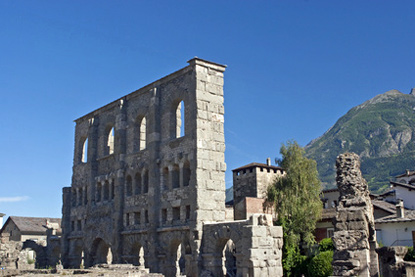
 Nestled in the Italian Alps, Aosta is a remarkable city that holds the distinction of being Italy's second-richest location for Roman ruins. Founded in 25 BCE by Emperor Augustus as Augusta Praetoria Salassorum after defeating the Celtic Salassi tribe, the city served as a crucial strategic outpost controlling mountain passes between Italy and northwestern Europe. The perfectly preserved ancient Roman walls stretch for three kilometres, featuring 20 towers and four magnificent gates. The city's Roman heritage is evident in its impressive monuments, including a 22-metre-high Roman theatre that once seated 4,000 spectators. Fascinatingly, the Romans deliberately oriented the city towards the winter solstice, and between 21-23 December, visitors can witness the sun rising in perfect alignment with the ancient Cardo Maximus just before 11 am. Today, this 'Rome of the Alps' continues to captivate visitors with its blend of Roman architecture, stunning Alpine scenery, and strategic location at the confluence of the Buthier and Dora Baltea rivers. |
|
Gran Paradiso National Park |
|---|
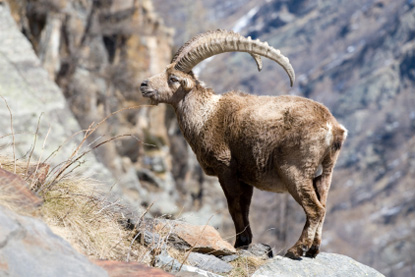
Gran Paradiso National Park, Italy's first national park established in 1922, spans 70,000 hectares of stunning Alpine terrain featuring 59 glaciers and 183 lakes. The park's fascinating history dates back to Roman times, with ancient bridges and roads still visible today. Originally a royal hunting reserve created in 1856 by King Vittorio Emanuele II to save the Alpine ibex from extinction, the area now boasts a thriving population of these majestic creatures, known for their spectacular backswept horns measuring nearly a yard long. The park's landscape is a testament to its rich heritage, featuring Roman rock engravings, medieval castles, and former royal hunting lodges situated above 2,000 metres that once accommodated the king and his court. Today, the park is a biodiversity hotspot, home to 168 species of fauna and 1,124 species of flora, with urban areas comprising merely 0.2% of its territory. The park's centrepiece, Mount Gran Paradiso, stands proudly at 4,061 metres, making it the highest peak entirely within Italian territory. |
|
Fort Bard |
|---|

 Perched dramatically on a rocky promontory at the entrance of the Aosta Valley, Fort Bard stands as a testament to over two millennia of history, with human settlements dating back to the Neolithic period and fascinating rock carvings from the second millennium BCE still visible at its base. The site's strategic importance was first recognised by the Romans, who carved a road through the rock, and later by the Ostrogoths who established a garrison here in the 6th century CE. The fort gained notoriety in 1800 when just 400 Austro-Piedmontese soldiers managed to halt Napoleon's 40,000-strong army for two weeks, so infuriating Bonaparte that he ordered the fortress demolished and dubbed it the 'evil castle of Bard'. The current impressive structure, rebuilt between 1830 and 1838, features 283 rooms across three main defensive levels and has been transformed from a military stronghold into a cultural centre housing several museums. A fascinating detail for visitors is the ancient Furiana canal, an ingenious Roman water drainage system that still functions beneath the village today. |
|
Fénis Castle |
|---|
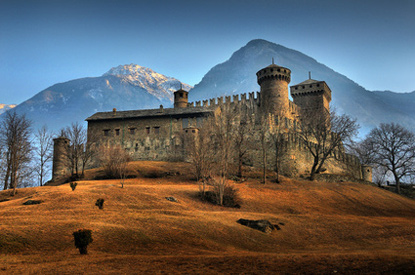
Perched on a gentle slope in Italy's Aosta Valley, Fénis Castle is a stunning medieval fortress that perfectly blends defensive architecture with aristocratic elegance. First mentioned in 1242, the castle belonged to the powerful Challant family and reached its architectural zenith between 1320 and 1420 when it acquired its distinctive pentagonal layout with multiple towers and crenellated walls. While its imposing defensive features might suggest a military stronghold, the castle was primarily built as a prestigious residence, featuring an enchanting inner courtyard adorned with remarkable frescoes depicting various scenes including the famous Saint George and the dragon. The castle's location has an intriguing connection to ancient history, as the surrounding area was once inhabited by the Salassi people, who fiercely resisted Roman conquest from 143 to 25 BCE. After centuries of glory, the castle faced a peculiar fate when it was transformed into a hay barn and stable in the 19th century, before being rescued and restored to its former grandeur. Today, it houses the Museum of Furniture of Aosta Valley and stands as one of the region's most visited attractions. |
|


 : Local interest
 : Moderately interesting
 : Outstanding place
 : Must-see in the country
 : Top cities in Europe