


| Contents |
|---|

Introduction
Trani is a coastal town in Puglia, serving as one of the three capital towns of the province of Barletta-Andria-Trani. With approximately 50,000 inhabitants, this historic fishing port is often referred to as the "Pearl of the Adriatic." The town is renowned for its stunning white limestone architecture, most notably the 12th-century Romanesque Cathedral of San Nicola Pellegrino which stands majestically overlooking the Adriatic Sea. Other significant landmarks include the 13th-century Swabian Castle built by Emperor Frederick II, a picturesque harbour lined with fishing boats and seafood restaurants, and a well-preserved medieval Jewish quarter featuring one of Europe's oldest synagogues. Trani rose to prominence during the Middle Ages as an important trading port with the Middle East and a departure point for pilgrims travelling to Jerusalem, though its significance declined in the 1500s due to Ottoman aggression. Today, visitors can explore its charming historic centre with narrow cobblestone streets, elegant palaces, and enjoy a leisurely stroll along the scenic waterfront promenade.
Interesting Facts about Trani
- Trani is a beautiful coastal town located in the Puglia region of Italy, known for its picturesque seaport and historic cathedral.
- The city's original name was Turenum or Tirenum, and according to myth, it was built by Tirenus, the son of the Greek hero Diomedes who fought in the Trojan War.
- Trani Cathedral, dedicated to Saint Nicholas the Pilgrim, was consecrated in 1143 and features beautiful bronze doors executed by Barisanus of Trani in 1175.
- In 1063, Trani issued the "Ordinamenta et consuetudo maris," which is considered the oldest surviving maritime law code of the Latin West.
- During the 11th century, Trani's port developed greatly, becoming the most important on the Adriatic Sea, particularly during the Crusades.
- The city reached its highest point of wealth and prosperity in the early 13th century under the rule of Emperor Frederick II, who built a massive castle in Trani.
- Trani was home to a significant Jewish community during the Middle Ages, with 200 Jewish families and four large synagogues at its peak.
- The renowned Rabbi Isaiah di Trani, one of the most famous rabbis of the Middle Ages, established a rabbinical school in Trani that attracted Jewish students from across the Mediterranean.
- The Scolanova Synagogue in Trani has been rededicated as a synagogue after serving as a church for many centuries.
- Trani is noted for its wines, particularly moscato, and for its stone quarries that export marble to Switzerland and Germany.
- The city was almost destroyed during the French Revolutionary Wars at the end of the 18th century, with over 1,000 people killed in riots and the subsequent French attack.
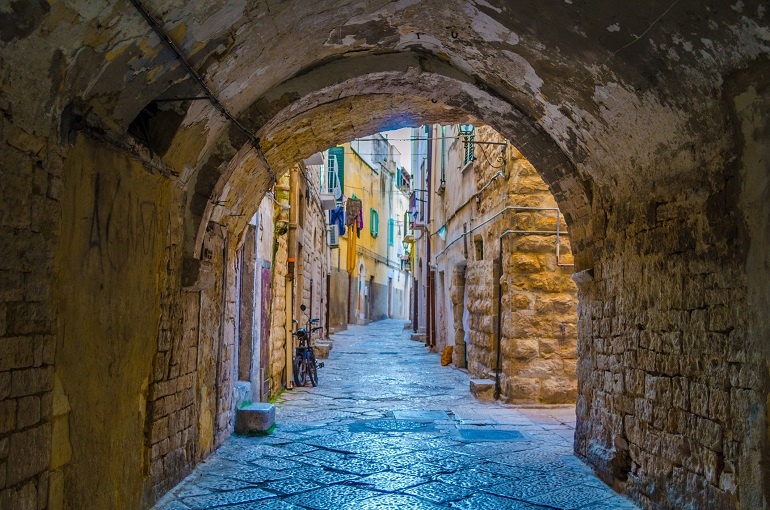
- Trani's historic centre features streets around the Ghetto area that remain much as they were in the medieval period, with many houses displaying Norman decoration.
History
Trani’s history is a tapestry of maritime prowess, multicultural exchange, and architectural grandeur. The city’s origins trace back to Roman times, with its earliest mention as Turenum on the Tabula Peutingeriana, a 3rd-century Roman itinerary. Myth attributes its foundation to Tirreno, son of the Homeric hero Diomedes, though its strategic coastal position near the Adriatic likely spurred its growth as a trading post. By the 9th century, Trani emerged as a Byzantine stronghold before falling to Lombard and Norman rule. The 11th century marked a golden age: the Normans established Trani as an episcopal seat, and its port flourished under the Ordinamenta Maris (1063), the Mediterranean’s oldest surviving maritime code, which cemented its status as a hub for Crusader expeditions and international trade. This era also saw the rise of a vibrant Jewish community, which by 1159 comprised 200 families and became a centre of Mediterranean scholarship under figures like Rabbi Isaiah di Trani.
The city’s zenith came under Holy Roman Emperor Frederick II, who fortified Trani with an imposing Swabian castle in 1233 and granted its Jewish population protected status. Trani’s white limestone cathedral, dedicated to St. Nicholas the Pilgrim, epitomises its medieval splendour. Constructed between 1099 and 1143, the cathedral’s Romanesque design features intricate bronze doors by Barisanus of Trani and a crypt housing relics of St. Febronia. However, Frederick II’s death in 1250 precipitated decline, as Angevin, Aragonese, and Venetian rivalries drained its resources. The Jewish community faced persecution under Dominican pressure, culminating in expulsions during the 15th–16th centuries. A devastating 1799 massacre by French Revolutionary forces, which killed over 1,000 residents, left the city scarred but its medieval core intact.
Despite these upheavals, Trani retained cultural significance. Under Bourbon rule in the 17th–18th centuries, it regained prominence as an administrative capital, constructing lavish marble palaces and maintaining its legacy as a centre for Apulian wine and stone production. Today, its heritage is palpable in the Jewish Quarter’s Scolanova Synagogue—reconsecrated in 2006 after centuries as a church—and the seafront Swabian Castle, now a museum. The city’s 11th-century maritime code, its role in Mediterranean trade networks, and its synthesis of Norman, Jewish, and Byzantine influences render it a living archive of southern Italy’s layered past.
Main Attractions
Swabian Castle (Castello Svevo)
Castello Svevo di Trani, located on the Adriatic coast of Puglia, is one of the most important fortified buildings erected by Emperor Frederick II of Swabia. Constructed between 1233 and 1249, this quadrangular fortress features four square towers at each corner and was strategically built on a rocky bench near the famous cathedral. Originally designed on the model of crusader castles, it formed part of an impressive defensive system protecting Frederick's Kingdom of Sicily. Throughout its history, the castle passed through Angevin and Aragonese dynasties, was reinforced by Charles V in the 16th century with the addition of two bastions, and served as a prison from 1844 to 1974.
Today, the castle stands as a museum and performance venue open to the public. Visitors can explore its imposing walls, majestic towers and intricate architectural details while enjoying panoramic views of the Adriatic Sea. The castle's ground floor houses a museum displaying stone finds and ceramics from excavations carried out during 20th-century restorations. The visit allows guests to understand the succession of constructive-defensive techniques that made the castle one of the most modern defensive bulwarks of the medieval period, through to Renaissance modifications and 19th-century interventions. The castle is open Monday to Sunday from 8:30 to 13:30.

Trani Cathedral (Cattedrale di San Nicola Pellegrino)
The majestic Norman-style Trani Cathedral stands as one of Puglia's most remarkable religious monuments. Dedicated to St Nicholas the Pilgrim, this masterpiece of Romanesque architecture was constructed between 1159 and 1186 using the distinctive local limestone that gives it a warm, honey-coloured glow that changes throughout the day. The cathedral's position directly on the seafront creates a breathtaking visual composition, with its pale stone walls rising dramatically against the azure backdrop of the Adriatic Sea.
The cathedral complex consists of three churches built atop one another. The lowest level houses the crypt of St. Maria della Scala, dating from the 6th century. Above this lies the 11th-century crypt dedicated to St. Nicholas, whilst the main cathedral sits proudly at the top level. The façade features exquisite stone carvings, including a magnificent rose window that filters light into the austere yet harmonious interior. The bronze doors, crafted by the local artist Barisano da Trani in the 12th century, depict biblical scenes with remarkable detail and artistry.
Inside, visitors will find a spacious nave with soaring ceilings supported by elegant columns. The minimalist interior, characteristic of Romanesque design, creates an atmosphere of contemplative serenity. The bell tower, accessible to visitors, offers panoramic views across Trani and the coastline, revealing the geometric beauty of the old town's layout and the endless blue of the Adriatic stretching to the horizon.

Trani Marina (Porto di Trani)
The picturesque marina forms the beating heart of Trani, where centuries of maritime tradition continue to this day. Unlike more commercialised ports, Trani's marina retains an authentic character with working fishing vessels moored alongside pleasure craft. The harbour basin is framed by historic buildings and the imposing silhouette of the cathedral, creating one of the most photogenic waterfronts in southern Italy.
In the early morning hours, the marina comes alive as fishing boats return with their catches, and the small fish market becomes a hive of activity. Local fishermen sell their fresh seafood directly from their boats, maintaining a tradition that has sustained the community for generations. The varieties on display reflect the rich biodiversity of the Adriatic, from anchovies and sea bream to octopus and mussels.
The marina is lined with waterfront cafés and restaurants housed in historic buildings, many featuring terraces that extend over the water. These establishments serve dishes prepared according to local traditions, often featuring the day's catch. As evening falls, the harbour lights create shimmering reflections on the water, and the promenade fills with locals taking their traditional passeggiata (evening stroll), creating an atmosphere of convivial Mediterranean charm.

Villa Comunale (Public Gardens)
The Villa Comunale provides a verdant respite from the stone-paved streets of the historic centre. This public garden stretches along the seafront, offering shaded walking paths beneath mature pine trees and palms that rustle in the sea breeze. Created in the 19th century as part of urban improvements across Italy, the garden retains elements of its formal design whilst having evolved to meet contemporary visitors' needs.
Throughout the gardens, ornamental plants typical of Mediterranean climates create splashes of colour against greenery. Seasonal blooms, including oleander, bougainvillea, and hibiscus, add vibrancy during warmer months. Scattered sculptures and monuments commemorate significant figures and events in Trani's history.
The garden's elevated position provides spectacular vantage points over the Adriatic Sea with strategically placed terraces and benches allowing visitors to pause and absorb panoramic seascapes. Children's play areas are thoughtfully integrated into this landscape making it popular among families.
Il Fortino (The Small Fort)
Perched above Trani's marina Il Fortino offers captivating views alongside historic insight into stone fortifications meant defensive medieval purposes yet today serves scenic belvedere.
Top Museums
Swabian Castle Museum
The Swabian Castle of Trani, built by Frederick II of Swabia in the 13th century, houses a museum on its ground floor. This museum displays stone and ceramic artefacts discovered during 20th-century restoration work. The castle itself is a remarkable example of medieval defensive architecture, featuring a quadrangular plan with four square towers. Visitors can explore various rooms and courtyards, witnessing the evolution of defensive techniques from the Middle Ages to the Renaissance period.
Palazzo delle Arti Beltrani - Ivo Scaringi Art Gallery
Located in Trani's historic centre, the Palazzo delle Arti Beltrani is a multifunctional cultural hub inaugurated in 2009. The museum houses diverse collections related to the city's history and its illustrious figures. The first floor features permanent exhibitions, including the Ivo Scaringi Art Gallery, dedicated to the eponymous painter (1937-1998). The museum also showcases 19th-century artworks and collections from prominent local families, offering a comprehensive view of Trani's artistic heritage.
Museum of the Sant'Anna Synagogue
Housed in the former Sant'Anna Synagogue, this museum is part of the Jewish Art Section of the Diocesan Museum of Trani. The building, originally constructed as a synagogue in 1246-47, was later converted into a church. Today, it displays relics, accounts, and documents relating to Trani's Jewish history, providing valuable insights into the city's diverse cultural past.
Typewriter Museum
Trani is home to an unexpected gem: the Typewriter Museum. This unique collection showcases the evolution of writing technology, featuring various models of typewriters from different eras. The museum offers a fascinating glimpse into the history of communication and office equipment.
Diocesan Museum
The Diocesan Museum of Trani, in addition to its religious artefacts, includes a section dedicated to Jewish art. This collection complements the Museum of the Sant'Anna Synagogue, further illustrating the intertwined religious and cultural history of Trani.
Local Cuisine
Trani's fishing heritage shines through its exceptional seafood dishes, with panino con polipo (octopus sandwich) being a popular street food to enjoy near the picturesque port. Local restaurants serve the region's famous orecchiette pasta, often paired with turnip tops or rich ragù. Visitors shouldn't miss sampling the creamy burrata cheese and stracciatella, produced in nearby farms. The traditional favette e cicorie (broad bean purée with chicory) exemplifies the simple yet flavourful nature of Tranese cooking, while riso, patate e cozze (rice, potatoes and mussels) beautifully combines land and sea ingredients. No meal is complete without the excellent local olive oils and a glass of robust Primitivo wine, perfect companions to the region's crispy focaccia pugliese topped with ripe tomatoes and aromatic herbs.

Getting There & Around
Trani is well-connected to major Italian cities via train (Trenitalia and Italotreno), with journeys from Rome taking 4 hours (€30) and from Milan 7 hours (€31). The nearest airport is Bari, 33 kilometres away, with direct London flights. Bus services like FlixBus connect Trani to cities such as Naples (€40), while drivers can access Trani via the A14 motorway. Once there, the compact historical centre is perfectly walkable, with the train station only 800 metres from the centre and the bus terminal 1.3 kilometres away. For longer trips within the area, taxis are readily available throughout the city.