


| Contents |
|---|

Introduction
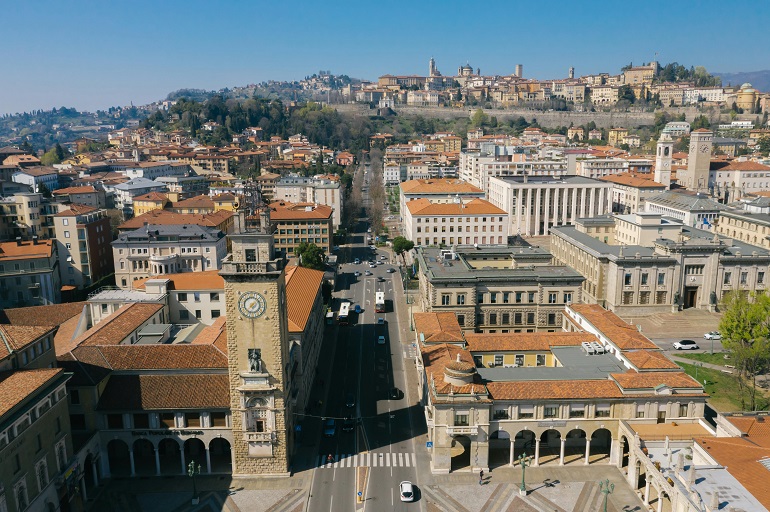
Bergamo (pop. 120,000) lies in Lombardy, 50km northeast of Milan, and is famed for its split layout: the medieval Città Alta perched on a hilltop, ringed by 16th-century Venetian walls, and the modern Città Bassa spread across the plain below. The funicular connects the two districts, making it easy to explore Romanesque churches, frescoed palazzi and narrow cobbled lanes above before descending to broad boulevards, galleries and shopping streets. Orio al Serio airport handles many low-cost European flights, while frequent trains link the city to Milan, Brescia and Lake Iseo. Local cuisine highlights casoncelli pasta and Taleggio cheese, and the surrounding Bergamasque Alps offer hiking and winter sports within an hour’s reach.
Interesting Facts about Bergamo
- Bergamo is uniquely divided into two distinct sections: the medieval Città Alta (Upper City) perched atop a hill and the modern Città Bassa (Lower City) below.
- The city is encircled by magnificent 16th-century Venetian walls spanning nearly six kilometres, which were designated a UNESCO World Heritage Site in 2017.
- Piazza Vecchia in the Upper City is considered one of the most beautiful squares in Italy, featuring the historic Palazzo della Ragione, the oldest town hall in the country.
- The ornate Colleoni Chapel was built by the famous condottiero Bartolomeo Colleoni as his personal mausoleum, featuring a striking façade adorned with pink and white marble.
- Legend has it that touching Bartolomeo Colleoni's coat of arms on the chapel gate at midnight brings good luck, though the emblem rather boldly depicts his testicles.
- For 360 years, the city's bell tower has chimed exactly 100 times every night at 10pm, originally marking the time when the city gates would close.
- Bergamo earned the nickname "Città dei Mille" (City of a Thousand) because approximately 1,000 volunteers from the city joined Giuseppe Garibaldi's famous expedition to unify Italy.
- The city is the birthplace of renowned opera composer Gaetano Donizetti, adding to its rich cultural heritage.
- The world-famous San Pellegrino mineral water originates from the Brembana Valley in the province of Bergamo.
- The Serio waterfalls in nearby Valbondione are Italy's highest at 300 metres, offering a spectacular natural display.
- The hills surrounding Bergamo produce Moscato di Scanzo wine in Italy's smallest DOCG area, a sweet wine so precious it was once served to Empress Catherine II of Russia.
- Originally settled by the Celtic Orobi tribe, Bergamo became a Roman municipality in 49 BCE, giving it over two millennia of continuous history.
- Visitors can reach the Upper City by bus, funicular railway, or by climbing ancient stone stairs whilst enjoying panoramic views of the city below.
- On clear days, you can see as far as Milan from the viewing telescopes positioned along the historic Venetian walls.
- Polenta, a corn-based porridge that pairs excellently with cheese, remains one of the city's most beloved traditional dishes.
History
Ancient Origins and Roman Domination
Bergamo's history stretches back to prehistoric times, when the area was first settled by the Ligurian tribe known as the Orobii during the Iron Age. Around 550 BCE, the Celtic tribe of Cenomani conquered the settlement during their invasion of northern Italy. The Romans subsequently transformed it into a municipality called Bergomum in 49 BCE, and it flourished as an important commercial and military hub on the road between Friuli and Raetia, reaching a population of approximately 10,000 inhabitants at its peak. The city's prosperity came to an abrupt end in the 5th century when it was destroyed by Attila the Hun, though it was later rebuilt and became the seat of one of the most significant Lombard duchies in northern Italy from the 6th century onwards, with its first Lombard duke being Wallaris.
Medieval Commune and Venetian Rule
Following Charlemagne's conquest of the Lombard Kingdom, Bergamo became the seat of a county, but from 1098 it emerged as an independent commune during the medieval period. The city played a crucial role in the Lombard League, joining the alliance against Emperor Frederick I Barbarossa in 1165, and participating in the famous Oath of Pontida in 1167 that sealed the league's commitment. Internal strife between the local Guelph and Ghibelline factions—represented by the Colleoni and Suardi families respectively—characterised much of the medieval period. After a brief interlude under the House of Malatesta starting in 1407, Bergamo was ceded by the Duchy of Milan to the Republic of Venice in 1428 following the aftermath of the Battle of Maclodio. Under Venetian rule, the city became the western outpost of the Serenissima, and the renowned condottiere Bartolomeo Colleoni from Bergamo fought valiantly for the republic. The Venetians began the massive fortification of Città Alta in 1561, creating the impressive defensive walls that still encircle the upper city today.
From Napoleon to Italian Unification
Venetian domination ended in 1797 with the Treaty of Campo Formio, which formally recognised Bergamo's inclusion in the French-controlled Cisalpine Republic. The city subsequently became part of the short-lived Napoleonic Italian Republic in 1802 and then the Napoleonic Kingdom of Italy in 1805. After Napoleon's fall, the Congress of Vienna in 1815 placed Bergamo under Austrian rule until 1859, when Giuseppe Garibaldi triumphantly entered the city at the command of the Hunters of the Alps, ending centuries of foreign domination. Bergamo earned the prestigious title "Città dei Mille" (City of the Thousand) for its significant contribution to the Italian Risorgimento, as many of its citizens volunteered to join Garibaldi's famous Expedition of the Thousand to liberate the Kingdom of the Two Sicilies. The city officially became part of the Kingdom of Italy in 1861, and throughout the 20th century experienced remarkable economic and industrial growth whilst preserving its medieval charm in the upper city and developing a thriving commercial centre in the lower town.
Main Attractions
Città Alta (Upper Town)
Piazza Vecchia
Serving as the historic heart of the Città Alta, Piazza Vecchia has been the centre of Bergamo's political and social life for centuries. The square is a harmonious ensemble of architecture, framed by the medieval Palazzo della Ragione and the imposing Torre del Campanone on one side, and the elegant, white-marble Palazzo Nuovo (now the Angelo Mai Library) on the other. At its centre stands the 18th-century Contarini Fountain, a gift to the city from a Venetian magistrate, adding a focal point to the open space where locals and visitors gather.
Palazzo della Ragione and Portici della Ragione
As the oldest municipal seat in Lombardy, the 12th-century Palazzo della Ragione stands as a testament to Bergamo's medieval past as a free commune. Its ground floor features the Portici della Ragione, a series of stone arcades that once sheltered a bustling marketplace and provided a space for public gatherings. A notable feature under the portico is a sundial carved into the floor, which accurately marks midday and the signs of the zodiac. The building's upper floor, once the hall of justice, is adorned with frescoes and connects Piazza Vecchia to the adjacent Piazza del Duomo.

Torre del Campanone (Civic Tower)
Known affectionately to locals as "il Campanone," this 12th-century civic tower dominates the skyline of the Città Alta. Visitors can ascend to its summit via a modern lift or by climbing the stairs for a rewarding 360-degree panoramic view over the rooftops of the old town, the modern Città Bassa, and the surrounding plains and mountains. The tower maintains a centuries-old tradition of ringing its largest bell 100 times every night at 22:00, a historical remnant of the curfew that signalled the closing of the city gates.
Basilica of Santa Maria Maggiore
Begun in the 12th century, the Basilica of Santa Maria Maggiore is a masterpiece of Romanesque architecture, although its interior was lavishly redecorated in the Baroque style during the 16th and 17th centuries. Unusually, it lacks a central main entrance, with access provided through two ornate side porches guarded by lions. Inside, the basilica is renowned for its spectacular collection of Renaissance tapestries, intricate wooden choir stalls featuring marquetry designs by Lorenzo Lotto, and the tomb of the celebrated Bergamasque composer, Gaetano Donizetti.
Cappella Colleoni (Colleoni Chapel)
Attached directly to the Basilica of Santa Maria Maggiore, the Cappella Colleoni is an exquisite example of Italian Renaissance architecture. Commissioned by the famed mercenary captain (condottiero) Bartolomeo Colleoni as his personal mausoleum, the chapel features a magnificent facade of polychrome marble inlay and intricate carvings. The interior is equally impressive, containing the ornate tombs of Colleoni and his daughter Medea, as well as masterful 18th-century ceiling frescoes painted by Giovanni Battista Tiepolo, depicting scenes from the life of St. John the Baptist.
Venetian Walls (Mura Venete)
Encircling the Città Alta is a formidable ring of fortifications known as the Mura Venete. Built by the Republic of Venice in the 16th century to defend its westernmost outpost, these walls stretch for over 6km and are remarkably well-preserved, having never been subjected to a siege. Today, this UNESCO World Heritage Site serves as a beloved public park and promenade. A walk along the top of the ramparts offers uninterrupted views across the landscape and is a popular activity, especially at sunset.
Funicular to San Vigilio and Castello di San Vigilio
For the most elevated views of Bergamo, a second funicular railway carries visitors from the Città Alta's Porta Sant'Alessandro up to the top of San Vigilio hill. Here lie the ruins of the Castello di San Vigilio, a medieval fortress that historically served as a strategic lookout post. Visitors can explore the remaining ramparts and towers of the castle, enjoying a commanding perspective that takes in the entire Città Alta, the Città Bassa, and on a clear day, the vast Lombardy plain extending towards the Alps.
Parco della Rocca
Situated on another prominent hill within the Città Alta, the Parco della Rocca is a public park centred around the Rocca di Bergamo, a 14th-century fortified complex. The fortress itself has a long military history, having been adapted and used by successive rulers of the city. The surrounding park provides a tranquil green space with benches and shaded paths, offering yet more scenic viewpoints over the red-tiled roofs of the historic town below.
Città Bassa (Lower Town)
Porta Nuova
Marking the formal entrance to the modern centre of Bergamo, Porta Nuova is not a defensive gate but a grand, neoclassical monument built in the 19th century. It consists of two symmetrical propylaea, or gatehouses, which frame the main avenue, Viale Papa Giovanni XXIII. This boulevard serves as a visual axis, creating a direct and impressive line of sight from the heart of the Città Bassa straight up to the distant silhouette of the Città Alta on its hill.
Torre dei Caduti (Tower of the Fallen)
Located in Piazza Vittorio Veneto, the central square of the Lower Town, the Torre dei Caduti is a memorial tower inaugurated in the 1920s. It stands as a solemn tribute to the soldiers from Bergamo who lost their lives during World War I. The tower's architecture is a prominent landmark of the modern city, and visitors can climb to the top for a unique perspective, looking up towards the historic Upper Town from the centre of the commercial district.
Churches of the Lower Town
While the Città Alta holds the most famous religious landmarks, the Città Bassa is home to several important churches that are rich in Renaissance and Baroque art. Prominent among these are the churches of Santi Bartolomeo e Stefano and Santo Spirito, both of which are particularly noted for housing magnificent altarpieces by the 16th-century Venetian painter Lorenzo Lotto, who spent several years working in Bergamo. Other significant buildings include the neoclassical Chiesa di Santa Maria Immacolata delle Grazie and the historic Church of San Bernardino in Pignolo.
Parks and Green Areas of the Lower Town
The Città Bassa offers several expansive green spaces for leisure and recreation. Parco Suardi is a traditional city park close to the centre, providing a quiet retreat with mature trees and pathways. Further out, the Parco della Trucca is a much larger park with a lake, extensive walking and cycling paths, and sports facilities, making it a popular destination for families and fitness enthusiasts. These parks are integral to the life of the modern city, offering a contrast to the dense, historic environment of the Città Alta.
Points of View and Walks
Sentiero dei Vasi
For those wishing to explore the landscape immediately surrounding Bergamo, the Sentiero dei Vasi is a well-regarded walking path. This trail starts near the Città Alta and meanders through the Parco dei Colli (Park of the Hills), connecting the urban environment with the region's more rural character. The walk takes you through countryside scenery, past small vineyards and farmsteads, offering a peaceful and scenic alternative to the city streets while still providing excellent views of the historic walls from a distance.
Top Museums
Accademia Carrara di Belle Arti
Housed in an elegant neoclassical palace, the Accademia Carrara is one of Italy’s premier art galleries. Founded in 1796 by Count Giacomo Carrara, it preserves his extensive collection of over 1,500 paintings and 130 sculptures, alongside drawings, prints and decorative arts.
- Highlights include Renaissance masterpieces by Pisanello, Botticelli, Mantegna, Bellini and Raphael, as well as works by Lorenzo Lotto and Titian.
- The gallery’s eighteenth-century classrooms gave birth to Bergamo’s art academy, and its intimate rooms evoke the scholarly spirit of Carrara’s original vision.
- Recent restoration (2008–15) enhanced exhibition spaces and introduced the adjacent PwC Gardens, a landscaped terrace that offers tranquil views over the city.
Galleria d’Arte Moderna e Contemporanea (GAMeC)
Founded in 1991 within a restored fifteenth-century convent opposite the Carrara, GAMeC is Bergamo’s centre for modern and contemporary art.
- Its 1,500 m² of exhibition galleries present rotating solo and group shows by international and emerging artists, alongside experimental projects in video, installation and performance.
- Educational programmes and workshops engage audiences of all ages, from hands-on family activities to evening talks and courses for adults.
- In summer, the courtyard transforms into a communal space for art-and-music “Happenings” under the open sky.
Museo delle Storie di Bergamo
The “Museum of Bergamo Stories” is a diffuse museum comprising seven historic sites across the Città Alta. Together, they narrate Bergamo’s evolution from Roman origins to the twentieth century.
- Palazzo del Podestà – Chronicles the city’s medieval and Renaissance heritage, with thematic digital maps and multimedia displays tracing urban development.
- Rocca – The city’s fortified stronghold hosts exhibitions on the Risorgimento and offers panoramic views of Bergamo and its Venetian walls.
- Porta Sant’Agostino – An immersive journey through the sixteenth-century defences of the Venetian Republic.
- Convento di San Francesco – Home to the Museo della Fotografia Sestini and Bergamo 900, exploring Bergamo’s nineteenth- and twentieth-century social life through photography, documents and interactive installations.
- Cittadella Viscontea – Houses the Civic Archaeological Museum.
- Natural Science Museum “E. Caffi” – Displays zoological, botanical and geological collections that document local biodiversity and natural history.
- Cathedral Museum – Showcases liturgical art and precious ecclesiastical objects from the Duomo’s treasury.
Civic Archaeological Museum
Situated in the thirteenth-century Palazzo Visconteo within the Cittadella, this museum presents Bergamo’s archaeological heritage from prehistory to the Lombard period.
- Key sections include pre-Etruscan Bronze Age finds, Celtic necropolis discoveries and the Roman lapidarium of inscriptions and sculptures.
- A recently inaugurated display features the mummy of the Egyptian priest Ankhekhonsu, highlighting the museum’s longstanding engagement with international collections.
Natural Science Museum “Egidio Caffi”
Located within the historic Cittadella complex, this museum traces the evolution and distribution of species through taxidermy specimens, fossil collections and botanical exhibits.
- The combined display with the Archaeological Museum emphasises the interplay of natural and human histories in Bergamo’s territory.
- Educational laboratories and guided tours foster scientific curiosity among school groups and families.
Museo Donizettiano
Dedicated to Bergamo’s most famous musical son, Gaetano Donizetti (1797–1848), this evocative museum occupies the first floor of the Domus Magna near the Basilica di Santa Maria Maggiore.
- Portraits, autograph scores, letters and personal effects—including his Viennese piano—reconstruct the composer’s life, training and operatic triumphs across Europe.
- Interactive audio stations allow visitors to hear Donizetti’s distinguished oeuvre as they progress through the thematic rooms.
Additional Sites of Note
- Museo del Burattino (Puppet Museum) – Traces the art of puppetry with marionettes, shadow-play figures and stage sets from Italian theatrical traditions.
- Donizetti’s Birthplace – The composer’s childhood home now hosts a small exhibition of early memorabilia.
- Archaeological Area of Via Arena – Ongoing excavations reveal a Roman insula beneath the Upper Town, occasionally open to public visits through the Archaeological Museum programme.
Local Cuisine
The city's most celebrated dish is casoncelli alla bergamasca, delicate pasta parcels filled with a sublime mixture of meat, breadcrumbs, cheese, and often a hint of amaretti biscuits and raisins, traditionally served with melted butter, crispy pancetta, and fresh sage. Equally iconic is polenta taragna, a hearty blend of corn and buckwheat flour enriched with local cheeses such as Taleggio and Branzi, creating a creamy, intensely flavourful dish that embodies the region's rustic soul. Cheese lovers will delight in the area's exceptional dairy offerings, including the pungent Strachitunt and the prized Formai de Mut dell'Alta Valle Brembana. For those with a sweet tooth, Bergamo proudly claims to be the birthplace of stracciatella gelato, that heavenly combination of fresh cream studded with dark chocolate flakes, invented at the local Pasticceria La Marianna in 1961. Other regional treasures include sciatt (crispy buckwheat and cheese fritters), the whimsically named polenta e osei (available both as a savoury dish and as charming marzipan sweets shaped like polenta with chocolate birds), and the decadent Torta Donizetti, a chocolate and hazelnut cake honouring the city's famous composer.
Shopping
In Bergamo’s Lower Town, the pedestrianised Via XX Settembre anchors a fashionable district bounded by Via Sant’Alessandro, Via Borfuro and Via Sant’Orsola, where international brands sit alongside independent boutiques showcasing local designers and artisanal craftsmanship. In the historic Città Alta, narrow medieval streets are lined with craft shops and stores selling regional gastronomic specialities. Regular markets add to the city’s retail mix: the indoor Mercato Coperto di Via Quarenghi operates Monday to Saturday with fresh produce and deli stalls, while the Mercato della Terra in Piazza Matteotti offers short–supply-chain organic goods every Saturday morning. For a modern contrast, the Orio Centre—just outside the airport—houses over 200 mid-range European and Italian brands under one roof.
Nature in and around Bergamo
Among the most accessible green spaces is Parco dei Colli di Bergamo, a 4,700-hectare regional park of rolling hills, mixed beech and chestnut woodland, 75 km of footpaths and the historic “Via dei Monasteri” linking medieval abbeys; its highest point is Canto Alto at 1 146 m. North of the city, the Parco delle Orobie Bergamasche spans some 63 000 ha of the southern Orobie Alps, rising to peaks above 3 000 m, with forests of spruce and larch, over a hundred alpine lakes, waterfalls and abundant wildlife such as ibex and golden eagle. The Serio Waterfalls, within the Orobie Park near Valbondione, tumble in three stages for a total drop of 315 m, making them the highest cascades in Italy. Finally, the limestone massif of Monte Presolana (2 521 m) in the Pre-Alps offers a variety of hiking and climbing routes and is renowned for its fossil and mineral finds.
Getting There & Around
Bergamo is easily accessible from across northern Italy and beyond through several convenient transport options. By train, Bergamo's railway station offers direct connections to Milan, Lecco, and Brescia, with regular services running throughout the day and journey times of approximately 50 minutes from Milan. By coach, numerous operators including FlixBus and other regional companies provide regular services to Bergamo's Central Bus Station from major cities across Italy and Europe, offering an economical alternative for travellers. By car, Bergamo is conveniently located just off the A4 Milan-Venice motorway - simply take the "Bergamo" exit, though visitors should be aware that the city centre has several Limited Traffic Zones and parking can be challenging during peak periods.
Best Time to Visit
The ideal time to visit Bergamo is during the spring months of April to June, or in the early autumn from September to October. During these periods, the weather is pleasantly mild, perfect for exploring the cobbled streets of the Città Alta and enjoying the city's alfresco dining culture. Summer, particularly July and August, can be quite hot and is also the peak tourist season, leading to larger crowds and higher prices for accommodation. While winter offers a more tranquil experience with fewer tourists, the weather is colder, which might be less appealing for those wishing to spend significant time outdoors. Therefore, for a balance of good weather and manageable crowd sizes, the shoulder seasons provide the most enjoyable experience for a trip to this Lombardian gem.